Crypto Algo Trading Strategies: A Complete Guide for Australian Traders in 2026
Crypto algo trading strategies have moved well past the “interesting experiment” phase. In 2026, algorithmic execution is how a meaningful portion of crypto volume gets done globally, and Australian traders are catching up fast, partly because the market never sleeps and humans do, and partly because the new regulatory framework has made the space feel more serious.
> TL;DR
> Crypto algo trading strategies use programmed rules and mathematical models to execute trades automatically, 24/7, without emotional bias. Common approaches include trend following, mean reversion, grid trading, and arbitrage. Australian traders must ensure any platform they use holds AUSTRAC registration and, from 2026, is working toward an AFSL — poor risk management remains the biggest danger of automated trading.
What Are Crypto Algo Trading Strategies and How Do They Work?

At the most basic level, crypto algo trading strategies are sets of programmed rules that tell a computer when to buy, when to sell, and how much. There is no gut feeling involved. The algorithm either sees the condition it was built to act on, or it does not.
Those conditions vary widely. A simple strategy might trigger a buy order when Bitcoin’s 10-day moving average crosses above its 50-day moving average. A more sophisticated one might factor in order book depth, volume anomalies, and correlation signals across multiple assets simultaneously. Either way, the logic is written in advance and executed without hesitation.
Orders get placed via exchange APIs. The algorithm connects to an exchange like Kraken, Binance, or Swyftx, authenticates using API keys, and places orders programmatically. The exchange never knows or cares whether a human or a script pressed the button. What this means practically is that your strategy can react in milliseconds to a price movement that a manual trader would take several seconds to even notice, let alone act on. In a market where spreads can compress and opportunities close in under a second, that speed difference matters.
The 24/7 nature of crypto markets is a genuine advantage for algo traders. BTC/AUD does not stop moving at 4pm on a Friday. Manual traders sleep; algorithms do not. I have had positions triggered at 3am AEST that I would have missed entirely trading by hand.
Before any strategy goes live with real capital, backtesting is the standard validation step. You run the strategy logic against historical price data to see how it would have performed. It is not a guarantee of future results, but it filters out ideas that would have haemorrhaged money in any past market environment.
The 4 Most Common Crypto Algo Trading Strategy Types
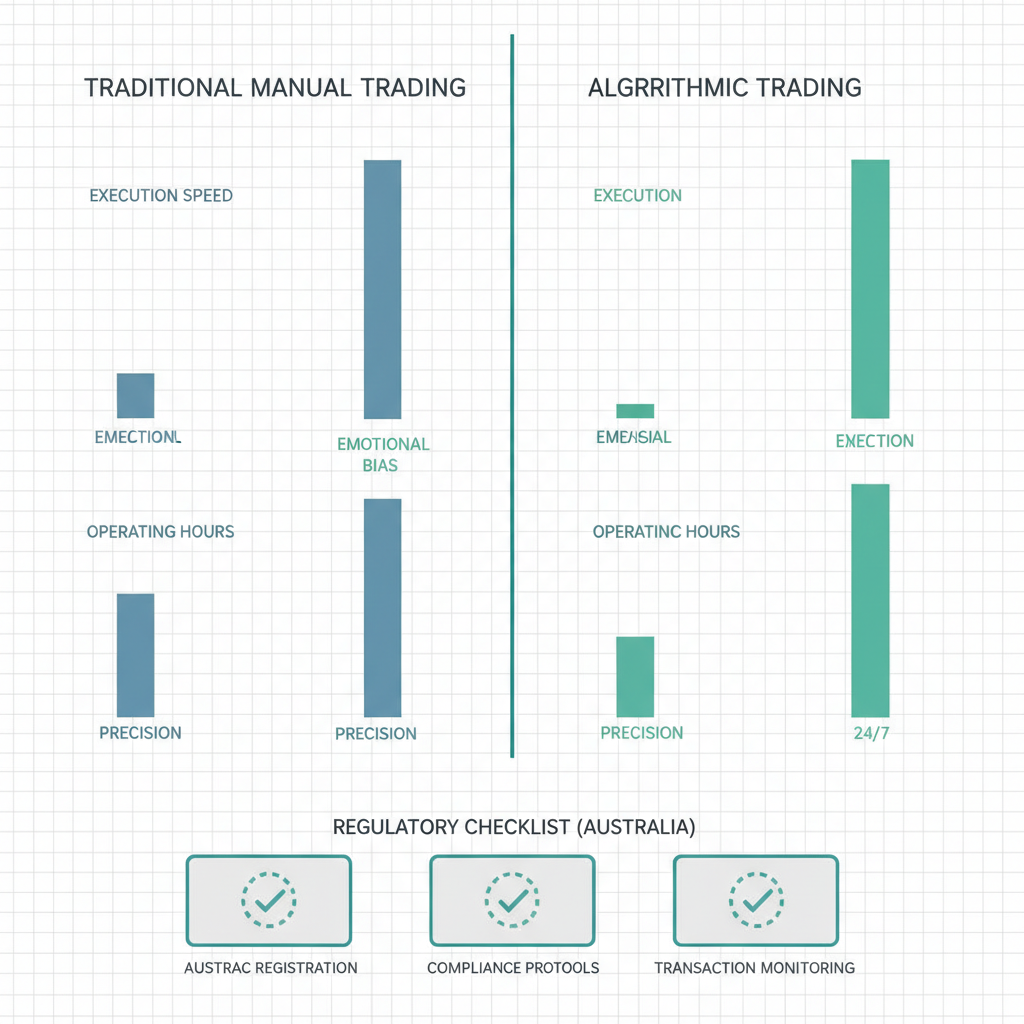
Understanding the major categories helps you match an approach to actual market conditions rather than just picking whatever sounds impressive.
Trend Following
Trend following is the most intuitive of the crypto algo trading strategies. The logic is simple: when an asset is moving up with momentum, buy it; when it is trending down, get short or get out. These strategies typically use technical indicators like moving averages, the Average Directional Index (ADX), or Donchian channels to identify and confirm a trend before committing capital.
Bitcoin’s extended bull and bear cycles make it reasonably well-suited to trend following. The October 2025 peak and the subsequent drop to around US$60,000 by early February 2026 was exactly the kind of sustained directional move these strategies are built to capture on the way down (or avoid on the way up, depending on how you have configured it). The weakness is choppy, sideways markets, where trend-following algorithms get chopped up generating false signals repeatedly.
Mean Reversion
Mean reversion strategies operate on the assumption that prices which have moved too far from a statistical average will eventually snap back. The algorithm calculates a reference point, such as a Bollinger Band or a volume-weighted average price, identifies when the current price is statistically extreme, and takes a position expecting a return to the mean.
These strategies tend to work well in ranging markets and can struggle badly during sustained directional moves. A mean reversion algorithm that kept buying every time ETH dropped in late 2025 would have been painful to watch.
Grid Trading
Grid trading places buy and sell orders at fixed price intervals above and below a central price point, forming a grid. As price oscillates, it fills orders on both sides, generating profit from the spread between buy and sell levels. It does not require predicting direction, only that the asset keeps moving within a range.
This approach suits sideways or mildly oscillating markets well. The risk is a strong breakout in one direction that fills all your orders on one side and keeps moving, leaving you with a large one-sided position.
Arbitrage
Arbitrage strategies identify price differences for the same asset across different exchanges and exploit them. If BTC/AUD is trading at $95,200 on Swyftx and $95,450 on Kraken simultaneously, an arbitrage algorithm buys the cheaper side and sells the dearer. In practice, execution speed, transfer times, and fees compress these windows significantly. True exchange arbitrage is increasingly difficult for retail traders to compete on, though statistical arbitrage between correlated pairs remains viable.
More advanced traders sometimes employ market-making strategies, placing both bids and asks around the mid-price to collect the spread. This requires deeper capital, reliable API connectivity, and a thorough understanding of inventory risk.
Key Benefits of Using Algorithmic Strategies in Crypto Trading
The most underrated benefit of running crypto algo trading strategies is not speed or scale; it is the removal of the emotional feedback loop that destroys most manual traders.
Panic selling during a flash crash and FOMO buying near a top are not personality flaws. They are predictable human responses to stress and social pressure. An algorithm does not experience either. If the conditions for a trade are met, the trade executes. If they are not met, nothing happens. The strategy behaves identically on the 200th trade as it did on the first.
Consistency is the compounding advantage. A strategy that produces a modest edge, applied reliably hundreds of times, outperforms a better strategy applied erratically by a trader who keeps second-guessing themselves. Algorithmic execution enforces the discipline that most traders agree they need but struggle to maintain manually.
The ability to monitor multiple markets and trading pairs simultaneously is another practical edge. A well-configured algorithm can watch BTC/AUD, ETH/AUD, SOL/USDT, and a dozen other pairs at once, executing across all of them when conditions align. A human trader managing that many positions simultaneously is almost certainly making errors.
Backtesting closes the loop. Before committing real capital, you can stress-test a strategy against years of historical data across different market conditions: bull runs, bear markets, high-volatility periods, and low-volatility ranges. It will not tell you the future, but it will tell you a lot about how the strategy behaves under pressure. Running backtests properly takes more time than most people expect, and the results require careful interpretation, but it is far better than finding out your strategy has a fatal flaw with real money on the line.
Biggest Risks of Crypto Algo Trading Strategies (And How to Manage Them)
Automation does not reduce risk. It redirects it. If your strategy has a flaw, it will execute that flaw faster and more consistently than you could manually, which is not a feature.
Poor Risk Management
This is the number one failure mode. Strategies without proper position sizing, stop-losses, or drawdown limits can rapidly accumulate losses that would have been capped immediately under manual trading. Every algorithmic crypto trading strategy should have defined maximum position sizes, hard stop-losses, and a circuit breaker that halts trading if total drawdown exceeds a pre-set threshold. These are not optional.
Over-Optimisation
Over-optimisation, sometimes called curve-fitting, is what happens when you tweak a strategy’s parameters until it looks exceptional on historical data, but the result is a strategy that is essentially memorising past price action rather than identifying a durable edge. These strategies typically fall apart immediately in live markets. A reasonable safeguard is holding back a portion of historical data from the backtesting process entirely, then testing the final strategy on that unseen data. If performance degrades severely on the out-of-sample data, the strategy is probably over-fitted.
Black Swan Events and Flash Crashes
Algorithms are built from patterns they have seen before. Unprecedented events, by definition, do not appear in training data. February 2026 illustrated this clearly: Bitcoin dropped to approximately US$60,000, losing close to 50% of its value since the October 2025 peak in a matter of months. Strategies that had been performing well in the bull market conditions were suddenly facing conditions they were not calibrated for. Some automated systems kept buying on the way down, treating each drop as a mean reversion opportunity rather than the start of a sustained correction.
API Failures and Exchange Downtime
Your algorithm is only as reliable as the connection it depends on. Exchange API outages, rate limiting, and connectivity failures can prevent orders from executing, leave positions unhedged, or cause partial fills that distort your strategy’s logic. Any serious automated crypto trading Australia setup should include alerting for API failures and a fallback plan.
Liquidity Risk
In normal conditions, the BTC/AUD spread on major exchanges sits around 0.1% to 0.3%. During periods of sharp volatility, that spread can blow out to 0.8% or more. For high-frequency strategies that depend on tight spreads to be profitable, this can turn a positive-expectancy strategy into a loss-making one instantly.
Practical risk management baseline: never risk more than 1% to 2% of total capital on a single trade, set hard drawdown limits at the portfolio level, paper trade any new strategy for at least 30 days before going live, and monitor positions actively even when running automated systems.
Australian Regulation: What Crypto Algo Traders Must Know in 2026
The regulatory picture for automated crypto trading in Australia changed substantially in early 2026, and traders who have not updated their understanding are operating with outdated assumptions.
The April 2026 Framework
On 1 April 2026, Australia passed its first comprehensive crypto regulatory framework. The headline requirement is that all exchanges and custody providers must obtain an Australian Financial Services Licence (AFSL) within six months. This brings crypto platforms into the same licensing regime that governs stockbrokers and managed fund operators. ASIC had already extended a sector-wide no-action position until 30 June 2026 to give firms time to adapt, but that window is closing. From mid-2026, operating without an AFSL where one is required will expose platforms to regulatory action.
ASIC’s Key Issues Outlook 2026, published in January, flagged digital assets as a “regulatory perimeter” risk, with unlicensed activity and misleading conduct identified as priorities for enforcement attention. The regulator is not being subtle about where it is looking.
AUSTRAC and VASP Registration
AUSTRAC registration has been mandatory for digital currency exchange operators for several years. On 2 April 2026, AUSTRAC implemented reforms that renamed Digital Currency Exchange (DCE) providers to Virtual Asset Service Providers (VASPs), in line with international FATF terminology. AML/CTF obligations were strengthened, and a public VASP register is now live.
Operating a virtual asset service in Australia without AUSTRAC registration is a criminal offence. Before depositing funds on any platform, check the public VASP register to confirm the platform appears on it. This takes about 90 seconds and is a non-negotiable part of due diligence. [INTERNAL LINK PLACEHOLDER: “VASP register” → AUSTRAC compliance guide pillar]
The DAEX Collapse
The collapse of DAEX in January 2026 is a useful case study. AUDX Australia, AUDX Global, and GlobalOne Exchange all ceased trading and entered voluntary liquidation, with a substantial shortfall in investor funds. DAEX was not a marginal, obscure operator. The lesson is that AUSTRAC registration is a floor, not a ceiling, for platform vetting. Check the VASP register, check whether an AFSL application has been lodged or granted, and do not treat any platform as automatically safe because it has been operating for a while.
ASIC’s Coverage
ASIC regulates crypto assets that qualify as financial products under the Corporations Act. The INFO 225 guidance sets out how ASIC interprets this in practice. Traders using derivative products, leveraged instruments, or managed crypto funds will likely be dealing with ASIC-regulated services. Algorithmic trading of spot crypto on a registered VASP sits in different territory, but the regulatory perimeter is shifting, and what is outside ASIC’s scope today may not be tomorrow.
Tax Obligations for Algo Traders in Australia
The ATO’s position on crypto taxation is clear, even if many traders have not fully absorbed it: swapping one cryptocurrency for another is a disposal event, and CGT applies. It is not only when you convert back to AUD. Every crypto-to-crypto trade triggers a CGT calculation.
For manual traders making a handful of trades per week, this is manageable. For algo traders running high-frequency strategies, it can mean thousands of CGT events per year. A grid trading algorithm running continuously across three pairs can generate tens of thousands of individual taxable events in twelve months. Tracking this manually is not realistic.
Records must be kept for at least five years and must include the date of each transaction, the amount of the asset, the AUD value at the time of the trade, and counterparty details where available. Most exchanges provide transaction export files, but the format varies and the AUD valuation at time of trade requires cross-referencing with price data.
Crypto tax software, such as Koinly or CoinTracking, integrates directly with exchange APIs and can generate ATO-compliant reports from your transaction history. For any trader running automated crypto trading in Australia at meaningful scale, this is not optional; it is part of the infrastructure cost of operating. I would also strongly recommend consulting a registered tax agent with actual crypto experience, not just one who has read a general guide. The nuances around cost base methods, the 50% CGT discount for assets held over 12 months, and treatment of wash sale scenarios are genuinely complex. [INTERNAL LINK PLACEHOLDER: “crypto tax” → Australian crypto tax guide pillar]
Platforms and Tools for Crypto Algo Trading in Australia
The tools available to Australian algo traders in 2026 split fairly cleanly into two categories: crypto-native exchanges with API access, and broader trading platforms that support algorithmic strategies across multiple asset classes.
Crypto-Native Exchanges
For direct crypto algo trading, the exchanges worth considering are Kraken, Binance, Coinbase Australia, and Swyftx. All offer API access. Kraken has historically had the most reliable API among the major platforms, and its fee structure (maker fees around 0.16% at lower volume tiers) is competitive for algorithmic trading Australia purposes. Binance has the deepest liquidity and the widest pair selection. Swyftx is the most Australia-focused of the group, with strong AUD support and a design that works well for traders who want a clean interface alongside their automated strategy.
Maker/taker fees across these platforms typically range from 0.1% to 0.25% for standard tiers. Factor these into your strategy’s profitability calculations before going live; a strategy that looks profitable at 0.05% per-trade friction may not be at 0.2%.
Automated Bot Platforms
Cryptohopper supports DCA, arbitrage, and market-making strategies through a subscription-based interface that connects to major exchanges. It does not require coding knowledge for basic strategies. TradersPost connects to TradingView and can automate strategy alerts into live orders across crypto and other asset classes.
Multi-Asset Platforms
For traders who want to run algorithmic strategies across crypto, futures, and equities from a single platform, Interactive Brokers Australia is the most capable option. IG Australia covers a wide product range. cTrader via Pepperstone or Vantage is well-regarded for algorithmic CFD trading. MetaTrader 4 and 5 are available through IC Markets and AvaTrade, and the MQL scripting environment has an enormous library of community-built strategies to adapt from.
AUD Deposits and Debanking
Most major exchanges accept AUD deposits via PayID and direct bank transfer. Some support BPAY. Fees range from free to a few dollars per deposit depending on the platform and method.
Worth knowing: debanking of crypto-related businesses remains an active issue in Australia. Some exchanges have had banking relationships terminated without warning. Before building a significant algo trading operation around any single platform, check that it has stable, established banking arrangements. This is harder to verify externally, but forums and community groups often surface issues early.
Quick platform checklist: AUSTRAC VASP registration confirmed, AFSL application lodged or granted, stable API with documented uptime, AUD deposit and