Crypto Algo Trading Australia 2026: Complete Guide
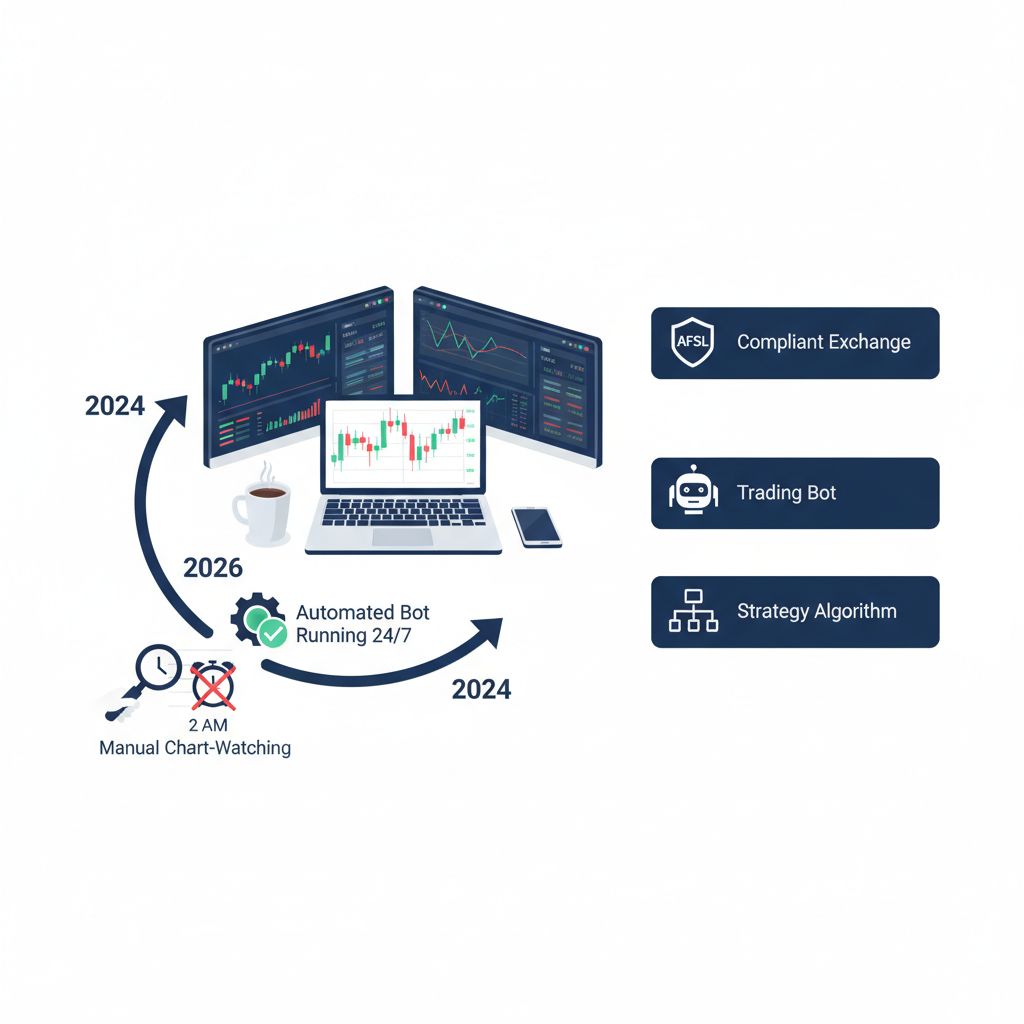
Crypto algo trading in Australia has moved well past the hobbyist phase. In the last 18 months alone, the regulatory ground has shifted significantly, the ATO has sharpened its position on bot traders, and the major exchanges have quietly rolled out proper API infrastructure. If you are still manually watching charts at 2am, this guide will explain why that might be unnecessary, and what the smarter setup actually looks like in 2026.
> TL;DR
> Crypto algo trading Australia relies on automated bots and pre-programmed strategies to execute trades around the clock without manual input. It is legal, but Australia’s April 2026 digital asset law now requires platforms to hold an AFSL, so using a compliant exchange matters more than ever. Profits from high-frequency bot trading may be taxed as ordinary income rather than capital gains, and top platforms for Australian traders include OKX Australia, Bitget, and Cryptohopper, alongside API-accessible local exchanges like Swyftx, Kraken AU, and Independent Reserve.
What Is Crypto Algo Trading in Australia?
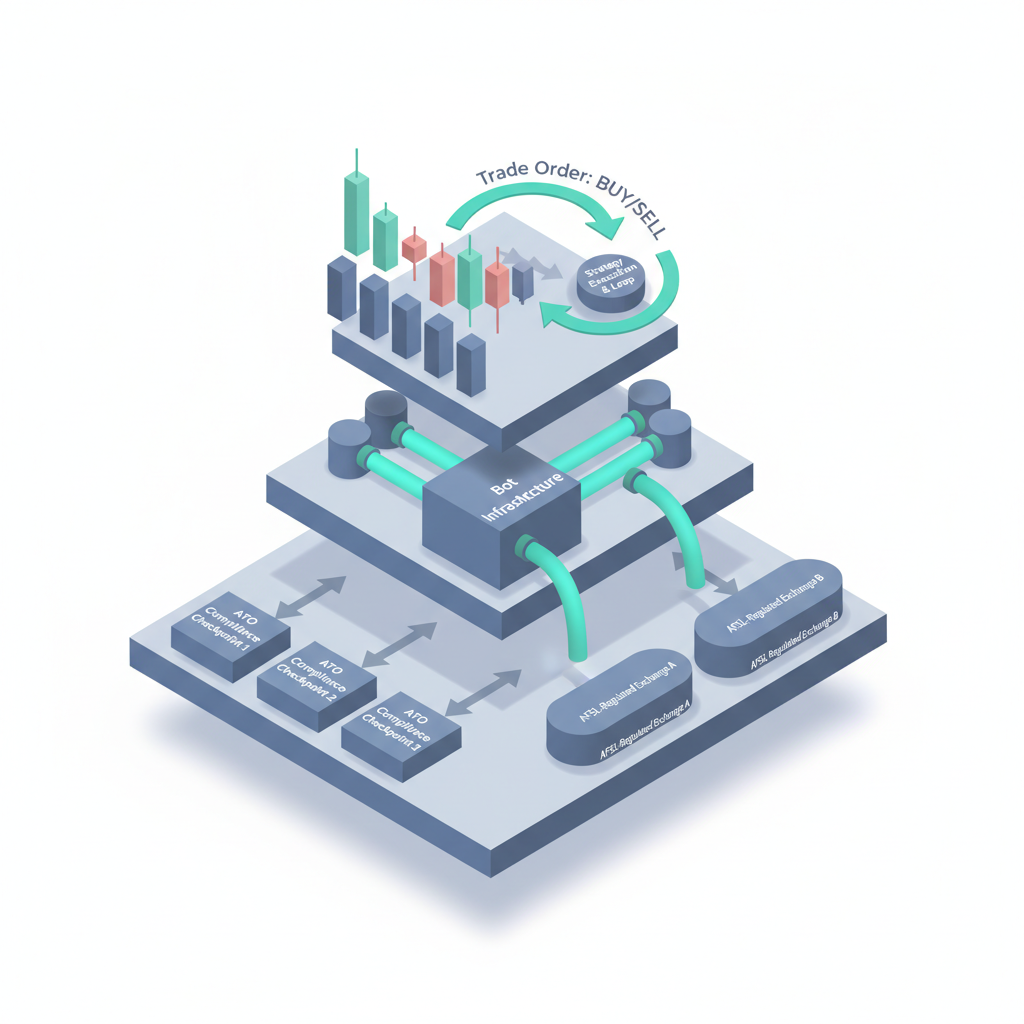
Algorithmic crypto trading is exactly what it sounds like: you write, buy, or configure a set of rules, and a bot executes trades automatically based on those rules. The system analyses market data, checks conditions, and fires orders in milliseconds, all without you touching a keyboard.
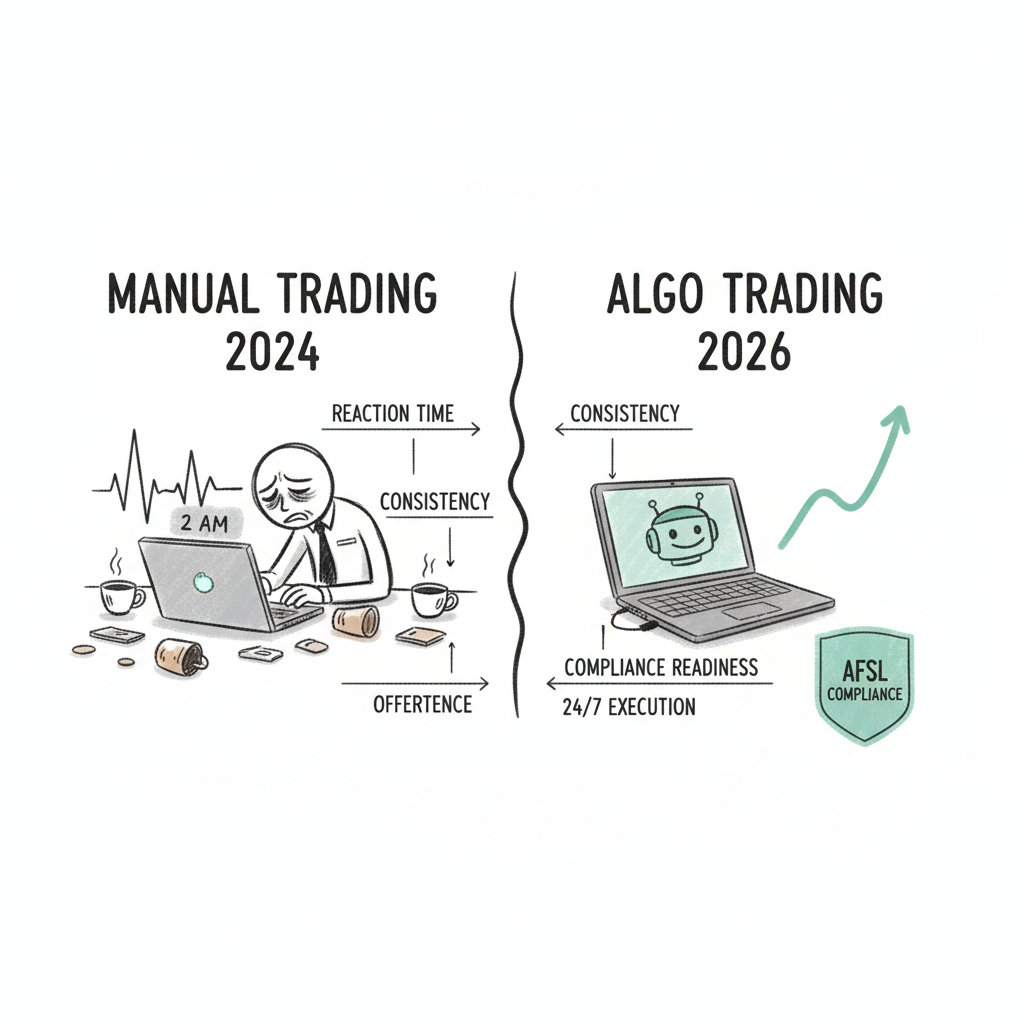
The difference from manual trading is not just speed. It is consistency. A manual trader gets tired, second-guesses themselves, and misses signals at 3am on a Tuesday. An algo runs the same logic at 3pm and 3am with identical discipline.
The main strategy types you will encounter in crypto algo trading Australia are grid bots, DCA bots, arbitrage bots, trend-following strategies, and market-making systems. Each suits a different market condition and risk profile. I will break them down properly in the next section.
Algo trading is legal in Australia. There is no prohibition on using automated systems to trade your own assets. What has changed in 2026 is the regulatory wrapper around the platforms that support it. Exchanges, custody providers, and services that hold client funds now operate under tighter licensing requirements, which I will cover in detail below.
This guide runs through how the main strategies work, the honest upsides and downsides, the new 2026 regulatory rules, ATO tax treatment, banking quirks, and a practical comparison of the best platforms available to Australian users right now.
How Algorithmic Crypto Trading Works: Strategies Explained
Understanding which strategy a bot is running matters before you put real money behind it. Each type has a different risk profile and performs differently depending on market conditions.
Grid Trading Bots
A grid bot places a series of buy and sell orders at defined price intervals within a set range. When BTC is trading sideways between $85,000 and $95,000 AUD, for example, the bot buys at each lower grid line and sells at each upper one, capturing small profits repeatedly. Grid bots perform well in ranging markets and poorly in strong trending ones, where the price blows through the grid entirely and leaves you holding a losing position.
DCA Bots
Dollar-cost averaging bots accumulate an asset at regular intervals or on price dips, regardless of current price. The logic is that buying more during drawdowns lowers your average cost base over time. This is popular with longer-term holders who want exposure to an asset without trying to pick the bottom. It is less a trading strategy and more an accumulation one.
Arbitrage Bots
Arbitrage exploits price differences for the same asset across different exchanges. If ETH is $3,800 AUD on one platform and $3,820 AUD on another, the bot buys on the cheaper exchange and sells on the more expensive one simultaneously. The margins are thin, the execution needs to be fast, and capital requirements are higher because you are funding accounts on multiple exchanges. Latency is everything here.
Trend-Following Strategies
These use technical indicators, typically moving average crossovers, RSI levels, or MACD signals, to identify momentum and take positions in the direction of the trend. When the 50-day MA crosses above the 200-day MA on BTC, for instance, the bot enters long. When conditions reverse, it exits. These strategies work well in strong trending periods and bleed in choppy sideways markets.
Market-Making Bots
Market-making bots post both a buy order and a sell order simultaneously, capturing the spread between the two. They profit when both sides fill. This is typically the domain of institutional players and sophisticated traders, because you need sufficient capital and low exchange fees to make the margins work.
Backtesting
Before going live, most serious algo traders run their strategy against historical price data to see how it would have performed. Backtesting can reveal obvious flaws and help tune parameters. The catch is over-optimisation, fitting a strategy so precisely to historical data that it falls apart in live conditions. A strategy that returned 40% on 2024 data might do nothing useful in 2026 market conditions.
Past performance in backtesting is not a reliable guide to future results. Crypto markets are too regime-dependent for that.
Key Benefits and Risks of Automated Crypto Trading
Automated crypto trading has genuine advantages. It also has real risks that most promotional content glosses over. Here is an honest read on both.
The genuine upsides. Speed is the obvious one: algorithmic systems execute in milliseconds, which matters in volatile markets where a 30-second manual delay costs real money. The bigger benefit, in my view, is emotion removal. Bots do not panic sell when a tweet drops the market 8% at midnight, and they do not chase pumps out of FOMO. They run the logic as defined.
Running multiple strategies simultaneously is also genuinely useful. You can have a grid bot running on ETH/AUD, a DCA bot accumulating SOL, and a trend-following strategy on BTC, all at the same time, without constant attention. Backtesting capabilities mean you can stress-test ideas without risking capital first.
The downsides, and they are significant. In a flash crash or a sustained trend against your position, a bot can amplify losses faster than you can manually intervene. A grid bot holding a long position through a 40% drawdown will keep buying all the way down. That is the strategy working exactly as designed, and it can still destroy a portfolio.
Technical failures are real. API outages, exchange downtime, and connectivity drops can leave your bot mid-trade or unable to execute exits. I have seen traders lose meaningful amounts because an exchange went into maintenance mode during a volatile session.
Over-optimisation during backtesting, often called curve-fitting, is probably the most common mistake. Strategies that look brilliant on historical data frequently underperform live because the parameters were tuned to noise rather than signal.
There is also a persistent myth that bot trading is passive. It is not. Reviews from cryptoresults.com.au users are consistent on this point: bots require regular monitoring, parameter adjustments as market conditions change, and active management when things go wrong. A bot left unsupervised for weeks is a liability.
Security is another consideration. API keys must be correctly scoped, meaning withdrawal permissions should never be enabled on keys used by a bot. If a key is compromised, a properly scoped one limits the damage to trading activity rather than giving an attacker access to withdraw your funds.
On the education side, cryptoresults.com.au’s Bitsgap Accelerator course costs AUD$7,200, which reflects genuine demand for structured algo trading training. The price is high, and it is a training course, not a platform where you hold assets. The 4.5/5 TrustScore from 51 Trustpilot reviews is reasonable, but the cost-to-benefit ratio depends heavily on whether you are disciplined enough to actually apply what you learn.
Australian Crypto Regulation and Licensing in 2026
Australia now has a proper regulatory framework for digital assets, and it changes the calculus for anyone using automated crypto trading strategies here.
On April 1, 2026, Australia passed its first comprehensive digital asset law. Any exchange or custody provider operating in Australia is required to obtain an Australian Financial Services Licence (AFSL) within six months. The threshold for mandatory AFSL licensing is holding client assets above $5,000 per individual or $10 million in total. In practice, any legitimate exchange is well above those thresholds.
The day after, on April 2, 2026, AUSTRAC’s expanded AML/CTF laws came into force. The category previously known as Digital Currency Exchanges (DCEs) was renamed to Virtual Asset Service Providers (VASPs), bringing Australian terminology in line with international FATF standards. Importantly, a searchable public VASP register launched on the same date. You can search it directly to confirm whether any platform you are considering is legitimately registered. Operating as an unregistered VASP is a criminal offence in Australia, not just a regulatory breach.
ASIC has already demonstrated it will act. The collapse of NGS Crypto is the clearest recent example, where investors were left exposed by an unlicensed scheme. The regulatory intent is clear: the wild-west period is over.
For algo traders, the practical implication is straightforward. The exchange or platform your bot connects to via API must be AUSTRAC-registered, and if it holds your funds, it must be moving towards AFSL compliance. Connecting a bot to an unregistered offshore platform is legal exposure that most Australian traders are not thinking about clearly.
Before you connect any trading bot to an exchange, check the AUSTRAC public register. It takes about 90 seconds and could save you significant grief.
[INTERNAL LINK PLACEHOLDER: AUSTRAC registration → AUSTRAC/ASIC compliance guide]
Tax on Crypto Algo Trading in Australia: What You Need to Know
The ATO treats crypto as property, not currency. Every time you dispose of a crypto asset, whether by selling it for AUD, trading it for another coin, or spending it, you trigger a capital gains tax event. This applies whether the trade was placed manually or by a bot.
The 50% CGT discount applies when an asset is held for more than 12 months before disposal. For most algo traders, this discount is irrelevant. Grid bots and arbitrage strategies are executing dozens of trades per day, each with a holding period measured in minutes. Those trades will not qualify for the discount.
More significantly, the ATO may classify profits from high-frequency and automated bot trading as ordinary income rather than capital gains. This is not a hypothetical risk. The ATO’s position is that where trading activity is systematic, repetitive, and profit-oriented, it looks more like a business activity than passive investing. Ordinary income is taxed at your marginal rate with no CGT discount available.
Income from staking, airdrops, and DeFi interest is assessed as ordinary income in the year it is received, regardless of holding period.
Record-keeping for algo trading is genuinely onerous. The ATO requires you to log the date, cost base, sale price, and AUD value at time of each transaction. A bot running 50 trades a day generates 18,000+ taxable events per year. Crypto tax software like Koinly or CoinTracker is not optional at that scale. It is essential.
Losses from trading can offset capital gains but must be correctly categorised. A capital loss offsets capital gains. An income loss from trading activities offsets other income. Getting this wrong creates problems with your tax return.
This is general information only. Crypto tax in Australia is genuinely complex, and the rules around business income versus capital gains classification require individual assessment. Talk to a registered tax agent who actually understands crypto before filing.
[INTERNAL LINK PLACEHOLDER: crypto tax Australia → ATO crypto tax guide]
Banking Restrictions for Crypto Traders in Australia
Before you set up any automated deposit or withdrawal cycle connected to your trading strategy, you need to understand what your bank will actually let you do.
Several major Australian banks have imposed monthly limits on transfers to crypto exchanges, primarily framed as scam prevention. Commonwealth Bank caps transfers to crypto at $10,000 per month and may place a 24-hour hold on your first transfer to a new exchange. ANZ Plus has a $10,000 per month limit on crypto payments after you disable their Crypto Protect setting, and the disabling process requires deliberate action on your part. Bank Australia introduced a $10,000 per calendar month limit on transfers to crypto exchanges effective May 27, 2024.
Some banks will request a verification call before processing larger transfers, even within limits. If you are trying to fund a trading account quickly to capitalise on a market opportunity, a 48-hour call-back process is going to be a problem.
Debanking of crypto businesses remains an ongoing concern in Australia. Some businesses in the space have had accounts closed or restricted without clear explanation, though the regulatory formalisation in 2026 may ease some of that tension over time.
The practical workaround for most Australian traders is PayID and Osko transfers to AUSTRAC-registered exchanges. These are generally free, fast (often near-instant), and do not trigger the same friction as larger SWIFT-style transfers. Most major Australian exchanges including Swyftx, Independent Reserve, and CoinSpot support PayID deposits without fees.
If your algo trading strategy involves frequent deposits or withdrawals, check your bank’s current policy before you build that into your workflow. Hitting a monthly cap mid-strategy is a disruption you can avoid with 10 minutes of preparation.
Best Platforms for Crypto Algo Trading in Australia: Compared
The right platform depends on whether you want a full algo suite built in, API access for your own bot, or an Australian-based exchange with solid compliance credentials. Here is how the main options stack up.
Comparison Table
| Platform | Type | AUSTRAC/AFSL Status | Algo/Bot Support | Spot Fee | AUD Deposit | Beginner-Friendly |
|---|---|---|---|---|---|---|
| OKX Australia | Exchange + Bots | AUSTRAC registered | Built-in grid, DCA, arbitrage bots | 0.1% maker / 0.15% taker | Yes (bank transfer) | Moderate |
| Bitget | Exchange + AI Bots | AUSTRAC registered | AI bots, copy trading, grid bots | From 0.01% (spot) | Yes | Moderate |
| Cryptohopper | Bot Platform | N/A (connects to exchanges) | Full bot suite, DCA, trailing, backtesting | Platform fee + exchange fee | Via connected exchange | Moderate |
| Swyftx | Australian Exchange | AUSTRAC registered | API access, no native bots | 0.1% | Yes (PayID, free) | High |
| Kraken AU | Exchange | AUSTRAC registered | Advanced orders, API, Pro interface | 0.16% maker / 0.26% taker | Yes (POLi, bank) | Low–Moderate |
| Independent Reserve | Australian Exchange | AUSTRAC registered | API, SMSF support, OTC desk | 0.05%–0.5% tiered | Yes (PayID, free) | Low–Moderate |
| CoinSpot | Australian Exchange | AUSTRAC registered | Limited API, 530+ coins | 0.1% (market), 1.22% card | Yes | High |
OKX Australia
OKX is one of the few platforms where algo tools are built directly into the interface rather than bolted on via third-party integration. Grid bots, DCA bots, and arbitrage tools are all available within the platform. It also supports derivatives and margin trading, which most Australian-based exchanges do not offer retail users. The interface is not beginner-friendly, but experienced traders will find it fully featured.
Bitget
Bitget’s spot trading fee starting from 0.01% is genuinely low by any measure. The AI-powered bot suite covers grid trading, DCA, and copy trading, where you can mirror the positions of verified traders. If you are new to algorithmic crypto trading Australia and want a guided entry point, the copy trading feature is worth looking at before you build your own strategy.
Cryptohopper
Cryptohopper is a dedicated bot platform rather than an exchange. You connect it to exchanges like Kraken or Binance via API and it manages trading from there. It supports DCA, trailing stop strategies, backtesting, and copy-trading signals. The subscription model means a monthly cost on top of your exchange fees, but the backtesting environment is more sophisticated than most exchange-native tools. For traders who want to run strategies across multiple exchanges simultaneously, it is worth the overhead.
Swyftx
I have been using Swyftx since 2022 and it remains my recommendation for Australian traders who want a reliable, AUSTRAC-registered base with clean AUD on-ramps. The 0.1% trading fee is competitive, Pay