Algorithmic Crypto Trading Australia: How It Works (And Whether It’s Worth It)
Algorithmic crypto trading Australia has a problem with perception: half the people who ask me about it think it’s a hedge fund black box requiring a maths PhD, and the other half think it’s a “set and forget” machine that prints money overnight. Neither is true, and both misunderstandings cost people either opportunity or real capital.
I have been running automated strategies on Australian exchanges since 2022, and the honest version sits somewhere in the middle. It is powerful, it has genuine advantages over manual trading, and it is absolutely accessible to retail traders in Australia. But it also carries regulatory obligations, tax complexity, and banking friction that nobody warns you about upfront.
This guide covers all of it.
> TL;DR: Algorithmic crypto trading Australia is a real and growing space where automated strategies execute trades 24/7 without emotional bias. In Australia, platforms must be AUSTRAC-registered and operate under ASIC’s expanding regulatory framework, while the ATO requires you to report every single trade your bot makes as a taxable event. This guide covers how it works, the regulatory environment, tax implications, banking restrictions, and the platforms worth considering.
What Is Algorithmic Crypto Trading?
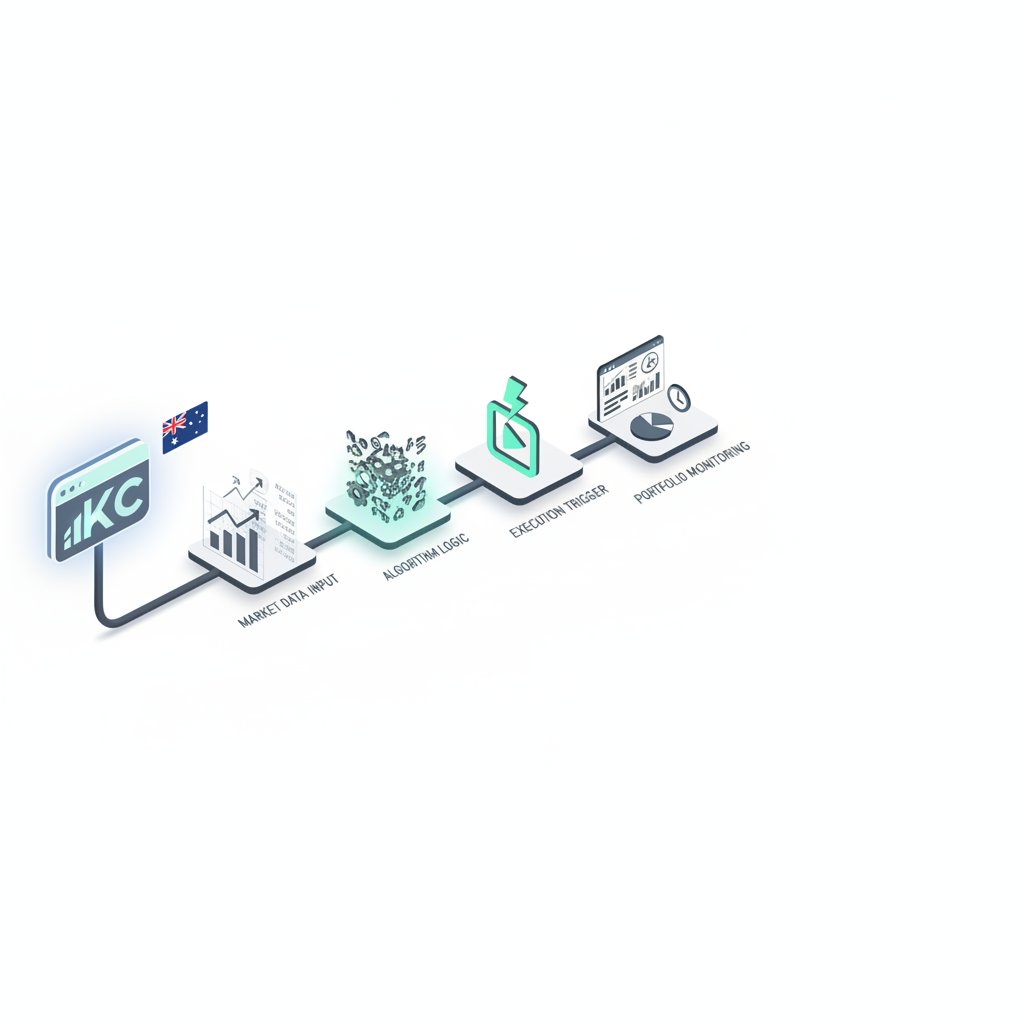
Algorithmic crypto trading is exactly what it sounds like: you write a set of rules, a program follows them, and trades execute automatically without you touching anything. The rules can be simple, like “buy BTC when the 50-day moving average crosses above the 200-day”, or extremely complex, involving multiple technical indicators, volume signals, and real-time order book data firing simultaneously.
The four broad strategy types you’ll encounter are trend-following, mean reversion, arbitrage, and market-making. Trend-following strategies buy momentum and ride it. Mean reversion bets that prices return to a historical average after moving too far in one direction. Arbitrage exploits price differences for the same asset across different exchanges, often in milliseconds. Market-making places simultaneous buy and sell orders to capture the spread, profiting on volume rather than direction.
In the Australian context, the always-on nature of crypto markets is what makes algorithmic strategies genuinely useful. The ASX closes at 4pm Sydney time. Bitcoin does not close, ever. Running a manual strategy across BTC/AUD, ETH/AUD, and a handful of altcoin pairs around the clock is not realistic for most people with jobs. An algorithm handles that without complaint.
There are three levels of automation worth distinguishing. Fully automated bots connect to an exchange via API and execute trades independently with no human input required after setup. Semi-automated tools, like TradingView alerts connected to a third-party bot, still require you to review signals and approve execution. Copy trading platforms, like eToro, sit in their own category where you mirror someone else’s manual or automated strategy rather than building your own.
Most retail traders in Australia start semi-automated and move toward full automation as their confidence in a strategy grows after backtesting.
Key Benefits of Running an Automated Crypto Strategy
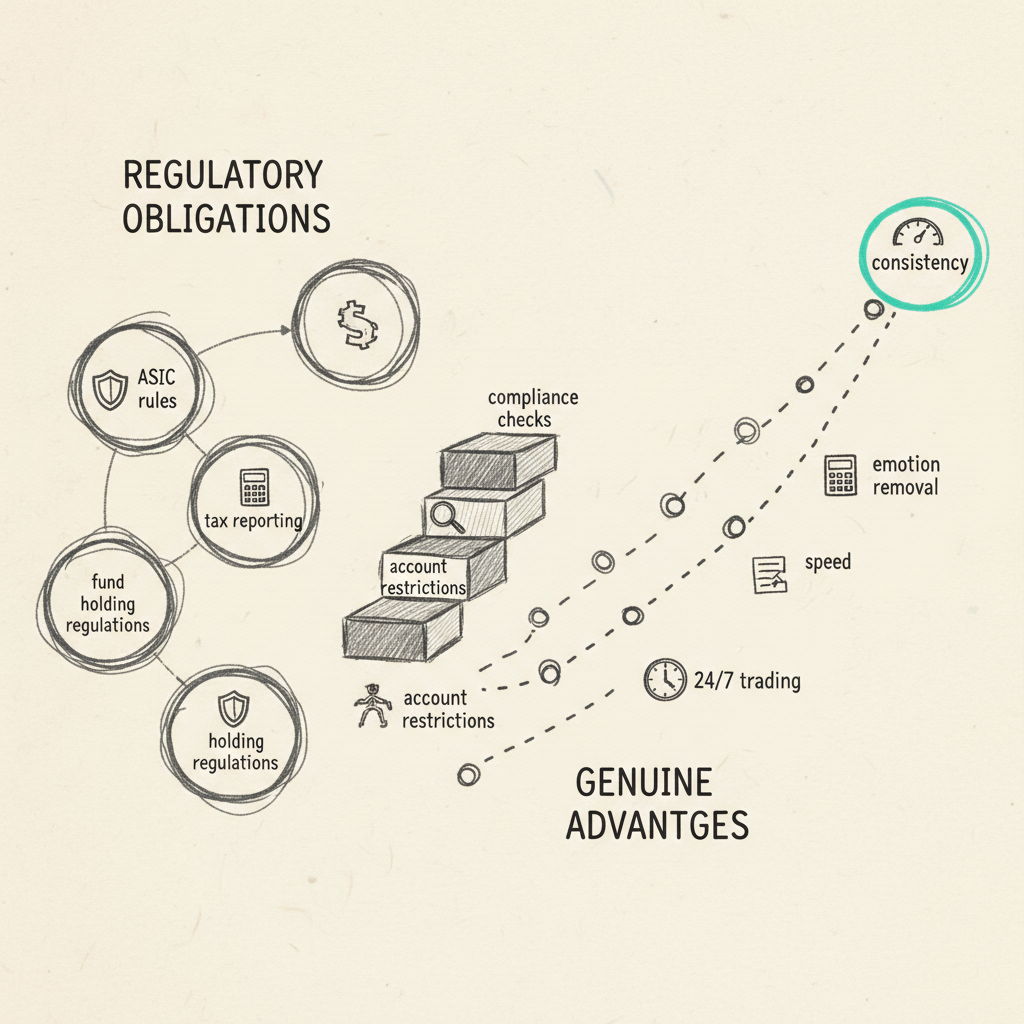
Speed is the most obvious one. A human looking at a chart, deciding to act, and placing an order takes several seconds at minimum. An algorithm responds to the same market condition in milliseconds. On volatile days where BTC/AUD moves 5% in minutes, that gap matters.
The second benefit is harder to quantify but more impactful in practice: removing emotion from decisions. Panic selling during a flash crash, or holding too long because you’re convinced a coin “has to come back”, are both expensive human tendencies. An algorithm executes the rule that was defined when you were calm and thinking clearly, not the impulse you have at 2am watching a red candle form.
Then there’s the consistency angle. Manual traders drift. They skip signals because they’re busy, they override their own rules when a trade feels wrong, and they size positions differently depending on their mood that day. A well-configured algorithm doesn’t do any of that. The strategy that worked in backtesting gets executed exactly as designed, every time.
Backtesting itself deserves a mention. Before you risk a single dollar of real capital, you can run your strategy against years of historical price data to see how it would have performed. No guarantee it repeats, but it is a far more disciplined starting point than gut instinct.
Finally, algorithms can monitor far more pairs than any individual trader realistically can. Running simultaneous strategies across BTC, ETH, SOL, and ten smaller AUD pairs is trivial for a bot and exhausting for a human.
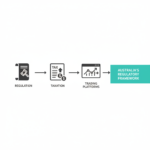
The Australian Regulatory Framework for Algorithmic Crypto Trading Australia
This section matters more than most guides admit, so I am going to be direct about what is settled and what is still in flux.
ASIC’s Position
ASIC treats digital assets as a “regulatory perimeter” issue. The two areas they focus on are unlicensed activity and misleading conduct, meaning if a platform is offering financial products or advice without appropriate licensing, ASIC can and does act.
In October 2025, ASIC updated its guidance and confirmed that much of the digital asset sector already falls under the Corporations Act 2001. This was significant because it removed the ambiguity some operators had been relying on to avoid compliance obligations. Platforms offering crypto-related managed investment schemes, derivatives, or financial product advice need an Australian Financial Services Licence (AFSL).
To give the industry time to adjust, ASIC granted a sector-wide no-action position until 30 June 2026 for firms actively seeking an appropriate licence. That window is closing. If you are evaluating a platform for algo trading, ask whether it has an AFSL or is in the process of obtaining one. If neither, that is a flag.
For individual traders using algo platforms, the licensing obligation sits with the platform, not with you personally. You do not need your own AFSL to run a bot on your personal account. But you should be using platforms that are compliant, because if they are not, your funds can end up frozen during enforcement action.
AUSTRAC Requirements
AUSTRAC is Australia’s AML/CTF regulator, and every digital currency exchange serving Australian customers must be registered and comply with anti-money laundering and counter-terrorism financing rules. This is not optional and has teeth.
In October 2025, AUSTRAC fined Cryptolink $56,340 for AML/CTF deficiencies. In March 2026, Binance copped a $6.9 million fine over client misclassification. Enforcement is not theoretical. New AML standards effective 31 March 2026 bring crypto exchanges to near bank-level compliance requirements, which is a meaningful step up from where many platforms were operating.
The mandatory travel rule now applies to transfers above $1,000, requiring exchanges to collect and transmit information about the originator and beneficiary of crypto transactions. This affects how you move funds between platforms and how exchanges report.
The practical implication for algo traders is straightforward: use AUSTRAC-registered platforms, keep clean records of your transfers, and do not route funds through unregistered services to avoid fees or limits. The short-term saving is not worth the compliance exposure.
How the ATO Taxes Algorithmic Crypto Trading in Australia
Crypto tax in Australia is not complicated in principle, but it becomes genuinely difficult in practice when a bot is executing dozens of trades per week.
The Core Framework
The ATO treats most crypto disposals as CGT events. Selling BTC for AUD, swapping ETH for SOL, or spending crypto on goods and services all trigger CGT at your marginal income tax rate, with the gain or loss calculated in AUD at the time of the transaction. Transferring crypto between wallets you own is not a taxable event, which is worth remembering if you move funds between exchange accounts.
Income from staking rewards, airdrops, mining, or receiving crypto as salary is taxed as ordinary income at market value when you receive it. That value then becomes your cost base if you later sell.
The 50% CGT discount is available to individual investors who hold crypto for more than 12 months before disposal. If you buy ETH and hold it for 13 months before selling at a profit, you only include half the gain in your assessable income. The key word there is “investor”.
Where Algo Traders Get Caught Out
If you are trading frequently through an automated strategy, the ATO may classify you as carrying on a business of trading. That classification matters because it means your gains are ordinary income, not capital gains, and the 50% discount disappears entirely. There is no hard threshold; the ATO looks at the frequency of trading, the commercial nature of the activity, and whether it is carried out in a business-like manner.
A bot executing 50 trades per week across multiple pairs is exactly the kind of activity that tips that classification. You don’t need to be registered as a business entity for this to apply; sole traders operating algorithmically can still fall into the “business of trading” category.
GST has not applied to buying or selling crypto since 1 July 2017, which simplifies things at least.
The record-keeping requirement is where most algo traders underestimate their workload. Every trade the bot executes is a taxable event. If it runs 2,000 trades in a financial year, you have 2,000 CGT calculations to make. Platforms like Koinly and CoinTracker can pull exchange data via API and generate ATO-ready reports, which is not optional at that volume, it is essential.
My strong recommendation is to engage a crypto-specialist accountant before the end of your first financial year running an algo strategy. The cost is considerably less than an ATO audit.
Banking Restrictions Australian Crypto Traders Need to Know
The gap between Australian banking policy and crypto trading reality is a real friction point that can derail an otherwise sound algo strategy. I have had transactions delayed mid-strategy because a bank flagged a transfer, and it is genuinely frustrating.
Banks to Be Cautious About
Commonwealth Bank caps payments to crypto exchanges at $10,000 per month and applies 24-hour delays on those transfers. For an active algo trader moving capital between accounts, that delay alone can cause missed setups or leave funds in limbo during a volatile period.
Bankwest, Macquarie Bank, BOQ, and HSBC apply stricter controls or outright blocks on crypto exchange payments. In February 2026, Coinbase called out Australian banks directly at a federal inquiry, describing the debanking of crypto and fintech firms as “systemic” and a standard protocol that threatens competition. That complaint is backed by the experience of a lot of traders I know.
Banks That Are Generally Workable
ANZ, NAB, Westpac, ING Australia, St. George Bank, UBank, Bank Australia, and Great Southern Bank are generally more permissive about crypto exchange transfers. That is not a guarantee of zero friction, but the rate of blocked or delayed transactions is meaningfully lower.
PayID is the most reliable deposit method for Australian exchanges. Transfers typically clear in seconds rather than hours, which matters when you are trying to fund an account to take advantage of a market opportunity. Before committing any automated strategy to live trading with real capital, test your deposit and withdrawal process end to end with small amounts. Find out where the friction is before it matters.
Top Platforms for Algorithmic Crypto Trading in Australia
The platform landscape for Australian algo traders splits into two categories: dedicated bot platforms that connect to exchanges via API, and exchanges with native automation features. Here is what is worth knowing about each.
Comparison Table
| Platform | Type | AUD Support | Key Feature | Approx. Fees | AUSTRAC/ASIC Status |
|---|---|---|---|---|---|
| Cryptohopper | Dedicated bot platform | Via connected exchange | DCA, market-making, trailing | Free trial, then subscription | Via connected exchange |
| Altrady | Multi-exchange algo | Via connected exchange | TradingView integration | 0.9% trading fees | Via connected exchange |
| Strovemont Capital | AI autopilot investing | Yes | AI portfolio management | Premium subscription | Australian-focused |
| Interactive Brokers AU | Full-service broker | Yes | Multi-language API, backtesting | Variable | AFSL holder |
| Swyftx | Australian exchange | Yes | Demo mode, 420+ assets | ~0.6% spread on BTC/AUD | AUSTRAC registered |
| CoinSpot | Australian exchange | Yes | Low maker fees, AUD pairs | From 0.1% (market orders) | AUSTRAC registered |
| Kraken | International exchange | Yes | AUD deposits, staking, pro interface | Competitive | Compliant |
| Capital.com | CFD broker | Yes | AI assistant, TradingView integration | No commissions (spread-based) | AFSL holder |
| Alpaca Trading | API-first broker | USD primary | Free stock/ETF trading, strong API | Free for equities | US-regulated |
The Dedicated Bot Platforms
Cryptohopper is the most established bot platform available to Australian traders. It connects to major exchanges via API and supports DCA, market-making, trailing stop strategies, and copy trading from other bot operators. The free trial is worth using before you commit to a subscription tier, and I would strongly recommend running in paper trading mode for at least a month before going live.
Altrady is worth considering if you are already using TradingView for your analysis. The integration is solid, the quick scanner helps identify setups across multiple pairs simultaneously, and the platform supports quantitative models with a level of depth that suits more experienced traders. The 0.9% trading fee is on the higher end compared to exchange-native fees, so account for that in your strategy’s profitability calculations.
The Australian-Focused New Entrant
Strovemont Capital launched in April 2026 and positions itself as an AI-powered automated investing platform built specifically for Australian traders. The portfolio autopilot feature manages allocation and rebalancing without requiring manual input. It is too new to have a meaningful track record, but the Australian focus and the timing, given the incoming AML reforms, suggests the compliance infrastructure is being built with the current regulatory environment in mind. Worth watching rather than going all-in immediately.
The Exchanges
Swyftx is where I would send most Australian traders starting out with algo strategies. The demo mode lets you test execution and get familiar with the API before real capital is at risk. Over 420 assets with AUD pairs, AUSTRAC registered, and the onboarding is straightforward. The spread on BTC/AUD sits around 0.6%, which is reasonable for a retail platform.
CoinSpot offers the lowest fees for market orders at 0.1%, which is competitive for strategies relying on high volume and thin margins. The instant buy/sell option is convenient but costs closer to 1%, and card deposits run at around 1.22%. For algo strategies where fee structure materially affects returns, CoinSpot’s market order fees are worth building around.
Interactive Brokers Australia is the choice if you want to run serious algorithmic strategies across crypto and traditional assets from a single platform. It supports multiple programming languages for API integration, has advanced backtesting tools, and holds an AFSL. It is overkill for someone running a simple DCA bot on BTC, but for traders building multi-asset strategies, nothing else in Australia comes close.
Capital.com is worth noting for crypto CFD exposure with TradingView and MetaTrader integration. No commissions, though the spread-based model means you need to factor that into your strategy returns. The AI-powered assistant is a useful addition for signal generation.
[INTERNAL LINK PLACEHOLDER: best crypto exchanges Australia → /best-crypto-exchanges-australia]
[INTERNAL LINK PLACEHOLDER: crypto tax Australia guide → /crypto-tax-australia]
Frequently Asked Questions
Do I need a licence to run an algorithmic crypto trading strategy in Australia?
Individual traders do not need their own AFSL to run automated strategies on personal accounts. The licensing obligation sits with the platform you use. Focus on using AUSTRAC-registered, ASIC-compliant platforms and you are on the right side of the rules personally.
Is algorithmic crypto trading profitable in Australia?
It can be, but profitability depends entirely on the strategy design, fee structure, market conditions, and how well you manage risk. Backtesting a strategy is essential before going live. Many strategies that look good in backtests underperform live due to slippage, exchange fees, and market conditions that differ from historical data.
How does the ATO treat profits from an automated trading bot?
The ATO treats each trade executed by your bot as a taxable event. If you trade frequently, your gains may be classified as ordinary income rather than capital gains, which removes the 50% CGT discount available to long-term investors. Keep records of every transaction and consult a crypto-specialist accountant.
Which Australian banks are most compatible with crypto trading?
ANZ, NAB, Westp