
Algorithmic Crypto Trading Australia: How It Actually Works (And What You Need to Get Started)
Algorithmic crypto trading Australia is not just for quants at hedge funds anymore. I have been watching this space since 2022, and the gap between “you need a computer science degree” and “anyone can click deploy on a pre-built bot” has collapsed faster than most people realise. What hasn’t changed is the number of Aussie traders who go live before they understand the rules, the tax events they’re triggering, or why their backtest looked great and their live account didn’t.
This guide is the one I wish existed when I started. It covers the legal framework, the ATO obligations, the four-stage workflow that separates traders who stick around from those who blow up in month two, and a straight comparison of the tools actually worth your time.
> TL;DR
> Algorithmic crypto trading Australia is legal for self-directed traders, no licence required. You don’t need to be a developer to start, basic Python or Pine Script helps, but bot platforms let beginners automate strategies with $200–$500. Before you go live, you need to understand your AUSTRAC, ASIC, and ATO obligations. This guide covers everything from strategy selection and backtesting to tax and compliance.
What Is Algorithmic Crypto Trading and Why Are Aussie Traders Interested?
Algorithmic crypto trading means using rules-based software to enter and exit positions automatically, without you sitting at a screen pulling the trigger. You define the conditions, the code handles the execution. Buy when the 50-period moving average crosses above the 200-period. Sell when RSI hits 75. Place a grid of orders between $90,000 and $100,000 BTC and collect the spread as price bounces around. The logic varies; the principle is the same.
Compared to manual trading, the appeal is concrete. A well-written algo removes emotional decision-making, executes in milliseconds rather than seconds, and runs continuously without needing you awake. That last point matters more for crypto than for any other asset class. The ASX closes at 4pm. Bitcoin does not.
For Australian traders specifically, this is significant. If you’re holding BTC, ETH, or any altcoin position overnight, something will happen while you sleep. A 6% move at 3am is not unusual. An algo can be set to cut a losing trade, lock in a profit, or rebalance a portfolio while you’re doing nothing except getting eight hours.
The range of people this suits is wider than most assume. On one end, you have beginners using platforms like Cryptohopper or Bitsgap with pre-built templates, no code required. On the other, experienced developers are writing custom strategies in Python via Freqtrade or QuantConnect, running backtests against years of tick data before a single dollar goes live.
CryptoAlgo.com.au exists specifically for this audience — self-directed Aussie traders who want to automate without handing money to someone else to manage. Independent reviews, practical strategy guides, and no fluff.
Is Algorithmic Crypto Trading Legal in Australia?
Yes, trading your own account algorithmically is completely legal in Australia. No licence, no registration, no special permission required. You can run a bot on your personal exchange account the same way you can manually click buy and sell. The law does not care whether a human or a script is placing the order.
Where it gets regulated quickly is the moment you start running that strategy on behalf of other people. Operating an automated trading service for others, pooling funds, or marketing a strategy as a managed product triggers Australian Financial Services Licence (AFSL) requirements under ASIC, or potentially managed investment scheme regulations. The distinction matters. Your bot, your money: legal. Your bot, other people’s money: you need proper licencing or you’re operating outside the law.
ASIC flagged regulatory gaps around digital assets and AI as key issues for 2026 in its January report. The specific concerns are unlicensed activity and the absence of AI-specific regulation in Australia. The regulatory framework is playing catch-up, which creates uncertainty for anyone trying to build something at the commercial end. ASIC’s position is clear that if consumers put money into something unlicensed or unregulated, recourse is limited if things go wrong.
On the exchange side, AUSTRAC is the relevant regulator. Any exchange you use to run your algo must be registered with AUSTRAC as a Digital Currency Exchange (DCE) provider and appear on the Virtual Asset Service Provider (VASP) Register. This is not optional for the exchange, and it should be your filter when selecting a platform.
AUSTRAC has been active. In early 2025, it issued “please explain” letters to 50 Australian crypto exchanges over money laundering risk concerns, and took enforcement action against 13 of those exchanges. Cryptolink received an infringement notice of $56,340 in October 2025 for late reporting and AML/CTF deficiencies. The practical tip: check the AUSTRAC VASP Register before connecting any bot to an exchange. If the exchange isn’t on it, don’t use it regardless of how attractive the API documentation looks.
How Crypto Algo Trading Is Taxed in Australia
Every automated trade your bot executes has potential tax consequences. This is the part that catches most new algo traders completely off guard, and it’s worth understanding before you deploy anything.
The ATO treats cryptocurrency as property, not currency. Selling crypto for AUD, swapping one crypto for another, or converting crypto into any fiat currency are all CGT events. Each one requires you to calculate the cost base and the proceeds, and record the date, amount, and value in AUD at the time. For a grid bot running 24/7, that could be dozens or hundreds of CGT events per week.
Staking rewards and airdrops are treated differently. These are assessed as ordinary income at the market value of the crypto on the date you receive them. They go on your tax return as income, not capital gains. If you later sell those staked tokens for a profit, that sale is also a CGT event on top of the original income assessment.
Transfers between wallets you own are not taxable. Sending BTC from one of your addresses to another does not change ownership and is not a disposal. Keep records of these transfers regardless, because exchange records don’t always make it obvious what was a transfer and what was a trade.
GST has not applied to crypto since 1 July 2017, so you don’t need to worry about that one.
The most significant change coming is from 1 July 2027. Parliament passed legislation on 25 June 2026 abolishing the 50% CGT discount for crypto assets held longer than 12 months. From that date, gains arising on crypto will be subject to an indexation model with a minimum 30% tax floor. If you currently hold long-term crypto positions that have appreciated significantly, the window to realise those gains under the current discount regime is narrowing.
For algo traders running high-frequency strategies, the record-keeping burden is real. Portfolio tracking tools that integrate directly with ATO reporting, such as Koinly or CoinTracker, handle the CGT event logging automatically by pulling trade history from exchange APIs. Using one of these is not optional if your bot is active; attempting to reconstruct hundreds of trades manually at tax time is a bad afternoon.
[INTERNAL LINK PLACEHOLDER: “portfolio tracking tools” → crypto-tax-tools-australia]
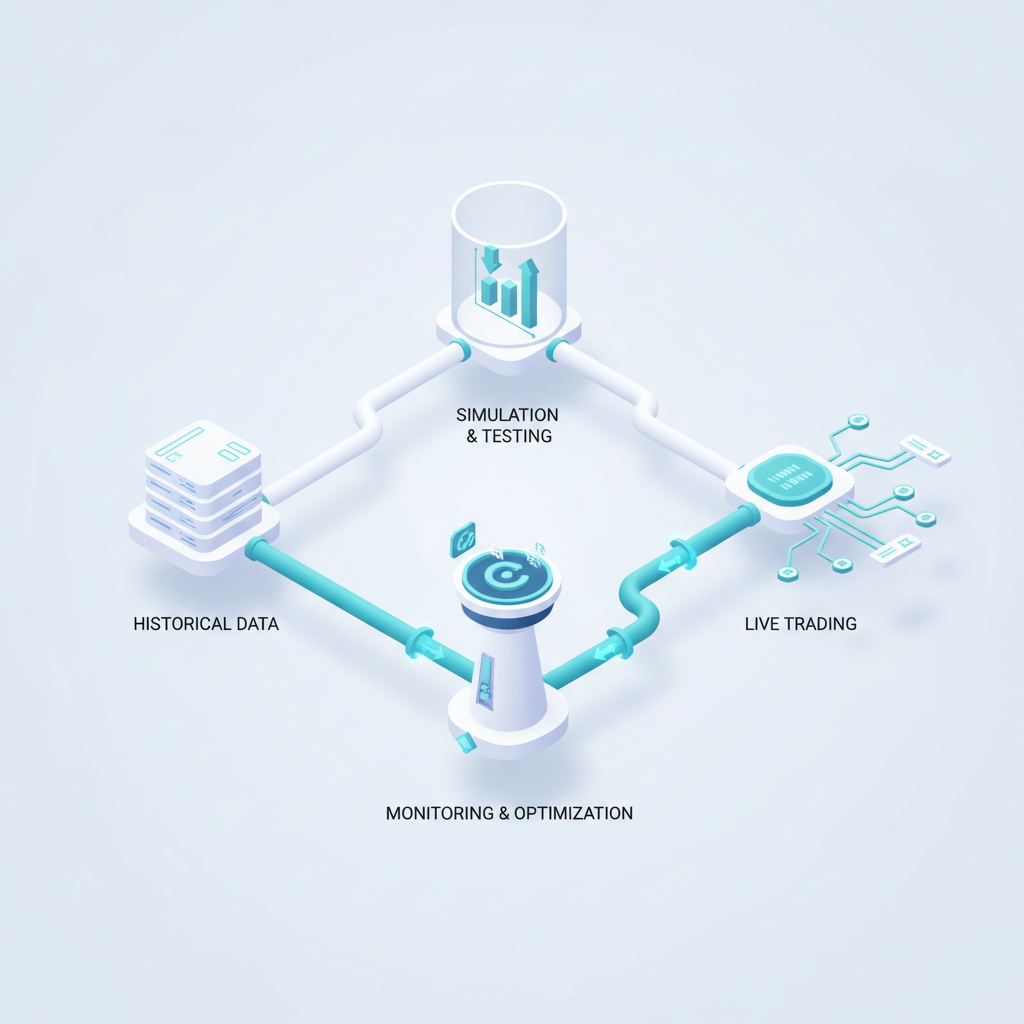
The Four-Stage Workflow Every Algo Trader Should Follow
Most algo strategies fail not because the underlying idea is wrong, but because the trader skipped steps. Here is the workflow I use and recommend.
Stage 1: Research and Idea Generation. You need a specific, testable hypothesis about a market inefficiency or systematic edge. “Crypto is volatile” is not a strategy. “BTC tends to mean-revert within a 4-hour period after a 3% move against the prevailing daily trend” is at least a testable idea. The hypothesis should have a logical reason to exist, not just a pattern you spotted once on a chart.
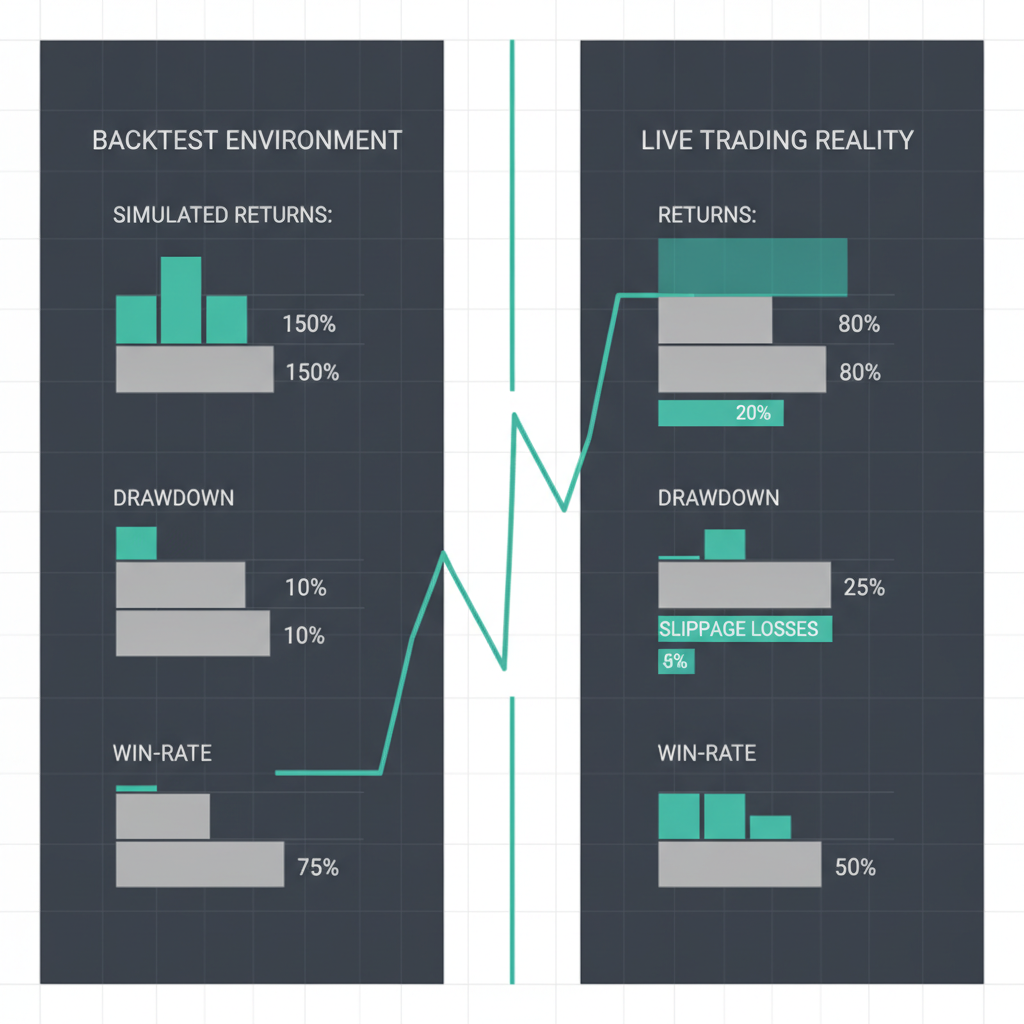
Stage 2: Backtest. Test the idea against historical data using real tick or OHLCV data before any capital goes near it. This is where most of the analytical work happens. The next section covers the specific traps that make backtests misleading. Do not skip this stage because the idea “seems obvious” — the number of obvious-seeming strategies that fall apart in backtesting is depressingly high.
Stage 3: Paper Trade. Run the strategy live against real market conditions, in real time, with no actual money. This stage catches execution issues that backtesting misses. API latency, order fill timing, exchange rate limits, and connectivity problems all show up here. I have had strategies that looked fine in backtesting run significantly worse in paper trading purely because of fill timing on a fast-moving order book.
Stage 4: Deploy with Small Size. Go live at minimum viable capital, typically $200–$500, before scaling anything. The psychological experience of live trading, even with a small amount, is genuinely different from paper trading. Confirm the strategy behaves as expected at small size before adding capital.
The most common reason strategies fail is moving from stage 1 to stage 4, skipping the work in the middle.
Backtesting Your Strategy: Common Traps to Avoid
A backtest that looks excellent is worth approximately nothing if it was built with any of these errors.
Look-ahead bias is the most insidious. It happens when your signal calculation accidentally uses information that wouldn’t have been available at the time of the trade. A classic example is calculating a daily close-based indicator and using it to generate a signal within that same candle before the close has actually occurred. The backtest looks great because your strategy “knew” where price was going to close. In live trading, it doesn’t. Tools like TradingView Pine Script have specific functions to handle this correctly; using them wrong is an easy mistake.
Overfitting means you’ve optimised your strategy parameters so specifically to historical data that the strategy has essentially memorised the past rather than identified a real pattern. If a strategy requires a 14.7-period RSI and a 2.3x ATR multiplier to show any edge, it’s probably overfit. A genuine edge should survive reasonable parameter variation.
Survivorship bias affects anyone backtesting across a basket of assets. If you’re testing “buy the top 20 altcoins by volume,” but your historical data only includes coins that still exist today, you’ve excluded every coin that lost 95% and disappeared. The result is falsely optimistic.
Unrealistic fills assume that your limit orders fill instantly at the quoted price. In reality, liquidity varies, slippage exists, and order book depth at your target price may not accommodate your full position size. Backtesting platforms that let you set realistic fill assumptions and slippage percentages produce more honest results.
Ignoring fees is fatal for high-frequency strategies. A strategy with 0.6% round-trip costs on every trade needs to generate more than 0.6% per trade just to break even. Run your backtests with actual exchange fee rates applied to every fill.
For tooling, TradingView Pine Script is the lowest-friction starting point. Freqtrade is the best open-source Python framework for more rigorous work. QuantConnect handles serious quantitative backtesting with institutional-grade data. Always paper trade before deploying real capital, regardless of how clean the backtest looks.
[INTERNAL LINK PLACEHOLDER: “backtesting crypto australia” → backtesting-crypto-strategies-australia]
Popular Algo Trading Strategies for Crypto Markets
The strategy you choose should match your capital size, technical ability, and how much time you want to spend managing the system after it’s live.
Grid bots are the most accessible starting point. The bot places a series of buy and sell orders at regular price intervals within a defined range. When price moves down, it buys. When it bounces back up, it sells. The profit comes from the spread between those intervals, captured repeatedly as price oscillates. These work well in ranging, volatile markets, which describes a lot of crypto behaviour. They don’t work well in a sustained trend where price breaks out of the grid range and stays there. Platforms like Bitsgap have grid bot functionality with a UI that doesn’t require any coding.
DCA automation is even simpler conceptually. You instruct the bot to buy a fixed dollar amount of a given asset at regular intervals, regardless of price. It’s not trying to time anything; it’s systematically reducing the average cost basis over time. The automation value is just in removing the decision point and ensuring it happens consistently.
Trend-following strategies use moving averages or similar indicators to define market direction, entering long when price is above a defined average and exiting when it crosses back below. Simple to understand, harder to execute well because the entry and exit signals are always lagging.
Mean reversion takes the opposite bet, assuming that after an extreme price move, prices will revert toward a statistical average. This suits choppy, range-bound conditions and can be built with RSI, Bollinger Bands, or z-score based signals.
Market making via Hummingbot is a more advanced approach, placing simultaneous bid and ask orders to capture the spread repeatedly. The returns can be consistent but the setup complexity and exposure to inventory risk in fast markets is not beginner territory.
For intermediate traders, Pine Script strategies deployed via TradingView webhooks to an exchange is a genuinely practical setup. You write the logic in Pine Script, set a webhook alert, and the alert fires an order through a connector. No server required.
Match the strategy to the capital. Grid bots with $500 make sense. Running a statistical arbitrage strategy across multiple exchanges with $500 doesn’t, once you account for fees and the minimum order sizes on both sides.
Tools and Platforms Compared: Bots, Charting, and Quant Frameworks
There’s no single best tool. The right choice depends on your coding ability, capital size, and what you’re actually trying to build. Here’s how the main options break down across three tiers.
Beginner Tier: Pre-Built Bot Platforms
Cryptohopper and Bitsgap are the two most commonly used entry-level platforms for Australian traders. Cryptohopper offers social trading (copy someone else’s strategy settings), a marketplace for signals, and bot templates you can customise without writing code. Bitsgap connects to 17+ exchanges, has AI-assisted bots, smart order types, and a clean interface. Neither requires coding knowledge to get started.
The trade-off at this tier is that you’re working within the constraints of someone else’s software. You can’t build genuinely custom logic, and you’re paying a monthly subscription ($20–$100/month depending on tier) regardless of whether the strategy is performing.
Intermediate Tier: TradingView + Webhooks
TradingView Premium, combined with Pine Script and an exchange webhook connector, is arguably the best value setup for traders who are comfortable with basic logic and want to write their own rules without running a server. Pine Script is purpose-built for this and easier to learn than Python. The webhook fires alerts to execute orders via a connector like 3Commas or directly to an exchange API.
This tier suits traders who want to write their own strategies but don’t want to manage Linux servers and Python environments.
Advanced Tier: Self-Hosted Frameworks
Freqtrade is the best open-source, self-hosted framework I’ve found for serious crypto algo trading. It’s written in Python, has an active community, built-in backtesting, a full strategy library, and Telegram integration for trade notifications. You run it on a VPS (a $5–$10/month virtual server handles it fine) and you have complete control over your logic.
Hummingbot is the go-to for market-making and liquidity mining specifically. It’s more complex to configure but purpose-built for strategies that need to manage simultaneous bid/ask inventory.
QuantConnect is the most powerful option if you’re doing serious quantitative work. Python or C#, institutional-grade historical data, backtesting with realistic fill simulation, and direct deployment to live brokerages. Overkill for grid bots; well suited for multi-factor statistical strategies.
Broker API Options
For traders who want to run algos through a brokerage rather than a pure crypto exchange, Alpaca is the standout for developer-friendliness and low fees. Pepperstone supports full MetaTrader, cTrader, and TradingView automation and is well-regarded for CFD trading with tight spreads and fast fills. Interactive Brokers covers the widest asset range with powerful API access if you need equities alongside crypto exposure.