Crypto Tax Australia: How Australian Crypto Traders Can Avoid the Most Expensive Tax Mistakes
The ATO does not care that your exchange showed a loss in USD while you made a gain in AUD. It does not care that you never converted back to dollars. And it definitely does not care that your bot ran 300 trades while you were asleep. Crypto tax in Australia catches traders off guard not because the rules are secret, but because most people do not read them until they get a letter.
> TL;DR
> Crypto tax Australia rules mean the ATO taxes most crypto disposals as CGT events, treats staking and mining income as ordinary income, and counts every crypto-to-crypto swap as a taxable event. Australian traders who automate strategies through bots face the same obligations — just at higher frequency. Keeping accurate records from day one is the single biggest lever you have to reduce your tax bill and avoid penalties.
The Short Answer: Yes, Almost Everything You Do With Crypto Is Taxable
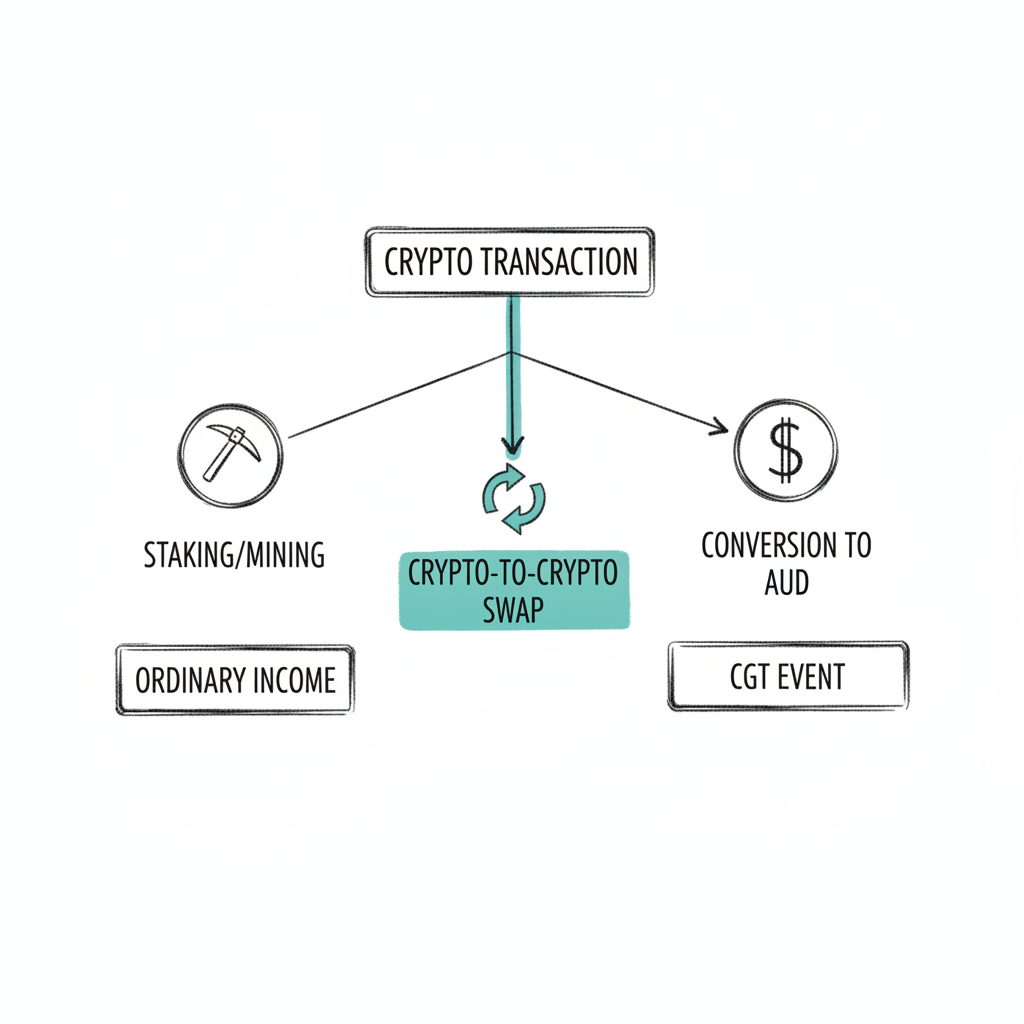
Crypto tax in Australia starts from a simple position: the ATO classifies cryptocurrency as a CGT asset for most individuals, not as a foreign currency. That distinction matters enormously. Foreign currency gains under a certain threshold get some relief. CGT assets do not get that treatment, and nearly everything you do with crypto counts as a disposal.
Disposal events include selling for AUD, swapping one cryptocurrency for another, spending crypto on goods or services, and gifting crypto to someone else. Each of those triggers a CGT calculation based on the AUD value at the time of the transaction.
The personal use asset exemption is the one carve-out people try to claim, and it almost never applies to active traders. The threshold is under $10,000, and the ATO applies it narrowly — it is designed for someone who bought $200 of BTC to buy a gift card, not someone running a portfolio. If you are reading this article, it almost certainly does not apply to you.
One thing that is genuinely not taxable: transferring crypto between wallets you own. Moving ETH from your Swyftx wallet to your Ledger is not a disposal. The ATO is clear on this, and it is one of the few clean answers in this space.
The two categories that cover almost all crypto tax obligations are capital gains tax and ordinary income. The distinction between them affects your rate, your eligibility for discounts, and how losses can be applied.
Capital Gains Tax vs Ordinary Income: Which One Applies to You?

This is where most traders get confused, and the confusion is expensive.
CGT applies when an individual holds crypto as an investment and disposes of it — selling BTC you bought six months ago, for example. The gain is the difference between your cost base (what you paid, including fees) and what you received in AUD terms at disposal.
Ordinary income treatment applies to a different set of activities. Staking rewards, mining proceeds, airdrops, DeFi yield, and being paid in crypto for work or services — these are all assessed as ordinary income at the AUD market value on the date you receive them. You cannot defer this by not selling. The income is assessed when it hits your wallet.
The 50% CGT discount is the most valuable concession available to Australian crypto investors. If you hold a CGT asset as an individual for at least 12 months before disposing of it, you only pay tax on half the gain. That can make a meaningful difference to your actual tax bill. However, proposed changes in the 2026-2027 budget suggest this discount may be affected from July 2027, so it is worth watching that space and getting advice before year end if you are planning to sell.
Short-term gains — assets held for under 12 months — are taxed at your marginal income tax rate, the same rate as your salary. There is no discount. A trader on a $120,000 income who makes a $30,000 short-term crypto gain is adding that $30,000 to their taxable income at the 37% marginal rate (plus the Medicare levy). That is a real number.
The business versus investor distinction is something the ATO takes seriously, and it matters more than most traders realise. If you are trading at high frequency, running bots, or treating it like a commercial operation, the ATO may classify you as carrying on a business. That changes everything: gains are taxed as ordinary income (no CGT discount), but you may also have access to broader deductions. There is no bright-line test. The ATO looks at frequency of trades, profit-making intent, commercial structure, and whether you operate in a businesslike manner.
A practical example: you buy BTC in March 2024, hold it, and sell in April 2025. You have held for 13 months. As an individual investor, you are eligible for the 50% CGT discount on any gain. That is the scenario the discount was designed for.
Every Crypto-to-Crypto Swap Is a Taxable Event (Here’s What That Means in Practice)
This is the rule that catches the most people off guard, particularly those using DeFi protocols or automated trading strategies.
When you swap ETH for SOL, you have disposed of your ETH. The ATO treats that as a sale of ETH at its AUD market value at the moment of the swap, and an acquisition of SOL at the same AUD value. It does not matter that no AUD ever left your wallet. It does not matter that the swap happened on a decentralised exchange at 2am. A taxable event occurred, and you are required to calculate the gain or loss on the ETH you disposed of.
The gain or loss is calculated as: AUD value of ETH at time of swap, minus your cost base in that ETH (what you originally paid for it, plus any acquisition fees). If ETH has gone up since you bought it, you have a capital gain. If it has gone down, you have a capital loss you can carry forward.
For someone making a handful of trades per year, this is manageable with a spreadsheet. For algo traders running strategies on platforms like BTC Markets or Swyftx, the numbers get large fast. A bot executing 20 trades per day generates over 7,000 taxable events per year. Each one needs to be recorded with the AUD value at the time of execution.
This is why crypto tax software is not optional for active traders. Tools like Koinly and CoinTracker connect to exchange APIs, pull trade history, and calculate gains and losses automatically. They are not perfect, and you still need to verify the output, but attempting to do this manually for high-frequency trading is not realistic.
The record-keeping burden from swap-heavy strategies is a real compliance cost that most traders do not price in when they start. [INTERNAL LINK PLACEHOLDER: ‘crypto bot tax implications’ → crypto-trading-bot-tax-australia]
Staking, Mining, Airdrops and DeFi Yield: How the ATO Taxes Passive Crypto Income
The phrase “passive income” is popular in crypto marketing. The ATO’s treatment of it is anything but passive.
Staking rewards are assessed as ordinary income at the AUD market value on the date you receive them. If you receive 0.5 ETH as a staking reward on a day when ETH is worth $4,000 AUD, you have $2,000 of assessable income in that tax year. Full stop.
Here is where it gets important: when you later sell that 0.5 ETH, you trigger a separate CGT event. Your cost base for the CGT calculation is the $2,000 you already declared as income — not zero. So if you sell it for $3,000, you have a $1,000 capital gain, not a $3,000 one. You are taxed on two different events, but you are not double-taxed on the same dollars. The distinction matters when people complain that staking is “taxed twice.”
Mining is treated differently depending on scale. If you are mining as a hobby, the proceeds are treated as a CGT asset acquisition at market value. If you are mining as a business, the proceeds are ordinary income. The ATO applies a facts-and-circumstances test — looking at commercial intent, equipment investment, and whether you are operating in a systematic way. There is no simple answer here, and if you are mining at any serious scale, get advice from a registered tax agent who knows crypto.
Airdrops are generally assessable as ordinary income at market value when received, unless you received them entirely passively without seeking them out. That edge case is narrow and contested. My practical advice: assume airdrops are income unless your tax agent tells you otherwise for a specific situation.
DeFi yield and liquidity pool returns are treated similarly to staking by the ATO, though guidance in this area is still developing. The ATO’s 2023 guidance touched on it, but the space is evolving faster than the rulebook. Log the AUD value of every reward on the day it hits your wallet. That record is what protects you in an audit.
Automated Trading and Crypto Bots: The Tax Implications Most Traders Miss
A bot executing 50 trades per day generates up to 18,250 taxable events per year. Let that sink in before you set up your first grid strategy.
Every one of those trades needs to be recorded with the following: date and time, asset traded, quantity, AUD value at the time of the trade, and the fee paid. Exchange fees are part of your cost base, so they are not just a nice-to-have — they reduce your taxable gain and need to be captured accurately.
Australian exchanges including BTC Markets, Swyftx, and Independent Reserve all allow CSV export of trade history via their account portals. If you are running bots via API on any of these platforms, set up regular exports and back them up. Exchange records can and do disappear if a platform closes, gets acquired, or changes its data retention policy.
The business classification risk is particularly real for bot traders. The ATO looks at frequency, commercial intent, and systematic operation — all of which describe algorithmic trading almost perfectly. If the ATO classifies your bot trading as a business, your gains are ordinary income rather than CGT events. You lose access to the 50% CGT discount, but you gain access to broader deductions. Whether that is better or worse depends entirely on your numbers, which is another reason to get professional advice early rather than after the fact.
Strategies like DCA (dollar-cost averaging) bots or grid trading bots — common on Cryptohopper and similar platforms — still trigger CGT rules on every execution. Running a grid bot that buys and sells BTC/AUD in a range does not create a single annual gain. It creates dozens or hundreds of individual gain and loss events, each calculated at the AUD spot price at the time.
Fees paid to trading bot platforms — Cryptohopper subscriptions, Freqtrade hosting costs, API data costs — may be deductible as expenses incurred in earning assessable income, particularly if you are classified as a business. Keep receipts. Consult a tax professional on how to apply them correctly.
For a full breakdown of how bot trading intersects with Australian tax law, our dedicated article covers the strategy-level detail. [INTERNAL LINK PLACEHOLDER: ‘crypto trading bot tax’ → crypto-trading-bot-tax-australia]
What Records You Must Keep (And for How Long)
The ATO requires you to keep records for five years after lodging the relevant tax return. For most traders, that means a rolling five-year window of transaction data. If you started trading in 2021, those records are still required.
At a minimum, each transaction record needs: the date, a description of what happened (buy, sell, swap, staking receipt), the AUD value at the time, the counterparty if known (exchange name or wallet address), and any fees paid. For DeFi interactions, the smart contract address is the closest equivalent to a counterparty.
Exchange transaction histories and CSV exports are the foundation. Supplement these with bank statements showing AUD deposits to and withdrawals from exchanges — they are supporting evidence if the ATO questions the timing or size of transactions.
Australian exchanges make this relatively straightforward. CoinSpot, Independent Reserve, and BTC Markets all offer full trade history exports. I have been using Swyftx since 2022, and their transaction history export is clean and includes fee data, which saves a step when feeding data into tax software.
Cloud backups of all exported data are not optional. If an exchange closes or changes its data retention policy, your records go with it. Store CSVs in at least two places.
Crypto tax software like Koinly or CoinTracker can automate the aggregation of data across multiple exchanges and wallets. They are useful tools, but they do not replace your obligation to verify accuracy. The software is only as good as the data you feed it, and mismatched timestamps or missing cost bases will create errors that end up in your tax return.
Can You Deduct Crypto Trading Expenses in Australia?
Yes, but the rules depend on how your trading activity is classified, and getting this wrong creates its own problems.
Trading fees — exchange fees, network gas fees — are included in your cost base for CGT purposes. They reduce the gain you pay tax on. A $50 network fee on a $5,000 BTC purchase means your cost base is $5,050, not $5,000. Over time and across many transactions, this adds up.
If your trading is assessed as a business, the deduction landscape widens. Software subscriptions (tax tools, charting platforms, bot subscriptions), data feeds, and hardware costs may be deductible expenses. Internet and computer costs are deductible only to the extent they are used for the business activity — not 100% of your NBN bill because you check your portfolio each morning.
Capital losses work differently. They can be used to offset capital gains in the same income year, or carried forward to offset future capital gains. They cannot be used to offset ordinary income. If you had a bad year on altcoins but earned a salary and staking income, those losses do not reduce your PAYG or staking assessments — they sit as a carry-forward asset.
Tax professional fees for crypto-specific advice are generally deductible, which is a reasonable reason to get advice in the first place. An accountant who understands crypto is not cheap, but their fee pays for itself if they correctly categorise your activity or identify deductions you missed.
One practical note: the rules around what is and is not deductible in crypto are genuinely complex, and they depend on the facts of your specific situation. The above is a general guide. Always get confirmation from a registered tax agent who is familiar with Australian crypto tax before claiming deductions.
Frequently Asked Questions
Is cryptocurrency taxable in Australia?
Yes. The ATO treats most cryptocurrency as a CGT asset. Nearly all disposal events — selling for AUD, swapping for another crypto, spending, or gifting — trigger a taxable event. Receiving crypto as income (staking, mining, airdrops, payment for work) is assessed as ordinary income.
Does the ATO know about my crypto trades?
Almost certainly. Australian exchanges are AUSTRAC-registered and are required to report to the ATO under data-matching programs. The ATO has been matching exchange data against tax returns since at least 2019. Assuming trades are invisible is a significant compliance risk.
What is the 50% CGT discount and does it apply to crypto?
If you hold a cryptocurrency for at least 12 months as an individual investor before selling, you may only pay tax on 50% of the capital gain. It applies to crypto held as an investment, not to business traders. Proposed changes from July 2027 may affect this discount — check current ATO guidance closer to that date.
Are crypto-to-crypto swaps taxable in Australia?
Yes. The ATO treats swapping one cryptocurrency for another as a disposal of the first asset. You calculate a capital gain or loss based on the AUD value of the asset at the time of the swap, even if no AUD changes hands.
How does the ATO tax staking rewards?
Staking rewards are assessed as ordinary income at the AUD market value on the date they are received. When you later sell those coins, a separate CGT event occurs. The cost base for that CGT event is the value you already declared as income.
Do I need to report crypto if I made a loss?
Yes. You should still report disposals even if you made a loss. Capital losses can be offset against capital gains in the same year or carried forward to future years, so they have real tax value. Failing to report is not a strategy — it is a compliance risk.
How are crypto bot trades taxed in Australia?
The same rules apply as manual trading. Every trade a bot executes is a taxable event. If a bot runs 50 trades per day, each one generates a CGT calculation. High-frequency bot trading may also increase the risk of being classified as carrying on a business by the ATO, which changes how gains are taxed.
What records do I need to keep for crypto tax in Australia?
For each transaction: date, type of event, asset, quantity, AUD value at the time, fees paid, and counterparty if known.