Algorithmic Crypto Trading in Australia: Complete 2026 Guide
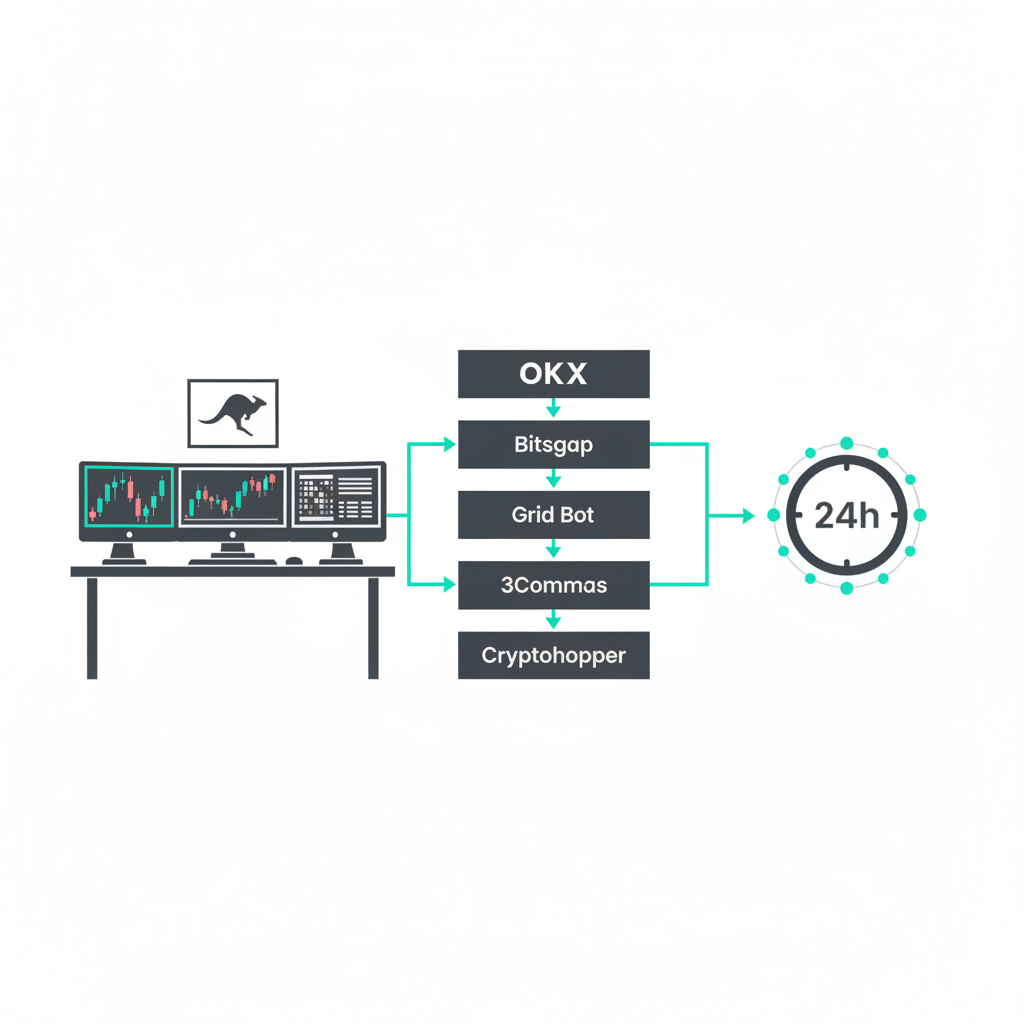
Algorithmic crypto trading in Australia has moved well past the “early adopter” phase. Walk into any serious trading community in Sydney or Melbourne and you will find retail traders running grid bots on OKX, backtesting mean reversion strategies on Bitsgap, and arguing about whether 3Commas or Cryptohopper handles DCA better on volatile altcoins. This is not fringe behaviour anymore.
> TL;DR: Algorithmic crypto trading in Australia uses programmed strategies to automatically execute trades 24/7, removing emotional bias from your decision-making. As of 2026, all platforms must be AUSTRAC-registered VASPs and are moving toward ASIC AFSL licensing under the new Digital Assets Framework. Profits are subject to CGT, and a 50% discount applies for assets held over 12 months.
What has changed in 2026 is the regulatory floor underneath all of it. The Corporations Amendment (Digital Assets Framework) Bill 2025 passed on April 1, 2026, and AUSTRAC formally renamed DCE providers to VASPs the following day. The rules are no longer ambiguous. That is mostly good news for traders who want certainty, and bad news for the dodgy offshore platforms that have been operating in a grey zone for years.
This guide covers how algo trading actually works, the strategies worth knowing, the platforms available to Australians right now, the 2026 regulatory picture, and the tax obligations that catch most traders off guard.
What Is Algorithmic Crypto Trading in Australia?
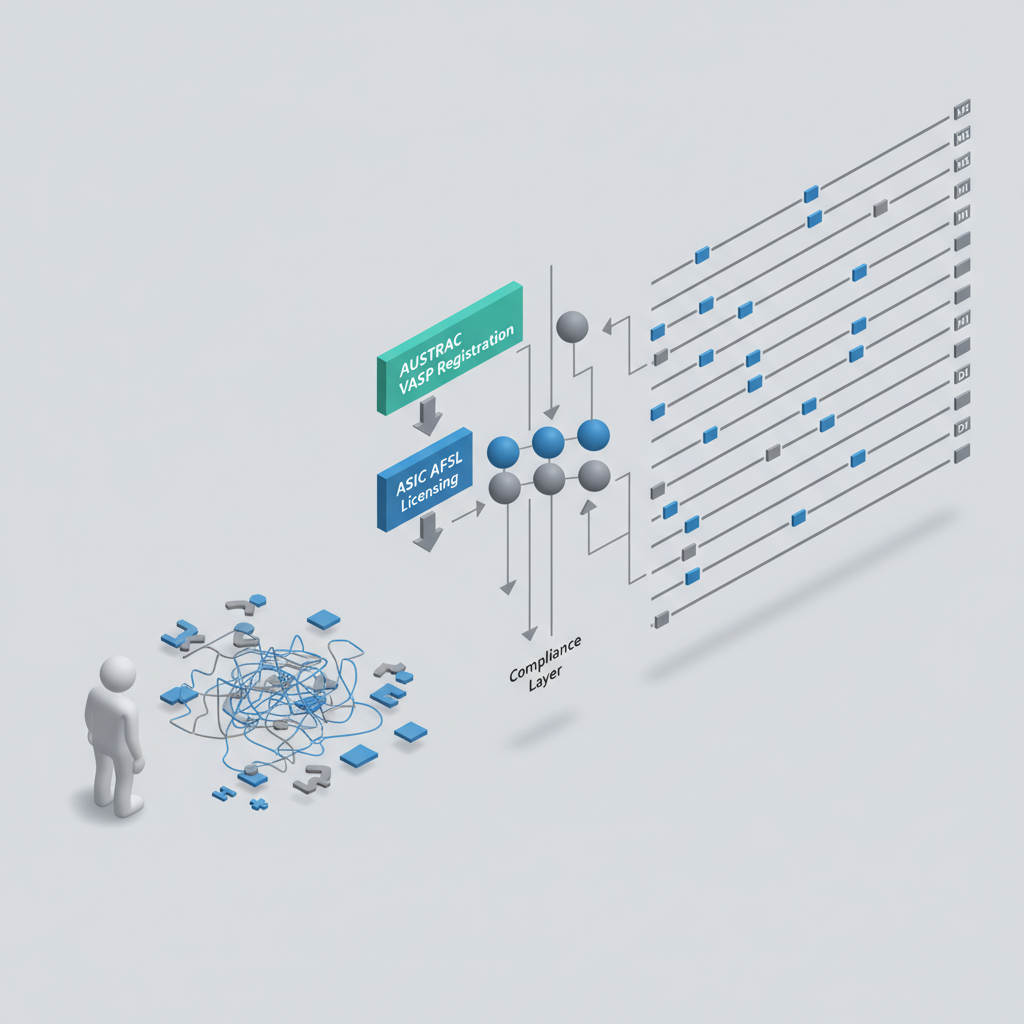
Algorithmic crypto trading is the use of programmed strategies and mathematical rules to automatically execute buy and sell orders on cryptocurrency markets, without you needing to sit at a screen and click buttons manually.
The algorithm watches price data, applies its rules, and fires orders based on whatever conditions you have set. Those conditions might be as simple as “buy BTC when the 20-day moving average crosses above the 50-day moving average” or as complex as a multi-factor momentum model that accounts for order book depth, volatility regimes, and correlation to ETH. The sophistication is up to you.
Two practical benefits make this appealing for Australian traders specifically. First, crypto markets run 24/7 including weekends and public holidays, and no human trader can monitor markets around the clock without losing their mind. An algorithm does not sleep. Second, it removes the emotional decision-making that causes most retail traders to buy tops and sell bottoms. The bot does not panic during a flash crash at 3am.
In Australia, algorithmic crypto trading is entirely legal. It falls under the same regulatory framework as any other crypto trading activity. The ATO treats each automated trade as a CGT event the same way it treats a manual trade. ASIC governs the platforms facilitating those trades. AUSTRAC monitors them for AML/CTF compliance.
The new Digital Assets Framework Bill, which passed in April 2026, has brought significantly more structure to this space. Algo traders using compliant platforms are in a better position now than they were 18 months ago, when regulatory uncertainty was the dominant conversation.
[INTERNAL LINK PLACEHOLDER: crypto regulation australia → ASIC Digital Assets Framework pillar]
How Algorithmic Crypto Trading Works
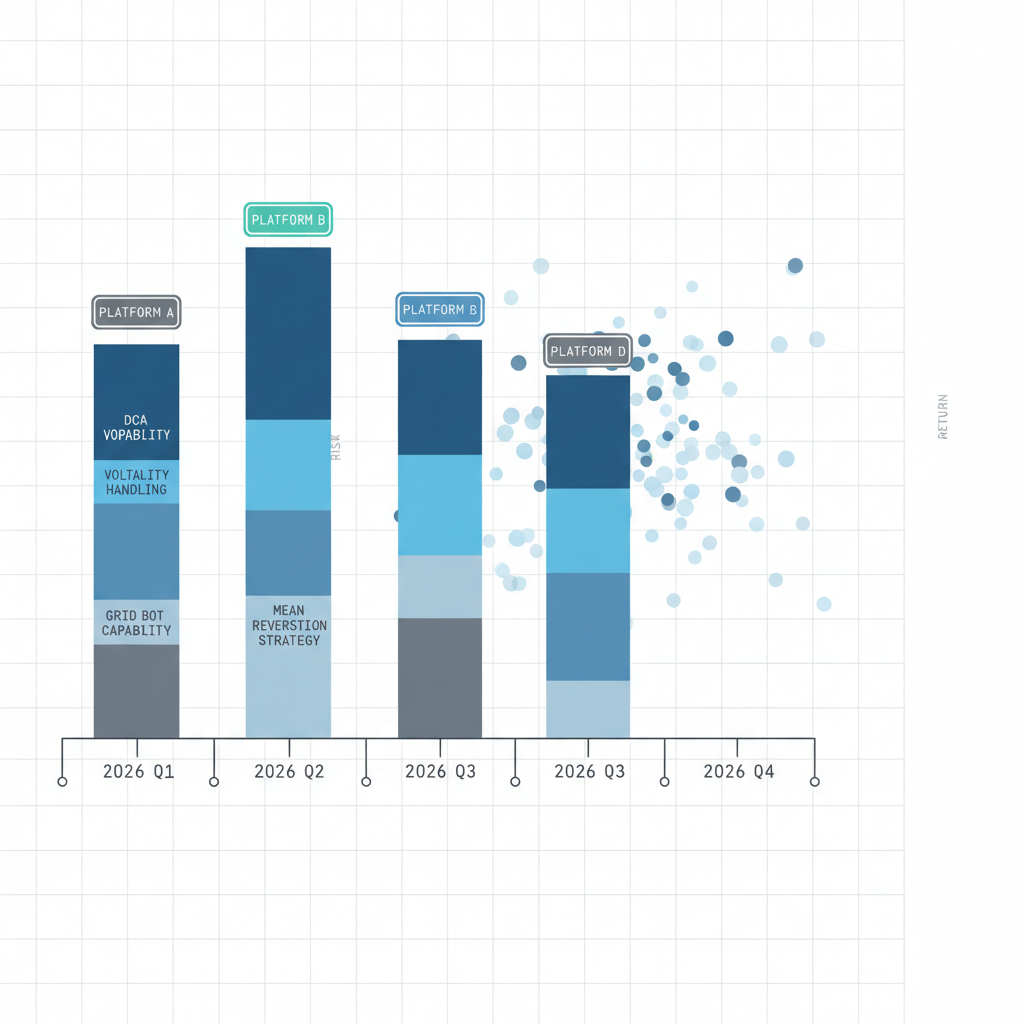
At its core, an automated trading system has four components working together: the strategy logic, a market data feed, an order execution engine, and risk management rules.
The strategy logic is the brain. It defines the conditions under which the algorithm buys, sells, or holds. The market data feed supplies real-time price information, order book data, volume, and sometimes external signals like social sentiment. The execution engine connects to an exchange via API and sends the actual orders. The risk management layer sets position sizing, stop-losses, and maximum drawdown limits so a single bad trade does not wipe the account.
Connecting to Exchanges
Platforms like Swyftx, Kraken, and Coinbase Advanced expose APIs that allow external software to query balances, place orders, and retrieve trade history. Algo platforms like Bitsgap and Cryptohopper plug into these APIs, so you configure your strategy on the bot platform and it executes on your exchange account. Your funds stay on the exchange; the bot just gets permission to trade them.
Backtesting and Paper Trading
Before risking real capital, most serious traders backtest their strategy against historical data. This shows how the strategy would have performed over a defined period. The limitation is obvious: past performance does not guarantee future results, and crypto markets have structural breaks that make older data less relevant. Still, backtesting filters out the obviously bad strategies quickly.
Bitsgap and CryptoRobotics both offer demo or paper trading modes where you run the bot with simulated money in real market conditions. I would not skip this step. Strategies that look clean in backtests can fall apart fast when slippage and exchange latency enter the picture.
Execution Speed
Even retail-grade algo systems execute orders in milliseconds, far faster than any manual trader. For grid bots and DCA strategies this speed advantage is modest but real. For arbitrage strategies, execution speed is everything, and that is where institutional infrastructure starts to matter.
Common Algorithmic Trading Strategies for Crypto
Most retail algo traders in Australia gravitate toward a handful of strategy types. Here is what each one actually does and where it fits.
Trend-following is the most intuitive. The algorithm identifies a sustained price move and enters in the direction of that trend, holding until momentum fades. BTC and ETH volatility makes this strategy genuinely viable in crypto, unlike in some other asset classes where trends are shorter-lived. The risk is that whipsaw markets generate false signals and accumulate losses quickly.
Arbitrage exploits price differences for the same asset across different exchanges. If BTC is trading at $95,400 on one exchange and $95,600 on another, the algorithm buys on the cheaper venue and sells on the more expensive one simultaneously. In practice, this is harder than it sounds. Fees, withdrawal delays, and the time it takes to move funds between Australian and global exchanges often erode the margin. Pure arbitrage opportunities close within seconds.
Mean reversion takes the opposite view to trend-following. It assumes prices that have moved far from their historical average will return to it. These strategies perform well in ranging, sideways markets and poorly in strong trends. When BTC decides to run 40% in three weeks, a mean reversion bot gets repeatedly stopped out.
Momentum trading is a cousin of trend-following but focuses on acceleration rather than sustained direction. The algorithm enters when price movement picks up speed, betting the move continues. It works well around major news events and protocol upgrades.
Grid and DCA bots are the most popular retail-friendly options, available natively on OKX and through platforms like Bitsgap and Cryptohopper. A grid bot places a ladder of buy and sell orders at set intervals above and below a price range, capturing profits as the price oscillates. DCA bots buy fixed dollar amounts at regular intervals regardless of price, reducing average entry cost over time. Neither requires you to predict direction correctly, which is why they suit most retail traders.
Market making involves simultaneously placing buy and sell orders on both sides of the order book to capture the spread. It requires deep liquidity, fast execution, and tolerance for inventory risk. At the retail level it is marginal. At the institutional level it is a business.
High-frequency trading operates at the millisecond level and requires co-located servers at exchange data centres, proprietary order routing, and significant capital. It is not accessible to retail traders and is generally irrelevant to the Australian retail algo trading conversation.
Top Algorithmic Crypto Trading Platforms Available in Australia (2026)
The platforms accessible to Australian traders split into three categories: dedicated crypto bot platforms that connect to exchanges via API, crypto exchanges with native bot tools built in, and traditional trading platforms that have added crypto.
Platform Comparison
| Platform | Strategy Types | Approx. Fees | AUD Deposits | AUSTRAC/VASP | Demo Mode |
|---|---|---|---|---|---|
| Cryptohopper | DCA, grid, momentum, copy trading | From $29/mo subscription | Via connected exchange | Operates via registered exchanges | Yes |
| Bitsgap | DCA, grid, combo, BTFD | From $29/mo subscription | Via connected exchange | Operates via registered exchanges | Yes |
| OKX (native bots) | Spot grid, DCA Martingale, arbitrage | 0.1% maker / 0.15% taker | No direct AUD | VASP-registered | Yes |
| CryptoRobotics | AI bots, trend, DCA | From $20/mo | Via connected exchange | Operates via registered exchanges | Yes |
| Capitalise.ai | NLP strategy builder, automation | Free for Pepperstone clients | Via Pepperstone | Via Pepperstone (ASIC-licensed) | Yes |
| 3Commas | DCA, grid, options bots | From $37/mo | Via connected exchange | Operates via registered exchanges | Yes |
| Swyftx | Recurring buy (DCA) | 0.6% fee + spread | Yes (PayID, bank transfer) | VASP-registered | No |
| Coinbase Advanced | Manual + API algo | Under 0.35% maker | Yes (bank transfer) | VASP-registered | No |
| Kraken Pro | Manual + API algo | 0.25% maker / 0.40% taker | Yes (bank transfer) | VASP-registered | No |
| Interactive Brokers Australia | Full algo suite (crypto + traditional) | Variable | Yes (AUD account) | ASIC-licensed | Yes (paper trading) |
| MetaTrader 5 (MT5) | EAs, custom scripts | Via broker | Via broker | Via broker | Yes |
What to Know About Each Category
Dedicated bot platforms like Cryptohopper, Bitsgap, and 3Commas do not hold your funds. They connect to your exchange account via API keys and execute trades on your behalf. This means AUSTRAC compliance sits with the exchange, not the bot platform. You still need your underlying exchange to be a registered VASP. Check the AUSTRAC register before you link any bot to a new exchange.
Capitalise.ai deserves a specific mention for traders who hate coding. It uses natural language processing, meaning you write something like “buy ETH when RSI drops below 30 and hold for 5 days” and it converts that to an automated strategy. It is free for Pepperstone clients, and Pepperstone holds an ASIC AFSL, which matters under the new framework.
Australian exchanges with native tools are simpler operationally. Swyftx offers recurring buys, which is a basic DCA implementation. I have been using Swyftx since 2022 and it is solid for straightforward automated buying, though it is not a full algo platform. For more sophisticated execution, Kraken Pro and Coinbase Advanced both offer API access with low maker fees, and Australian traders can fund them in AUD via bank transfer.
Traditional platforms like Interactive Brokers Australia and MT5-based brokers support genuine algorithmic trading with languages like Python, Java, and C++. If you are running a strategy that crosses asset classes (crypto plus equities or futures), IBKR is worth considering. It is also ASIC-licensed already, which puts it ahead of crypto-only platforms still working toward AFSL compliance.
Any platform not listed on the AUSTRAC VASP register and not on track for ASIC AFSL licensing is a risk to avoid in 2026. This is not theoretical. AUSTRAC cancelled several VASP registrations in March 2026 due to money laundering and terrorism financing concerns. Check the register at austrac.gov.au before depositing.
Australian Regulations for Algo Crypto Trading in 2026
The regulatory picture for automated crypto trading in Australia crystallised significantly in April 2026, and traders who have not updated their understanding are operating on outdated assumptions.
The Digital Assets Framework Bill
The Corporations Amendment (Digital Assets Framework) Bill 2025 passed on April 1, 2026. The effect is straightforward: crypto exchanges and custody providers must obtain an Australian Financial Services Licence from ASIC within six months of the bill’s commencement. That window runs through late 2026.
An AFSL brings with it obligations that traditional brokers have carried for years: safeguarding client assets, providing clear disclosure documents, maintaining internal dispute resolution systems, and meeting capital adequacy requirements. For algo traders, this means the platforms you use will increasingly look and behave like regulated financial services businesses, with the legal protections that implies.
The exemption threshold is worth knowing. Platforms holding less than A$5,000 per customer and facilitating under A$10 million in annual transactions may be exempt from AFSL requirements. Most serious algo trading platforms will exceed these thresholds, so the exemption is largely irrelevant for the platforms in the comparison table above.
AUSTRAC’s VASP Framework
On April 2, 2026, AUSTRAC formally expanded its AML/CTF laws and renamed Digital Currency Exchange providers to Virtual Asset Service Providers. A public, searchable VASP register launched on the same date. This is practically useful: you can now look up any platform and confirm its registration status before depositing funds.
AUSTRAC’s “Use It or Lose It” initiative, completed prior to April 2026, removed inactive registrations from the register. The March 2026 cancellations of several VASPs for money laundering and terrorism financing risks reinforced that registration is active and ongoing, not a set-and-forget status.
New virtual asset services that commenced on March 31, 2026, had until April 28, 2026 to enrol with AUSTRAC. Any service that missed that window and is still operating without registration is non-compliant.
What This Means for Algo Traders
The practical checklist is short. Before connecting any bot or depositing onto any platform:
1. Confirm the exchange is on the AUSTRAC VASP register.
2. Check whether it has applied for or received an ASIC AFSL (or has a clear pathway before the six-month deadline).
3. If using a third-party bot platform, confirm that the underlying exchange is VASP-registered, since the bot platform’s compliance depends on it.
The broader picture is encouraging. A TRM Labs report from March 2026 found that less than 1% of Australian crypto on-chain transaction volume, across roughly $50 billion in transactions between March 2025 and February 2026, was linked to illicit actors. The regulatory tightening is working, and it is creating a cleaner environment for legitimate traders.
[INTERNAL LINK PLACEHOLDER: AUSTRAC VASP register guide → AUSTRAC compliance pillar]
Tax on Algorithmic Crypto Trading in Australia
Algo trading generates a lot of taxable events. This is where most automated traders underestimate their obligations, and it is where the ATO’s data-matching program catches people who assumed they could quietly ignore it.
CGT Basics
The ATO classifies cryptocurrency as property, not currency. Every time you dispose of a crypto asset, whether selling to AUD, swapping one crypto for another, or using crypto to pay for goods or services, you trigger a Capital Gains Tax event. The gain or loss is the difference between the asset’s cost base and its disposal value in AUD at the time of the transaction.
For individual investors, a 50% CGT discount applies to assets held for more than 12 months before disposal. Here is the catch for algo traders: most algorithmic strategies, particularly grid bots, DCA exits, and momentum strategies, cycle in and out of positions over days or weeks, not years. The 12-month discount will rarely apply. Your gains will be assessed at your full marginal income tax rate.
High-Frequency Record-Keeping
A grid bot running on a volatile altcoin pair can generate hundreds of trades per month. Each one is a CGT event requiring a cost base, a disposal value, and an AUD conversion at the time of transaction. Attempting to reconcile this manually is a nightmare.
Crypto tax software is not optional for active algo traders. Koinly and CoinTracker both support API imports from most major Australian exchanges and can generate ATO-ready capital gains reports. K