Sell Bitcoin for AUD Australia: Which Exchanges Actually Charge the Least?
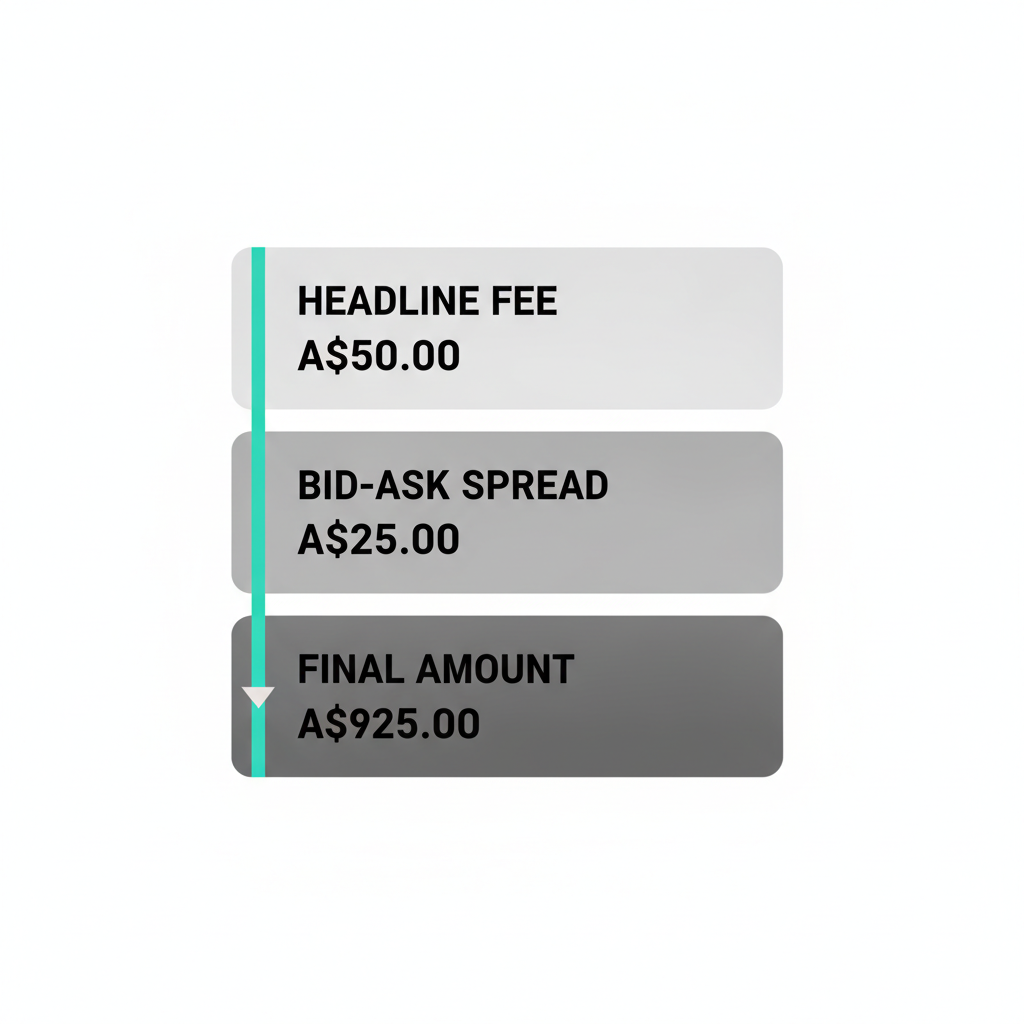
If you have ever sold Bitcoin on CoinSpot using the instant sell button and then looked at what landed in your bank account, you already know something is off. The 1% headline fee sounds reasonable. What you probably did not clock was the 1–2% spread sitting on top of it, quietly taking another slice before the AUD ever hit your account.
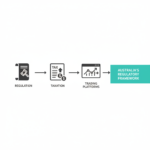
That gap between the headline fee and what you actually pay is what this article is about. To sell bitcoin for AUD in Australia without getting gouged, you need to understand three separate cost layers across every platform you are considering.
> TL;DR
> To sell bitcoin for AUD Australia-wide, your total cost comes from three layers: trading fee, bid-ask spread, and AUD withdrawal fee. CoinSpot instant sells can cost $20–$30 on a $1,000 trade once the spread is included, while Independent Reserve and Binance can bring that figure under $5 for active traders. Direct bank transfer and PayID withdrawals are free on most AUSTRAC-registered exchanges. Always calculate the all-in cost before choosing a platform.
Why the Headline Fee Is Never the Whole Story
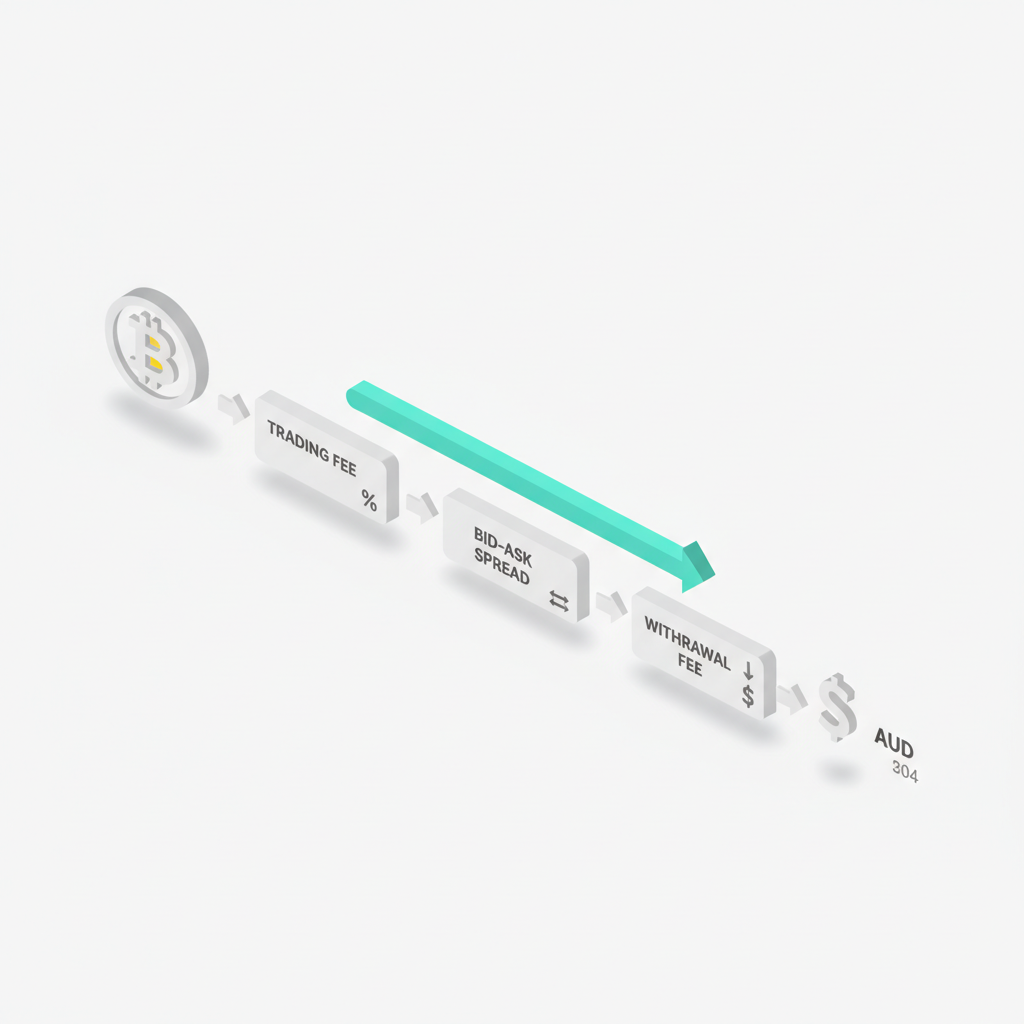
Every exchange publishes a trading fee. Almost none of them put the spread in the same font size.
When you sell bitcoin for AUD in Australia, three costs hit you in sequence. First is the trading fee, the percentage the exchange charges to execute the transaction. Second is the bid-ask spread, the gap between the market price of Bitcoin and the price the exchange actually gives you. Third is the AUD withdrawal fee, charged to move your cash to a bank account.
Spreads are where casual sellers get hurt most. CoinSpot’s instant sell carries a 1–2% spread on top of its stated 1% flat fee. That means a single instant sell on CoinSpot can cost you 2–3% all-in before your money even leaves the exchange. On a $5,000 Bitcoin sale, that is $100–$150 in friction costs you probably did not budget for.
Gas and network fees matter if you are moving Bitcoin on-chain before selling, but for AUD withdrawals after a sell, most major Australian exchanges charge nothing. PayID and direct bank transfers are free across the board on the platforms covered here.
One thing every Australian seller needs to keep front of mind: every Bitcoin-to-AUD conversion is a CGT event under Australian tax law. It does not matter which exchange you use or how small the amount. The ATO treats each sale as a disposal of a capital asset, and you will need records of the cost base, sale price, and date for every transaction. The exchange fee itself is a cost that can be added to your cost base, which is worth tracking. [INTERNAL LINK PLACEHOLDER: “CGT event” → Crypto Trading Bot Tax in Australia article]
The metric worth benchmarking across every platform is all-in cost: trading fee percentage plus estimated spread percentage, expressed as a dollar figure on your actual trade size.
How Each Major Australian Exchange Charges You to Sell Bitcoin
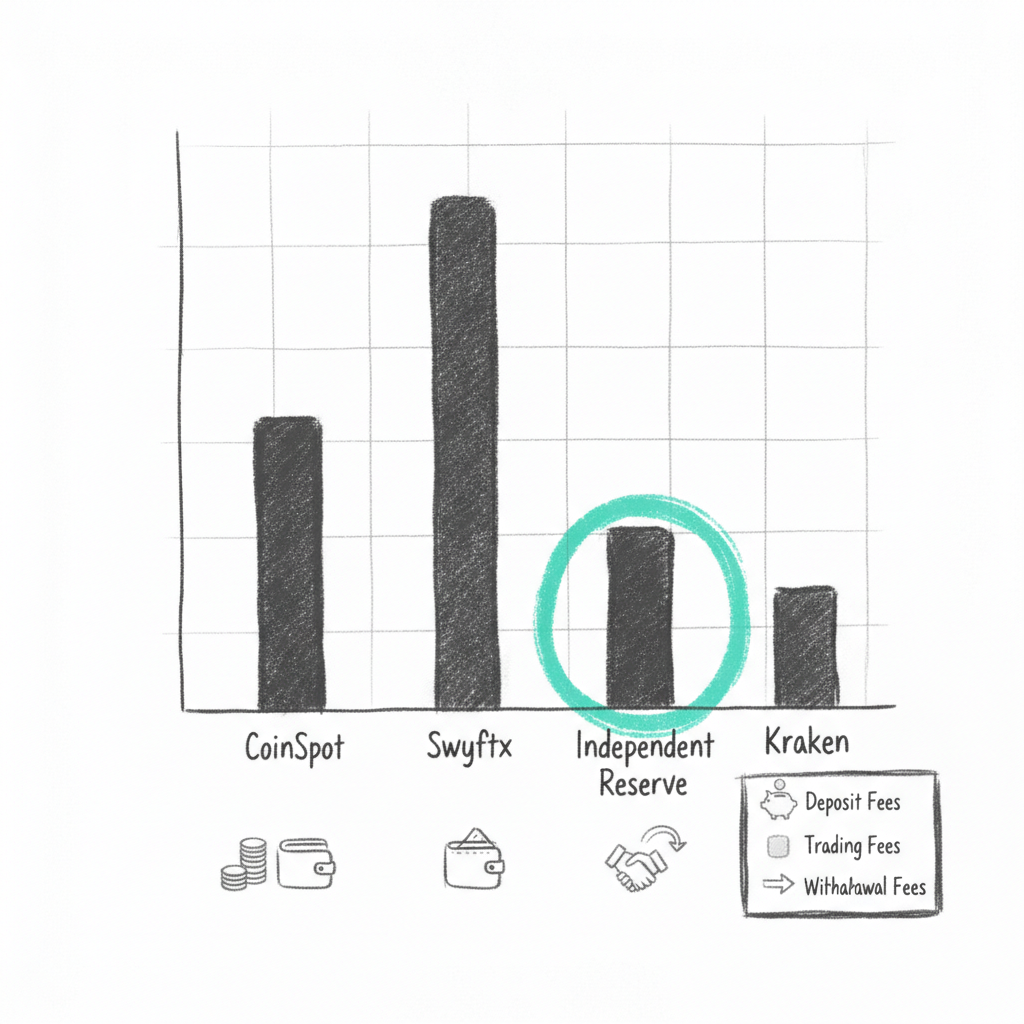
Here is how the main platforms structure their costs for Australian Bitcoin sellers.
CoinSpot
CoinSpot charges 1% on instant buys and sells, plus a spread of roughly 1–2% baked into the quoted price. For a quick, low-effort sale this is the price of convenience. Their market order system is a different story: 0.1% trading fee with a much tighter spread, often making it the better choice even for casual sellers who can wait a few minutes for the order to fill. CoinSpot is ISO 27001 certified, AUSTRAC-registered, and an AFCA member, which matters if you ever have a dispute. I have had funds sitting on CoinSpot since 2022 and have never had a withdrawal issue, but I switched to market orders a long time ago.
Swyftx
Swyftx charges between 0.1% and 0.6% trading fee with a competitive spread that sits well below CoinSpot’s instant sell. The platform is ISO 27001 certified and AUSTRAC-registered. The standout feature for newer traders is the demo mode, which lets you practise a sell strategy with simulated funds before committing real Bitcoin. For straightforward AUD conversions without needing to learn order books, Swyftx is genuinely hard to fault on the cost side.
Independent Reserve
Independent Reserve runs a tiered maker/taker model starting at 0.5% and dropping to 0.02% for high-volume accounts. Spreads are tight because the order book is deeper than most Australian-only platforms. This is the exchange I would point anyone towards if they are selling more than $10,000 at a time, or if they hold Bitcoin inside an SMSF. Independent Reserve explicitly supports SMSF crypto accounts with proper documentation, which almost no other Australian exchange does.
Binance
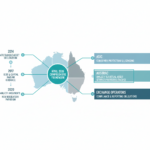
Binance charges 0.1% spot maker/taker fees with extremely tight spreads due to its global liquidity depth. AUD deposit and withdrawal options are available to Australian users. It is not an Australian-domiciled exchange, so it does not carry AUSTRAC registration in the same way as CoinSpot or Independent Reserve, which is worth understanding before you commit large sums. For pure fee efficiency, though, it is hard to beat.
Gate.io, OKX Australia, and Crypto.com
Gate.io offers 0–0.1% fees with various discount structures but is not focused on the Australian market. OKX Australia runs a tiered structure from 0% to 0.7%. Crypto.com drops to 0–0.075% for high-tier users who hold significant CRO balances, but for most Australian retail sellers the effective rate will be higher. These platforms are available to Australians but lack the local banking integration and regulatory footing of CoinSpot, Swyftx, or Independent Reserve.
Fee Comparison Table: Selling $1,000 of Bitcoin to AUD
Spreads below are estimates based on typical market conditions and will vary with volatility. The all-in cost figures assume a straightforward AUD sell with no on-chain withdrawal involved.
| Exchange | Trading Fee % | Typical Spread % | Est. All-In Cost on $1,000 | AUD Withdrawal Fee | AUSTRAC Registered |
|---|---|---|---|---|---|
| CoinSpot (instant sell) | 1.0% | 1.0–2.0% | $20–$30 | Free (bank transfer) | Yes |
| CoinSpot (market order) | 0.1% | 0.1–0.3% | $2–$4 | Free (bank transfer) | Yes |
| Swyftx | 0.1–0.6% | 0.2–0.5% | $3–$11 | Free (PayID/bank transfer) | Yes |
| Independent Reserve | 0.02–0.5% | 0.05–0.2% | $1–$7 | Free (bank transfer) | Yes |
| Binance | 0.1% | 0.05–0.15% | $1.50–$2.50 | Free (bank transfer) | No (global) |
| Crypto.com | 0.075% (high tier) | 0.1–0.3% | $2–$4 | Free (bank transfer) | No (global) |
A few things jump out of that table. CoinSpot’s instant sell is genuinely expensive compared to any other option, including CoinSpot’s own market order function. Independent Reserve and Binance are in a different tier for active traders, with all-in costs well under $5 on a $1,000 trade. PayID and direct bank transfer AUD withdrawals are free across every platform listed, so that layer does not usually differentiate them.
AUD Deposit and Withdrawal Fees: The Final Step Most Traders Forget
Getting AUD into and out of an exchange is the part of the fee calculation most traders skip until they see their bank balance.
On the deposit side, direct bank transfer and PayID/OSKO are free on every major Australian exchange. This should be your default method. BPAY typically attracts a 0.9% fee, which is meaningful if you are moving large amounts. Cash deposits can cost around 2.5% and credit or debit card deposits generally run about 1.88%. There is rarely a reason to use anything other than PayID for regular deposits.
On the withdrawal side, AUD withdrawals to Australian bank accounts are free on all the major platforms covered here. Some exchanges offer an instant PayID withdrawal that processes in seconds, while standard bank transfers settle within one business day. A small number of platforms charge a nominal fee for the instant option, so check before assuming they are equivalent.
Where it gets more complex is if you are moving Bitcoin out of an exchange to a hardware wallet or self-custody address before selling. On-chain Bitcoin withdrawals attract network fees, which fluctuate with mempool congestion. At current levels these are not extreme, but if you are running a strategy that involves regular on-chain movements before selling down to AUD, those fees compound quickly and become a legitimate line item in your cost base for CGT purposes.
Practical approach: use PayID for deposits, use standard bank transfer for AUD withdrawals unless you need the funds immediately. Avoid BPAY and card deposits unless there is no alternative.
Which Exchange Is Cheapest for Different Types of Bitcoin Sellers?
The cheapest exchange depends almost entirely on how often you sell and in what size.
Casual or one-off seller under $1,000. CoinSpot market orders or Swyftx are the practical choices here. Neither requires you to understand order books in depth, both are AUSTRAC-registered, and the all-in cost on a sub-$1,000 sale is manageable even if not rock-bottom. The regulatory peace of mind from using an AFCA-member Australian exchange is worth something for a one-off transaction.
Regular retail trader selling $1,000–$10,000 per trade. At this size, the spread difference between CoinSpot instant sell and Swyftx or Independent Reserve starts adding up to real money across a year. Swyftx sits in a good middle ground: Australian-based, AUSTRAC-registered, solid fee structure, and straightforward to use. Independent Reserve becomes more compelling as trade size grows toward $10,000 because its tiered structure rewards volume.
High-volume or algo trader. Independent Reserve’s tiered fees, which can fall to 0.02% for high-volume accounts, are the most competitive within the Australian-registered ecosystem. Binance offers the deepest liquidity and tightest spreads globally, and for an algo trader executing many sells per week the per-trade cost difference compounds into a significant annual figure. If your bot is selling Bitcoin to AUD repeatedly, 0.02% versus 0.6% across hundreds of trades is not trivial.
SMSF accounts. Independent Reserve is the clear answer here. They explicitly support SMSF crypto accounts with appropriate documentation and have built processes around the compliance requirements trustees face. No other mainstream Australian exchange matches this.
Beginners wanting to learn before committing. Swyftx demo mode is worth spending a few sessions in before you sell real Bitcoin. Understanding how order types affect your final AUD figure, without risking actual funds, is a practical edge that most beginners skip entirely.
The Hidden Tax Cost of Selling Bitcoin in Australia
The exchange fee you just read about is almost certainly smaller than your CGT bill.
Every time you sell Bitcoin for AUD in Australia, the ATO treats it as a disposal of a capital asset. That is a CGT event, and it applies whether you sell $50 or $500,000 worth. Crypto-to-crypto swaps are also CGT events, so if you converted BTC to USDT before selling to AUD, that first conversion already triggered a taxable event.
The good news: if you held the Bitcoin for more than 12 months before selling, you qualify for the 50% CGT discount on the gain. A $10,000 gain on Bitcoin you held for 14 months might only add $5,000 to your assessable income. That is a meaningful difference, and it is worth factoring into your sell timing if you are close to the 12-month mark.
Capital losses from Bitcoin sales can offset capital gains from other assets including shares. This gives Australian traders some flexibility in managing their overall tax position across a portfolio, though the wash sale rule limits the strategy: you cannot sell Bitcoin to crystallise a loss and immediately buy it back. The ATO has been increasingly clear that this applies to crypto.
Trading fees and gas fees are legitimate costs that can be added to your cost base, reducing the taxable gain. Track them. Every dollar of fees you record is a dollar off your CGT bill.
For anyone running a bot that sells Bitcoin to AUD frequently, the volume of taxable events becomes the real problem. A strategy executing 50 sells per month generates 600 CGT events per year. Doing that in a spreadsheet is not realistic. Crypto tax tools with API or CSV import support from your exchange are essential infrastructure at that point, not optional extras. [INTERNAL LINK PLACEHOLDER: “Crypto tax tools” → Crypto Trading Bot Tax in Australia article]
CryptoAlgo.com.au covers the tax implications of automated trading strategies in its Crypto Trading Bot Tax article, which goes into the specifics of cost base calculations and which tools handle Australian CGT correctly.
One important note: everything in this section is general information, not tax advice. Crypto tax in Australia has nuances that depend on your individual circumstances, trading frequency, and entity structure. Talk to a registered tax agent who actually understands crypto before you finalise your position.
FAQ
What is the cheapest way to sell bitcoin for AUD in Australia?
Using market orders on CoinSpot (0.1% fee, tight spread), Independent Reserve (0.02–0.5% tiered), or Binance (0.1% with very tight spreads) will give you the lowest all-in cost. Avoid CoinSpot’s instant sell if cost is a priority. The cheapest AUD withdrawal method on all major platforms is direct bank transfer or PayID, both of which are free.
Is the spread included in the advertised trading fee on Australian crypto exchanges?
No. The trading fee and the spread are separate. CoinSpot’s instant sell, for example, charges 1% as a stated fee but also includes a 1–2% spread in the quoted price. Market orders fill against the actual order book and typically carry much smaller spreads.
Do I pay CGT every time I sell Bitcoin to AUD in Australia?
Yes. Every disposal of Bitcoin, including a sale to AUD, is a CGT event under Australian tax law. The ATO requires you to record the date, cost base, and sale price for each transaction. Trading fees can be added to the cost base. Hold for more than 12 months to potentially qualify for the 50% CGT discount.
Are Australian crypto exchanges like CoinSpot and Swyftx safe?
CoinSpot is AUSTRAC-registered, ISO 27001 certified, and an AFCA member. Swyftx is also AUSTRAC-registered and ISO 27001 certified. Both have operated for several years without major security incidents. AUSTRAC registration means the exchange is subject to Australian anti-money-laundering and counter-terrorism-financing laws, which provides a baseline of regulatory oversight.
Can I sell Bitcoin for AUD on Binance as an Australian?
Yes. Binance supports AUD deposits and withdrawals for Australian users and offers some of the tightest spreads and lowest fees available. It is not an AUSTRAC-registered Australian exchange in the same way as CoinSpot or Independent Reserve, which is worth understanding from a regulatory perspective before using it for large transactions.
What is the all-in cost on a $1,000 Bitcoin sell on different Australian exchanges?
CoinSpot instant sell: approximately $20–$30. CoinSpot market order: $2–$4. Swyftx: $3–$11 depending on the spread at time of execution. Independent Reserve: $1–$7 depending on your fee tier. Binance: $1.50–$2.50. These figures include estimated spreads and assume free AUD bank withdrawal.
Does Independent Reserve support SMSF Bitcoin accounts?
Yes. Independent Reserve explicitly supports SMSF crypto accounts with appropriate documentation and processes for trustee compliance. This is a genuine differentiator from other Australian exchanges if you are managing a self-managed super fund.