Algorithmic Crypto Trading Australia: 2026 Guide to Automated Strategies & Platforms
Algorithmic crypto trading in Australia has moved well past the “early adopter” phase. In 2026, roughly one in three Australians has some exposure to crypto, and a growing chunk of that activity is being executed by bots, not humans.
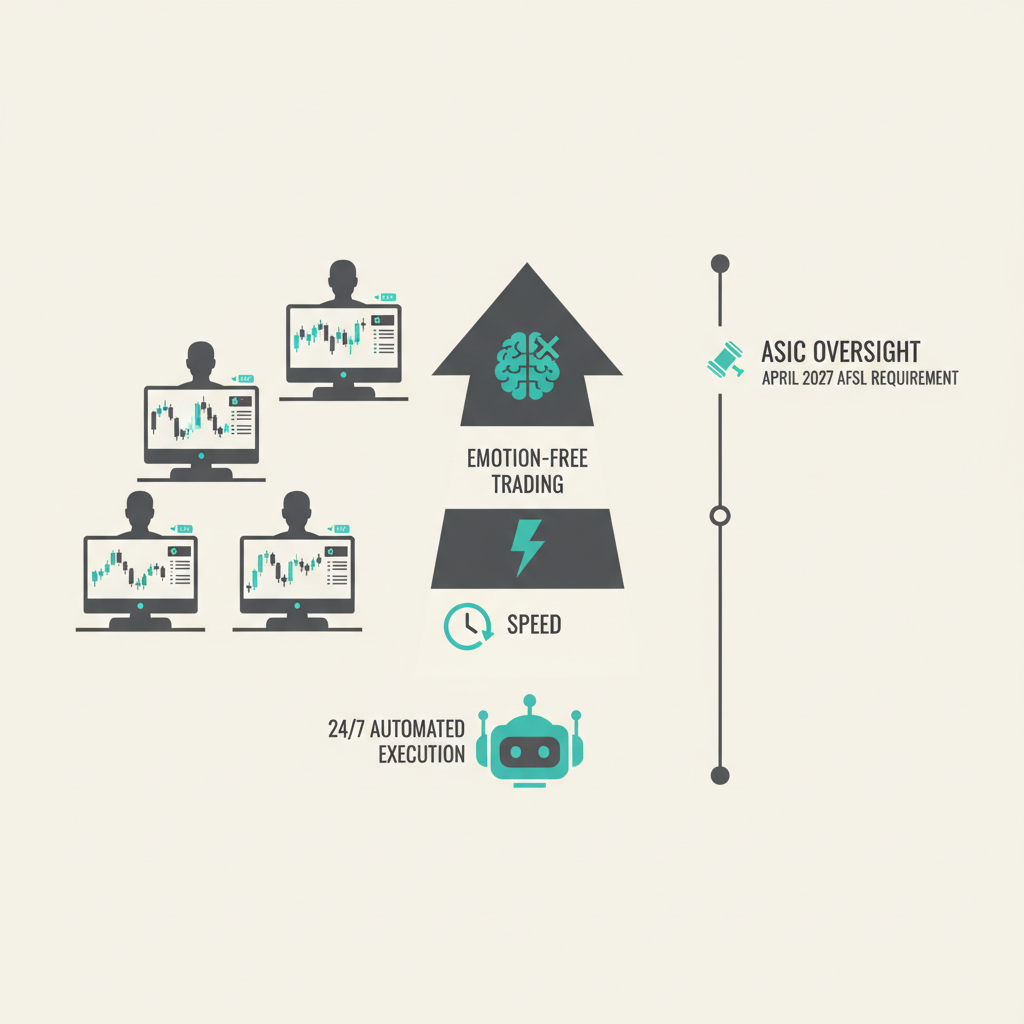
> TL;DR: Algorithmic crypto trading in Australia uses pre-defined strategies and automated bots to execute trades 24/7 without human intervention, offering speed, consistency, and emotion-free execution. ASIC and AUSTRAC regulate the space, with major reforms requiring digital asset platforms to hold an AFSL from April 2027. Top platforms include eToro, Kraken, OKX Australia, Eightcap, and IC Markets — but always verify AUSTRAC registration and understand your CGT obligations before you deploy a single bot.
What Is Algorithmic Crypto Trading in Australia?
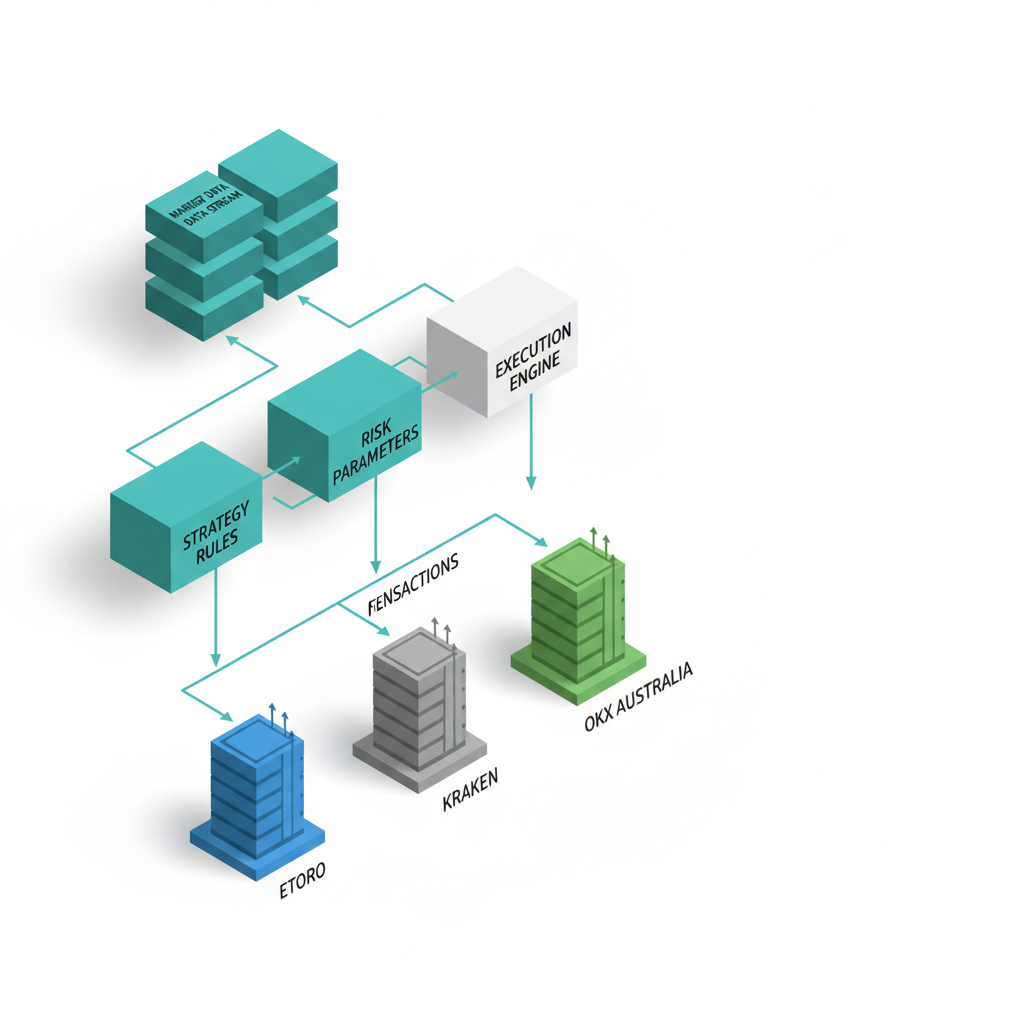
Algorithmic crypto trading in Australia refers to the use of computer programs that execute buy and sell orders automatically based on pre-set rules. The algorithm analyses real-time market data — price, volume, order book depth, technical indicators — and fires an order the instant those conditions are met. No hesitation, no second-guessing, no checking Twitter first.
In practical terms, that might be a grid bot placing limit orders above and below the current BTC price on Swyftx, or a trend-following EA running on MT4 through IC Markets, or a copy trading portfolio on eToro that mirrors a top-ranked trader’s positions automatically.
It is worth distinguishing between the main categories:
Algo trading uses coded strategies, often written in Python or via a platform’s native bot builder, to automate entry and exit logic. Trading bots are typically plug-and-play implementations of those strategies, packaged for non-developers. Copy trading replicates another human trader’s activity automatically, so the “algorithm” is essentially someone else’s decision-making. Manual trading is just you, a chart, and your feelings, which is what the other three are trying to improve on.
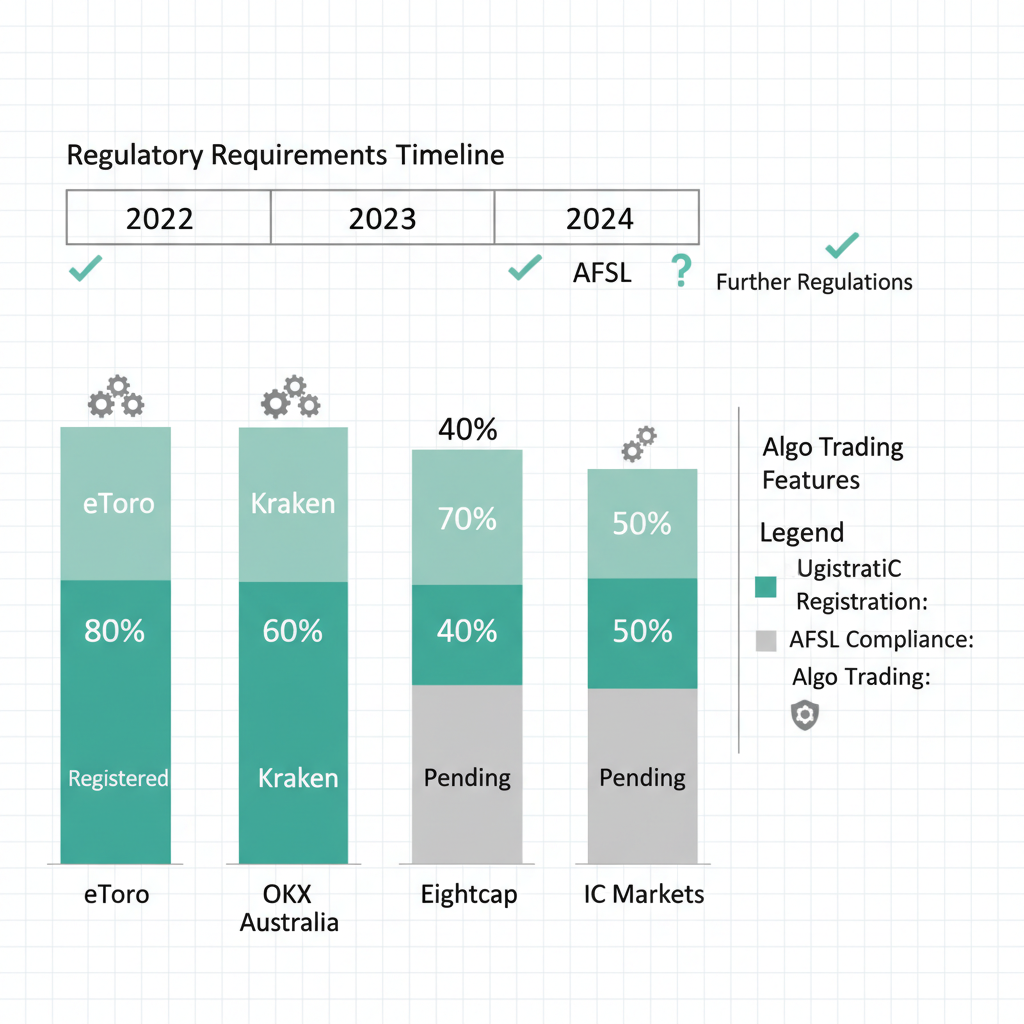
The regulatory picture matters here too. AUSTRAC requires any business exchanging digital currencies in Australia to be registered as a Virtual Asset Service Provider (VASP). ASIC covers the financial products side. New legislation, taking effect from April 2027, will require digital asset platforms to hold an Australian Financial Services Licence. More on all of that below.
[INTERNAL LINK PLACEHOLDER: “AUSTRAC registration” → AUSTRAC compliance guide]
Key Benefits of Algorithmic Crypto Trading for Australian Traders
The headline benefit is speed. An algorithm can react to a price movement in milliseconds. By the time you have unlocked your phone and opened an app, the trade has already been placed, filled, and logged. On volatile assets like ETH or SOL, that gap between intent and execution is where a lot of money gets lost.
The second benefit is consistency. Humans deviate from their own rules constantly, particularly under pressure. A bot does not panic-sell at 3am, and it does not chase a pump because someone on Reddit sounds confident. The strategy runs exactly as coded, every time.
For Australian traders specifically, the 24/7 nature of crypto markets is genuinely relevant. US and Asian market sessions overlap with times when most Australians are asleep. Algo trading lets you participate in those sessions without setting an alarm for 2am.
Beyond that, a well-built algorithm can process data from dozens of indicators simultaneously, something no human trader can replicate manually. Backtesting is another significant advantage: most serious platforms let you run your strategy against months or years of historical price data before you commit real capital. I have used backtesting on Kraken‘s advanced interface to stress-test a mean reversion strategy before going live, and it saved me from a fairly embarrassing loss.
The risks of over-relying on backtests are real (covered later), but the ability to validate a strategy in simulation is still far better than flying blind.
Common Algorithmic Trading Strategies Used in Crypto
Trend Following
This is the most straightforward strategy type and a good starting point. The algorithm identifies a sustained directional move, typically using moving averages or momentum indicators, and enters a position in that direction. It stays in the trade until the trend shows signs of reversing. Works well in strong bull markets. Gets chopped up badly in sideways conditions.
Arbitrage
Arbitrage exploits price differences for the same asset across different exchanges. In Australia, this is particularly interesting given we have multiple local platforms trading AUD pairs alongside global exchanges. If BTC/AUD on Swyftx is briefly priced differently from BTC/USD converted at the current rate on Kraken, an arbitrage bot could theoretically capture that spread. In practice, fees and execution speed compress the margins significantly, but statistical arbitrage across correlated assets remains viable.
Mean Reversion
Mean reversion assumes that prices tend to return to a historical average after extreme moves. The algorithm buys when the price drops sharply below the average and sells when it spikes above it. This strategy suits range-bound markets and tends to underperform during prolonged trends.
Momentum Trading
Momentum strategies enter positions as an asset’s price velocity increases, betting that strong moves continue in the short term. These are often triggered by volume spikes or breakouts above key price levels. Higher risk, higher potential reward, and more sensitive to sudden reversals.
Market Making
Market making involves placing both buy and sell limit orders around the current price and profiting from the bid-ask spread. It requires significant capital and low-latency infrastructure to do properly. On most retail platforms, grid bots are a simplified version of this concept and are far more accessible.
Grid and DCA Bots
For most Australian traders getting started, grid bots and Dollar Cost Averaging bots are the practical entry points into algorithmic trading. Grid bots place a series of buy and sell orders at set intervals above and below the current price, capturing small profits from price oscillation. DCA bots automate regular purchases to average your entry price over time. Both are available natively on platforms like OKX Australia and through third-party tools like Bitsgap.
High-Frequency Trading (HFT)
HFT executes enormous numbers of orders at very high speeds, typically holding positions for fractions of a second. This requires co-located servers, direct exchange API access, and substantial capital. It is not a beginner strategy and is largely the domain of institutional players, though some of the infrastructure available through IC Markets does cater to the lower end of high-frequency retail trading via MT4/MT5 Expert Advisors.
Top Algorithmic Crypto Trading Platforms Available in Australia
eToro
eToro is the go-to platform for copy trading. Its CopyTrader feature lets you automatically replicate the portfolio of any top-ranked trader on the platform, proportionally allocating capital to each of their trades. If they buy ETH, you buy ETH. If they close a position, yours closes too. It is not strictly algo trading in the coded-strategy sense, but it delivers the same core benefits: automated execution without manual input. eToro holds an AUSTRAC VASP registration and is accessible to Australian retail users. The asset range for crypto is solid, though fees via the spread model can add up at higher volumes.
Kraken
Kraken has been a reliable option for Australian traders who want a professional-grade interface without the complexity of a derivatives-first platform. Security track record is strong, the range of assets is wide, and the pro interface supports advanced order types that pair well with manual algo strategies. Kraken does not have its own native bot marketplace, but it offers robust API access for traders building custom strategies. AUSTRAC registered.
OKX Australia
OKX Australia is probably the most feature-complete platform for automated trading currently available in Australia. Native bots include grid trading, DCA, arbitrage bots, and iceberg orders, all configurable without writing code. Fees are among the lowest in the market. The platform also supports derivatives and margin trading for experienced users, though you need to qualify under Australian regulatory requirements. If you are serious about algo trading and want a single platform that covers most strategy types, OKX Australia is worth a close look.
Eightcap
Eightcap is an ASIC-regulated broker offering over 95 crypto CFDs. The key differentiator here is MT4 and MT5 support, which means you can deploy Expert Advisors directly. If you already have a working EA from forex trading or have access to a library of MT4 strategies, Eightcap lets you apply them to crypto. Note that these are CFDs, not spot crypto, which has different tax treatment and means you do not hold the underlying asset.
IC Markets
IC Markets is well established in the Australian retail trading space and supports Expert Advisors via MT4 and MT5. Ultra-low spreads on major crypto pairs and fast execution infrastructure make it a reasonable option for higher-frequency automated strategies. Again, crypto here is via CFDs. ASIC regulated.
Swyftx
I have been using Swyftx since 2022 and it remains my recommendation for Australian beginners wanting to get started with automated trading. The platform offers a demo mode with $10,000 in virtual funds, which is legitimately useful for testing strategies without financial exposure. Over 420 assets available, AUD deposits via PayID are free and fast, and the interface is clean without being dumbed down. Native bot functionality is more limited than OKX Australia, but for a first experience, it is a sensible starting point. AUSTRAC registered and Australian-owned.
Binance Australia
Binance Australia offers spot and margin trading for Australian users. Derivatives are no longer available to Australian retail clients following regulatory changes. The fee structure is competitive and the platform supports API access for custom strategies, but the regulatory history has been bumpy. Worth knowing about, worth using cautiously.
Dedicated Bot Platforms
For traders who want to run strategies across multiple exchanges from one interface, third-party bot platforms are worth considering. Bitsgap offers DCA bots, grid bots, and a demo trading mode across a wide range of connected exchanges. Altrady is strong for day traders with its quick scanner and signal bots. TradersPost connects to TradingView alerts and automates order execution, which is a neat bridge between manual charting and automated execution. CryptoHero suits beginners with its preset technical indicator bots and multi-exchange support.
Platform Comparison Table: Algorithmic Crypto Trading in Australia 2026
The table below covers eight platforms relevant to algorithmic crypto trading in Australia. Fees were current at time of writing but should be verified directly with each platform before depositing.
| Platform | ASIC/AUSTRAC Status | Automation Type | Trading Fees | Min. Deposit | Best For |
|---|---|---|---|---|---|
| eToro | AUSTRAC registered | Copy trading, manual | Spread-based (variable) | ~$50 AUD | Copy trading beginners |
| Kraken | AUSTRAC registered | API-based custom bots | 0.16% maker / 0.26% taker (standard) | No minimum | Professional API traders |
| OKX Australia | AUSTRAC registered | Native bots, API, grid, DCA | 0.08% maker / 0.10% taker (standard) | No minimum | Advanced algo traders |
| Eightcap | ASIC licensed | MT4/MT5 Expert Advisors | Spread-based, from ~1% on crypto CFDs | $100 AUD | EA/MT4 crypto automation |
| IC Markets | ASIC licensed | MT4/MT5 Expert Advisors | Spread-based, from ~0.1% on major pairs | $200 AUD | HFT-adjacent EA strategies |
| Swyftx | AUSTRAC registered | Demo mode, limited bots, API | 0.6% spot spread on BTC/AUD | $0 | Australian beginners |
| Altrady | No direct exchange (connects to others) | Signal bots, grid, QFL | From $19/month subscription | No minimum | Active day traders |
| Bitsgap | No direct exchange (connects to others) | DCA bots, grid bots, demo mode | From $23/month subscription | No minimum | Multi-exchange bot trading |
Verifying AUSTRAC registration: Go directly to the AUSTRAC VASP register at austrac.gov.au and search by company name or ABN before depositing funds. Do not rely solely on a platform’s own claims. Registrations are being cancelled for non-compliance throughout 2026.
[INTERNAL LINK PLACEHOLDER: “AUSTRAC VASP register” → how to check if a crypto exchange is legit in Australia]
How ASIC and AUSTRAC Regulate Algorithmic Crypto Trading in Australia
The AUSTRAC Framework
AUSTRAC requires every business providing digital currency exchange services in Australia to be registered as a VASP. That terminology changed on April 2, 2026, when expanded AML/CTF laws came into effect and renamed DCE providers to Virtual Asset Service Providers. The obligations are more comprehensive now: enhanced due diligence, stronger KYC requirements, and expanded transaction reporting.
Operating as a VASP without registration is a criminal offence. AUSTRAC has been actively pruning its register throughout 2026, cancelling the registrations of non-compliant entities including Self Custody Pty Ltd and Coinsec Australia Pty Ltd. When you check a platform’s AUSTRAC status, check the live register, not a screenshot from their website.
ASIC’s Expanding Role
ASIC’s jurisdiction covers crypto where it touches financial products or services. The Corporations Amendment (Digital Assets Framework) Act 2026 will require digital asset platforms to hold an Australian Financial Services Licence from April 2027. This is a significant structural shift. Platforms that currently operate under AUSTRAC registration alone will need to meet the full AFSL requirements or restructure.
Coinbase Australia Pty Ltd received its AFSL on May 4, 2026, becoming an early example of the new framework in practice. ASIC has also been active on enforcement, taking action against unlicensed crypto mining schemes and flagging scam websites.
For traders using algo or automated strategies, this matters because the platforms you connect your bots to need to be properly licensed. An algorithm running on a non-compliant exchange does not protect you from the consequences of that exchange’s regulatory failure.
[INTERNAL LINK PLACEHOLDER: “Australian Financial Services Licence” → ASIC crypto regulation guide]
Tax Obligations for Algorithmic Crypto Traders in Australia
The ATO does not treat crypto trading as a hobby unless the activity is genuinely small-scale and infrequent. For anyone running bots that execute dozens or hundreds of trades, the tax picture gets complicated quickly.
Capital Gains Tax vs Income Tax
CGT applies when you dispose of a crypto asset, including selling it for AUD, swapping it for another cryptocurrency, gifting it, or converting it to fiat. Each one of those events is a CGT event. If your grid bot has been cycling through BTC/USDT trades all month, each completed round-trip is potentially a taxable disposal.
Income tax applies to staking rewards, airdrops, and crypto received as payment. The ATO treats these as ordinary income at their AUD value on the date you receive them.
The Volume Problem for Algo Traders
High-volume automated trading creates a record-keeping challenge. A bot executing 200 trades per month generates 200 CGT events, each requiring the acquisition cost, disposal proceeds, and date to be recorded accurately. Manual record-keeping is not realistic at that volume.
Crypto tax software like Koinly, CoinTracking, or CryptoTaxCalculator can pull trade data via API and calculate your CGT position automatically. I would not attempt a tax return with significant algo trading activity without one of these tools. The ATO has been steadily improving its data-matching capabilities, and the new ASIC framework will increase the flow of exchange data to the ATO over time.
Whether you are classified as a hobby trader or operating a crypto business affects expense deductibility. A business classification allows you to deduct platform fees, software subscriptions, and potentially hardware costs. It also changes how losses are treated. A qualified Australian tax accountant who understands crypto is worth the cost, particularly if you are trading at scale.
[INTERNAL LINK PLACEHOLDER: “crypto tax Australia” → crypto tax