Crypto Algo Trading in Australia 2026: Complete Guide
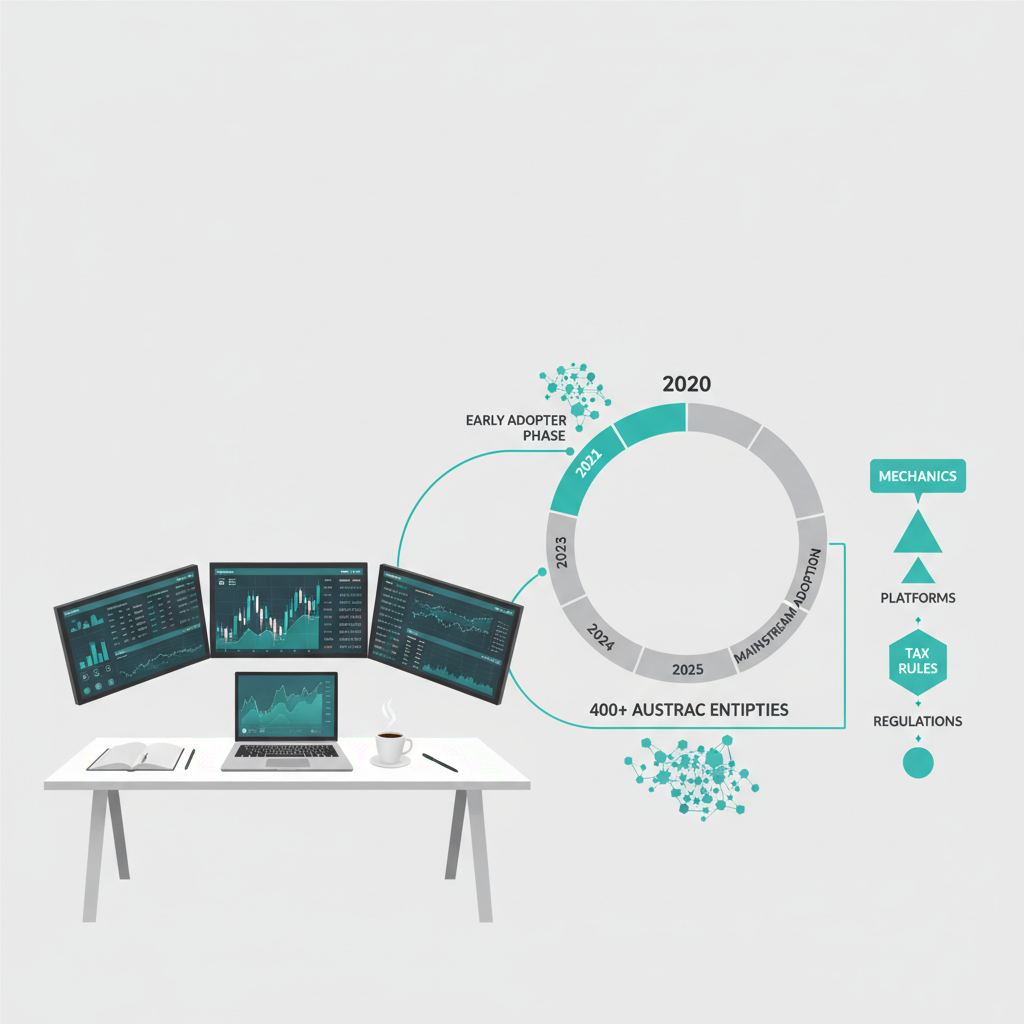
Crypto algo trading in Australia has moved well past the “early adopter” phase. With over 400 AUSTRAC-registered entities operating locally, a brand-new regulatory framework that came into force in April 2026, and a wave of AI-powered bot platforms now available to retail traders, the question is no longer whether algorithmic trading is accessible to Australians. It is whether you are set up to use it properly.
This guide covers the mechanics, the platforms, the tax rules, and the regulatory requirements you need to know before you commit real capital to an automated strategy.
> TL;DR
> Crypto algo trading in Australia uses automated, rule-based systems to trade cryptocurrencies 24/7 without emotional interference. This guide covers how it works, the best platforms available to Australians in 2026, tax obligations under the ATO, AUSTRAC and ASIC regulatory requirements, and which banks are most crypto-friendly. If you are already using a bot platform and have not reviewed your AFSL compliance exposure since April 2026, start with the regulatory section.
What Is Crypto Algo Trading in Australia?
Crypto algo trading in Australia refers to the use of automated, rule-based systems to execute cryptocurrency trades without manual input. You define the conditions, the algorithm watches the market, and trades fire when those conditions are met. No sitting at a screen at 2am, no panic-selling on a red candle.
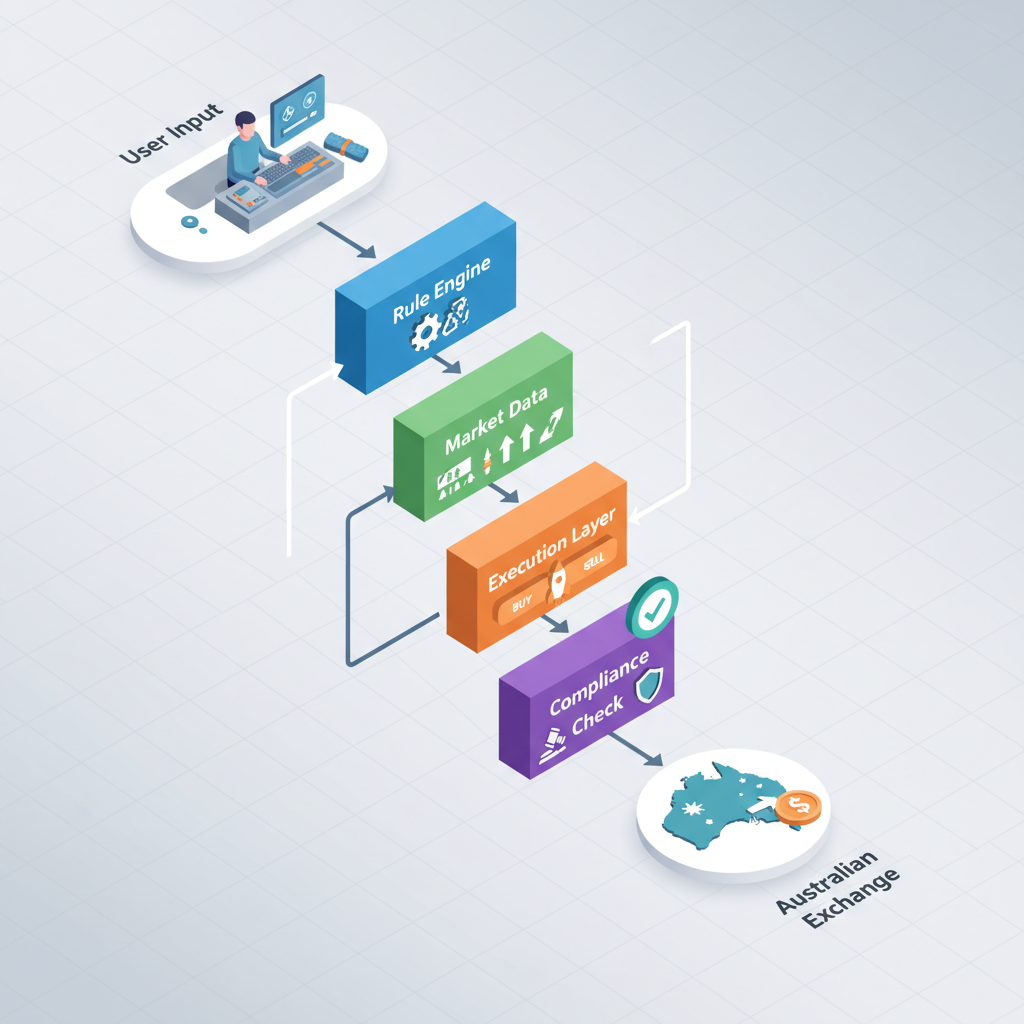
The core mechanics are straightforward. You write or select a set of rules: “buy BTC when the 20-day moving average crosses above the 50-day moving average, sell when it crosses back below.” The algorithm monitors live market data, checks those conditions continuously, and places orders through an exchange API the moment the trigger is met. Execution happens in milliseconds, far faster than any human can act.
The 24/7 nature of crypto markets makes algorithmic trading particularly well-suited to this asset class. Traditional equity markets close at 4pm. Bitcoin does not. An algo runs overnight, on weekends, and through public holidays without you doing a thing.
Australia’s crypto sector gives this real practical weight. As of 2026, over 400 entities hold AUSTRAC registration as Digital Currency Exchange Providers, meaning there is a deep and regulated ecosystem of exchanges for algo platforms to connect to. The market is mature enough to support serious automated strategies.
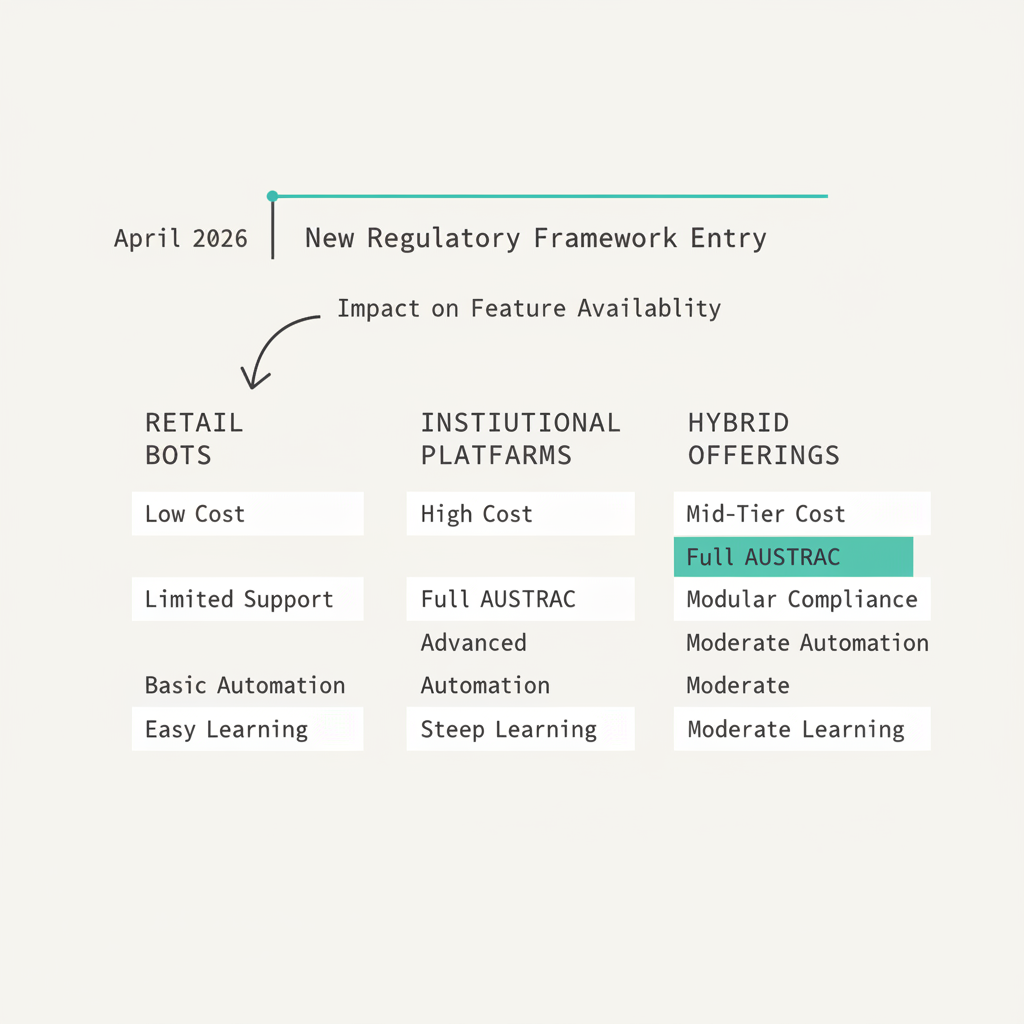
The regulatory environment tightened considerably on 1 April 2026, when Australia passed its first comprehensive crypto regulation framework. Under this framework, all exchanges and custody providers must obtain an Australian Financial Services Licence (AFSL) within six months. That has direct implications for which platforms you should trust with your capital, and I will come back to that in detail.
[INTERNAL LINK PLACEHOLDER: “AUSTRAC-registered exchanges” → AUSTRAC crypto exchange Australia pillar]
How Algorithmic Crypto Trading Works: Key Strategies
Understanding the different strategy types matters because they carry different risk profiles, different infrastructure requirements, and different suitability for retail versus institutional traders.
Trend-following is the most common entry point. The algorithm identifies directional momentum, buying when an asset is trending up and selling when it turns. It does not try to predict reversals; it rides what is already happening. Simple moving average crossovers are the textbook example, and they still work well enough on longer timeframes.
Arbitrage exploits price differences for the same asset across different exchanges. If BTC is trading at $98,500 on Exchange A and $98,650 on Exchange B, the bot buys on A and sells on B simultaneously, capturing the spread. In practice, these gaps close in milliseconds, so arbitrage is increasingly the domain of well-capitalised, low-latency operations rather than retail traders running a script on a laptop.
Mean reversion strategies assume that prices oscillate around an average and will revert to it after significant deviations. If ETH spikes 8% on no news, a mean-reversion bot might short it, expecting the price to pull back. These strategies work well in ranging markets and badly in strong trends, which is a key risk to understand.
Momentum trading is adjacent to trend-following but focuses on the rate of change rather than the direction itself. Assets showing unusually strong moves, relative to their recent history, are flagged as candidates.
Market making involves placing both buy and sell limit orders simultaneously to capture the bid-ask spread. It requires high liquidity and tight spreads to be profitable, and the execution infrastructure needed is significant.
High-frequency trading (HFT) sits at the extreme end: thousands of trades per second, co-located servers, microsecond execution. This is not a retail strategy. Mentioning it here because you will encounter the term, not because it is relevant to most Australians reading this.
For retail Australian traders, the practical entry points are DCA bots (which dollar-cost average into a position at set intervals) and grid bots (which place a ladder of buy and sell orders across a price range, profiting from volatility). Both are accessible through platforms like Pionex and SaintQuant without requiring any coding knowledge.
Benefits and Risks of Automated Crypto Trading
The benefits get listed in every article on this topic, so I will keep it honest and brief. Speed of execution is genuine: an algorithm reacts to a trigger faster than you can move a mouse. Emotion-free decisions are real: there is no equivalent of holding a losing position because you “believe in the project.” And 24/7 participation matters in crypto specifically, because significant price moves routinely happen at 3am Sydney time.
The risks are where most of these articles go soft, and they should not.
Over-optimisation (also called curve-fitting) is probably the most common way retail traders get burned by algos. You backtest a strategy, tweak the parameters until it looks incredible on historical data, then run it live and watch it collapse. The strategy was fitted to past noise, not to a genuine market pattern. Always test across multiple timeframes and market regimes, not just the period where your strategy happens to look good.
Market regime changes break strategies. A trend-following bot set up during a bull market will underperform badly in a sideways or bear market. Strategies need to be monitored and periodically recalibrated, not just set and forgotten.
Platform risk is real and, after December 2025, impossible to dismiss. In December 2025, a Federal Court ordered the liquidation of NGS Crypto and associated companies for operating without a licence. Hundreds of Australians lost money, with only $4.6 million recovered from $40.2 million invested. The lesson is not subtle: unregulated platforms carry existential risk. Check AUSTRAC registration and AFSL status before you connect your funds to any platform.
API key exposure is a technical risk specific to bot trading. Your bot accesses your exchange account through an API key. If that key is stolen (through a compromised third-party platform, phishing, or a data breach), someone else controls your positions. Use IP whitelisting, disable withdrawal permissions on API keys used for trading bots, and rotate keys regularly.
Backtesting and paper trading before committing real capital are not optional steps. Most reputable platforms offer both. Use them.
Top Crypto Algo Trading Platforms Available in Australia
The platforms worth considering in 2026 split roughly into three categories: Australian-registered bot platforms, international bot platforms accessible to Australians, and regulated Australian brokers with automation support.
Australian-Registered Platforms
SaintQuant is the most notable local option right now. Operated by SAIN PTY LTD, it is an AI-powered platform that combines machine learning with quantitative models to automate DCA, Grid, and Swing strategies. Plans start at $99, and as of May 2026 they are offering a 10-day free trial. Being Australian-registered matters under the post-April 2026 framework. I would verify their AFSL status before committing capital, as the six-month transition period is still running.
International Bot Platforms
Pionex is probably the most beginner-accessible option available to Australians. It has 16+ pre-built bots that run natively on its own servers, so you do not need to connect it to a separate exchange account. The grid bot and DCA bot are straightforward to set up without any coding. Fees are low at 0.05% per trade. The limitation is that you are trading on Pionex’s own exchange, which has lower liquidity than Binance or Coinbase for less common pairs.
Bitsgap connects to 17+ exchanges and offers AI bots alongside a portfolio tracker and manual trading terminal. It is more feature-rich than Pionex but has a steeper learning curve and a monthly subscription fee that starts around USD $29.
Coinrule lets you build “if-this-then-that” style rules without writing code. It supports historical backtesting and connects to major exchanges including Binance and Coinbase. Good option for traders who want more strategic control than a pre-built bot offers but are not ready to write Python.
Tradetron sits at the more advanced end. It supports customisable strategies and integrates with crypto exchange APIs including Delta Exchange. Worth looking at if you have a specific strategy you want to automate and need more flexibility than the consumer-grade platforms offer.
Altrady is a multi-exchange platform with quantitative models and automated features. It includes a smart portfolio tracker alongside the bot functionality, which is useful if you are running positions across multiple exchanges.
Regulated Australian Brokers
Eightcap is an ASIC-regulated Australian broker offering 95+ crypto CFDs. It supports automation through MT4 and MT5 expert advisors and has a proprietary CryptoCrusher tool. Trading crypto CFDs here means you are not holding the underlying asset, which has different CGT implications (gains are taxed as income for CFD products). Worth understanding before you start.
IC Markets is another ASIC-regulated broker with MT4 and MT5 support, ultra-low spreads, and fast execution. The infrastructure is good enough for more sophisticated automated strategies. Same CFD caveat applies.
Interactive Brokers Australia is the most technically capable option on this list for experienced traders. It supports algorithmic strategy development in Java, C++, and Python through its API, with serious backtesting capability. The onboarding is more involved and the interface is not consumer-friendly, but for quantitative traders who want institutional-grade infrastructure, it is the right tool.
One important note: some platforms on this list exclude US investors by design. As an Australian user you should confirm your eligibility directly, and always verify AUSTRAC registration and AFSL status given the transition period under the 2026 framework.
Platform Comparison Table: Crypto Algo Trading in Australia 2026
| Platform | Regulation/Registration | Bot Types | Supported Exchanges | Starting Cost | Best For |
|---|---|---|---|---|---|
| SaintQuant | Australian-registered (SAIN PTY LTD); AFSL status: verify | DCA, Grid, Swing (AI/ML) | Proprietary + API | $99/mo (10-day trial) | Australian retail traders wanting local AI bots |
| Pionex | Not AUSTRAC-registered; offshore | Grid, DCA, Rebalancing (16+ pre-built) | Pionex exchange (native) | Free (0.05% per trade) | Beginners, low-cost entry |
| Bitsgap | Not AUSTRAC-registered; offshore | AI bots, Grid, DCA | 17+ exchanges | ~USD $29/mo | Multi-exchange management |
| Coinrule | Not AUSTRAC-registered; offshore | Rule-based (if/then), no coding | Binance, Coinbase, others | Free tier available | No-code strategy builders |
| Tradetron | Not AUSTRAC-registered; offshore | Advanced custom + prebuilt | Delta Exchange, others via API | Varies by strategy | Advanced custom strategies |
| Eightcap | ASIC-regulated; AUSTRAC-registered | MT4/MT5 EAs, CryptoCrusher | Proprietary (CFD broker) | No minimum stated | Regulated CFD traders, MT5 users |
| IC Markets | ASIC-regulated; AUSTRAC-registered | MT4/MT5 Expert Advisors | Proprietary (CFD broker) | No minimum stated | Experienced algo traders, low spreads |
| Interactive Brokers AU | ASIC-regulated | Java, C++, Python API | Proprietary (broker) | No minimum stated | Quantitative/professional traders |
| Altrady | Not AUSTRAC-registered; offshore | Quantitative, automated, multi-exchange | 10+ exchanges | ~USD $29/mo | Multi-exchange portfolio management |
AFSL licensing status for non-broker platforms should be verified directly given the six-month transition period following Australia’s April 2026 framework.
Australian Regulatory Requirements: AUSTRAC, ASIC, and the 2026 Framework
Any platform facilitating crypto services in Australia must register with AUSTRAC as a Digital Currency Exchange Provider. This is an anti-money laundering and counter-terrorism financing obligation, not an investment quality stamp, but registration at least confirms the platform has identified itself to the regulator and agreed to AML/CTF reporting obligations. As of 2026, over 400 entities hold this registration.
You can verify AUSTRAC registration through the public register on AUSTRAC’s website. If a platform claims to be AUSTRAC-registered and does not appear on that register, walk away.
The bigger change is the April 2026 framework. On 1 April 2026, Australia passed its first comprehensive crypto regulation, requiring all exchanges and custody providers to obtain an AFSL within six months. ASIC administers the AFSL regime, and it has already shown it will act against unlicensed operators. The NGS Crypto liquidation in December 2025 is the clearest example: hundreds of Australians lost access to $40.2 million, with only $4.6 million recovered. The Federal Court ordered liquidation specifically because NGS was operating without a licence.
The six-month AFSL transition period runs through to roughly October 2026. During this window, some legitimate platforms may be operating legally while their applications are processed. That is not the same as a platform that has not applied at all, or one that has no intention of complying. Ask the platform directly about their AFSL application status and do not accept vague answers.
For algo trading specifically, the AFSL requirement covers platforms that provide financial services including operating a financial market or providing financial product advice. If a bot platform is recommending strategies and executing trades on your behalf, it is arguably in scope. Platforms that provide infrastructure only (connecting your own API keys and running your own rules) sit in a different part of the regime, but the lines are not perfectly drawn yet.
ASIC has also been active in scrutinising crypto products more broadly, and has launched civil proceedings against unlicensed operators. The combination of AUSTRAC and ASIC oversight means the Australian regulatory environment for crypto is among the more developed in the Asia-Pacific region.
[INTERNAL LINK PLACEHOLDER: “AUSTRAC registration” → AUSTRAC crypto exchange Australia pillar]
Crypto Algo Trading Tax Rules in Australia
The ATO does not have a special tax category for automated trading. Every trade your bot executes is subject to the same rules as a manual trade, and when you are running an algo that fires dozens of transactions per day, that adds up fast.
The foundational rule: disposing of cryptocurrency is a CGT event. Disposing means selling for AUD, swapping one crypto for another, spending crypto on goods or services, or gifting it. Each of these triggers a capital gain or loss calculation based on the cost base (what you paid, including fees) versus the proceeds (what you received at market value on that date).
The 50% CGT discount is available if you hold an asset for more than 12 months before disposing of it. With algo trading, most strategies turn positions over in days, hours, or minutes. The 12-month discount will rarely apply to individual bot trades. This is worth factoring into your expected return calculations.
Individual tax rates apply to net capital gains, stacked on top of your other income. The effective rate ranges from 0% (if your taxable income including the gain stays below the tax-free threshold) up to 45% for high earners, plus the 2% Medicare levy.
Income from staking, mining, airdrops, and activity that rises to the level of carrying on a business of trading is taxed as ordinary income, not CGT. If the ATO