CryptoAlgo Review Australia 2026: Is This Algo Trading Platform Worth It?
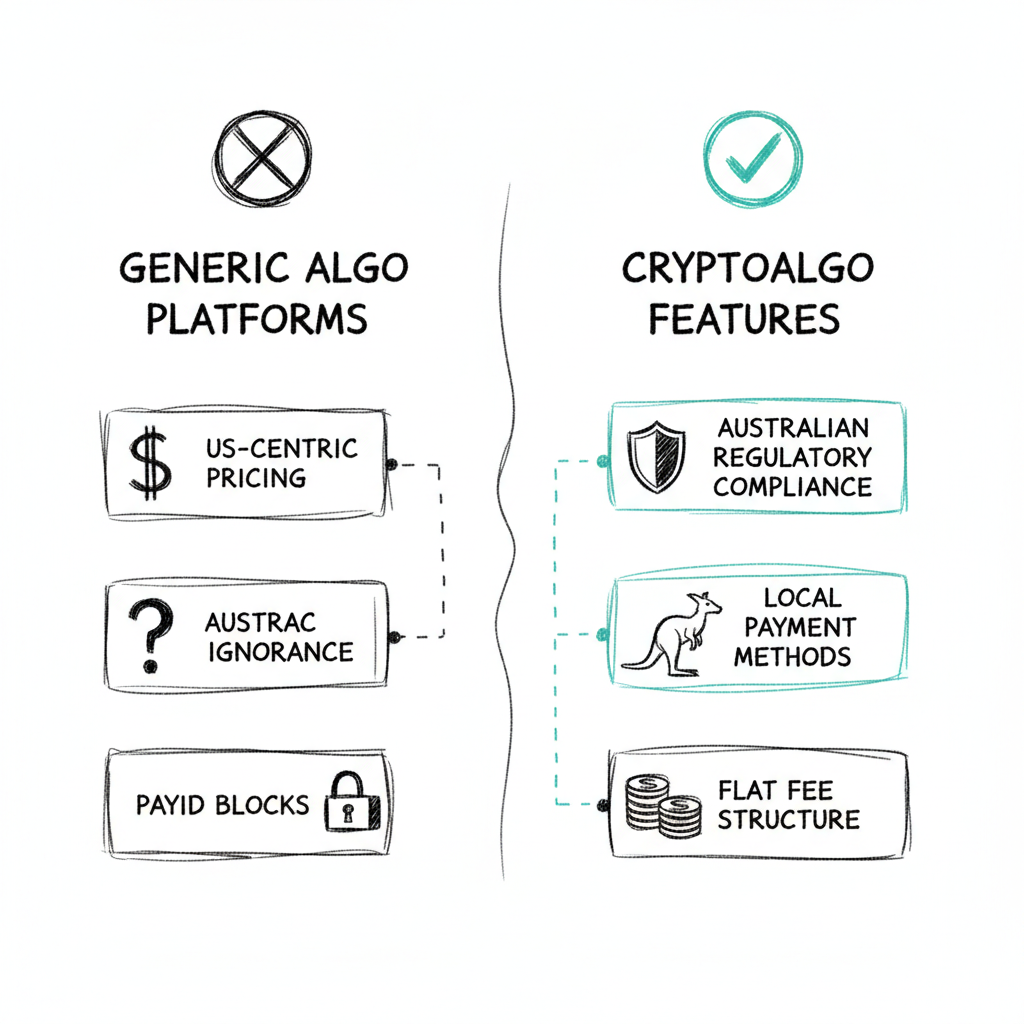
If you have been looking for an automated crypto trading platform that actually caters to Australian conditions, you have probably already noticed how thin the field is. Most algo trading tools are built for US markets, priced in USD, and largely indifferent to whether you are dealing with AUSTRAC obligations or a Commonwealth Bank block on your PayID transfer. CryptoAlgo positions itself differently, and one of its more notable features is a flat-out exclusion of US investors. That alone makes this a cryptoalgo review australia worth reading carefully.
> TL;DR
> CryptoAlgo is an algorithmic crypto trading platform explicitly available to Australian users, with US investors excluded by the platform’s own terms. This cryptoalgo review australia examines how it stacks up against Australia’s new Digital Assets Framework (law as of April 14, 2026), AUSTRAC registration requirements that became mandatory from April 2, 2026, and real competitors like Cryptohopper, Altrady, and OKX bots. If you want a quick verdict: it suits experienced traders who already understand automated strategy construction, but there are meaningful compliance questions you need to verify before committing funds.
CryptoAlgo Review Australia: Our Quick Verdict (2026)
Overall rating: 3.5 / 5
CryptoAlgo is a functional algo trading platform with a clear target audience: traders who already know how to build or configure automated strategies and want a tool that works across multiple exchanges without the overhead of running their own infrastructure. It is not a hand-holding platform, and it is not trying to be.
Best for: Experienced traders who want to automate rule-based or quantitative strategies without managing bots from scratch. If you understand concepts like DCA, grid trading, and signal-based entry triggers, you will find something useful here.
Not suitable for: Complete beginners who have never actively traded crypto. This is not a “set and forget” wealth-building product. You need to understand what the bots are doing or you will lose money in sideways markets as readily as falling ones. And if you are a US-based investor, stop here — CryptoAlgo explicitly excludes US participants by platform policy.
The more pressing question for Australian readers in 2026 is regulatory standing. The Corporations Amendment (Digital Assets Framework) Bill passed both houses of Parliament on April 14, 2026, making an Australian Financial Services Licence mandatory for trading and custody platforms. AUSTRAC registration became compulsory for all virtual asset service providers from April 2, 2026. Whether CryptoAlgo satisfies both requirements is something you need to confirm directly via the AUSTRAC public VASP register before depositing anything. I will walk through exactly how to do that below.
What Is CryptoAlgo and How Does It Work?
CryptoAlgo is an algorithmic and automated crypto trading platform. At its core, it provides tools that let traders define rule-based strategies — conditions under which the system will buy, sell, or rebalance — and then execute those strategies automatically across connected exchanges via API.
In plain terms: instead of watching charts and placing orders manually, you set the rules once, connect your exchange account, and the platform executes trades when your conditions are met. This can be as simple as “buy BTC when the RSI drops below 30 on the 4-hour chart” or as complex as a multi-asset quantitative model with dynamic position sizing. The sophistication depends entirely on what the platform’s tools allow and how much you know about strategy design.
CryptoAlgo connects to major exchanges rather than holding your funds directly. Your crypto stays on whatever exchange you use — Binance, OKX, Kraken, or others — and CryptoAlgo accesses it via API keys. This is a standard architecture for third-party bot platforms.
On the question of AUD pairs: because CryptoAlgo operates through your existing exchange account, whether AUD pairs are available depends on which exchange you connect. Swyftx and CoinSpot both offer AUD-denominated pairs; Binance and OKX primarily trade in USDT. For Australian tax purposes, this matters — trading BTC/USDT rather than BTC/AUD does not exempt you from CGT obligations, and the ATO is clear that any crypto-to-crypto trade is a taxable event.
US investors are explicitly excluded. This is not a grey area or a terms-of-service footnote — the platform states it directly. For an algo trading tool with global ambitions, that is an unusual restriction. For Australian traders, it arguably signals that the platform is at least aware of jurisdictional compliance requirements, even if it does not resolve every local regulatory question.
Compared to rivals: Cryptohopper has a larger user base and more polished onboarding; Altrady leans harder into multi-exchange portfolio management; OKX bots are native to the OKX ecosystem and cost nothing extra if you already trade there.
Is CryptoAlgo Regulated and Compliant in Australia?
This is the section that matters most in 2026, and I will be direct: you need to do your own verification, because compliance status can change and I cannot guarantee what CryptoAlgo’s position is at the moment you read this.
AUSTRAC registration
From April 2, 2026, Australia’s AML/CTF laws were expanded to explicitly cover virtual asset service providers. Every VASP operating in Australia, whether Australian-founded or foreign, must now be registered with AUSTRAC and meet ongoing AML/CTF obligations. AUSTRAC has published a searchable public register. Before you fund any account, go to the AUSTRAC website and search for the platform by name. If it is not on that register, it is operating outside Australian law. AUSTRAC has already demonstrated willingness to act, taking enforcement action against crypto ATM providers for AML/CTF breaches. The message is clear that non-compliance is not a theoretical risk.
AFSL requirement
The Corporations Amendment (Digital Assets Framework) Bill, which passed on April 14, 2026, now requires that crypto trading and custody platforms hold an Australian Financial Services Licence. This is a significant shift. An AFSL requires the platform to meet conduct obligations, maintain adequate compensation arrangements, and give users meaningful recourse if something goes wrong. Platforms without an AFSL are operating in breach of the Corporations Act. Ask CryptoAlgo directly whether they hold an AFSL or are operating under a transitional exemption, and get that answer in writing.
ASIC’s concerns
ASIC flagged algorithmic and AI-driven crypto tools specifically as an area of concern for 2026, noting that the pace of product innovation is outrunning the regulatory framework. Unlicensed financial advice embedded in algorithmic recommendations is one of the identified risks. If a platform’s bot tells you to buy or sell based on its own models, that starts to look like financial advice under the Corporations Act — and providing that without an AFSL or appropriate authorisation is a problem.
What this means practically
If CryptoAlgo is AUSTRAC-registered and AFSL-licensed, you have meaningful protections: AML oversight, dispute resolution obligations, and some degree of fund accountability. If it is not, you are taking on regulatory risk in addition to market risk. That is your call to make, but make it with open eyes.
CryptoAlgo Fees, Spreads, and Subscription Costs
I want to be transparent here: specific verified fee data for CryptoAlgo’s own subscription tiers is not publicly confirmed at the time of writing. What follows gives you the framework for assessing costs, and where I am working from unverified data I will say so.
Trading fees
Because CryptoAlgo operates through your exchange’s API, the trading fees you pay are your exchange’s fees, not CryptoAlgo’s. On Australian platforms, maker fees typically run 0.1% to 0.25% and taker fees 0.1% to 0.6%. On Binance, maker/taker starts at 0.1%/0.1% for regular users. On OKX, the base rate is similar. These costs compound quickly with high-frequency strategies — a bot making 10 trades a day at 0.2% taker fees is costing you 2% of deployed capital daily in fees alone before you account for spreads.
Spreads
BTC spreads on major exchanges typically sit between 0.1% and 0.8%, widening materially during volatility spikes. Some platforms embed costs in spreads rather than explicit fees. With algo trading, where small edges matter, unfavourable spread conditions can turn a theoretically profitable strategy into a losing one.
Subscription costs
[UNVERIFIED] CryptoAlgo likely charges a subscription for platform access, as is standard for third-party algo tools. Cryptohopper, for comparison, offers a free tier with limited functionality and paid plans ranging from roughly $19 to $107 USD per month. Until CryptoAlgo publishes clear pricing, treat any specific figure you see as unconfirmed and verify directly with the platform.
AUD deposits and withdrawals
If you fund via an exchange like Swyftx or Kraken AU, PayID deposits are typically free. Card deposits attract around 1.22% on most Australian platforms. PayPal deposits where available run about 0.5%. AUD withdrawals range from free to $25 per transaction. Crypto withdrawal fees are network-dependent and fluctuate.
CryptoAlgo Features: Bots, Strategies, and Automation Tools
Bot types and strategy support
The core offering covers grid bots, DCA (dollar-cost averaging) bots, and signal-based bots. Grid bots place buy and sell orders at defined intervals around a price range, profiting from volatility within a band. DCA bots reduce average entry cost by buying in increments on price dips. Signal-based bots trigger trades based on technical indicators or external signals from third-party providers.
Whether CryptoAlgo supports custom algorithmic logic (the kind a Python-literate trader would write themselves) is worth confirming. Some platforms in this space offer visual strategy builders that do not require coding; others support Python or JavaScript integrations for developers. The platform’s value proposition shifts considerably depending on which category it falls into.
Backtesting
Any serious algo trading platform needs backtesting. Running your strategy against historical data before deploying real capital is non-negotiable. Confirm whether CryptoAlgo’s backtesting environment uses genuine tick data or aggregated OHLCV candles — the difference matters for strategies that depend on intraday price action.
AI and quantitative model integration
The April 2026 launch of SaintQuant out of Cairns is worth noting as market context: Australian-built AI trading platforms are emerging, and the competitive bar for quantitative model integration is rising. If CryptoAlgo uses AI-assisted signal generation, understand whether those signals constitute financial advice under Australian law (see the regulation section above).
Multi-exchange support and interface
For non-coders, the quality of the interface determines whether the platform is actually usable. Altrady has a Quick Scanner and QFL Bot that experienced traders find genuinely useful; Cryptohopper has a marketplace where you can copy other traders’ strategies. If CryptoAlgo’s interface requires deep technical knowledge to configure without providing equivalent results, the value case narrows to developers.
Paper trading or demo mode is important for testing strategies risk-free. Confirm availability before subscribing. Mobile app access and API documentation quality are secondary considerations but relevant if you travel or want to monitor positions remotely.
CryptoAlgo vs Competitors: How Does It Compare?
The honest summary is that CryptoAlgo occupies a mid-field position in a crowded space. It is not the most feature-rich option, it is not the cheapest, and it is not the easiest to use. What it offers is a focused tool for Australian traders who want algo functionality without being forced into a US-centric ecosystem.
The US investor exclusion is genuinely unusual. Most platforms in this space accept US users or at least do not explicitly ban them. For Australian traders, that restriction is a minor positive signal about jurisdictional awareness, though it does not substitute for verified AUSTRAC and AFSL status.
eToro is worth considering as an alternative approach: its copy trading model lets you mirror experienced traders automatically without building any strategy yourself. That is meaningfully different from algo trading, but for some readers it solves the same problem more simply.
For developers who want true algorithmic trading — custom code, direct market access, low fees — Alpaca Trading is worth a look. It is more of a brokerage API than a bot platform, but if you can code your own strategy, the flexibility is considerable.
| Platform | Bot Types | AUD Support | AUSTRAC/AFSL Status | Fees (approx) | Best For |
|---|---|---|---|---|---|
| CryptoAlgo | Grid, DCA, Signal | Via exchange | Verify on AUSTRAC register | Subscription + exchange fees | Experienced AU traders |
| Cryptohopper | DCA, Trailing, Copy, Signal | Via exchange | Not AU-registered VASP | Free–~$107 USD/mo | Beginners to intermediate |
| Altrady | Signal, QFL, Grid | Via exchange | Not AU-registered VASP | From ~$22 USD/mo | Multi-exchange power users |
| OKX Bots | Spot Grid, DCA Martingale | USDT primarily | OKX registered where applicable | No extra fee (exchange fees apply) | OKX users, low extra cost |
| Binance Bots | Grid, DCA, Rebalancing | Via Binance AU | Binance AU operates under AU rules | No extra fee (exchange fees apply) | Binance users |
| SaintQuant | AI/Quant models | AUD (AU-based) | AU-founded, April 2026 launch | Not yet publicly confirmed | Quant-focused AU traders |
[INTERNAL LINK PLACEHOLDER: “best algo trading crypto australia” → best-crypto-trading-bots-australia]
Australian Banking and Funding: Depositing and Withdrawing AUD
The friction between Australian banks and crypto platforms is real, and if you have not hit it yet, you will. CBA, ANZ, Westpac, and NAB are all running some combination of transfer holds (up to 24 hours), monthly caps (commonly $10,000), and outright rejections on transfers to crypto exchanges. They cite AML rules and rising scam activity, which is not entirely disingenuous — crypto-related scam losses in Australia are significant. Coinbase has formally accused the Big Four of systematically debanking legitimate crypto businesses, which adds a political dimension, but the practical reality for you as a trader is the same regardless of who is right.
What actually works for deposits
PayID is your best starting point. It is fast, usually free, and most compliant Australian exchanges support it. Bank transfers (direct debit or EFT) work but can take one to two business days and may trigger a review flag if the amount is large or the recipient is flagged. Card deposits (credit or debit) work but cost you around 1.22% upfront, which is expensive for anything meaningful.
If your bank blocks a transfer, the most reliable workaround is calling the bank directly and confirming the transaction. Some banks have dedicated crypto inquiry lines now. Avoid multiple failed attempts in quick succession — it tends to escalate the restriction.
AUD pricing and withdrawal
Whether CryptoAlgo quotes in AUD depends on the exchange you connect it to. Swyftx and CoinSpot are the most AUD-native options for Australian traders. Withdrawing AUD back to your bank account typically takes one to two business days via EFT and is free on most Australian exchanges above a minimum threshold. Instant PayID withdrawals may incur a small fee on some platforms.
For CGT purposes, the ATO requires you to record the AUD value at the time of each trade. If you are running a bot that executes dozens of trades per day, make sure your tax reporting tool (Koinly and CoinTracking both work in Australia) is connected and capturing every transaction. That is not optional, and “the bot did it” is not a defence the ATO will accept.
[INTERNAL LINK PLACEHOLDER: “crypto tax australia” → crypto-tax-australia-guide]
Frequently Asked Questions
Is CryptoAlgo available to Australian traders?
Yes. CryptoAlgo explicitly accepts Australian users. It is one of the few algo trading platforms that addresses jurisdictional access directly, specifically excluding US investors rather than the other way around.
Can US investors use CryptoAlgo?
No. CryptoAlgo explicitly states that US investors cannot access or participate in the platform. This is a hard restriction, not a soft disclaimer.
Is CryptoAlgo registered with AUSTRAC?