
Crypto Algo Trading Australia: How the 2026 Regulations Are Reshaping Automated Strategies
Crypto algo trading in Australia changed permanently on July 1, 2026. Not gradually, not in ways you can ignore until next EOFY. The AUSTRAC Travel Rule went live, ASIC’s no-action position had already expired the day before, and traders running automated strategies across multiple wallets suddenly found themselves operating in a very different compliance environment. If your bot was happily sweeping profits to a Ledger every night, you probably noticed.
> TL;DR
> Australia’s regulatory framework for crypto algo trading underwent its most significant overhaul in years across a six-week window in mid-2026. The AUSTRAC Travel Rule launched on July 1, ASIC’s no-action position expired on June 30, and the Digital Assets Framework Act received Royal Assent in April. For anyone doing crypto algo trading in Australia, these changes affect which exchanges you can safely automate on, how your bot trades are taxed, and what friction you will hit when withdrawing to a self-hosted wallet. This guide covers every major change and what it actually means for your strategy.
Why 2026 Was a Turning Point for Australian Crypto Traders
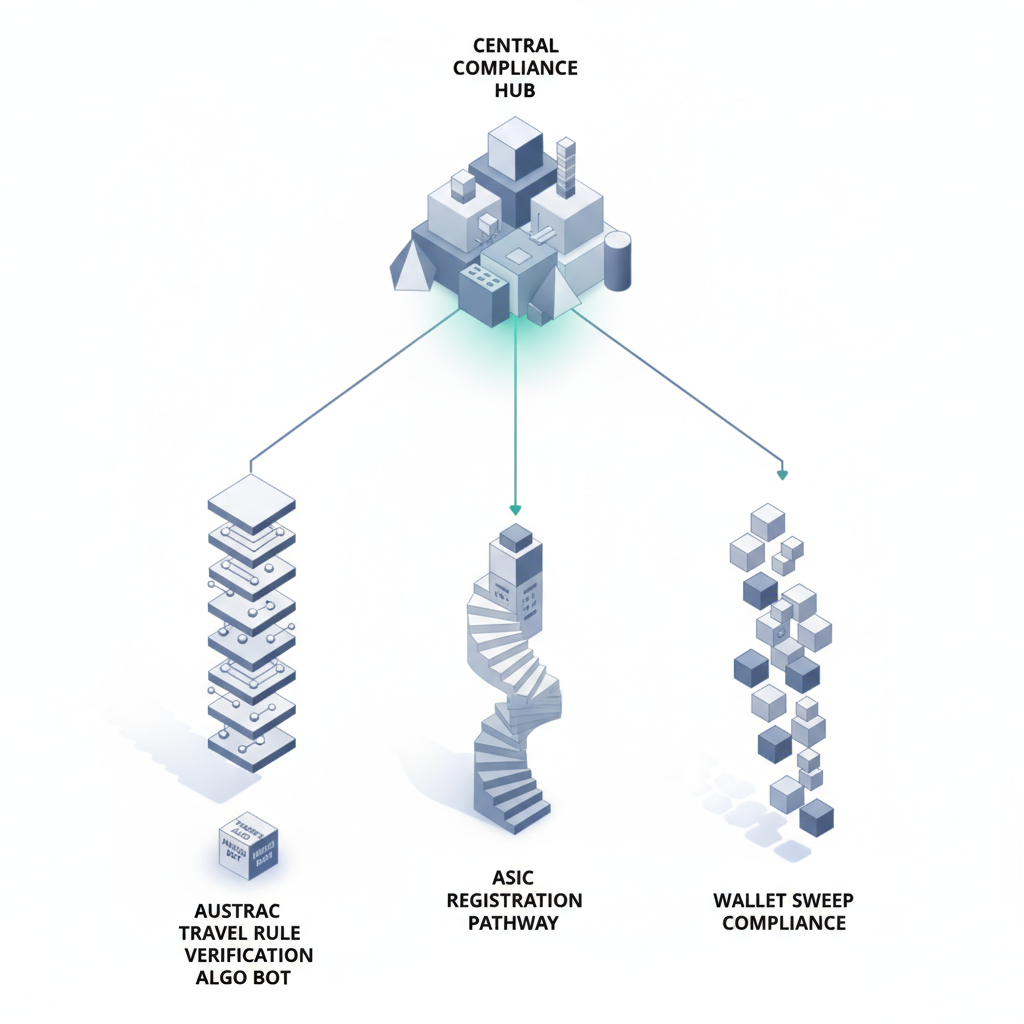
Three things happened in quick succession, and the combination matters more than any one of them individually.
On April 8, 2026, the Corporations Amendment (Digital Assets Framework) Act 2026 received Royal Assent. On June 30, ASIC’s sector-wide no-action position for unlicensed digital asset services expired. On July 1, the AUSTRAC Travel Rule came into effect. That is three structural changes to the Australian crypto regulatory environment inside 84 days.
Previous years had produced consultation papers, ASIC information sheets, and ATO guidance updates. 2026 produced actual law with actual commencement dates and actual enforcement exposure. That is the difference.
Algo traders are disproportionately affected for a simple reason: volume. A grid bot running on BTC/AUD might execute dozens of trades per day. An arbitrage bot sweeping price differences across two exchanges generates constant inter-platform transfers. Each trade is a CGT event. Each transfer now potentially triggers Travel Rule obligations on the exchange side. High-frequency, high-volume activity is precisely what these regulations were designed to see more of, not less.
At CryptoAlgo.com.au, we track AUSTRAC-registered exchanges specifically because compliance status has become a core factor in exchange selection for algo traders, not just a background consideration. If your exchange of choice has not lodged an AFSL application or sits in a grey zone on the VASP register, running large automated positions there carries regulatory risk that it did not carry 12 months ago.
One thing to be clear on: this article is general information, not financial or legal advice. See our full disclaimer.
AUSTRAC’s Expanded VASP Obligations: What Changed on March 31 and July 1
The VASP Designation Expansion
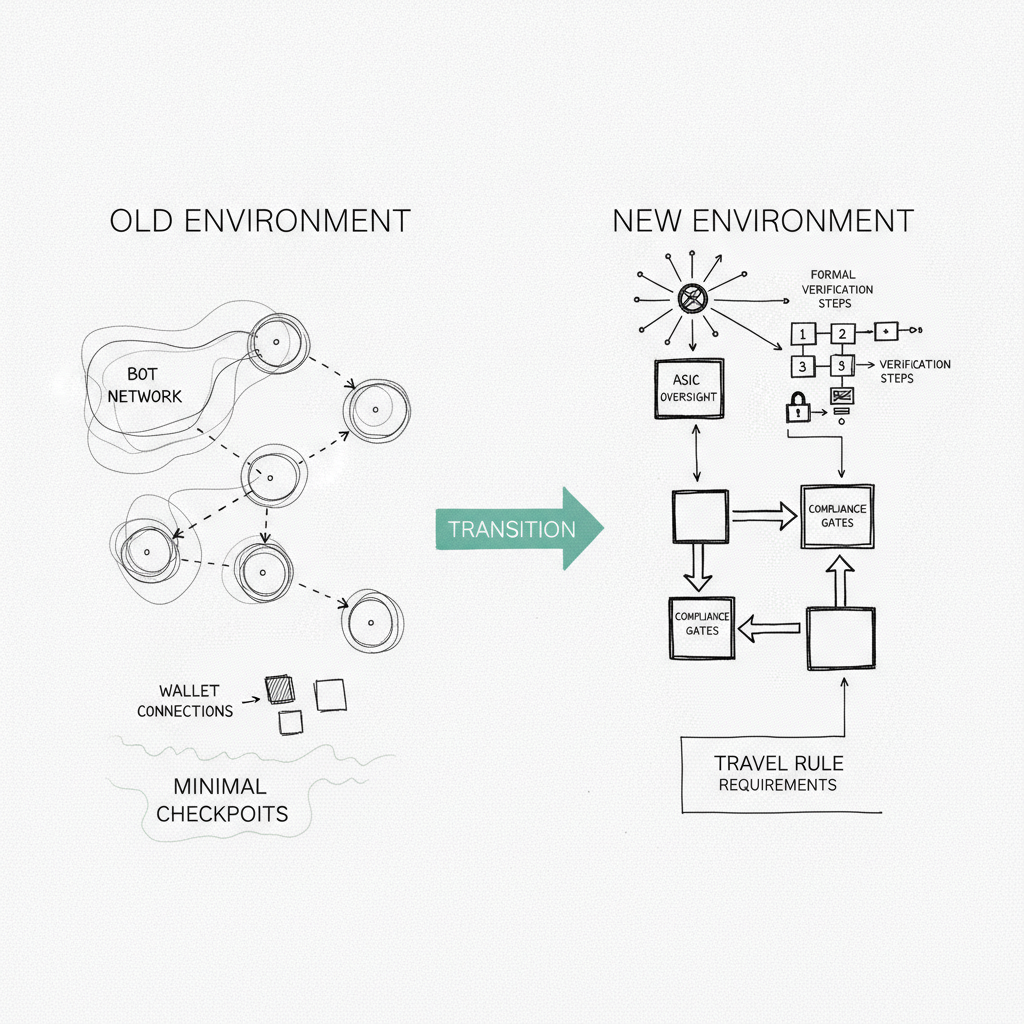
From March 31, 2026, AUSTRAC expanded its Virtual Asset Service Provider (VASP) designation to include crypto-to-crypto exchange on behalf of clients. This matters for algo traders because many automated strategies, particularly those involving bots that rebalance portfolios or execute pairs trading across crypto assets, operate in exactly this space. If your exchange is facilitating those swaps, they are now a VASP under the expanded definition, with all the registration and compliance obligations that entails.
Existing Digital Currency Exchange (DCE) operators, the category that covered most Australian exchanges until this point, had until May 30, 2026 to update their AUSTRAC enrolment details to reflect the new VASP status. New VASPs have until July 29, 2026 to complete enrolment and registration. Any exchange that has not done this is operating outside the framework.
AUSTRAC launched a public searchable VASP register on April 2, 2026. You can use it directly at the AUSTRAC website to verify whether an exchange you are trading on, or planning to automate on, is legitimately registered. I check this before recommending any exchange on this site. If a platform is not on the register, it does not get a recommendation here, full stop.
The Travel Rule
The Travel Rule is the change with the most immediate practical impact for algo traders running withdrawal automation. From July 1, 2026, VASPs must collect and transmit originator and beneficiary data on every transfer, not just fiat transactions but crypto transfers too. This includes transfers between two exchanges and transfers from an exchange to a self-hosted wallet.
Due diligence on counterparty VASPs is now mandatory. When you transfer from Swyftx to Independent Reserve, both exchanges need to share originator and beneficiary information. The receiving exchange needs to be satisfied that the sending exchange is a compliant VASP. This creates friction in automated workflows that were previously fire-and-forget.
The self-hosted wallet situation is more nuanced. AUSTRAC requires VASPs to apply risk-based policies for transfers to wallets that are not held by another registered VASP. In practice, this means exchanges will assess the risk profile of withdrawals to personal hardware wallets and may require additional verification steps, particularly for large or unusual withdrawal amounts. More on this in the withdrawal section below.
De-banking remains an undercurrent through all of this. Despite no explicit legal prohibition, Australian financial institutions have continued to restrict banking services to some crypto businesses throughout 2026. Compliance with AUSTRAC obligations does not guarantee a business can maintain stable banking relationships, which is worth knowing if you are relying on a smaller exchange for your strategy.
ASIC Licensing and the Digital Assets Framework Act Explained
The No-Action Expiry
ASIC’s no-action position was a practical accommodation. It said, roughly, that ASIC would not pursue enforcement against certain unlicensed digital asset service providers while the regulatory framework was being developed. That position expired on June 30, 2026.
Businesses that lodged an Australian Financial Services Licence (AFSL) application by June 30 remain covered during the assessment period. Businesses that did not are now exposed to enforcement action. For traders, this translates directly: if the exchange running your automated strategy has not lodged an AFSL application, it is operating with elevated regulatory risk. That is not a hypothetical. ASIC has powers to seek injunctions, impose penalties, and order businesses to cease providing financial services.
The Digital Assets Framework Act
The Corporations Amendment (Digital Assets Framework) Act 2026 introduces a dedicated licensing regime with two new AFSL categories. Digital Asset Platforms (DAPs) cover exchanges and trading platforms. Tokenised Custody Platforms (TCPs) cover custody of tokenised assets. The Act received Royal Assent on April 8, 2026, but does not commence until April 9, 2027, so exchanges have a transition window to get their licences in order.
This is important context for the no-action expiry: the full new regime does not kick in for another year, but the old grace period has already ended. The gap between June 30, 2026 and April 9, 2027 is not a free period. It is a period where unlicensed operators face enforcement risk under existing financial services law while the new framework’s formal licensing categories are not yet operative.
eToro holds both an AFSL and AUSTRAC registration, which makes it a clean example of what full compliance looks like under the current framework. Not every exchange is in this position. Before automating significant capital on any platform, verifying both AUSTRAC VASP registration and AFSL status is now a basic due diligence step, not an optional extra.
[INTERNAL LINK PLACEHOLDER: “best Australian crypto exchanges for algo trading” → exchange comparison pillar]
How the Travel Rule Affects Withdrawing Crypto to Personal Wallets
This is the question I have seen more than any other since July 1. The short version is: withdrawals to self-hosted wallets still work, but they have more friction than they used to, and automated withdrawal scripts need to account for this.
Under the Travel Rule, exchanges must collect originator and beneficiary information on every transfer. For withdrawals to a personal Ledger or Trezor, the exchange is the originator’s VASP and there is no receiving VASP, because a self-hosted wallet is not a registered entity. AUSTRAC’s requirement for risk-based policies in this scenario means exchanges will exercise judgement about how much verification they need before processing the withdrawal.
In practical terms, if you are withdrawing from CoinSpot or Swyftx to a hardware wallet, you may encounter a verification prompt, particularly for amounts above the exchange’s internal threshold. Smaller, routine withdrawals to a previously used wallet address are less likely to trigger this. Large one-off withdrawals to a new address are more likely to require you to confirm ownership of the wallet, potentially with a message signing or small test transaction.
For algo traders running automated withdrawal scripts, this is a genuine operational concern. A script that expects an instant withdrawal confirmation and uses that as a trigger for the next step in the strategy may fail or stall if the exchange inserts a manual review step.
The practical fix is straightforward: whitelist your personal wallet addresses on your exchange account well before you need them. Both CoinSpot and Swyftx have address whitelisting features. An address that has been whitelisted and previously verified is far less likely to trigger additional friction than a new address appearing in an automated withdrawal at 2am.
One tax point worth flagging here: transferring crypto between your own wallets, including from an exchange to your personal Ledger, is a tax-free event under ATO rules. No CGT event is triggered by moving your own assets between your own wallets. The Travel Rule changes the compliance obligations on the exchange’s side, but it does not create a new tax liability for you.
Crypto Tax Rules for Algo Traders in Australia: CGT, Income Tax, and the 2027 Changes
The Baseline
The ATO treats cryptocurrency as property, which means it is subject to Capital Gains Tax or income tax depending on the nature of your trading activity. This has not changed in 2026. What has changed is the volume of taxable events that algo traders are generating, and what is coming in 2027.
Every trade your bot executes is a CGT event. A grid bot running on ETH/AUD that executes 40 trades in a day generates 40 CGT events, each requiring you to record the cost base, the disposal proceeds, and the resulting gain or loss. High-frequency algo strategies can produce thousands of taxable events in a financial year. Without dedicated crypto tax software, the record-keeping alone becomes unmanageable.
[INTERNAL LINK PLACEHOLDER: “best crypto tax software Australia” → tax tools review pillar]
The CGT Discount and What Changes in 2027
The 50% CGT discount for assets held 12 months or more is technically available to crypto traders, but most algo strategies do not benefit from it because they rarely hold positions for that long. A grid bot or an arbitrage bot turns positions in hours or days, not years. DCA bots are the exception: if your DCA bot is accumulating BTC and you are not selling, those accumulated positions are building toward a 12-month holding period.
From July 1, 2027, the CGT discount framework is proposed to change. The 50% flat discount would be replaced with an inflation-based discount, and a minimum 30% tax on long-term gains would apply to assets acquired after that date. This is still a proposal at budget stage, not yet legislated, but it is far enough along that it is worth factoring into strategy design now, particularly for DCA bots accumulating positions intended to be held long-term.
Trader vs Investor Classification
The ATO distinction between a trader and an investor carries real consequences. Investors pay CGT and may access the 50% discount. Traders pay income tax on profits, with no CGT discount available, but can deduct trading losses against other income.
Algo traders running systematic, high-frequency strategies are at elevated risk of ATO classification as traders rather than investors. The ATO looks at factors including the volume and frequency of transactions, the commercial nature of the activity, the use of sophisticated tools or strategies, and whether the activity is carried on in a businesslike manner. Running a Python-based arbitrage bot across three exchanges with a dedicated trading account ticks most of those boxes.
This is not necessarily worse than investor status, especially if your strategy generates losses in a given year. But it does mean you need to know which classification applies before you lodge your return, and you need your records to support that position.
Tax Profiles by Bot Type
Different bot strategies have different tax profiles, and it is worth being clear on this.
DCA bots accumulate assets over time. If you are not selling, you are not generating CGT events. The tax complexity comes when you eventually dispose of those assets, and the lot-matching method you use (FIFO, HIFO, or specific identification) will significantly affect your outcome.
Grid bots generate frequent, small taxable events constantly. The gains and losses tend to net out to some degree, but each individual trade is still a reportable event. Volume is the challenge here, not complexity.
Arbitrage bots are the most complex. They involve rapid, high-volume trading often across multiple exchanges, potentially in multiple currency pairs. The ATO classification risk is highest for systematic arbitrage operations, and the record-keeping requirements are the most demanding.
The practical answer to all of this is software. Koinly, CoinTracker, and CryptoTaxCalculator all integrate with Australian exchanges and can ingest trade history via API. I have reviewed several of these on CryptoAlgo.com.au and the differences in how they handle bot trades, particularly for edge cases like partial fills and cross-exchange transfers, are more significant than the headline pricing suggests.
Frequently Asked Questions
Does the AUSTRAC Travel Rule apply to transfers between my own wallets on the same exchange?
No. Internal transfers within the same exchange’s system, such as moving funds between a spot wallet and a futures wallet on the same platform, are not covered by the Travel Rule. The rule applies to transfers between separate entities, including from an exchange to your personal self-hosted wallet.
My exchange is not on the AUSTRAC VASP register. Should I move my funds?
If an exchange that was previously operating as a DCE has not updated to VASP registration by May 30, 2026, or a new VASP has not enrolled by July 29, 2026, they are operating outside the AUSTRAC framework. That carries real risk for users, including potential account freezes if AUSTRAC takes enforcement action. I would not leave significant capital on an unregistered exchange.
Are my bot’s losses tax-deductible in Australia?
Yes, capital losses from bot trades can offset capital gains in the same financial year or be carried forward to future years. If you are classified as a trader rather than an investor, losses are treated as business losses and can offset other income, subject to the ATO’s non-commercial loss rules.
Does the Digital Assets Framework Act change anything right now, or only from April 2027?
The Act itself received Royal Assent in April 2026 but does not commence until April 9, 2027. However, the ASIC no-action position expired June 30, 2026, so there is a transitional period where unlicensed operators face enforcement risk under existing law. The formal new licensing categories are not operative until 2027, but that does not mean the current period is low-risk for unlicensed platforms.
Will the CGT discount change in 2027 affect assets I already hold?
The proposed change from July 1, 2027 applies to assets acquired after that date. Assets you already hold and dispose of after July 1, 2027 should retain access to the existing 50% discount based on acquisition date. This is still a budget proposal and has not been legislated, so stay across any changes before the 2027-28 financial year.
How do I verify whether an exchange is AUSTRAC-registered?
Use the public VASP register AUSTRAC launched on April 2, 2026. It is searchable by business name. Cross-reference this with ASIC Connect for AFSL status. Both checks take about two minutes and are worth doing before automating any significant capital on a new platform.
What is the tax treatment of staking rewards generated through an automated strategy?
The ATO treats staking rewards as ordinary income at the time of receipt, based on the AUD value at that point. A subsequent disposal of those staked assets is then a separate CGT event. If your bot is auto-compounding staking rewards, each reward receipt is a taxable income event, which is another reason accurate, automated record-keeping is essential.
CryptoAlgo may earn a commission if you sign up through links on this page. This does not affect our editorial independence — we only recommend platforms we have actually used and would recommend to a mate. This article is general information, not financial advice. Crypto is volatile and you can lose money. Always do your own research and consider speaking to a licensed Australian financial adviser before investing.