Crypto Algo Trading in Australia: Complete Guide for 2026
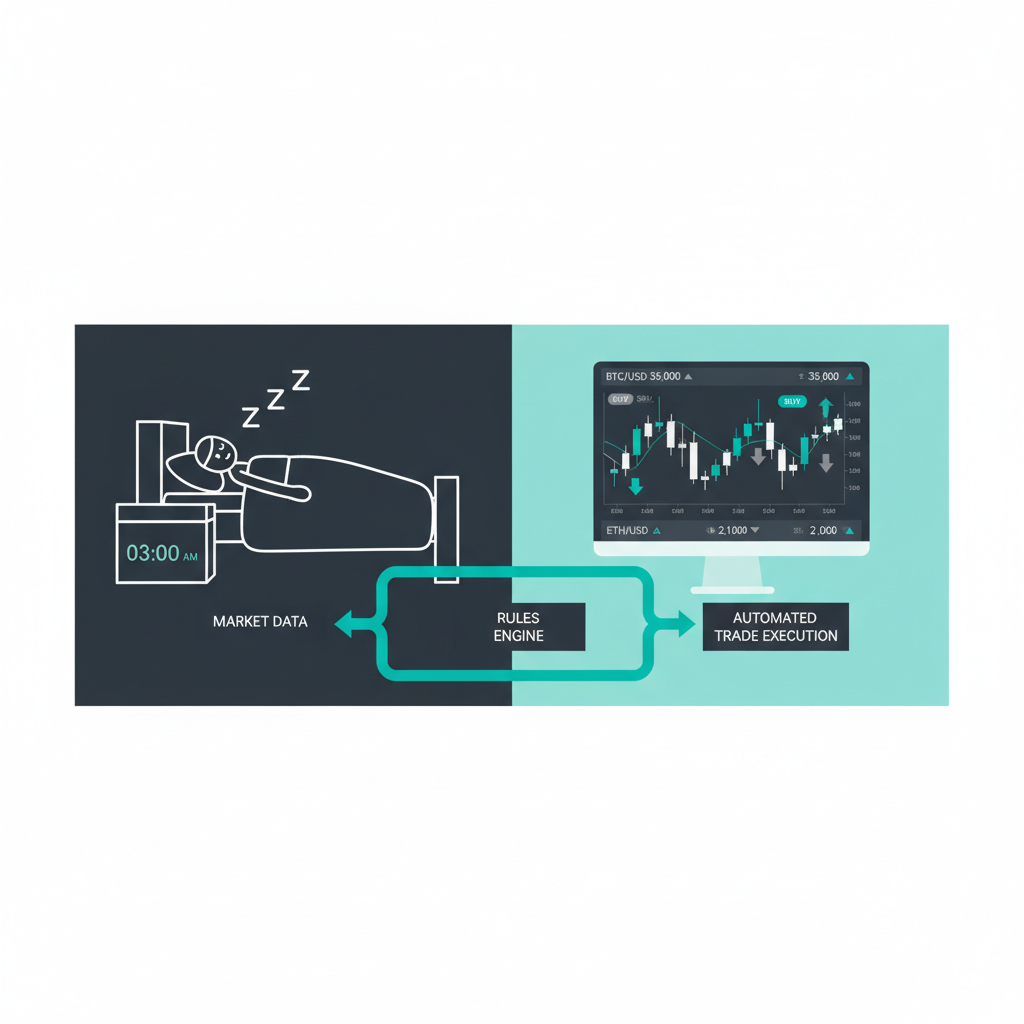
The alarm goes off at 3am in Sydney. Bitcoin just had a 12% swing while you were asleep, and the US Federal Reserve dropped a surprise announcement that sent ETH up, then down, then back up again. If you were trading manually, you missed all of it. If you had an algorithm running, it either capitalised on the move or protected your position with a stop-loss, depending on how well you built the thing.
That is the core promise of algorithmic crypto trading, and in 2026 it is more accessible to Australian retail traders than it has ever been. It is also more regulated, more scrutinised, and more consequential to get wrong.
> TL;DR: Crypto algorithmic trading uses automated, rules-based systems to execute trades 24/7 without emotional bias. As of 2026, new AFSL requirements under the Corporations Amendment (Digital Assets Framework) Bill mean platforms must meet bank-grade standards. The ATO taxes crypto as property, with a 50% CGT discount for assets held over 12 months. Top platforms include Eightcap, IC Markets, Swyftx, and Altrady. Risk management and continuous strategy monitoring are not optional.
What Is Crypto Algo Trading? (The Short Answer)
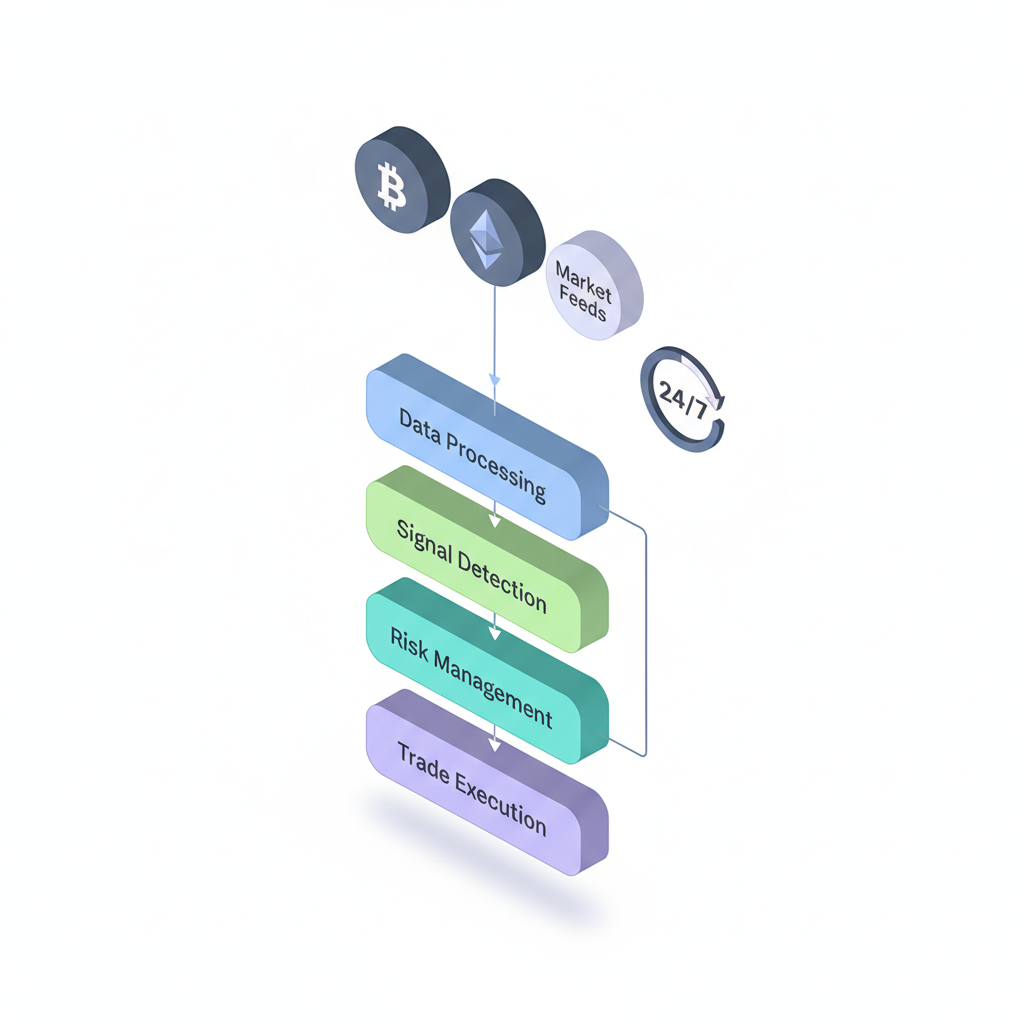
Algorithmic crypto trading means using programmed, rules-based systems to automatically execute buy and sell orders based on predefined conditions. Instead of sitting at a screen watching candles, you define the logic, such as “buy BTC when the 20-day moving average crosses above the 50-day, sell when RSI exceeds 75,” and the software executes it without asking you first.
The contrast with manual trading is not subtle. A human can process one or two signals at a time, hesitates when a position goes against them, and cannot watch eight markets across three time zones simultaneously. An algorithm does not care about any of that. It runs the same logic on every trade, at speeds measured in milliseconds, around the clock.
Common strategy types include trend-following (buying into momentum and exiting when it reverses), arbitrage (exploiting price differences across exchanges), market-making (placing orders on both sides of the book to capture the spread), and mean reversion (betting that prices return to a historical average after extreme moves). None of these are exotic. They have existed in traditional finance for decades, and they translate reasonably well to crypto markets.
What they do not do is guarantee profits. The algorithm enforces your strategy precisely, which is a feature if your strategy is sound and a problem if it is not. Australian traders can access algo tools through ASIC-regulated brokers, local exchanges like Swyftx, and dedicated multi-exchange platforms like Altrady. The infrastructure is there. What you do with it is still on you.
[INTERNAL LINK PLACEHOLDER: “trend-following strategies” → crypto-trading-strategies-guide]
Why Australian Traders Are Turning to Algorithmic Crypto Strategies
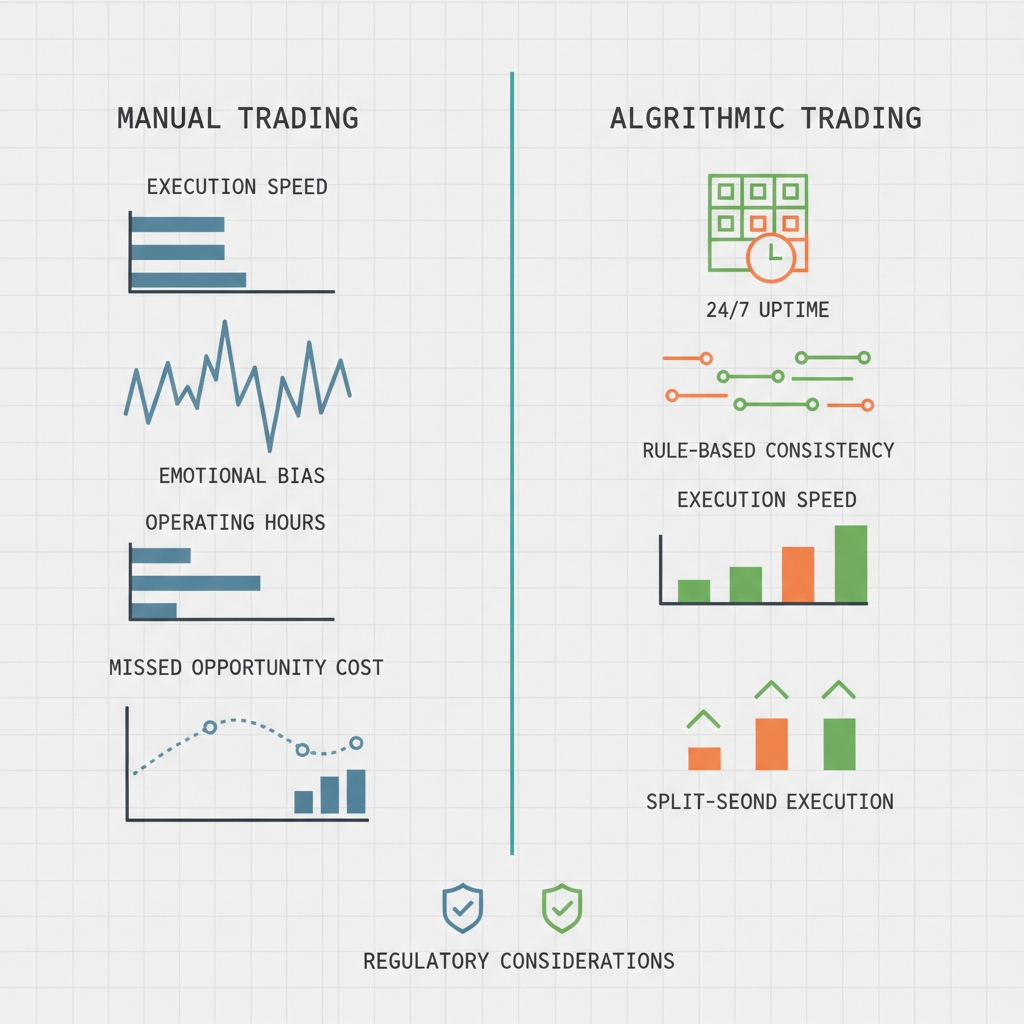
The time zone problem is real. Sydney is UTC+10 (or +11 during daylight saving), which means the New York open happens at midnight, London opens around 6pm, and major US macro announcements land somewhere between 2am and 4am. If you are trading crypto manually and you live in Australia, you are structurally disadvantaged compared to someone in London or New York who can react to market-moving news during their business hours.
Algorithms neutralise that disadvantage completely. The bot does not sleep, does not go to a barbecue on Saturday afternoon, and does not miss a flash crash because it was watching the footy.
Beyond the time zone issue, crypto volatility is simply higher than most asset classes. Bitcoin regularly moves 5% to 15% in a single session. That creates genuine opportunity for systematic strategies, but it also creates the kind of environment where emotional decision-making destroys accounts. The trader who panic-sold during a 20% drawdown in March 2024 and missed the subsequent recovery knows exactly what that feels like. Algorithms enforce consistency even when markets are doing something irrational.
The regulatory environment has also shifted. ASIC-regulated platforms now support automated strategies with proper infrastructure, and the 2026 AFSL requirements have pushed out a number of fly-by-night operators. The platforms that survived that process are more credible. That matters when you are connecting API keys and trusting a system with real capital.
Retail access to these tools has also improved significantly. What required institutional infrastructure five years ago, including backtesting engines, paper trading environments, and multi-exchange execution, now ships as standard features on platforms available to any Australian with a verified account.
Key Benefits of Algorithmic Crypto Trading
Speed is the obvious one. Algorithms execute orders in milliseconds. By the time you have seen a signal, picked up your phone, opened the app, and placed the order, the price has already moved. In volatile crypto markets, that delay is often the difference between a good fill and a bad one.
Removing emotion from execution is more valuable than most people admit until they have lost money because of it. Fear and greed are not character flaws; they are normal human responses to financial risk. The problem is they are reliably counterproductive in trading. Algorithms do not second-guess a signal because the last three trades lost. They do not hold a losing position longer than the rules allow because they “feel” like it will come back. The rules run as written.
Consistency is related but distinct. Every trade gets the same entry and exit logic, the same position sizing, the same risk parameters. Over hundreds of trades, that consistency is where the statistical edge, if one exists, actually shows up. One deviation from the rules, driven by a hunch or a headline, can invalidate weeks of disciplined execution.
The data processing capacity of even a simple algorithm outpaces human ability. Monitoring price action, volume, order book depth, and multiple indicators across twenty assets simultaneously is not something a person can do well. A bot can do it across hundreds.
Backtesting deserves a specific mention because it is genuinely useful, not just a marketing feature. Being able to run your strategy against two years of historical price data before committing real capital gives you a rough sense of whether the logic has ever worked. It will not tell you it will work in the future, but it will quickly expose strategies that have never worked at all.
The caveat is worth stating plainly: automation amplifies both gains and losses. A poorly configured algorithm running without position limits in a volatile market can blow up an account faster than any manual trader could manage.
Risks and Limitations You Must Understand First
If the section above sounded like an advertisement, this one is the correction.
Algorithms amplify outcomes in both directions. A system with a positive expected value, compounded over thousands of trades, produces strong returns. A system with a negative expected value, or one that worked during the backtesting period but does not translate to live conditions, produces losses at the same speed and consistency. The automation is neutral. Your strategy is not.
Over-optimisation is one of the most common failure modes. It happens when a strategy is tuned so precisely to historical data that it fits the noise of that specific dataset rather than any genuine market pattern. The backtest looks exceptional. Live performance looks nothing like it. This is called curve fitting, and it is a serious problem because the trader usually does not discover it until real money is gone.
Technical failures are underappreciated. Exchange APIs go down. Your internet drops out. A code bug causes orders to fire incorrectly. A connectivity issue leaves a position open when it should have been closed. These are not hypothetical scenarios; they happen regularly across every platform. Any serious algo setup needs monitoring, alerts, and fail-safes built in.
Crypto market structure changes faster than almost any other market. A strategy that worked well in the 2024 ranging environment may perform completely differently in a trending 2026 market. Algorithms require ongoing adjustment, not set-and-forget deployment.
Platform risk matters more than people acknowledge. Using an unregulated or offshore platform with no AFSL means your funds have no real protections if the platform fails or exits the market. DAEX’s voluntary liquidation in January 2026 is a recent local example of what that looks like for affected traders.
Position sizing, stop-losses, and daily loss caps are not optional features. They are the difference between a bad week and an account wipeout. If your algorithm does not have hard limits built in, fix that before going live.
[INTERNAL LINK PLACEHOLDER: “risk management for crypto traders” → crypto-risk-management-guide]
Best Platforms for Crypto Algo Trading in Australia (2026 Comparison)
Choosing the right platform depends on whether you want to trade crypto CFDs through a regulated broker or hold actual crypto assets on an exchange. These are meaningfully different structures, with different tax treatments and different risk profiles.
| Platform | ASIC Regulated | Algo / Bot Support | AUD Deposits | Fees | Best For |
|---|---|---|---|---|---|
| Eightcap | Yes | MT4, MT5, TradingView, CryptoCrusher | Yes | Spread-based, varies by asset | CFD algo traders, TradingView automation |
| IC Markets | Yes | MT4, MT5, cTrader | Yes | From 0.0% spread + commission | Experienced traders, low-latency execution |
| Capital.com | Yes | TradingView, MetaTrader, AI assistant | Yes | No commissions, spread-based | Beginners to intermediate, 100+ crypto CFDs |
| Altrady | No (platform tool) | QFL Bot, Signal Bot, Paper Trading | Via exchanges | Subscription from ~$25 USD/month | Multi-exchange automation, quantitative models |
| Swyftx | AUSTRAC registered | Demo mode, API access, tax reports | Yes, free via PayID | 0.6% spread on BTC/AUD, no deposit fees | Australian beginners, spot crypto, tax tools |
| Pepperstone | Yes | MT4, MT5, cTrader, TradingView | Yes, free PayID | Flat 0.1% commission, no spread mark-up | Cost-conscious CFD traders |
Eightcap
Eightcap holds an AFSL and is one of the more crypto-focused brokers in the Australian CFD space. The CryptoCrusher tool is a proprietary sentiment overlay that pulls market signals and can be paired with TradingView-based automation. MT4 and MT5 support means any Expert Advisor you have already built will run without modification. You are trading CFDs here, not holding actual coins, so there are no private keys and no withdrawal to a cold wallet.
IC Markets
IC Markets is ASIC-regulated and has a reputation among Australian traders for competitive spreads and fast execution. It is better suited to traders who already know what they are doing with MetaTrader or cTrader. The platform does not hand-hold, which is either a feature or a problem depending on your experience level.
Capital.com
Capital.com covers more than 100 crypto CFDs and charges no commissions, making costs predictable for algorithmic strategies with high trade frequency. The built-in AI assistant is more useful than most of these tools tend to be, particularly for flagging unusual price behaviour. TradingView integration works cleanly.
Altrady
Altrady is the most purpose-built algo trading environment on the list. It connects to multiple exchanges simultaneously, supports QFL Bot and Signal Bot strategies, and has a paper trading mode that lets you run strategies against live market data without real capital. It is a subscription tool layered on top of your exchange accounts, not a standalone broker, so you still need accounts elsewhere. Not ASIC-regulated in itself, but compatible with regulated exchanges.
Swyftx
I have been using Swyftx since 2022 and it remains the exchange I point most Australian beginners toward. The demo mode is genuinely useful for understanding how the platform works before committing funds, the tax reporting integrates directly with Koinly, and the 420+ asset range covers most things you would want to trade. The API access is solid enough for basic automation. It is not the platform for sophisticated multi-leg strategies, but for systematic spot trading with Australian-friendly banking and proper ATO-compliant records, it is hard to beat.
Pepperstone
Pepperstone is ASIC-regulated and charges a flat 0.1% commission on crypto trades with no spread mark-up, which makes it genuinely cost-competitive for higher-frequency strategies. PayID deposits are free and typically instant. The platform supports MT4, MT5, cTrader, and TradingView, which covers most algorithmic setups.
For international options with algo features, KuCoin, Binance, and Kraken all offer API access and bot-compatible infrastructure, but none hold an AFSL. Under 2026 regulations, that is a meaningful distinction if you are depositing substantial funds.
[INTERNAL LINK PLACEHOLDER: “compare Australian crypto exchanges” → best-australian-crypto-exchanges]
Australia’s 2026 Crypto Regulations: What Algo Traders Need to Know
The Corporations Amendment (Digital Assets Framework) Bill 2025 passed on April 1, 2026, and it fundamentally changed the legal obligations for any platform holding client crypto assets in Australia. The short version: platforms now need an AFSL and must meet bank-grade standards for custody, solvency buffers, and net tangible assets.
This is not a minor administrative change. AFSL requirements for financial services businesses are substantial. They involve capital requirements, compliance frameworks, responsible manager standards, and ongoing ASIC reporting obligations. The platforms that cannot meet those standards are no longer legally able to hold Australian client assets.
ASIC has been actively pursuing civil proceedings against unlicensed operators. That enforcement posture has accelerated since the new legislation took effect. If you are using a platform that has not confirmed its AFSL status under the 2026 framework, that is a material risk to your funds.
AUSTRAC simultaneously expanded its VASP (Virtual Asset Service Provider) register from April 2026, with a publicly searchable database and strengthened AML/CTF obligations. The review process that preceded the expansion resulted in 62 inactive crypto businesses exiting the sector. That is not a bad outcome: dormant or non-compliant businesses holding client funds are a systemic risk.
For algo traders specifically, the practical implication is straightforward. Only use platforms that are AFSL-licensed or clearly compliant under the 2026 framework for anything involving real capital. For the actual strategy layer, tools like Altrady operate as software that connects to exchanges via API rather than holding funds directly, which puts them in a different category, but the underlying exchange still needs to meet compliance standards.
ASIC’s position on crypto CFD products from unlicensed offshore providers has also hardened. A platform offering crypto derivatives to Australian residents without an AFSL is operating illegally, and your recourse if something goes wrong is essentially nil.
[INTERNAL LINK PLACEHOLDER: “ASIC crypto regulation explained” → asic-crypto-regulation-australia]
Banking Restrictions and AUD On-Ramps for Algo Traders
This is the part that catches people off guard, especially those coming from traditional investing where transferring money to a brokerage is frictionless.
The Commonwealth Bank, ANZ, Westpac, and NAB all impose varying levels of restriction on transfers to crypto exchanges. These range from delays and additional verification steps through to monthly caps of $10,000, and in some cases outright rejection of transactions. The banks cite AML/CTF obligations and scam prevention, which are legitimate concerns in principle, but the application has been blunt enough that even well-credentialed, AFSL-compliant exchanges have been caught in the net.
Coinbase made that tension public on February 3, 2026, filing a formal complaint with the Australian Parliament accusing the big four of running what it called an “illegal regulatory ban” on legitimate crypto companies. Whether that characterisation holds legally is a separate question, but the underlying problem it describes is real and documented.
Practically speaking, if you are planning to fund an algo trading account with a significant AUD amount, test the pathway first. Send $200, confirm it arrives, confirm the exchange processes it correctly, and then scale up. Finding out your bank blocks large transfers after you have already committed to a strategy is an avoidable problem.
Smaller and digital banks tend to be more accommodating. UBank, ING, and Up Bank have all been more permissive with crypto-related transfers in practice, though policies can change without notice. PayID and OSKO deposits are free on most supported exchanges and settle faster than standard bank transfers, often within minutes. AUD withdrawal fees range from free to around $25 depending on the platform and the withdrawal method.
One more thing worth confirming before you deposit: check whether your