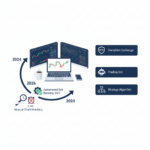
Algorithmic Crypto Trading in Australia: Strategies, Platforms & Regulations (2026)
My first algo strategy ran for eleven days before blowing 8% of the test account. The rules looked perfect on paper. The backtest was clean. Then the market did something the historical data had never done in quite that sequence, and the bot just kept buying into a waterfall. That experience taught me more about algorithmic trading than any blog post ever could, and it is why this guide exists.
Algorithmic crypto trading is not a shortcut. It is a discipline. Get it right and you have a tireless system working while you sleep. Get it wrong and you lose money faster than you would have by clicking manually.
> TL;DR
> Algorithmic crypto trading uses automated rules to execute trades 24/7 without emotion or fatigue. In Australia, the regulatory environment shifted dramatically on April 1, 2026, when a comprehensive digital asset law made AFSL licensing mandatory for all exchanges and custody providers. This guide covers the most effective algo strategies, how to verify a platform is compliant, ATO tax obligations, and what Australian traders need to know before deploying any automated strategy.
What Is Algorithmic Crypto Trading and Why Australia Is Ideal for It
Algorithmic crypto trading means writing a set of rules, price crosses moving average, volume spikes above threshold, RSI drops below 30, and letting software execute buy and sell orders automatically whenever those conditions are met. No manual clicking, no second-guessing, no watching charts at 2am.
The 24/7 nature of crypto markets makes this a natural fit in a way that traditional equities never quite were. The ASX closes at 4pm. Bitcoin does not. Significant moves on BTC/AUD regularly happen between midnight and 5am Australian time, when US and European sessions overlap or when Asian liquidity starts driving the market. A manual trader misses most of that. An algorithm does not.
Australia also sits in a useful timezone position. Sydney bridges the tail end of the US session and the open of Asian markets, meaning there is genuine liquidity in AUD pairs during reasonable waking hours, but the overnight gaps where manual traders go blind are substantial. That asymmetry, coverage gaps in manual attention, is exactly where automated strategies earn their keep.
The speed advantage matters too. Crypto price dislocations are sharp and brief. A 1.5% move on ETH can materialise and partially reverse within seconds during a volatile session. Algorithms react in milliseconds. By the time a human trader identifies the signal, decides to act, and places the order, the opportunity has often narrowed or closed entirely.
None of this means algorithms are magical. They amplify whatever logic and risk control you build into them. Well-designed rules applied consistently will reduce emotional trading errors and capture opportunities you would otherwise miss. Poorly designed rules will lose money faster than you could manually, because the bot executes every mistake at full speed with no hesitation.
Australia’s growing retail and institutional crypto adoption is also quietly building liquidity depth in AUD pairs, which matters for strategy execution. Thinner markets mean wider spreads and more slippage, both of which erode algo performance. As more capital enters the market, the conditions for certain strategies improve.
[INTERNAL LINK PLACEHOLDER: “AUD crypto pairs” → guide-to-buying-crypto-australia]
6 Core Algorithmic Crypto Trading Strategies Explained
Understanding what each strategy actually does, and what it requires, saves you from chasing something that does not suit your capital, infrastructure, or risk tolerance.
Trend Following
This is the most accessible strategy for retail algo traders. The system identifies a confirmed trend, typically using moving average crossovers (e.g., the 50-period crossing above the 200-period) or breakout signals above recent highs, and enters trades in the direction of that trend. It exits when the trend shows signs of exhaustion.
Trend following works well in crypto because the asset class produces extended directional moves more frequently than most traditional markets. It does poorly in choppy, sideways conditions, which is a real limitation. Expect to lose small amounts frequently during ranging markets, and profit during the periodic directional runs. Suitable for traders with modest capital and a medium to long-term time horizon.
Arbitrage
Arbitrage exploits price differences between exchanges or trading pairs. If BTC is trading at $137,200 AUD on one exchange and $137,450 on another, a fast enough system can buy low and sell high simultaneously for a near-risk-free profit.
Triangular arbitrage is common in crypto: using price inefficiencies between three related pairs (e.g., BTC/AUD, ETH/AUD, ETH/BTC) to extract value without directional exposure. In practice, true arbitrage windows are thin and brief. By 2026, most obvious cross-exchange arb on major AUD pairs gets consumed quickly by well-capitalised bots. Retail traders can still find edges in less liquid altcoin pairs, but execution speed and transaction costs are critical. Withdrawal delays between exchanges also create real execution risk.
Mean Reversion
Mean reversion strategies assume that prices, after extreme moves in either direction, tend to return toward a statistical average, often defined by Bollinger Bands or Z-score calculations. The system buys after sharp downward deviations and shorts (or reduces position) after upward deviations.
This works in crypto during periods of relative stability but carries serious blow-up risk during sustained trends. If BTC drops 12% and your system interprets that as a reversion opportunity, but it is actually the start of a 40% bear leg, the losses compound. Strict stop-losses and position sizing are non-negotiable here.
Momentum Trading
Momentum strategies buy assets that are accelerating in price and exit when that acceleration fades. Unlike trend following, which waits for trend confirmation, momentum trading enters earlier, when an asset starts showing above-average price velocity, and exits faster.
Crypto is particularly momentum-driven at the retail level. News events, social sentiment shifts, and exchange listings can create short, sharp momentum windows. The edge is real but the timing is demanding. Momentum strategies suit traders comfortable with higher turnover and tighter risk management.
Market Making
A market maker places simultaneous buy orders below the current price and sell orders above it, profiting from the spread when both sides fill. This is less directional trading and more liquidity provision.
Running a retail market-making bot on a major exchange is viable in theory but increasingly difficult in practice. You are competing with professional market makers who have faster infrastructure and tighter risk models. This strategy requires significant capital to generate meaningful returns at the spreads available on AUD pairs, plus a platform with a proper API that supports limit order placement at speed.
High-Frequency Trading
HFT executes thousands of trades per second, exploiting microsecond price inefficiencies. This is institutional territory. You need co-location (servers physically placed near exchange matching engines), proprietary infrastructure, and teams of quantitative engineers. Retail traders in Australia cannot meaningfully compete here, and no standard bot platform gives you genuine HFT capability. If a service claims to offer it to retail users, read the fine print very carefully.
Key Benefits of Running Automated Strategies on Crypto Markets
The case for automation in crypto is more concrete than in most asset classes, because the market’s specific characteristics amplify each advantage.
Execution speed is the most obvious. A well-configured algo can react to a signal and place an order within milliseconds. During a volatile BTC/AUD session, that gap between signal and execution can be the difference between a clean entry and significant slippage. Manual traders clicking through a web interface are operating on a completely different timescale.
Emotion-free consistency is where most retail traders actually gain the most. FOMO buying into a spike, panic selling a dip, holding a loss too long because you believe in the project, these are the behaviours that quietly destroy accounts. An algorithm does not care about news headlines or Twitter sentiment. It executes the rules. Every. Single. Time.
24/7 participation matters more in crypto than anywhere else. Significant moves regularly happen during periods when Australian traders are asleep or at work. Running an algo means you capture those moves without setting alarms or neglecting your day job. I have woken up to closed trades that I would never have taken manually, some profitable, some not, but all consistent with the strategy I designed.
Simultaneous analysis is another genuine edge. A human can meaningfully watch perhaps two or three charts at once. An algorithm can monitor fifty assets, apply technical filters, calculate correlations, and rank opportunities by signal strength in real time. For portfolio-level strategies, this is transformative.
Backtesting before risking real capital is discussed in the next section, but it belongs on this list. The ability to test a hypothesis against years of historical data before deploying a dollar is something manual discretionary traders simply do not have.
Backtesting Your Crypto Algo Strategy: Why It Is Non-Negotiable
Every strategy should be backtested. Full stop. Running a live algo without backtesting is the equivalent of deploying untested code into a production environment that directly controls your bank account.
Backtesting runs your set of rules against historical price data to estimate how the strategy would have performed. The goal is to get a realistic picture of win rate, average profit and loss per trade, drawdown characteristics, and how the strategy behaves across different market conditions.
The tools most commonly used by Australian retail algo traders are TradingView Pine Script (excellent for indicator-based strategies with a low coding barrier), the MT4/MT5 Strategy Tester (better for tick-level precision), and platform-native backtesters like those built into Altrady. Swyftx offers a demo mode that functions as a forward-testing environment, which is the next stage after historical backtesting.
Overfitting is the cardinal sin of backtesting. This is where you tweak parameters, RSI period, moving average length, stop-loss percentage, until the strategy looks brilliant on historical data. The result is a system that is perfectly calibrated to the past and useless for the future. A good backtest uses a walk-forward methodology: optimise on one portion of historical data, then validate on a separate out-of-sample portion you have not touched.
Ignoring slippage and fees is the second most common mistake. Backtests often assume you buy and sell at exactly the signal price. In reality, market orders fill at the best available price, which during volatile moments can be meaningfully worse. Include realistic fee assumptions, at least 0.1% to 0.6% per side depending on the platform, and model slippage into your calculations. Strategies that look profitable before costs frequently are not after them.
Survivorship bias is subtle but real. If you backtest only on assets that still exist today, you are missing the coins that went to zero during your test period. This inflates apparent returns because the worst outcomes are invisible.
After backtesting, run the strategy in paper trading (forward testing with simulated capital) for at least four to eight weeks before going live. Market regimes change. A trend-following strategy backtested on 2023-2024 data may perform very differently in a 2026 ranging market. No backtest guarantees future performance. They are a necessary starting point, not a finish line.
[INTERNAL LINK PLACEHOLDER: “crypto backtesting tools” → best-crypto-trading-bots-australia]
Australia’s 2026 Crypto Regulation: What Algo Traders Must Know
On April 1, 2026, Australia passed its first comprehensive digital asset law, and it materially changed the operating environment for anyone running automated strategies on Australian platforms.
The law integrates crypto exchanges and custody providers into the Corporations Act 2001 framework. Any platform holding client assets or crossing certain thresholds must now obtain an Australian Financial Services Licence (AFSL). This is the same licence structure that governs managed funds, stockbrokers, and financial advisers. It brings with it capital requirements, custody standards, mandatory disclosures, and ongoing ASIC oversight.
The terminology shifted too. What AUSTRAC previously called Digital Currency Exchanges (DCEs) are now classified as Virtual Asset Service Providers (VASPs) under the expanded Anti-Money Laundering and Counter-Terrorism Financing (AML/CTF) regime. This reflects the broader scope of crypto-related services now brought under regulatory oversight, not just simple spot exchange but custody, staking products, and tokenised asset platforms.
AUSTRAC published a searchable public VASP register following the April 2026 announcement, which is genuinely useful for traders trying to verify a platform before connecting an API or depositing funds. In late 2025, AUSTRAC also ran what it internally described as a “Use It or Lose It” blitz, removing inactive or dormant DCE registrations to prevent shell entities from misusing the registration status. The register is cleaner now than it has been at any point since crypto regulation began in Australia.
For algo traders specifically, the practical implications are significant. Your bot is connecting to an exchange via API and placing orders automatically, potentially at high frequency. If the platform is not AUSTRAC-registered and working toward AFSL licensing, you have no regulatory protection if something goes wrong. Unregistered platforms can disappear, freeze withdrawals, or simply fail compliance checks that cut off their banking relationships.
The mandatory AFSL pathway also means platforms must meet bank-grade standards for custody and settlement. This is genuinely good news for algo traders who hold funds on-exchange between trades, which most strategies require. The risk of an unregulated platform misusing client funds or failing without recourse is meaningfully reduced.
Exchanges have a six-month window from April 1, 2026, to obtain their AFSL. During this transition period, platforms with existing DCE registrations can continue operating, but the clock is running.
[INTERNAL LINK PLACEHOLDER: “AFSL crypto exchanges Australia” → best-crypto-exchanges-australia]
AUSTRAC and ASIC Compliance for Algo Trading Platforms
Verifying a platform’s compliance status before connecting a trading bot should be the first step in your setup process, not an afterthought.
AUSTRAC registration has always been the baseline requirement for any legitimate Australian crypto exchange. It is a prerequisite for maintaining banking relationships, which is the operational lifeblood of any exchange. Without it, a platform cannot reliably process AUD deposits and withdrawals. Checking the public VASP register at austrac.gov.au takes about sixty seconds and tells you immediately whether a platform is registered. If it is not on that register, stop there.
KYC verification is mandatory on all compliant platforms, and this directly affects algo trading setup. You will need to complete identity verification, typically a government ID upload and sometimes a liveness check, before you can generate API keys or fund an account. This is not optional and is not unique to any one platform. Factor this into your setup timeline if you are planning to deploy quickly.
On the ASIC side, the April 2026 framework introduces a new layer. Platforms that hold client assets (which every exchange that stores your crypto between trades does) must now obtain or be working toward an AFSL. ASIC’s oversight brings mandatory disclosure requirements, so platforms must clearly communicate fees, risks, and the terms under which they hold your assets. For algo traders running strategies that involve significant funds sitting on-exchange, this is meaningful protection.
The banking friction problem is real and worth knowing about before you start. In February 2026, Coinbase filed a formal complaint with the Australian Parliament accusing CBA, Westpac, ANZ, and NAB of imposing what it called an illegal regulatory ban by systematically refusing services to crypto companies. The banks have not publicly acknowledged this characterisation, but the operational reality is documented. Major banks impose 24-hour holds on transfers to crypto exchanges, monthly caps as low as $10,000, and in some cases outright rejections.
For an algo trader, this creates a specific problem. Your strategy may require topping up exchange balances, moving funds between platforms for arbitrage, or withdrawing profits regularly. If your primary bank is obstructive, you need a plan. Platforms with strong, established banking relationships, typically the larger, longer-operating Australian exchanges, experience less friction than newer entrants. Some traders maintain a secondary account with a more crypto-friendly institution, such as Up or Macquarie, to handle exchange transfers.
Swyftx, CoinSpot, and Kraken are among the platforms with established AUD banking infrastructure in Australia as of 2026. Eightcap and Pepperstone, which offer crypto CFD trading rather than spot exchange, operate under ASIC regulation via existing AFSL licences and are largely insulated from the banking friction that spot exchanges face.
For API-based algo trading specifically, check that your chosen platform supports the order types your strategy requires (limit orders, stop-limit, trailing stops), has documented rate limits that your bot can work within, and provides a sandbox or testnet environment for bot validation before going live. Not all Australian exchanges offer full API feature parity with their web interface, and discovering a missing order type after your strategy is built is an expensive lesson.
[INTERNAL LINK PLACEHOLDER: “crypto API trading Australia” → best-crypto-trading-bots-australia]
Frequently Asked Questions
Is algorithmic crypto trading legal in Australia?
Yes, it is legal.