Algorithmic Crypto Trading in Australia: Complete 2026 Guide
Algorithmic crypto trading in Australia has shifted from a niche hobby for developers into something retail traders are taking seriously, and the 2026 regulatory overhaul means the stakes just got higher. If you are running a bot that fires off fifty trades a day, the ATO already knows about it in real time.
> TL;DR
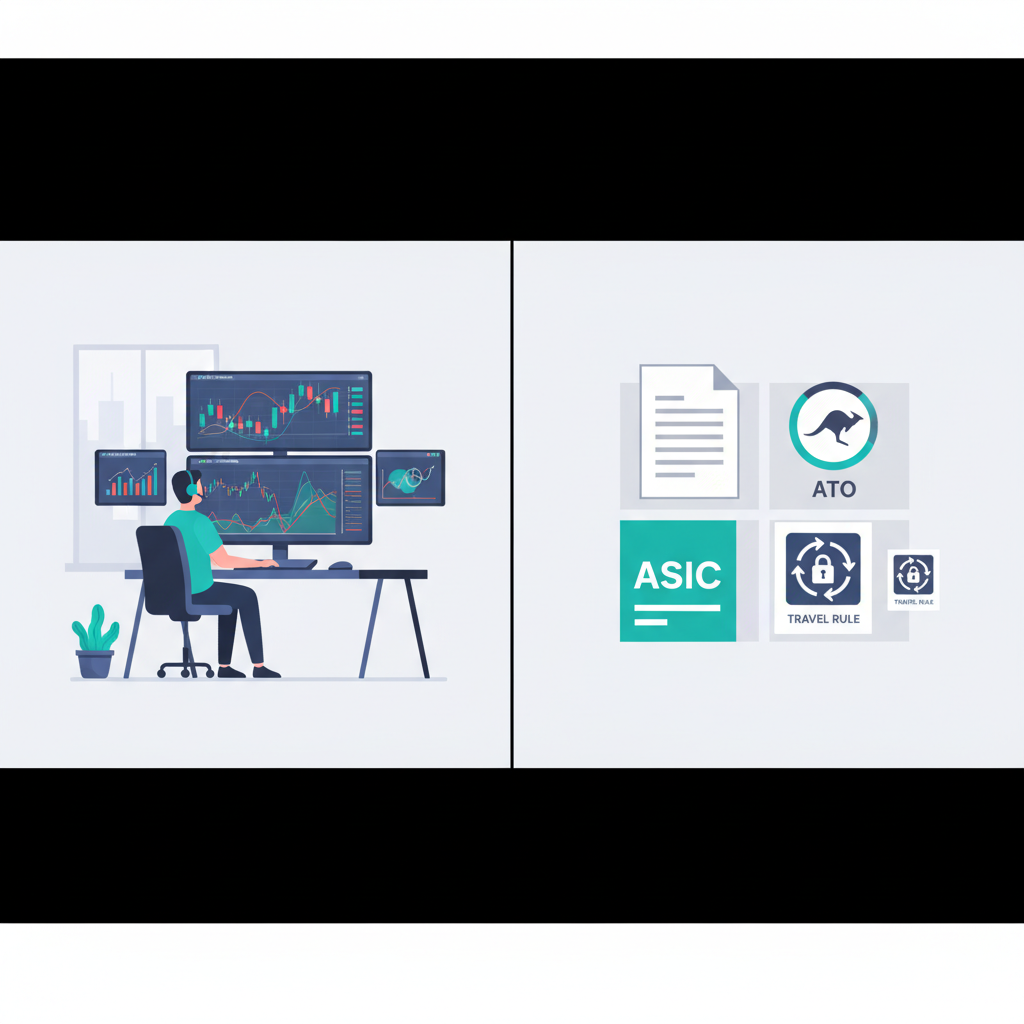
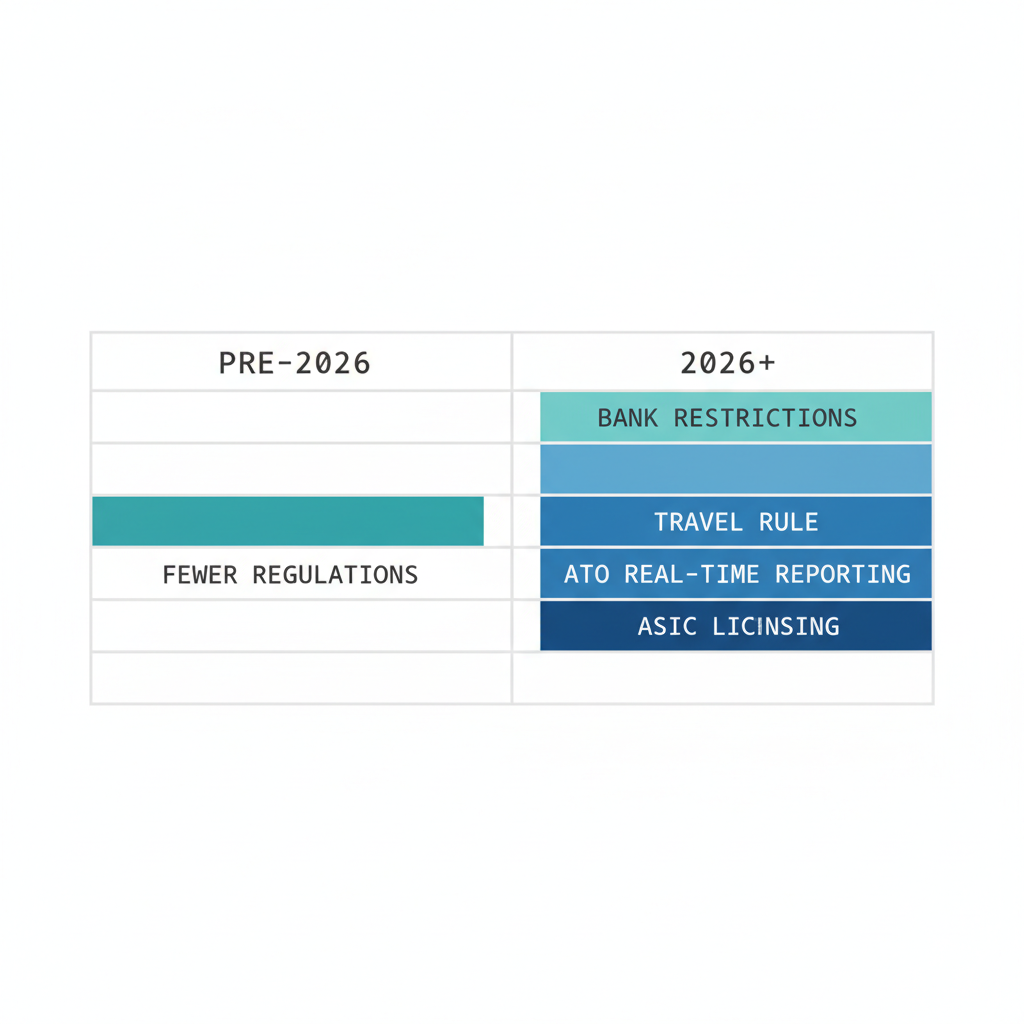
> Algorithmic crypto trading in Australia lets you automate buy and sell decisions using pre-programmed rules, removing emotion and capturing 24/7 market opportunities. In 2026, Australian traders must navigate new ASIC licensing rules, ATO real-time tracking, the Travel Rule, and bank transfer restrictions. The core advantages of speed, consistency, and round-the-clock execution still make algo trading compelling, but you need to go in with your eyes open on both the technical and compliance sides.
What Is Algorithmic Crypto Trading in Australia?
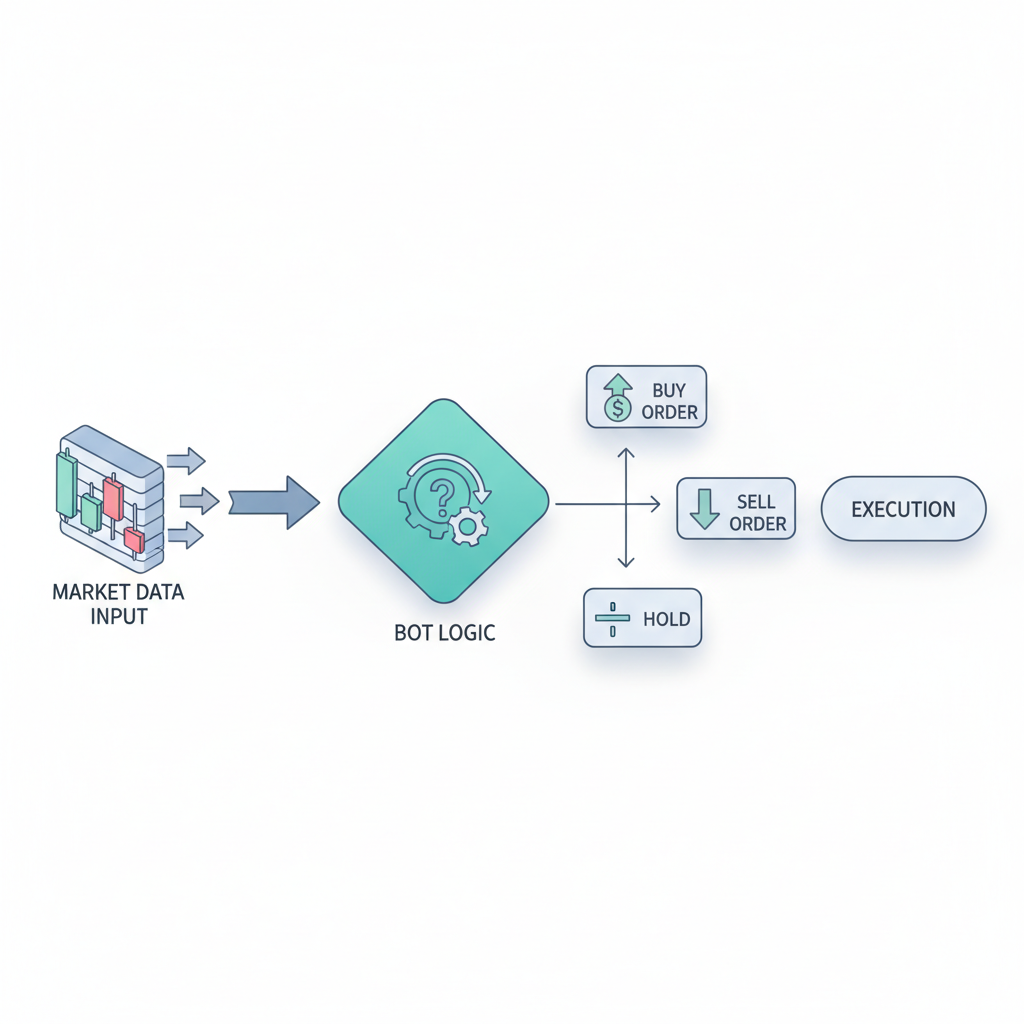
At its core, algorithmic crypto trading means you write a set of rules, hand them to a piece of software, and the software executes trades on your behalf without you needing to be at a screen. The rules might be simple (“buy $200 of BTC when the 50-day moving average crosses above the 200-day”) or deeply complex (multi-factor momentum models across a dozen pairs), but the principle is the same: a mathematical model drives the decisions, not your gut.
The appeal for Australian traders is obvious. Crypto markets don’t close at 4pm Sydney time. They run through Christmas, through the long weekend, through the RBA announcement that sends everything sideways at 2:30am. A bot doesn’t care. It just executes.
This matters for emotion management too. Anyone who has panic-sold ETH at the bottom of a flash crash, or held through a 60% drawdown because they “believed in the project,” knows the damage that human psychology does to trading results. Removing that is a genuine edge, not a marketing line.
The Australian regulatory and tax environment adds a layer of complexity that traders in some other jurisdictions don’t face. The ATO treats every trade as a CGT event (or income, depending on your circumstances), AUSTRAC now classifies crypto businesses as Virtual Asset Service Providers, and a brand-new licensing regime kicks in from April 2027. All of that affects how you set up your algo operation, which platform you use, and how you record your activity. The sections below cover each of those in detail.
How Crypto Algo Trading Works: Core Mechanics
The basic plumbing is straightforward once you understand it. Your bot connects to an exchange via API keys, which are essentially a username and password that grant programmatic access to your account. The exchange streams real-time market data to the bot, including current prices, order book depth, and recent trade history. The bot monitors that feed and acts when its conditions are met.
A simple rule might look like this in logic: if the price of ETH/AUD drops 3% within a 15-minute candle and the RSI is below 35, place a buy order for $500 at market price. If the price rises 5% from entry, place a sell order. If it falls another 4%, exit to limit losses. That entire sequence executes in milliseconds, which no human trader can match manually.
Back-testing is the step most beginners skip, and it is where a lot of money gets lost. Before you run any strategy live, you should test it against historical price data to see how it would have performed. Most serious platforms include a back-testing engine. The catch is a concept called curve-fitting: if you optimise your strategy too tightly against past data, it will look brilliant in the back-test and fail immediately in live markets because you’ve essentially memorised history rather than found a real pattern.
Paper trading, or demo mode, is the next step. Several Australian-accessible platforms let you run your bot against live market conditions without committing real capital. I always recommend at least four weeks of paper trading before going live, ideally across a period that includes both trending and choppy market conditions.
On security, this point cannot be overstated. Your API keys should be set to trade-only permissions, never withdrawal permissions. If someone compromises your bot and the keys can’t move funds off the exchange, your downside is limited to whatever position they might open. Withdrawal-enabled keys are an open invitation to lose everything. Store them in a secrets manager, not in a plain text config file.
Popular Algorithmic Trading Strategies for Crypto
Trend-Following and Momentum
The two most common strategies for retail algo traders are trend-following and momentum trading, and they are related but distinct. Trend-following systems identify that a market is moving in a direction and ride it, typically using moving averages or channel breakouts as signals. Momentum strategies enter in the direction of strong recent price moves, betting that what has been moving fast will keep moving fast for a little longer.
Both work reasonably well in crypto’s historically trending markets. Both also get chopped up badly in sideways conditions, so you need filters to avoid trading during ranging periods.
Arbitrage
Arbitrage exploits price differences between exchanges. If BTC is trading at $105,000 on BTC Markets and $105,400 on Kraken simultaneously, a bot can buy on one and sell on the other. In practice, pure exchange arbitrage has become very thin because professional traders have compressed those gaps significantly. Triangular arbitrage, exploiting price inefficiencies between three trading pairs on the same exchange, is more accessible but requires fast execution and low fees.
Mean Reversion and Grid Trading
Mean reversion strategies assume that after a large price deviation from a historical average, the price will snap back. Grid trading is a practical implementation of this idea: you place a series of buy orders at fixed intervals below the current price and sell orders above it, profiting from oscillations within a range. Grid bots are popular for retail traders because they are relatively simple to configure and perform well in sideways markets, which is exactly when trend-following strategies struggle.
DCA Bots and Market Making
Dollar-cost averaging bots simply automate regular purchases at set intervals regardless of price. They are not particularly sophisticated, but they remove the temptation to time the market and are an easy entry point for people new to automated crypto trading in Australia.
Market making involves placing simultaneous buy and sell limit orders to capture the spread. This is the territory of professional operations with low-latency infrastructure, not something a retail trader running a cloud-based bot can compete in effectively. High-frequency trading sits in the same category: without co-located servers and direct market access, the edge is not there for retail participants.
Benefits and Risks of Automated Crypto Trading
The Real Advantages
The 24/7 execution point is not trivial. Some of the sharpest moves in BTC and ETH happen between midnight and 6am AEST when Australian traders are asleep. A properly configured bot doesn’t miss those moves. It also doesn’t get bored, distracted, or suddenly convinced by a Twitter thread that it should abandon its strategy.
Speed and consistency compound over time. A bot applies its rules identically on the hundredth trade as on the first. That consistency is genuinely hard for humans to replicate. The ability to run multiple pairs simultaneously, say BTC/AUD, ETH/AUD, and SOL/AUD, without cognitive overload is another real benefit. Back-testing gives you data-driven confidence before committing capital, which is more than most manual traders have.
The Genuine Risks
Curve-fitting is the biggest silent killer. A strategy that returned 300% in back-testing over 2021-2024 data might be a perfect description of the past and completely useless going forward. Always validate on out-of-sample data, meaning price history the strategy was not optimised against.
API key security is the second major risk. Compromised keys with trade permissions can wreak havoc even without withdrawal access; a malicious actor can open large leveraged positions that liquidate your account. Flash crashes and extreme volatility events can trigger large unexpected losses if your stop-loss logic has any gaps. The May 2021 and November 2022 crashes wiped out poorly configured bots that had no circuit breakers.
Platform risk is underappreciated. If your chosen exchange goes down during a volatile period, your bot cannot execute exits. If a platform loses its AUSTRAC registration or, from 2027 onwards, its AFSL, it may freeze withdrawals. Always keep position sizes that you could stomach being locked up for days.
The regulatory risk in Australia is growing more specific. From April 2027, trading on a platform that does not hold an AFSL will carry compliance implications that currently don’t exist.
Australian Crypto Platforms and Tools for Algo Trading
CryptoAlgo
CryptoAlgo is an Australian-focused platform specifically built around algorithmic trading strategies. The site notes it does not accept investors from the United States, which keeps it firmly within the Australian and international retail market. Fee structures should be confirmed directly with the platform, as specific pricing is not publicly listed in detail. Worth exploring if you want a tool designed with the Australian algo trader in mind rather than adapted from a global product.
BTC Markets
BTC Markets has been operating out of Melbourne since 2013, which in crypto years makes it ancient and battle-tested. The API is well-documented and reliable, fees are competitive (maker fees sit around 0.1% to 0.22% depending on volume tier), and the AUSTRAC registration is long established. It does not have the broadest asset selection, covering around 35+ pairs, but for traders focused on BTC and ETH with AUD, it is a solid foundation for automated crypto trading in Australia.
Kraken
Kraken is the global option that Australian traders can actually use properly, with AUD deposits and withdrawals supported. The API is comprehensive and well-regarded by developers. Fees start at 0.25% taker for standard accounts, dropping with volume. The professional trading interface and deep liquidity make it a reasonable choice for more sophisticated algo setups, including those running arbitrage or momentum strategies across multiple pairs.
Swyftx
Swyftx is where I would point someone who is new to crypto algo trading in Australia. The demo mode lets you test strategies against live market conditions without risking capital, which is genuinely useful for validation. I have been using Swyftx since 2022 and the platform has been reliably available during volatile periods, which matters when your bot needs to execute exits. The spread on BTC/AUD sits around 0.6%, which is higher than BTC Markets for pure algo execution, but the demo functionality and UI quality make it a fair trade-off for beginners.
Interactive Brokers Australia
Interactive Brokers Australia is the serious end of the spectrum. It supports algorithmic trading across a wide range of asset classes including crypto, and you can write strategies in Python, Java, C++, or use their TWS API. If you are running a multi-asset portfolio with crypto as one component, this is worth serious consideration. The compliance overhead is higher and the interface is less friendly than consumer-grade crypto exchanges, but the infrastructure quality is correspondingly better.
UltraAlgo
UltraAlgo focuses on trading indicators and algorithmic signals for retail traders rather than being a full exchange. Think of it as the strategy and signal layer that you connect to an exchange of your choice. Useful for traders who want pre-built algorithmic signals without writing their own code from scratch.
CoinSpot
CoinSpot is one of Australia’s largest exchanges by user count and offers over 530 assets, but it is primarily a retail buying platform. The algo infrastructure is limited compared to the options above, and if automated crypto trading in Australia is your primary goal, you will likely find it constraining.
Platform Comparison Table: Algo Trading Options for Australians
| Platform | AUD Support | API / Bot Access | Approx. Fees | ASIC/AUSTRAC Registered | Best For |
|---|---|---|---|---|---|
| CryptoAlgo | Yes | Yes | Confirm directly | Yes (AUSTRAC) | AU-focused algo traders |
| BTC Markets | Yes | Yes, well-documented | ~0.1–0.22% maker | Yes (both) | Serious AU algo traders, BTC/ETH focus |
| Kraken | Yes | Yes, comprehensive | 0.25% taker (standard) | AUSTRAC registered | Advanced algo setups, global liquidity |
| Interactive Brokers AU | Yes | Yes, multi-language | Variable (IBKR structure) | AFSL held | Multi-asset, professional algo traders |
| Swyftx | Yes | Limited | ~0.6% spread BTC/AUD | Yes (both) | Beginners, demo/paper trading |
| UltraAlgo | N/A | Signal layer only | Subscription-based | N/A | Retail traders wanting pre-built signals |
Notes: From April 9, 2027, all platforms serving Australian clients must hold an AFSL. Australian exchange trading fees generally range from 0.1% to 1% per trade. CryptoAlgo fee data is unverified and should be confirmed directly with the platform before committing capital.
2026 Australian Crypto Regulations Every Algo Trader Must Know
The DAF Act: What Actually Changed
The Corporations Amendment (Digital Assets Framework) Act 2026, referred to as the DAF Act, passed both houses of parliament on April 1, 2026 and received Royal Assent on April 8. It commences on April 9, 2027, giving the industry an 18-month implementation window that runs until October 2028 for full compliance.
The headline change is that every crypto exchange and custody platform serving Australian clients will need to hold an Australian Financial Services Licence. This is a significant shift from the previous regime where AUSTRAC registration (an anti-money-laundering obligation) was the primary compliance requirement. AFSL licensing involves ongoing capital requirements, dispute resolution membership, compliance frameworks, and regular ASIC reporting. Smaller platforms that cannot meet those requirements will likely exit the Australian market or be acquired.
ASIC has already signalled that many widely traded digital assets qualify as financial products under existing law, not just under the new framework. This means some providers should already hold AFSLs and have not. The DAF Act formalises and extends this, but the exposure existed before April 2026.
AUSTRAC and the Travel Rule
AUSTRAC renamed digital currency exchange providers to Virtual Asset Service Providers (VASPs) effective April 2, 2026. If your platform was already operating in Australia before March 31, 2026, it needed to re-register under the new VASP category. New businesses providing virtual asset services from March 31 onwards had to enrol with AUSTRAC by April 28, 2026. AUSTRAC maintains a searchable public register, so you can verify whether your platform is listed.
The Travel Rule is the practical change that affects everyday algo traders most directly. For any crypto transaction over $1,000, verified sender and receiver information is now automatically passed to authorities. For a bot firing off dozens of trades daily, every one of those transactions is generating a compliance record. This is not a reason to stop trading, but it is a reason to ensure your identity verification is complete on every platform you use and that your tax records are immaculate.
The ATO Is Already Watching
The ATO has established real-time API connections with licensed Australian exchanges. Every trade your bot executes, every staking reward that lands in your account, is being matched against your tax return as it happens. The days of treating crypto tax as something you figure out in June are over.
For algo traders specifically, this creates a significant record-keeping obligation. Short-term gains, meaning crypto held for less than 12 months, are taxed at your marginal income tax rate. Given that a momentum bot might hold a position for 48 hours, most of your bot’s gains will fall into this category. If you hold a position longer than 12 months, you may be eligible for the 50% CGT discount that applies to Australian individuals, but automated strategies rarely hold that long by design.
Staking rewards are treated as ordinary income at the time of receipt, valued at the AUD price at that moment. Mining income works the same way. Cost base for CGT purposes is that income value on receipt.
Banking Friction
The major Australian banks, CBA, ANZ, Westpac, and NAB, have all tightened controls on transfers to crypto exchanges. Monthly transfer caps of $10,000, multi-day holds, and outright rejections for specific exchanges are common. This affects algo traders trying to top up accounts when their strategy signals say the opportunity is there. Having your AUD sitting on your preferred exchange in advance, rather than trying to transfer on demand, is a practical workaround many experienced traders use.
[INTERNAL LINK PLACEHOLDER: ATO crypto tax obligations → /tax/crypto-tax-australia]
FAQ
What is the difference between automated and algorithmic crypto trading?
Automated crypto trading