Algorithmic Crypto Trading Australia 2026: Complete Guide
Algorithmic crypto trading Australia is no longer just something quant funds do at 3am in Sydney CBD server rooms. Retail traders running bots on Cryptohopper and Bitsgap, executing hundreds of trades a week while they sleep, are a genuine and growing part of the local market, and the regulatory environment is catching up fast.
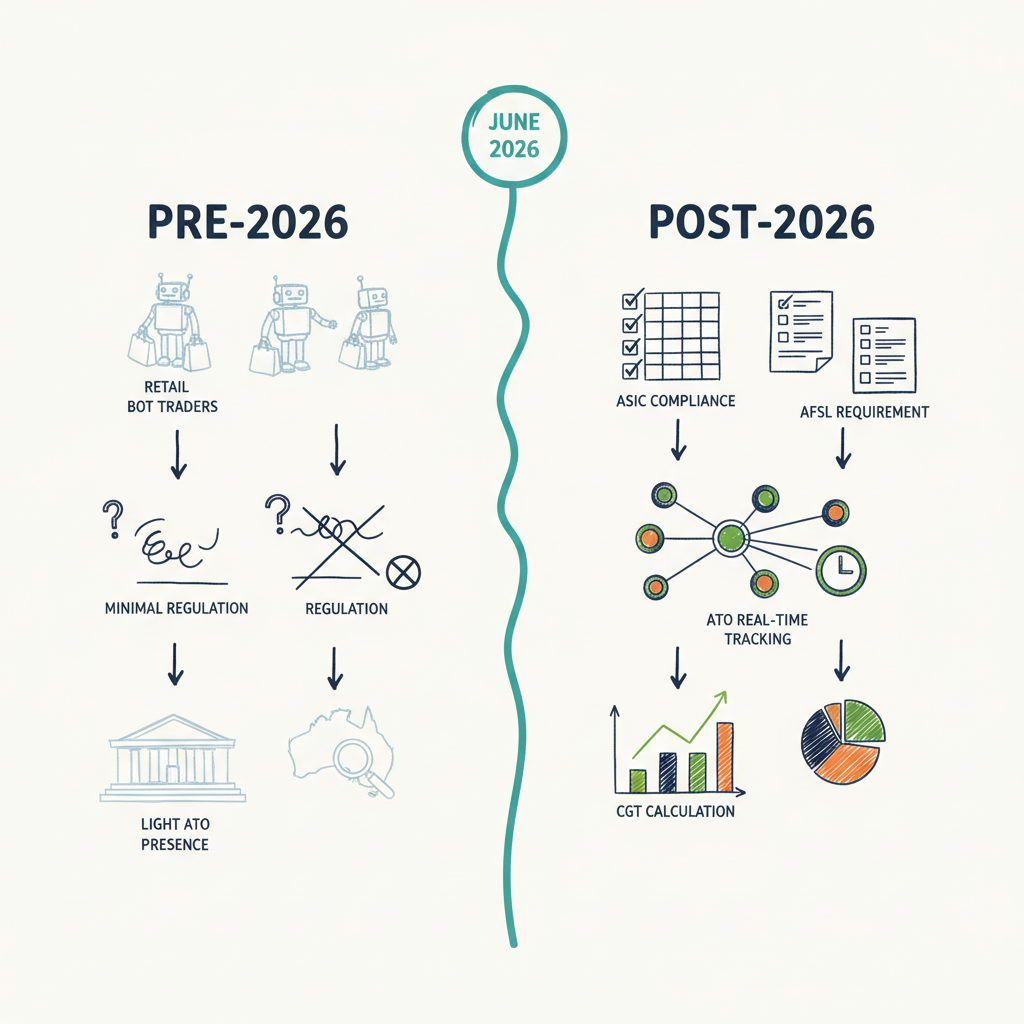
> TL;DR: Algorithmic crypto trading Australia is legal, growing, and now subject to significant new regulation. The DAF Act 2026 will require digital asset platforms to hold an AFSL from April 2027, and ASIC’s no-action relief deadline hits June 30 2026. The ATO tracks all trades in real time and most disposals trigger CGT, meaning a bot executing 500 trades a month creates 500 taxable events. This guide covers how algo trading works, which platforms Australian traders are actually using, what the new laws mean for you, and how to stay tax-compliant in 2026.
What Is Algorithmic Crypto Trading in Australia?

Algorithmic crypto trading, at its core, means using programmed strategies and mathematical models to execute trades automatically based on predefined conditions. Instead of sitting at a screen watching BTC/AUD tick up and down and making gut calls, you define rules, a bot executes them, and you review the results.
The advantages are real. Bots react in milliseconds, not seconds. They do not panic sell at 2am or second-guess a strategy because they read a bearish tweet. They run 24/7 across a market that never closes. You can also backtest a strategy against historical price data before risking a cent of real capital.
It is worth being clear about the terminology, because the terms get used interchangeably and they should not. A trading bot is the software that executes orders. An algo strategy is the logic the bot follows, whether that is a simple moving average crossover or a machine learning model trained on order book data. Copy trading is different again, where you mirror another trader’s positions rather than running your own coded strategy.
In 2026, algo trading is relevant to Australian traders for two reasons beyond personal preference. Institutional adoption is accelerating, which means retail traders who do not automate are increasingly competing against those who do. And the new regulatory framework under the DAF Act 2026 means the platforms you use will need to meet higher compliance standards. Choosing the right setup now saves pain later.
Crypto trading bots are legal in Australia. Full stop. The legal requirement is that you use them on exchanges that comply with Australian law, specifically AUSTRAC registration and, from April 2027, AFSL requirements.
How Crypto Trading Bots Work: Strategies and Mechanics
Most traders start with one of five bot types, each suited to different market conditions and risk tolerances.
Grid bots place a ladder of buy and sell orders within a defined price range. If BTC/AUD bounces between $140,000 and $150,000, a grid bot profits from each oscillation. They work well in ranging markets and poorly in strong trends. DCA bots (Dollar Cost Averaging) buy fixed amounts at regular intervals or after price drops by a set percentage, reducing average entry cost over time. They are low-drama and reasonably beginner-accessible. Martingale bots double position size after a loss, aiming to recover on the next winning trade. They can be effective but carry serious drawdown risk, and I would not run one without hard position-size limits set in advance.
Arbitrage bots exploit price differences between exchanges, buying low on one and selling high on another simultaneously. The margins are thin and execution speed is critical. Signal-based bots act on external triggers, typically TradingView alerts, technical indicators, or data feeds, and execute when conditions are met.
Bots connect to exchanges through APIs. You generate an API key on the exchange, feed it into the bot platform, and the bot places orders on your behalf without ever needing your login credentials. One non-negotiable: restrict the API key to trading only. Do not grant withdrawal permissions. If the bot platform is compromised, an attacker with a trading-only key can move your portfolio around but cannot drain your funds off the exchange.
Before running a strategy live, use the backtesting function to run it against historical data, then paper trade (simulated live trading with no real money) for at least two to four weeks. Strategies that look brilliant in backtesting often underperform live due to slippage, fees, and market conditions the historical data did not capture.
Risk management features to look for: stop-loss orders, take-profit targets, and position sizing controls. Newer platforms including Cryptohopper and WunderTrading are integrating AI and machine learning to adapt strategies dynamically, though the evidence on whether these outperform simpler approaches at the retail level is mixed.
One thing specific to Australia: your bot needs to connect to an exchange that is AUSTRAC-registered. If you are routing AUD through a non-registered exchange, you are operating outside compliant channels regardless of how well the bot performs.
Top Algorithmic Crypto Trading Platforms Available in Australia (2026)
The honest answer is that no single platform is perfect for every Australian algo trader. The right choice depends on which exchange you want to trade on, your technical comfort level, and how seriously you take regulatory compliance.
| Platform | Bot Types | Monthly Fee (AUD approx.) | AUD Support | AUSTRAC/AFSL Status | Best For |
|---|---|---|---|---|---|
| Cryptohopper | Grid, DCA, Signal, Copy, AI | ~$30–$130 | Via connected exchange | Connects to AUSTRAC-registered exchanges | Mid-level traders wanting full feature set |
| Bitsgap | Grid, DCA, BTD, Combo | ~$28–$115 | Via connected exchange | Connects to AUSTRAC-registered exchanges | Clean UI, multi-exchange management |
| WunderTrading | Signal, Grid, DCA, AI | Free tier available, ~$28–$70 paid | Via connected exchange | Connects to AUSTRAC-registered exchanges | TradingView signal users |
| OKX | Spot Grid, DCA, Martingale | Built into platform | Limited direct AUD | Working toward AFSL compliance | Traders already on OKX |
| Binance | Grid, DCA, TWAP, VP | Built into platform | BinanceAU PayID support | AUSTRAC registered (AU entity) | High-volume traders, low fees |
| MEXC | Grid, Copy | Built into platform | Limited AUD on-ramp | AUSTRAC registration — verify directly | Ultra-low fee traders (0% maker) |
Cryptohopper is the most feature-complete third-party bot platform accessible in Australia. It supports over 75 exchanges, includes a marketplace for strategies and templates, and has decent backtesting tools. The AI-assisted strategy optimisation is worth exploring, though treat it as a starting point rather than a finished product.
Bitsgap has a cleaner interface and is particularly good at managing multiple exchange accounts from one dashboard. If you are running bots across Binance and Kraken simultaneously, the unified view is genuinely useful. Their Grid bot is one of the more reliably implemented versions I have seen.
WunderTrading is worth considering specifically if you use TradingView for analysis. The signal-to-bot pipeline, where a TradingView alert automatically triggers a trade on your exchange, is smooth and does not require coding. The free tier covers basic use cases.
For exchanges with native bot functionality, OKX and Binance are the most capable. Binance’s Australian entity is AUSTRAC registered and accepts AUD deposits via PayID, which matters for smooth on-ramping. MEXC offers genuinely low fees (0% maker, 0.05% taker for spot) but the AUD on-ramp situation is less straightforward and you should verify their current AUSTRAC and compliance status directly before committing capital.
On the broader algo trading side, Interactive Brokers Australia and Oanda support algorithmic strategies through proper APIs, though they focus on traditional assets and FX rather than crypto specifically. Capital.com integrates with TradingView and offers crypto CFDs, but CFDs carry different risk and tax treatment than spot crypto.
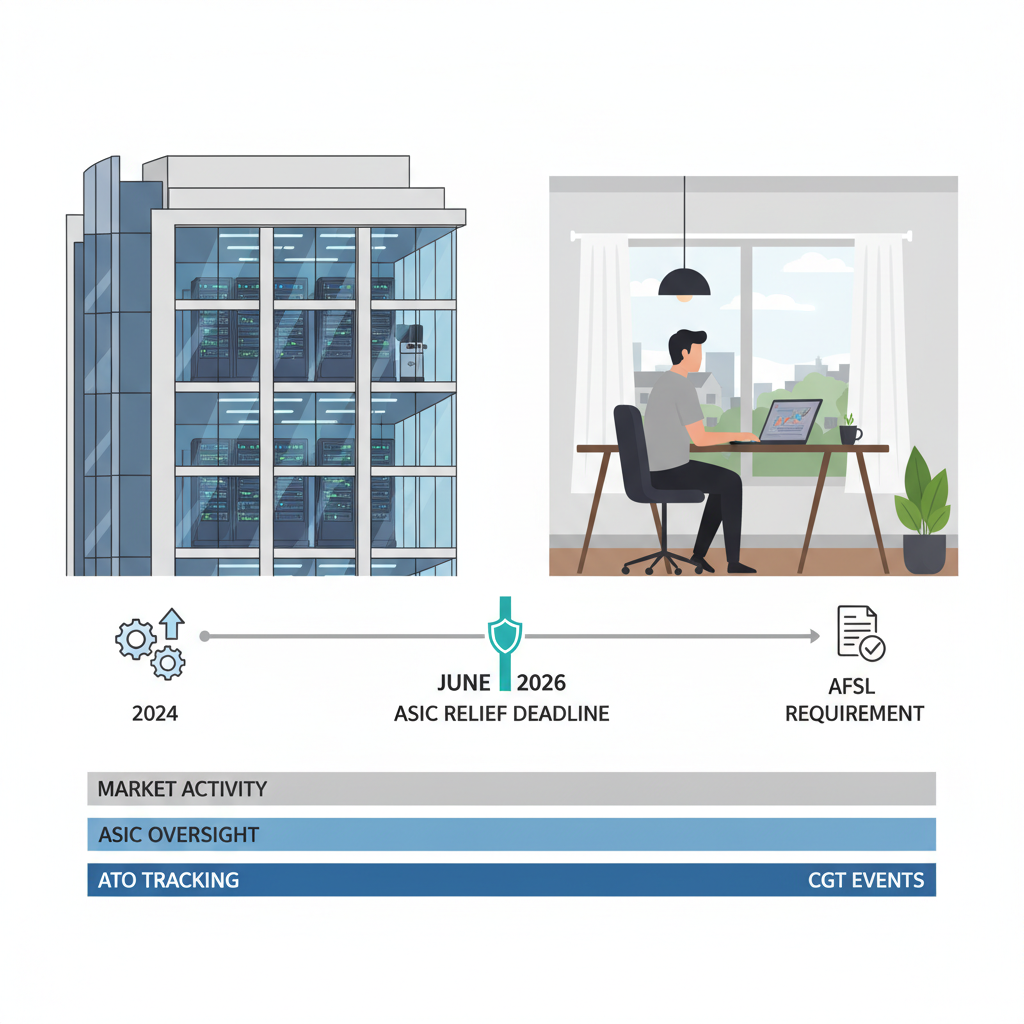
The deadline you need to know: ASIC’s no-action relief for businesses operating without an AFSL expires June 30 2026. After that date, platforms that have not applied for AFSL authorisation are in a grey zone. When choosing a bot platform or exchange, check whether they are actively pursuing AFSL compliance. Reputable platforms will have public statements on this. If a platform cannot answer the question, that tells you something.
[INTERNAL LINK PLACEHOLDER: ‘best crypto exchanges Australia’ → /best-crypto-exchanges-australia]
New Australian Crypto Regulations in 2026: What Algo Traders Must Know
The regulatory shift that has been coming for years landed in April 2026. The Corporations Amendment (Digital Assets Framework) Act 2026, known as the DAF Act, passed on April 1 2026 and received Royal Assent on April 8 2026. The Act commences on April 9 2027, giving industry a 12-month runway to get licensed.
Under the DAF Act, Digital Asset Platforms (DAPs) and Tokenised Custody Platforms (TCPs) must hold an Australian Financial Services Licence with the appropriate authorisations. This brings crypto exchanges and custody providers under the same licensing regime as managed funds and stockbrokers. For consumers, it means platforms holding your funds will face capital adequacy requirements, dispute resolution obligations, and AFS duty of care standards.
ASIC has an 18-month implementation roadmap. An industry advisory group was established in Q2 2026, with consultation on operational standards and guidance running through late 2026 and into 2027. Expect detailed rules on custody, technology requirements, and product disclosure to emerge through this period.
The no-action relief is the critical near-term deadline. To operate lawfully during the transition and avoid enforcement action, businesses dealing in digital assets must apply for an AFSL before June 30 2026. If they submit a compliant application before that date, ASIC will generally not take action while the application is assessed. Businesses that miss the June 30 date lose that protection. As a trader, this means you should be using platforms that have publicly committed to applying for AFSL by June 30. Any exchange or bot platform that dismisses the question is one to avoid.
AUSTRAC registration remains the baseline. Every exchange operating in Australia must be registered with AUSTRAC for AML/CTF compliance, regardless of the new AFSL requirements. These are separate obligations and both matter.
The travel rule, now in effect for 2026, requires that crypto transactions over $1,000 carry verified sender and receiver information passed to relevant authorities automatically. If your bot is executing high-frequency trades or moving funds between wallets, the exchange is responsible for collecting and transmitting this data, but you should be aware it is happening. Privacy expectations around crypto transactions have changed materially.
[INTERNAL LINK PLACEHOLDER: ‘AFSL crypto Australia’ → /afsl-crypto-australia]
AUSTRAC, Banking Rules, and What They Mean for Automated Trading
Running a crypto trading bot is not just a technical exercise. The AUD moving in and out of your exchange account touches a banking system that has become progressively less friendly to crypto over the past few years.
AUSTRAC registration is the minimum compliance bar for any exchange you should be using. Registered exchanges operate AML/CTF programs, report suspicious transactions, and maintain records. The list of registered exchanges is publicly searchable on the AUSTRAC website. If an exchange is not on it, do not fund it with AUD.
The banking side is more frustrating. Australian banks have been implementing monthly caps on transfers to crypto exchanges, with figures around $10,000 per month appearing at multiple institutions. Some have blocked transfers to specific exchanges outright. Account closures for customers with heavy crypto activity have not been uncommon. This is not random, it is driven by AML/CTF obligations and pressure from AUSTRAC to reduce scam-related fund flows. It is also genuinely inconvenient for legitimate traders.
For algo traders specifically, the issue is that frequent automated buy/sell activity can look unusual in transaction monitoring systems, particularly if your bot is on-ramping and off-ramping regularly. A few practical approaches help. Use PayID for smaller AUD deposits since it is faster and creates a cleaner transaction trail than standard bank transfers. Keep a working AUD balance on exchange rather than repeatedly cycling in and out. Exchanges with strong, established banking relationships, such as Independent Reserve and BTC Markets, have historically had fewer banking disruption issues than smaller or newer platforms.
The travel rule creates additional operational context for high-frequency strategies. If your bot is executing dozens of transactions per hour and each one over $1,000 triggers automated data reporting, those records are being held and could be reviewed. This is not a reason to stop trading; it is a reason to trade on compliant platforms where the reporting is handled correctly, and to keep your own records clean.
Crypto Tax in Australia 2026: How Algo Trading Is Taxed
This section matters more for algo traders than for almost anyone else in the crypto market, because bots multiply the number of taxable events dramatically.
The ATO treats crypto as property. Every time you dispose of it, whether by selling to AUD, swapping one token for another, gifting it, or using it to buy something, you have a CGT event. Each event requires you to calculate the capital gain or loss using the asset’s cost base versus the proceeds at the time of disposal. A bot executing 20 trades per day creates 20 CGT events per day, around 7,300 per year. Do not pretend this is manageable in a spreadsheet.
The 50% CGT discount applies to assets held by individuals for 12 months or more. If you are running a grid bot that buys and sells BTC every few days, none of those positions will qualify for the discount. Every gain is fully assessable. This is not a dealbreaker, but it factors into whether certain long-term holding strategies make more after-tax sense than active bot trading depending on your personal situation.
Staking rewards, mining income, airdrops, and crypto received as payment are taxed as ordinary income at your marginal rate, assessed at the AUD value on the date received. If your bot strategy involves staking earned rewards, the receipt is a taxable income event and a subsequent disposal is a CGT event.
The ATO is not working from honour-system disclosures. Since 2025, the ATO has had real-time API connections to licensed Australian exchanges. Your trade history, staking rewards, and on-chain activity are visible to them. Omitting trades is not a viable strategy.
The business versus hobby distinction is something serious algo traders need to think about. If you are running automated strategies at scale, reinvesting profits, and treating it with the intent of making a profit, the ATO may classify you as running a crypto trading business rather than an individual investor. Business classification means gains are taxed as income rather than CGT, meaning no 50% discount, but it also means trading costs, platform fees, and relevant software subscriptions may be deductible. This is not a bright-line rule and the facts of your individual situation matter.
For reconciling bot activity, use dedicated crypto tax software. Koinly handles API imports from most major exchanges and bot platforms, automatically matching trades and calculating cost bases. CoinTracker is another solid option. Both are used widely by Australian traders and support AUD cost base calculations. Your accountant will thank you for arriving with a Koinly report rather than a CSV export from your bot.
Keep records at minimum covering: date and time of each trade, AUD value at the time (not just the crypto amount), fees paid, the exchange and bot platform used, and your wallet addresses. The ATO expects you to hold these for five years.
[INTERNAL LINK PLACEHOLDER: ‘crypto tax Australia guide’ → /crypto-tax-australia]
Risks of Algorithmic Crypto Trading and How to Manage Them
Anyone selling you algo trading as passive income with no downside is selling something. The risks are real, and in the Australian context some of them have local-specific flavours.
Market risk is the obvious one. Bots do not understand macroeconomic context. A grid bot running a tight BTC/AUD range will get destroyed if BTC drops 30% out of range. Properly configure stop-losses and define maximum drawdown limits before you go live. Test your settings in paper trading first.
Technical risk includes API outages, exchange downtime, and bot bugs. In 2024, multiple Australian traders were caught with open positions when a major exchange briefly suspended its API during a high-volatility period. Your bot cannot close a position it cannot communicate with the exchange to close. Set fallback alerts and check your positions at least once a day regardless of how automated your setup is.
Security risk from API key exposure is underappreciated. If you are using a third