Algorithmic Crypto Trading Australia 2026: Your Complete Guide
Algorithmic crypto trading in Australia has moved well past the “early adopter curiosity” phase. I have been running automated strategies on Australian exchanges since 2022, and the shift in platform maturity, regulatory seriousness, and trader sophistication over that period has been significant. If you are still manually watching charts at 2am because BTC decided to move, there is a better way.
> TL;DR
> Algorithmic crypto trading in Australia lets you automate buy and sell decisions using programmed rules, running 24/7 without emotional bias. In 2026, the regulatory environment has been reshaped by new AFSL licensing requirements under the Corporations Amendment (Digital Assets Framework) Act 2026, expanded AUSTRAC oversight, and ATO capital gains rules that apply to every single automated trade your bot executes. This guide covers how algo trading works, the top platforms available to Australians, what fees actually cost you at scale, tax obligations, and what the regulatory changes mean in practice.
What Is Algorithmic Crypto Trading in Australia?

Algorithmic crypto trading in Australia means using software to automatically execute trades based on pre-programmed rules and mathematical models, without you needing to place each order manually. The software monitors price feeds, applies your defined logic, and fires orders directly to an exchange, typically within milliseconds.
The 24/7 nature of crypto markets is the single strongest argument for automating. The ASX closes at 4pm. BTC does not. For Australian traders, that means meaningful price action happens overnight, during work hours, and across weekends with equal frequency. A manual trader either sleeps through it or burns out trying not to. An algo runs continuously regardless.
The core advantages are straightforward: execution is faster than any human, decisions are made without fear or greed interfering, the strategy monitors markets around the clock, and you can backtest your rules against historical data before risking a dollar. Those are genuine benefits, not marketing copy.
The range of what counts as “algo trading” is wide. At the simple end, a rule like “buy ETH when the 50-day moving average crosses above the 200-day moving average” qualifies. At the complex end, quantitative hedge funds run statistical models processing thousands of signals simultaneously. Most retail traders sit somewhere in the middle: rule-based bots with a handful of defined conditions.
From a regulatory standpoint, individual Australians do not need a special licence to use algo trading tools for their own account. The obligations fall on the platforms providing those tools. As of 2026, that means compliance with both ASIC requirements and AUSTRAC registration, which I will cover in detail later.
How Algorithmic Crypto Trading Strategies Work
Strategy choice matters more than platform choice. The best execution environment in the world will not save a poorly designed strategy.
Trend-following is the most widely used approach and the most intuitive starting point. These strategies use indicators like moving average crossovers or momentum signals to identify an established price direction and enter trades aligned with it. The logic is simple: prices that are rising tend to keep rising for a while. The weakness is that trend-following strategies get chopped up in sideways, range-bound markets where signals fire constantly but price goes nowhere.
Arbitrage exploits price differences for the same asset across different venues. If BTC/AUD is trading at $145,000 on Swyftx and $145,400 on CoinSpot, a fast enough bot can buy on the cheaper exchange and sell on the more expensive one, pocketing the difference minus fees. In practice, pure arbitrage opportunities are razor-thin and disappear quickly. Execution speed, withdrawal limits, and fee structures all eat into the edge. With multiple Australian and international exchanges operating simultaneously, the opportunity exists, but it requires low latency infrastructure to capture reliably.
Market-making involves placing simultaneous limit orders on both the buy and sell side of the order book, collecting the spread as compensation for providing liquidity. This is how professional market makers operate. For retail traders, it requires exchanges with maker-taker fee structures where adding liquidity is rewarded, and it carries inventory risk if price moves sharply in one direction.
Mean-reversion strategies assume that prices drift away from a historical average and will eventually return to it. If ETH drops 8% in an hour with no fundamental news, a mean-reversion bot might enter a long position expecting recovery. These strategies perform well in stable conditions and poorly in genuine trend breaks, where “reversion” becomes a prolonged loss.
Grid trading places buy and sell orders at fixed price intervals above and below a set price, profiting from repeated oscillations within a range. It works well in volatile but range-bound conditions. It bleeds badly in a sustained trend because the bot accumulates a large position in the wrong direction.
Before deploying any of these live, backtesting against historical data is non-negotiable. Most platforms covered below include backtesting tools. Run your strategy across at least 12 months of data, including a volatile period like late 2024, before trusting it with real capital.
One honest note: past performance does not predict future results, and algorithmic trading does not eliminate risk. It replaces emotional risk with model risk. That is a different problem, not a smaller one.
Top Platforms for Algorithmic Crypto Trading Available to Australians
The platforms available to Australian algo traders fall into a few distinct categories: dedicated algo platforms, international CFD brokers with bot support, and Australian spot exchanges with API access.
Dedicated Algo Platforms
UltraAlgo is a cloud-based platform that supports crypto alongside stocks, options, and forex. It offers real-time market data, one-click optimisation, backtesting, and a paper trading mode that lets you run strategies against live markets without risking capital. The paper trading feature alone makes it worth evaluating if you are building a new strategy. It is US-focused in origin, but accessible to Australian users.
SpeedBot is built specifically for crypto algo trading. It lets you design custom strategies, run backtests, and connect multiple exchange accounts simultaneously. The multi-exchange connectivity is genuinely useful for anyone running arbitrage or wanting to diversify execution across venues.
International Brokers with Algo Support
IC Markets supports Expert Advisors through MetaTrader 4 and MetaTrader 5, which means the entire MT4/MT5 algo ecosystem is available to you. Spreads are tight, execution is fast, and it is one of the better-known Australian-based brokers (headquartered in Sydney, AFSL licensed). Better suited to experienced traders who already understand the MT4 environment.
Capital.com offers over 100 crypto CFDs with no commissions, an AI-powered trading assistant, and integration with both TradingView and MetaTrader. The CFD structure means you are not buying spot crypto, which has tax and ownership implications worth understanding before you start. It is a competent platform for traders comfortable with CFDs and who want broad crypto exposure with algo tooling built in.
eToro takes a different approach. Its copy trading feature lets you automatically replicate the trades of other investors, which is technically a form of automated trading. It holds an AFSL in Australia and is registered with AUSTRAC. Not a platform for running your own coded strategies, but legitimate and accessible for traders who want automation without writing a line of code.
Australian Spot Exchanges
Swyftx is where I have done the bulk of my own trading since 2022. It offers over 420 assets, a demo mode, and integrated tax reports, which is genuinely useful at tax time when your bot has executed hundreds of trades. Native algo support is limited, but the API is accessible for connecting third-party bots. The spread on BTC/AUD typically sits around 0.6%.
CoinSpot is one of Australia’s oldest exchanges with strong brand recognition. It offers API access and fees from 0.1% on market orders, which makes it viable for bot trading. The interface is more retail-focused than trader-focused.
Binance Australia offers spot and margin trading. Derivatives are no longer available to Australian users following regulatory changes, so if your strategy relied on futures or options on Binance, you will need to look elsewhere for that component.
Platform Comparison Table: Algorithmic Crypto Trading Options in Australia
| Platform | AFSL/AUSTRAC Status | Algo/Bot Support | Asset Types | Typical Fees | Best For |
|---|---|---|---|---|---|
| UltraAlgo | International (US-based) | Native, full-featured | Crypto, stocks, forex | Subscription-based | Strategy builders wanting backtesting + paper trading |
| SpeedBot | International | Native, full-featured | Crypto | Subscription-based | Custom strategy design, multi-exchange bots |
| IC Markets | AFSL + AUSTRAC | MT4/MT5 Expert Advisors | Crypto CFDs, forex, indices | Spreads from 0.1 pip | Experienced MT4/MT5 traders |
| Capital.com | AFSL + AUSTRAC | TradingView + MetaTrader integration | 100+ crypto CFDs | No commissions (spread-based) | CFD traders wanting broad crypto access |
| eToro | AFSL + AUSTRAC | Copy trading only | Crypto spot + CFDs | Spread-based, 1%+ on crypto | Beginners wanting automated copying |
| Swyftx | AUSTRAC registered | API access (third-party bots) | 420+ crypto (spot) | ~0.6% spread on BTC | Australian spot trading, tax reporting |
| CoinSpot | AUSTRAC registered | API access | 350+ crypto (spot) | From 0.1% (market orders) | Long-term Australian holders, simple bots |
| Binance Australia | AUSTRAC registered | API access | Spot + margin (no derivatives) | 0.1% spot, varies | Active spot traders, margin strategies |
A few things worth flagging on this table. The platforms offering CFD exposure (IC Markets, Capital.com, eToro for some assets) are already subject to full AFSL requirements because CFDs are classified as financial products under existing law. The new Digital Assets Framework Act 2026 extends AFSL obligations to spot crypto platforms from April 2027. Demo and paper trading availability is a meaningful differentiator: if you cannot test a strategy in a simulated environment before going live, you are taking on unnecessary risk.
Fees compound aggressively in high-frequency strategies. A 0.2% taker fee sounds trivial. Across 200 trades per month, it becomes a significant drag on performance that your strategy must overcome before it generates a cent of profit.
[INTERNAL LINK PLACEHOLDER: “Swyftx review” → /reviews/swyftx]
[INTERNAL LINK PLACEHOLDER: “CoinSpot review” → /reviews/coinspot]
[INTERNAL LINK PLACEHOLDER: “Binance Australia review” → /reviews/binance-australia]
Fees and Spreads: What Algorithmic Traders Pay on Australian Crypto Platforms
Fees matter more for algo traders than for any other participant in the market. A strategy that is profitable at 0.1% per trade may lose money at 0.25%, and a bot that fires 50 trades a day will find out the hard way.
Trading fees on Australian platforms typically range from 0.1% to 1% per trade. Maker fees, charged when your order adds liquidity to the order book by sitting as a limit order, are generally lower at 0.1% to 0.25%. Taker fees, charged when your order removes liquidity by filling immediately against existing orders, tend to run higher. Most simple bots default to market orders, which means taker fees apply. If your strategy allows it, using limit orders instead can meaningfully reduce cost.
Instant buy and sell orders on exchanges like Swyftx and CoinSpot typically attract fees closer to 1%, because the exchange is taking on the spread as an intermediary. Bots using this order type need strategies with enough edge to absorb that cost.
AUD deposit fees are generally free via PayID and direct bank transfer, which is what most Australian traders use. Card deposits attract around 1.22% on most platforms. PayPal deposits sit around 0.5% where available. This is not a significant cost for a single deposit, but worth knowing.
AUD withdrawal to an Australian bank account is typically free on major platforms. Instant PayID withdrawals may incur a small fee. Withdrawals to overseas accounts can cost up to $25. For algo traders who are not moving fiat constantly, this rarely becomes a major expense.
Crypto withdrawal fees (gas fees) vary by blockchain and network congestion. Moving assets between wallets or exchanges as part of an arbitrage strategy is where these costs bite. Ethereum gas fees during busy periods can make small arbitrage profits disappear entirely. Strategies that require frequent cross-exchange asset movement need to account for gas costs explicitly.
Spreads on BTC/AUD typically sit between 0.1% and 0.8% on major Australian exchanges under normal conditions, widening during sharp market moves. At 0.6% spread plus a 0.2% taker fee, you are paying 0.8% round-trip on a trade before any profit is possible.
To make this concrete: a strategy executing 100 trades per month with $1,000 average position size, paying 0.4% per trade in combined fees and spread, costs $400 per month in friction. Your strategy needs to generate more than $400 in gains on $1,000 of capital before you are ahead. That is a demanding hurdle, and it is why fee structure needs to be part of strategy design from the start, not an afterthought.
Where possible, use maker orders, trade on exchanges with the lowest taker fees for your asset class, and run fee sensitivity analysis as part of backtesting.
[INTERNAL LINK PLACEHOLDER: “crypto exchange fees Australia” → /guides/crypto-exchange-fees-australia]
Australian Crypto Regulations in 2026: What Algo Traders Must Know
The regulatory environment for crypto in Australia changed substantially in 2026, and understanding it matters whether you are an individual trader or considering building a platform.
The Corporations Amendment (Digital Assets Framework) Act 2026
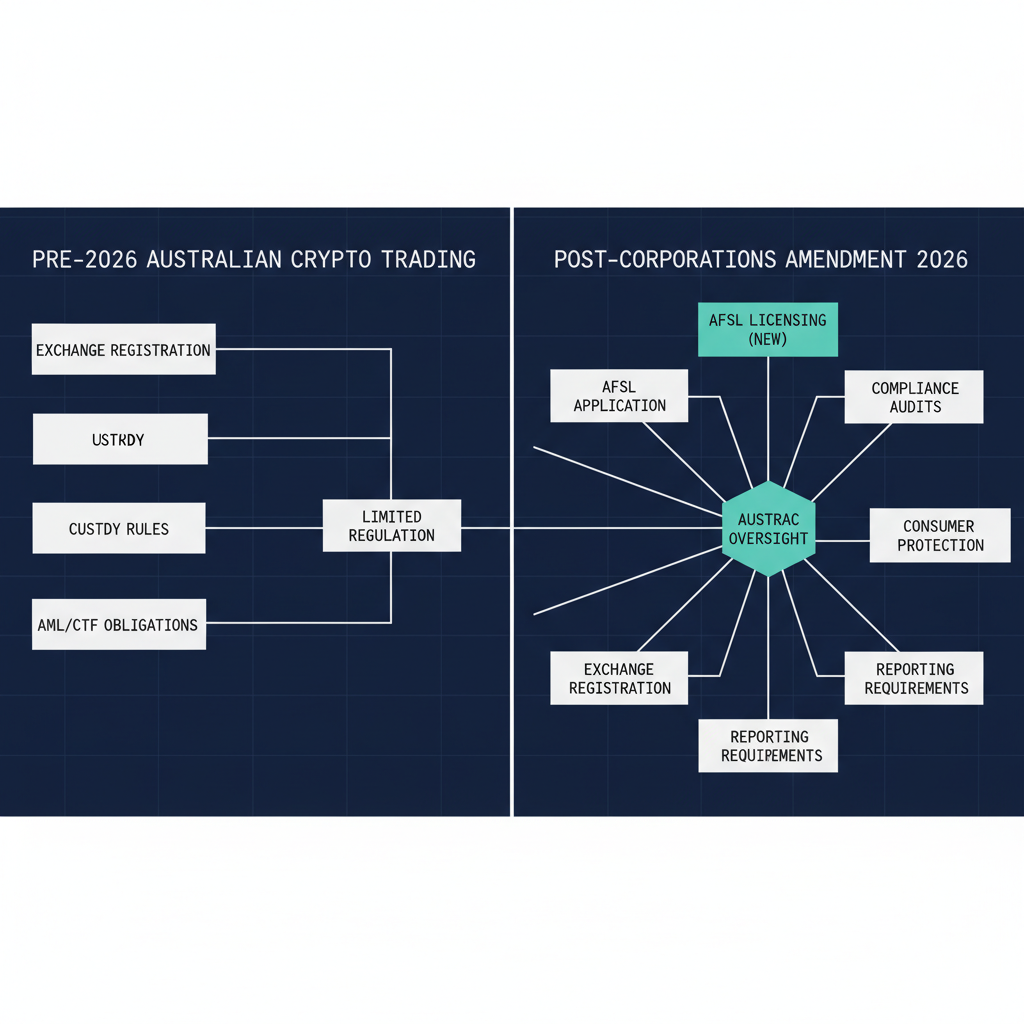
The most significant structural change is the Corporations Amendment (Digital Assets Framework) Act 2026. The bill passed both houses of parliament on 1 April 2026 and received Royal Assent on 8 April 2026. It commences on 9 April 2027.
From that date, digital asset platforms (DAPs) and tokenised custody platforms (TCPs) operating in Australia will be required to hold an Australian Financial Services Licence. This is a significant shift. Previously, AFSL requirements applied to crypto only where the assets were classified as financial products (derivatives, managed funds, etc.). The new framework extends licensing to spot crypto exchange and custody operations.
For individual algo traders, the practical implication is this: from April 2027, the platforms you use for automated crypto trading in Australia should hold an AFSL, not just AUSTRAC registration. Spot exchanges that are currently AUSTRAC-registered only will need to upgrade their compliance posture or exit the market.
ASIC has provided a no-action position until 30 June 2026, giving firms time to prepare licence applications under existing guidance. On 21 April 2026, ASIC released a detailed implementation roadmap covering stakeholder roundtables, an industry advisory group, and planned consultation on operational standards and guidance throughout Q2 and later in 2026. The pace is deliberate rather than rushed, which gives platforms reasonable transition time.
AUSTRAC and VASP Obligations
AUSTRAC’s role has expanded alongside the AFSL changes. Digital Currency Exchange providers have been formally renamed Virtual Asset Service Providers (VASPs) under the updated AML/CTF framework, effective 2 April 2026.
All VASPs operating in Australia must be registered with AUSTRAC. Obligations include developing and maintaining an AML/CTF program, implementing know-your-customer (KYC) procedures for all users, and reporting suspicious matters to AUSTRAC. These are not new obligations in spirit, but the renaming and tightening of the framework has given AUSTRAC clearer grounds for enforcement. Operating a VASP without registration is a criminal offence, and AUSTRAC cancelled several registrations in early 2026.
For algo traders, the verification requirements this creates are worth knowing about. When you connect a third-party bot to an exchange via API, you are still using an account that has gone through KYC. The bot does not change your compliance obligations as an individual.
What This Means in Practice
Use only AUSTRAC-registered platforms. Before 9 April 2027, verify which platforms have applied for or obtained an AFSL under the new framework. For CFD-based algo trading (IC Markets, Capital.com), AFSL requirements already applied under existing financial services law, so those platforms are already operating within the full licensing regime.
[INTERNAL LINK