Crypto Algo Trading in Australia 2026: Complete Guide for Aussie Traders
Crypto algo trading in Australia has moved well past the “early adopter” phase. Retail traders are running bots on Swyftx and Kraken via API, institutions are deploying systematic strategies across multiple exchanges, and unfortunately, scammers have noticed the interest and set up shop accordingly. If you are thinking about automating your crypto trading, the landscape here has some specific wrinkles, from AUSTRAC registration requirements to ATO tax obligations on every single automated swap, that you need to understand before you connect an API key to anything.
> TL;DR
> Crypto algo trading in Australia uses automated, rules-based strategies to execute trades without emotion. While legal and growing, Australian traders must use AUSTRAC-registered platforms, understand ATO tax obligations on every trade, and stay alert to unregulated scam platforms. This guide covers how it works, which strategies suit Aussie markets, what regulations apply, and how to pick a legitimate platform.
What Is Crypto Algo Trading in Australia and How Does It Work?
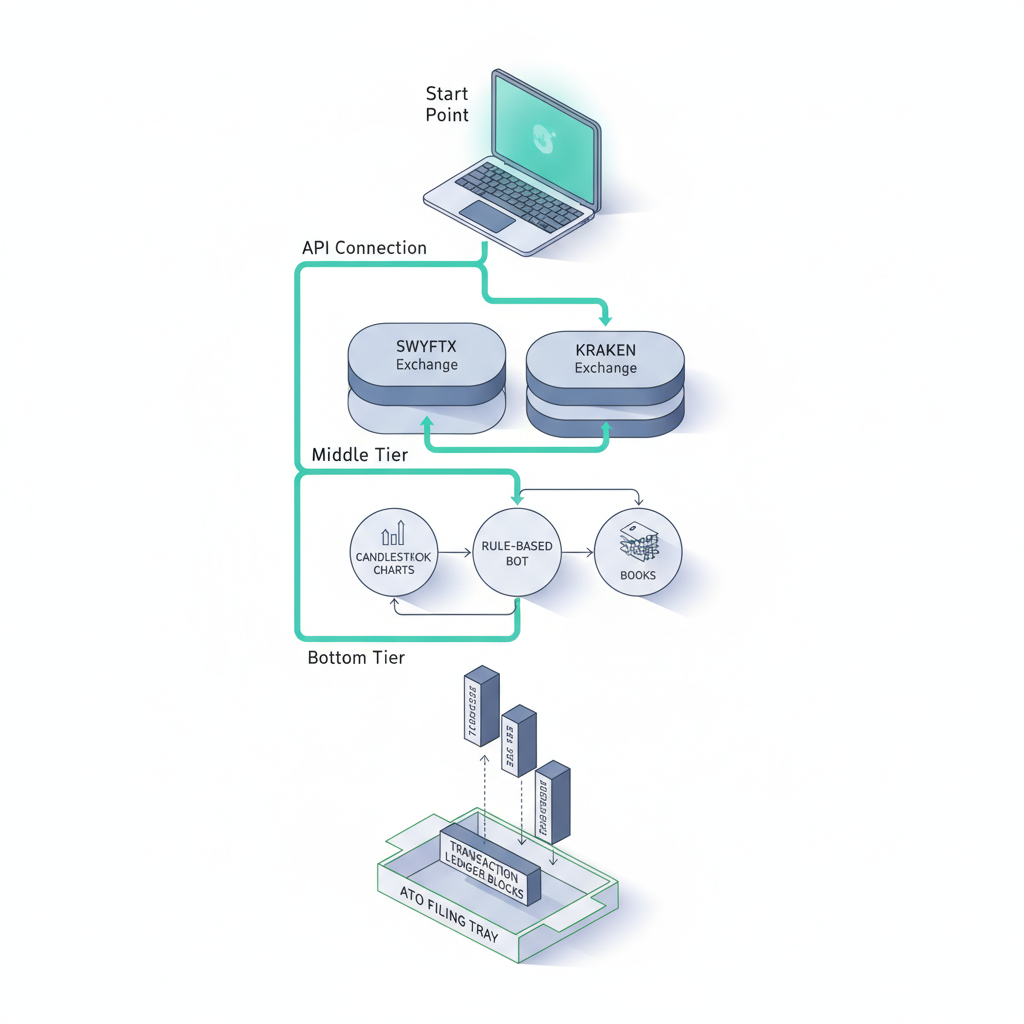
Crypto algo trading in Australia refers to the use of programmed rules and mathematical models to automatically execute buy and sell orders without you sitting at a screen making each decision manually. You define the conditions, the software watches the market 24/7, and when conditions are met, the trade fires. No hesitation, no second-guessing, no panic-selling at 3am.
The mechanics are straightforward. You connect a trading bot or custom script to a crypto exchange using an API key. The bot pulls live price data from the exchange, runs it through your strategy logic, and sends order instructions back when the conditions match. Most retail traders in Australia are doing this through platforms like 3Commas or Cryptohopper, which offer visual strategy builders and connect to exchanges like Binance or Kraken via their public APIs.
Crypto markets are well-suited to algorithmic approaches for a few reasons. They trade continuously, every hour of every day including public holidays, which means a human trader is always at a disadvantage compared to software that never sleeps. Volatility creates frequent opportunities for rules-based entries and exits. And because prices across different exchanges often diverge briefly, systematic strategies can catch those gaps.
The core appeal is removing emotional decision-making. Most retail traders blow up not because their strategy is wrong but because they override it. Algos do not do that. They execute the strategy you set, every time, without boredom or fear.
Strategies broadly fall into a few categories: trend-following, arbitrage, mean reversion, momentum, market making, and high-frequency trading. Each of these is covered in the next section.
Before going live with any strategy, backtesting against historical data is non-negotiable. You feed your strategy’s logic through past price data and see how it would have performed. It is not a guarantee of future results, but it tells you whether the logic holds up at all before you risk real AUD.
[INTERNAL LINK PLACEHOLDER: “backtesting crypto strategies” → /learn/backtesting-crypto-strategies]
Common Crypto Algo Trading Strategies Explained
Trend-Following
This is the most common starting point for retail algo traders. The strategy is simple: buy when an asset is trending upward, sell when it starts trending down. In practice, this usually means using moving averages, such as a 50-period and 200-period MA crossover, to signal entries and exits. BTC/AUD is a reasonable pair to start testing trend-following on given its liquidity and long price history.
Arbitrage
Arbitrage exploits price differences across exchanges or trading pairs. If BTC is trading at $98,200 AUD on CoinSpot and $98,450 AUD on Independent Reserve at the same moment, an arbitrage bot buys on the cheaper side and sells on the more expensive side. In practice, the windows are extremely short, fees eat into the margin quickly, and the strategy requires fast execution and multiple exchange accounts funded simultaneously. It exists, but it is harder than it sounds for retail traders.
Mean Reversion
Mean reversion assumes that when an asset’s price moves significantly away from its historical average, it will eventually return. The bot identifies extreme deviations and takes the opposite position, expecting a snap-back. This works reasonably well in sideways, range-bound markets but can get destroyed during strong trends, which crypto is prone to.
Momentum Trading
Where mean reversion bets against strong moves, momentum trading bets with them. The strategy enters a position after a strong directional move is confirmed and rides it, targeting volume-driven continuation. It tends to enter after the initial burst, so you miss the early gains, but the confirmation reduces false signals.
Market Making and HFT
Market making involves placing both buy and sell orders on either side of the current price, earning the spread repeatedly. It requires significant capital, very low fees, and fast execution. High-frequency trading takes this further with millisecond-level execution, which is essentially institutional territory. Retail traders in Australia are unlikely to get meaningful edge here given the infrastructure requirements.
For most Australian retail traders, trend-following and momentum strategies are the most accessible starting points. They are easier to backtest, have clearer logic, and do not require simultaneous multi-exchange infrastructure. Always run at least 6 to 12 months of historical data through any strategy before deploying real money.
[INTERNAL LINK PLACEHOLDER: “best crypto trading bots australia” → /reviews/best-crypto-trading-bots-australia]
Benefits and Risks of Automated Crypto Trading
What Actually Works in Your Favour
The speed advantage is real. A bot can identify a signal and send an order in milliseconds. By the time a human trader notices the same setup, opens their exchange app, and taps the buy button, the moment has often passed or filled at a worse price.
Consistent strategy execution is the other genuine edge. You set the rules, the bot follows them. There is no “I’ll just wait a bit longer” or “I’ll skip this one, it feels wrong.” For traders who know their strategy works on paper but keep overriding it emotionally, automation can be the difference between the strategy performing as designed and it not performing at all.
Backtesting lets you refine strategies without putting real money at risk. You can iterate through dozens of parameter combinations on historical BTC/AUD or ETH/AUD data before committing a dollar.
The Risks Worth Taking Seriously
The gap between backtest performance and live performance is the most common disappointment. Crypto volatility means market conditions can shift dramatically. A strategy that looked excellent backtested against 2023-2024 data might encounter conditions in 2025-2026 that it was never designed for.
Over-optimisation, sometimes called curve-fitting, is a related problem. If you run enough parameter combinations against historical data, you will eventually find one that fits the past data almost perfectly. That strategy will usually fail in live trading because it was essentially memorising history rather than capturing a genuine market pattern.
API key security is a real and underappreciated risk. If your API key is compromised, an attacker can execute trades through your account or, if you made the mistake of enabling withdrawal permissions on the key, drain it entirely. Use IP whitelisting, 2FA, and set API keys to trade-only with no withdrawal access.
Exchange downtime is another practical issue. If your exchange’s API goes down during a volatile period, your bot cannot execute. You might have an open position it cannot close.
Then there is the tax exposure, which is specific to Australian traders and covered in detail below. Every automated swap your bot executes is a CGT event. At high trading frequencies, this can mean thousands of taxable events in a year.
And then there are outright scams. A site called cryptoalgorithm.net has been flagged with significant scam warnings. It operates as an unregulated forex broker with no registration with ASIC, FCA, CySEC, or SEC/CFTC. Users have reported losing funds and being unable to withdraw. More on red flags in the platform selection section.
Australian Crypto Regulations You Must Know Before Algo Trading
This is not optional reading. Getting the regulatory picture wrong can cost you money, access to your funds, or worse.
AUSTRAC Registration
Any business providing digital currency exchange services in Australia must be registered with AUSTRAC, the Australian Transaction Reports and Analysis Centre. This applies to exchanges, OTC desks, and any Virtual Asset Service Provider operating here. Trading on a platform that does not hold AUSTRAC registration means your funds have no regulatory protection under Australian law, and the operator may be running an illegal operation.
In April 2026, AUSTRAC updated Australia’s AML/CTF laws and formally renamed digital currency exchange providers to Virtual Asset Service Providers, or VASPs. The obligations are broadly the same but the scope expanded. Operating without AUSTRAC registration is a criminal offence.
AUSTRAC also ran what it called a “Use It or Lose It” blitz in late 2025 and into early 2026, removing 62 inactive businesses from the VASP register. The intent was to prevent shell registrations from being used for money laundering. It is worth knowing the register is actively maintained, which makes it a more reliable verification tool than it was a few years ago.
You can verify any platform’s AUSTRAC registration directly on the AUSTRAC public VASP register before depositing a single dollar.
ASIC Licensing
ASIC licensing becomes relevant when platforms hold client assets above certain thresholds. If a platform holds your crypto or AUD and that value crosses $100,000 or meets other financial service thresholds, ASIC licensing is required. Licensed platforms must maintain at least $50,000 in Surplus Liquid Funds.
The consequences of trading on an unlicensed platform that should be licensed are significant. In December 2025, an Australian court ordered NGS Crypto to shut down after it was found operating without the required financial services licence. Auditors found only $4 million of the $40 million invested by clients. Clients had no ASIC protection to fall back on.
The Bigger Picture
A March 2026 report from the Digital Finance Cooperative Research Centre estimated Australia could generate AUD $24 billion annually from tokenised markets and digital assets, but noted regulatory uncertainty as a major constraint on realising that potential. The regulatory framework is maturing, but it is not fully resolved, and that creates ongoing risk for platforms and traders alike.
For algo traders specifically, the compliance requirement is straightforward: check the AUSTRAC VASP register and verify ASIC licensing status before you connect an API key or deposit funds. There are no exceptions worth making.
[INTERNAL LINK PLACEHOLDER: “AUSTRAC crypto registration explained” → /learn/austrac-crypto-registration]
Crypto Tax in Australia: What Algo Traders Need to Know
The ATO is clear on this: swapping one cryptocurrency for another is a disposal event subject to Capital Gains Tax. It does not matter that you never touched AUD in the transaction. Your bot trades BTC for ETH, that is a CGT event. Your bot closes a position and moves back to USDT, that is another CGT event.
For an active algo trading strategy, this can mean hundreds or thousands of taxable events in a single financial year. At high frequencies, you might trigger more CGT events in a month than a traditional share investor triggers in a decade.
What You Must Record
For every single trade, you need to capture the date of the transaction, the AUD value of the asset at the time of purchase, the AUD value at the time of disposal, wallet or exchange addresses involved, and any fees paid. Those records need to be kept for at least five years.
The ATO’s data-matching program means exchanges share user data directly with the ATO. If you are on a regulated Australian exchange and you are not reporting your gains, the ATO already has your transaction history. This is not a theoretical risk.
CGT Discount
Assets held for more than 12 months may qualify for the 50% CGT discount, reducing your taxable gain by half. The nature of most algo trading strategies, particularly momentum and mean reversion approaches with short holding periods, makes this discount difficult to achieve. Trend-following strategies with longer timeframes are more likely to capture some 12-month positions.
Managing the Tax Volume
Given the volume of transactions that automated trading generates, doing your tax manually is not realistic. Tools like Koinly and CoinLedger can connect to your exchange accounts or import transaction CSVs and calculate your CGT obligations automatically. They handle the AUD valuation at time of trade, match buys to sells, and produce reports compatible with Australian tax returns.
Given the complexity of automated trade volumes, I would strongly recommend consulting an accountant who has genuine experience with crypto taxation, not just a general practitioner who has read one blog post about Bitcoin. The difference in what they can legitimately optimise for you is material.
[INTERNAL LINK PLACEHOLDER: “crypto tax australia guide” → /learn/crypto-tax-australia]
How to Choose a Legitimate Crypto Algo Trading Platform in Australia
Start With the Register
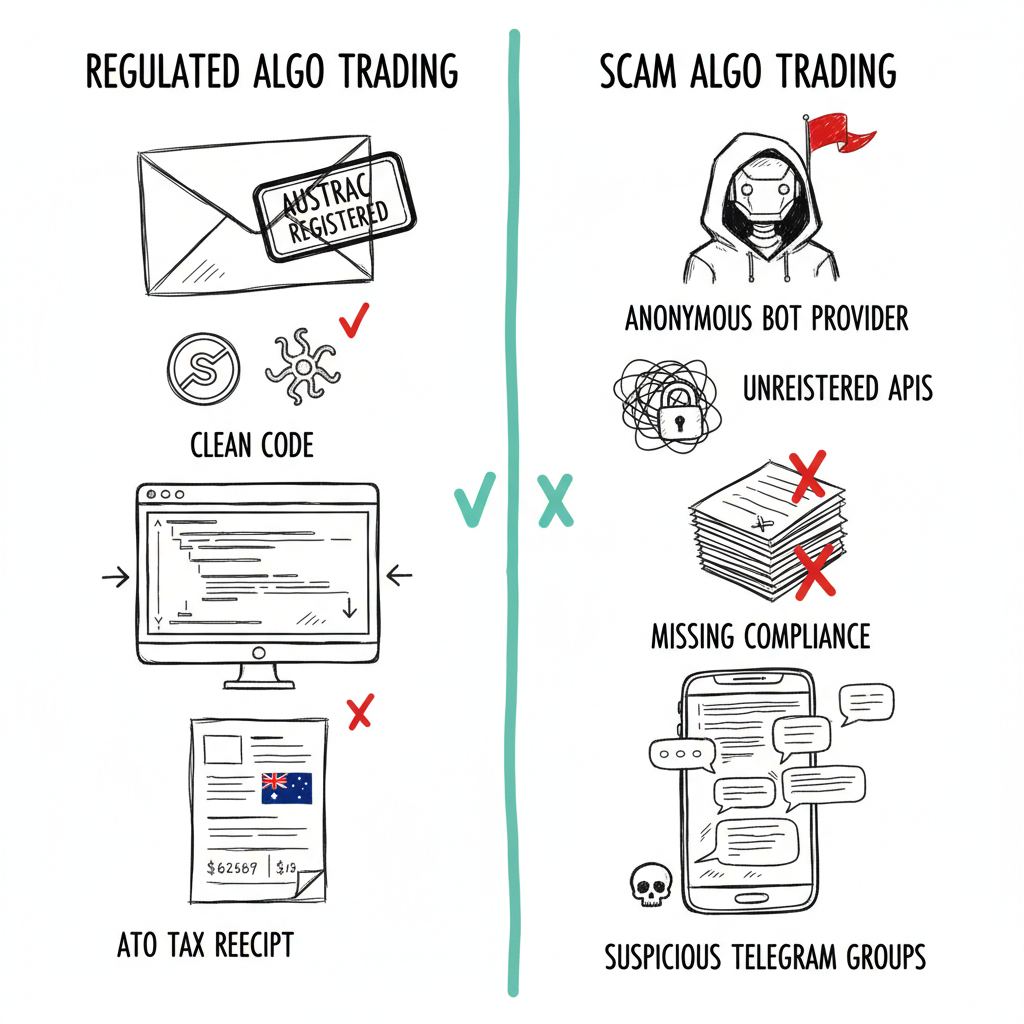
Before you do anything else, check the AUSTRAC VASP register. If the platform is not on it, stop there. Do not deposit AUD, do not create an account, do not connect a wallet. Australian registration is the minimum bar for any platform you should consider.
If the platform is claiming to hold your funds in custody or operates as a financial service, verify their ASIC licence on the ASIC Connect Professional Registers.
Red Flags That Should End the Conversation
Guaranteed returns are a scam signal without exception. No legitimate algo trading platform, bot provider, or exchange promises you a fixed return. Markets do not work that way.
Difficulty withdrawing your own funds is the other major red flag. Legitimate platforms process withdrawals. Scam platforms find reasons to delay, add requirements, or make it impossible.
Cryptoalgorithm.net is a specific example worth naming directly. It has been flagged as an unregulated forex broker with documented scam warnings. It is not registered with ASIC, FCA, CySEC, or any other regulator. Users have reported losing funds and being blocked from withdrawals. If you have seen this site advertised, avoid it.
The scale of crypto fraud targeting Australians is not abstract. In February 2026, Australian police charged a 42-year-old man in connection with a crypto investment scam that defrauded more than 190 elderly and vulnerable Australians of AUD $5 million. Investment scams overwhelmingly target people through social media, messaging apps, and search advertising.
What Legitimate Platforms Look Like
Legitimate platforms disclose their fee structures clearly. Trading fees on reputable Australian exchanges sit between 0.1% and 1% per trade depending on volume and order type. Spreads on major pairs like BTC/AUD typically run 0.5% to 2%, widening during volatile periods. If a platform will not tell you what it charges, that is a problem.
For algo trading specifically, look for AUD deposit support through PayID or Osko for quick funding, a demo or paper trading mode so you can test your strategy without real money, and strong API security features including IP whitelisting, 2FA requirements, and the ability to create trade-only API keys with no withdrawal permission.
Platforms Worth Considering
For exchange-level API access, Swyftx and Kraken are the most commonly used by Australian retail algo traders. I have been using Swyftx since 2022 and their API is reliable, with good uptime and clear documentation. BTC Markets is the other Melbourne-based option with a long compliance track record, serving Australian traders since 2013.
For bot management platforms that sit on top of exchanges, 3Commas and Cryptohopper both offer strategy building, backtesting, and multi-exchange connectivity. They charge monthly subscription fees for advanced features but offer limited free tiers to get started.
[INTERNAL LINK PLACEHOLDER: “best crypto exchanges australia 2026” → /reviews/best-crypto-exchanges-australia]
Platform Comparison: Algo-Friendly Australian Exchanges
| Platform | AUSTRAC Registered | API Available | AUD Deposit | Demo Mode | Fees (Maker/Taker) |
|---|---|---|---|---|---|
| Swyftx | Yes | Yes | PayID, Bank Transfer | Yes | 0.6% flat |
| Kraken | Yes | Yes | Bank Transfer | No | 0.16% / 0.26% |
| BTC Markets | Yes | Yes | PayID, BPAY | No | 0.15% / 0.85% |
| CoinSpot | Yes | Yes (limited) | PayID, POLi | No | 0.1% market / 1% instant |
| Independent Reserve | Yes |
Yes