Crypto Algo Trading in Australia 2026: Complete Guide
Crypto algo trading in Australia has shifted from a niche hobby for coders to a mainstream approach used by tens of thousands of Australian retail traders. If you have watched Bitcoin move 8% in an hour while you were asleep, you already understand why.
> TL;DR
> Crypto algo trading in Australia uses automated algorithms to execute trades 24/7 across volatile markets without you sitting at a screen. As of April 2026, Australia has introduced its first comprehensive crypto regulation framework requiring exchanges to hold an AFSL, which changes which platforms you should be using. This guide covers how algo trading works, the best platforms available to Australians, regulatory requirements, tax implications, and strategies to get started.
I have been covering Australian crypto platforms since 2022, and the regulatory shift that landed on 1 April 2026 is the single biggest change I have seen in that time. It affects which platforms are safe to use, how your trades are reported, and what protections you actually have if something goes wrong.
What Is Crypto Algo Trading in Australia?

Algorithmic trading means using computer programs to execute trades automatically based on pre-set rules and mathematical models. You define the conditions, the software does the rest. On a traditional stock exchange, this is mostly the domain of institutions. In crypto, the barriers are low enough that individual Australian traders can run genuinely sophisticated algorithms from a laptop.
The crypto market suits algo trading particularly well for three reasons. First, it operates 24 hours a day, seven days a week, which no human trader can match. Second, price volatility is high enough that small edges can be worth pursuing at scale. Third, execution speed matters enormously, and software reacts in milliseconds where a human takes seconds.
The main strategies Australian algo traders use include arbitrage (exploiting price differences between exchanges), market making (placing buy and sell orders simultaneously to profit from the spread), dollar cost averaging automation (scheduled recurring buys to smooth out volatility), scalping (rapid trades capturing small price movements), and momentum or trend-following approaches. Grid trading, where the bot buys and sells at fixed intervals around a set price, is also popular for ranging markets.
Beyond speed, the other major advantage is removing emotional bias. A human trader watching a position drop 15% will often panic-sell at exactly the wrong moment. A well-configured algorithm does not care. It follows the rules you set and does not second-guess itself at 2am.
The regulatory context matters here too. From April 2026, Australian algo traders need to be confident the platforms they connect to hold the right licences. More on that below.
[INTERNAL LINK PLACEHOLDER: “algorithmic trading strategies” → crypto-trading-strategies-australia]
Australia’s Crypto Regulation in 2026: What Algo Traders Must Know
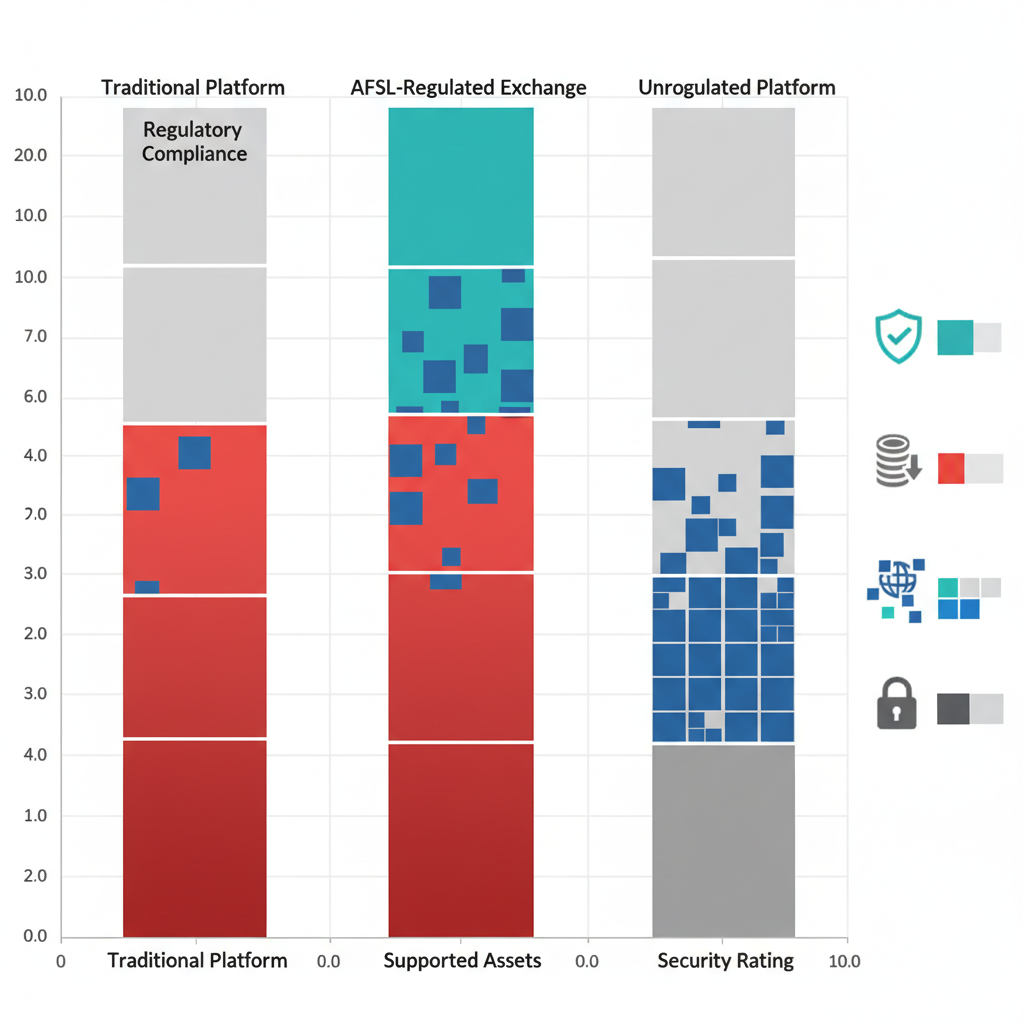
On 1 April 2026, Australia passed its first comprehensive crypto regulation framework. This is not incremental change. It is a full structural shift in how digital asset businesses operate in this country.
The AFSL requirement
All crypto exchanges and custody providers must now obtain an Australian Financial Services Licence (AFSL) within six months of the legislation passing. Digital asset platforms are being brought under the Corporations Act 2001, which means they face the same licensing obligations as managed funds and other financial product providers. If a platform is operating in Australia without that licence after the deadline, it is doing so illegally.
ASIC’s role has expanded accordingly. The regulator now has oversight of any crypto product that qualifies as a financial product under the Corporations Act, and it has already shown it is willing to act. ASIC initiated civil proceedings against NGS Crypto for operating without the necessary Australian licence, which should be a clear signal to traders that compliance is being enforced, not just discussed.
AUSTRAC registration
AUSTRAC registration has been compulsory for Australian crypto exchanges for several years, but enforcement has tightened. In April 2026, AUSTRAC conducted a targeted review of the digital currency exchange register and removed 62 inactive businesses. Crypto ATM operators have also been in AUSTRAC’s crosshairs, with several facing action for failing to meet anti-money laundering and counter-terrorism financing obligations.
Banking restrictions
Here is something that affects Australian crypto traders directly. Commonwealth Bank, ANZ, Westpac, and NAB have all introduced transaction caps and, in some cases, account closures for customers they identify as crypto-linked businesses. Some caps sit around $10,000 per month to certain exchanges. Coinbase lodged a formal complaint with the Australian parliament in February 2026, describing these practices as an effective unlawful regulatory ban on crypto businesses.
For algo traders, the practical impact is that funding your exchange accounts and withdrawing profits can be slower and more restricted depending on which bank you use. PayID via smaller banks or neobanks tends to be less problematic.
What this means for you
Simple. Only use platforms that are AUSTRAC-registered or, once the transition period ends, AFSL-licensed. Platforms operating outside these requirements offer you no recourse if things go wrong, and ASIC has made clear it will pursue unlicensed operators.
How Crypto Algo Trading Platforms Work
At the core of any algo trading platform is API connectivity. Your bot connects to an exchange via API keys, which grant it permission to place orders on your behalf without giving it access to withdraw funds to external addresses. You keep the keys, the bot does the trading.
Core features to look for
A proper algo trading platform will include a strategy builder (either visual or code-based), a backtesting engine that lets you run your strategy against historical price data, and a paper trading mode so you can validate performance without risking real capital. Paper trading is genuinely useful. Anyone telling you to skip it and go straight to live trading is giving you bad advice.
Types of bots
Grid bots place a series of buy and sell orders at regular price intervals. DCA bots execute scheduled purchases regardless of price. Signal bots act on triggers from technical indicators or external data feeds. Arbitrage bots monitor price differences across exchanges and execute simultaneously on both sides. Each has different risk profiles and works better in different market conditions.
Pricing models
Most dedicated algo trading platforms run on subscription tiers, typically ranging from free plans with limited bot numbers up to $100 or more per month for professional features. Some platforms take a commission on profits instead. CFD brokers generally make their money from the spread rather than a separate platform fee. Watch out for hidden per-bot fees or volume caps buried in the fine print.
Risk management
Any platform worth using will let you configure stop-loss and take-profit levels, position sizing limits, and maximum drawdown thresholds. Latency matters in volatile conditions. A bot that is 300 milliseconds slower than the market can turn a profitable scalping strategy into a consistent loser. Check where a platform’s servers are located if execution speed is critical to your strategy.
Best Crypto Algo Trading Platforms Available in Australia
The platforms below are the ones that make practical sense for Australian traders in 2026, covering everything from CFD brokers with full algo support to dedicated bot platforms and local exchanges with automation features.
Eightcap
Eightcap is a regulated Australian broker offering crypto CFDs with native support for MT4 and MT5, which means you can run Expert Advisors and connect to third-party automation tools without any workarounds. The CryptoCrusher tool provides sentiment data and signals, which can feed into signal-based strategies. Spreads on major crypto CFDs are competitive, and the fact that it holds an Australian licence makes it a straightforward choice for traders who want regulatory protection.
IC Markets
IC Markets is well regarded for ultra-low spreads and fast execution, which matters for scalping and high-frequency strategies. MT4 and MT5 are both supported, along with integrations to platforms like MyFXBook and ZuluTrade for copy trading. If you are running an Expert Advisor that depends on tight spreads and minimal slippage, IC Markets is one of the better options available to Australians.
eToro
eToro holds an AFSL and is AUSTRAC-registered, which puts it in a strong compliance position heading into the new regulatory environment. Its main algo-adjacent feature is copy trading, where you automatically replicate the positions of selected traders. This is not traditional algorithmic trading, but it is automation and it is accessible. Social features make it worth considering if you want a hybrid approach.
Capital.com
Capital.com offers access to over 100 crypto CFDs with no commissions, which is unusual. The spread is the cost. An AI-powered assistant provides market analysis and integrates with TradingView, making it a solid choice for traders who build strategies in TradingView and want to automate execution. No MT4/MT5 support is a drawback for traders already invested in that ecosystem.
Alpaca Trading
Alpaca is consistently rated among the top API trading platforms available to Australian traders. It was built for developers and algo traders from the ground up, with a clean REST API, free stock and ETF trading in the US market, and solid charting tools. Crypto support is available but limited compared to dedicated crypto exchanges. Best suited to traders who are comfortable writing their own code.
Swyftx
Swyftx is the Australian exchange I have personally used since 2022. It is AUSTRAC-registered, holds ISO27001 certification, and has over 700,000 users. With 420+ assets and a demo mode, it is one of the more accessible local options for traders who want to test automated strategies before going live. The integrated tax reports are genuinely useful at EOFY, pulling together your transaction history in an ATO-compatible format. Spreads on BTC/AUD sit around 0.6%. Not the cheapest, but the local compliance and tax tooling justify it for most Australian traders.
Altrady
Altrady is a multi-exchange platform built specifically for automated crypto trading. Features include a Quick Scanner for identifying opportunities across markets, a Signal Bot that acts on technical triggers, a QFL (Quick Fingers Luc) Bot for bounce trades, and paper trading mode. It connects to multiple exchanges simultaneously via API, which suits traders running arbitrage or who want redundancy across venues.
Tradetron
Tradetron offers both prebuilt strategies and the ability to build your own. It supports crypto scalping algorithms and futures trading, and integrates with a range of exchanges. The marketplace of prebuilt strategies is useful if you want to get started quickly without writing your own logic from scratch.
SpeedBot
SpeedBot covers strategy crafting, backtesting, live bot deployment, and simulated trading across multiple exchanges. The interface is more approachable than fully code-based platforms, which makes it a reasonable option for traders who want automation without heavy programming.
CoinSpot
CoinSpot is one of the longest-running Australian exchanges, with over 2.5 million users and 530+ cryptocurrencies. AUD payment options are extensive. It is not primarily an algo trading platform, but its API allows basic automation for traders who want to build their own bots on a familiar local exchange with a solid compliance history.
Digital Surge
Digital Surge is AUSTRAC-registered, offers 400+ cryptos, and has fees starting from 0.1%. Trigger orders and recurring buys are built in, making it one of the better local options for DCA automation without needing a third-party bot platform. PayID deposits are instant.
Platform Comparison Table: Crypto Algo Trading in Australia
| Platform | Regulation | Algo/Bot Support | Min Fees/Spreads | Paper Trading | AUD Support | Best For |
|---|---|---|---|---|---|---|
| Eightcap | AFSL, AUSTRAC | MT4/MT5, TradingView | Spread-based | Yes | Yes | CFD algo traders |
| IC Markets | AFSL, AUSTRAC | MT4/MT5, ZuluTrade | Ultra-low spreads | No | Yes | Scalping, EA traders |
| eToro | AFSL, AUSTRAC | Copy trading | 1% spread on crypto | No | Yes | Copy/social trading |
| Capital.com | AFSL | TradingView, AI assistant | 0% commission | No | Yes | CFD traders, no-commission |
| Alpaca | US-regulated | REST API, custom code | Free (stocks) | Yes | Limited | Developer/API traders |
| Swyftx | AUSTRAC, ISO27001 | Demo mode, API | ~0.6% BTC/AUD spread | Yes (demo) | Yes | Australian beginners–intermediate |
| Altrady | N/A (connects to exchanges) | Signal/Grid/QFL bots | Subscription from ~$25/mo | Yes | Via exchanges | Multi-exchange bot traders |
| Tradetron | N/A | Prebuilt + custom strategies | Subscription | Yes | Via exchanges | Strategy marketplace users |
| SpeedBot | N/A | Backtesting, live bots | Subscription | Yes | Via exchanges | Intermediate algo traders |
| CoinSpot | AUSTRAC | API access | 0.1–1% | No | Yes | AUD-first casual traders |
| Digital Surge | AUSTRAC | Trigger orders, recurring buys | From 0.1% | No | Yes | DCA automation, local exchange |
Regulatory status reflects position as of April 2026. AFSL transition period ends within six months of 1 April 2026.
Crypto Algo Trading Strategies Explained
Choosing a strategy before you pick a platform makes more sense than doing it the other way around. Different strategies suit different market conditions, risk tolerances, and time commitments.
Arbitrage
Arbitrage exploits price differences for the same asset across different exchanges. If Bitcoin is trading at $104,200 on one exchange and $104,450 on another, a bot can buy on the cheaper side and sell on the more expensive side simultaneously. The margin is thin, which means execution speed and fees are critical. New spread arbitrage guides published in April 2026 have documented how professional traders are structuring these strategies with updated exchange fee structures in mind. This approach requires capital on multiple exchanges simultaneously and works best with stablecoins to avoid conversion friction.
Dollar Cost Averaging automation
DCA automation runs scheduled buys at fixed intervals regardless of price. If you set a bot to buy $200 of ETH every Tuesday, you accumulate through both peaks and troughs, reducing the average cost over time. Platforms like Digital Surge and Swyftx have recurring buy features built in. Third-party platforms like Altrady give you more granular control over the DCA parameters.
Market making
Market making involves placing simultaneous buy and sell limit orders on either side of the current price, profiting from the spread each time both orders fill. On high-volume pairs this can generate consistent small gains. On illiquid pairs, the risk of holding inventory that moves against you is significant. Not a beginner strategy.
Scalping
Scalping algorithms execute many trades per day, each capturing a small price movement. A 0.1% gain per trade sounds modest, but run 50 times a day it compounds. This is the strategy most sensitive to fees and latency. It works poorly on exchanges with high taker fees.
Momentum and trend-following
These strategies identify an asset that is moving in a sustained direction and enter in that direction, exiting when momentum fades. Simpler to implement than arbitrage, though they underperform in sideways markets. Signal bots that act on moving average crossovers or RSI readings fall into this category.
Grid trading
Grid bots place buy orders below the current price and sell orders above it at fixed intervals. When price oscillates within the grid range, the bot repeatedly buys low and sells high within that band. Effective in ranging markets, but if price breaks out of the grid range decisively, the bot can accumulate a losing position.
Backtesting before going live
None of these strategies should go live without backtesting against historical data first. Backtesting does not guarantee future performance, but it will quickly show you if a strategy is fundamentally broken. Platforms like Altrady, SpeedBot, and Tradetron all include backtesting engines. Run your strategy through at least 6 to 12 months of historical data, across different market conditions including both trending and ranging periods, before committing real capital.
[INTERNAL LINK PLACEHOLDER: “crypto tax Australia” → crypto-tax-australia-guide]
Crypto Tax Obligations for Algo Traders in Australia
The ATO classifies cryptocurrency as property and applies Capital Gains Tax (CGT) to disposals. Every trade your bot executes that involves selling, swapping, or converting crypto is a taxable event. For active algo traders running hundreds of trades per month, this creates a significant record-keeping obligation.
If you hold a position for less than 12 months before disposal, the full gain is added to your assessable income and taxed at your marginal rate. Hold for more than 12 months and