Crypto Algo Trading Australia 2026: Is It Safe, Legal & Worth It?
Crypto algo trading in Australia is not some niche pursuit for quants with Bloomberg terminals anymore. Plenty of ordinary Australian retail traders are running bots on Kraken and Binance at 3am while they sleep, and the regulatory environment around all of it shifted significantly in April 2026. If you are thinking about setting up automated trading, or you have already started and want to know whether you are on the right side of ASIC and the ATO, this is the piece to read first.
> TL;DR: Crypto algo trading Australia sits in a complex regulatory space right now. ASIC is actively targeting AI-powered trading bot scams and has removed over 25,000 scam websites since 2023, while new AUSTRAC AML/CTF laws that came into force on 2 April 2026 require all virtual asset service providers to be registered. The ATO taxes every bot-executed trade as a CGT event, or as ordinary income if you are classified as a trader. Verify ASIC licensing and AUSTRAC registration before handing money to any automated trading platform, full stop.
What Is Crypto Algo Trading in Australia and How Does It Work?

Algorithmic crypto trading means using pre-programmed rules, or increasingly AI-driven models, to execute buy and sell orders automatically without you sitting at a screen. The bot watches price feeds, evaluates conditions you have defined, and fires off trades in milliseconds. For the 24/7 crypto market, where BTC/AUD can move 8% while you are at a Sunday barbecue, that kind of automation has obvious appeal.
The most common strategies Australian retail traders use fall into a few camps. Trend-following bots buy when momentum is up and sell when it reverses, using indicators like moving averages or RSI. Dollar-cost averaging (DCA) bots simply purchase a fixed AUD amount of an asset at regular intervals regardless of price. Arbitrage bots exploit price differences between exchanges, though the windows are vanishingly small and execution speed matters enormously. Market-making bots place both buy and sell orders around mid-price to collect the spread, which works better on deeper markets.
To actually execute trades, bots connect to exchanges through APIs. Kraken and Swyftx both publish documented APIs, and Binance’s API remains widely used by Australian traders despite the closure of Binance Australia’s derivatives offering. You generate API keys with specific permissions (usually trade permissions only, never withdrawal permissions for a bot), and the bot authenticates using those keys.
There is a meaningful difference between running your own bot coded in Python, using a third-party platform like Cryptohopper that connects to your exchange account, and copy trading where you simply mirror another trader’s positions. Self-hosted bots give you full control but require technical skill. Third-party platforms are accessible but introduce a counterparty whose own regulatory status you need to verify. Copy trading on platforms like eToro is the most hands-off option but also the furthest removed from “algorithmic” in any technical sense.
[INTERNAL LINK PLACEHOLDER: best crypto exchanges Australia → /best-crypto-exchanges-australia]
Is Crypto Algo Trading Legal in Australia? ASIC and AUSTRAC Rules Explained
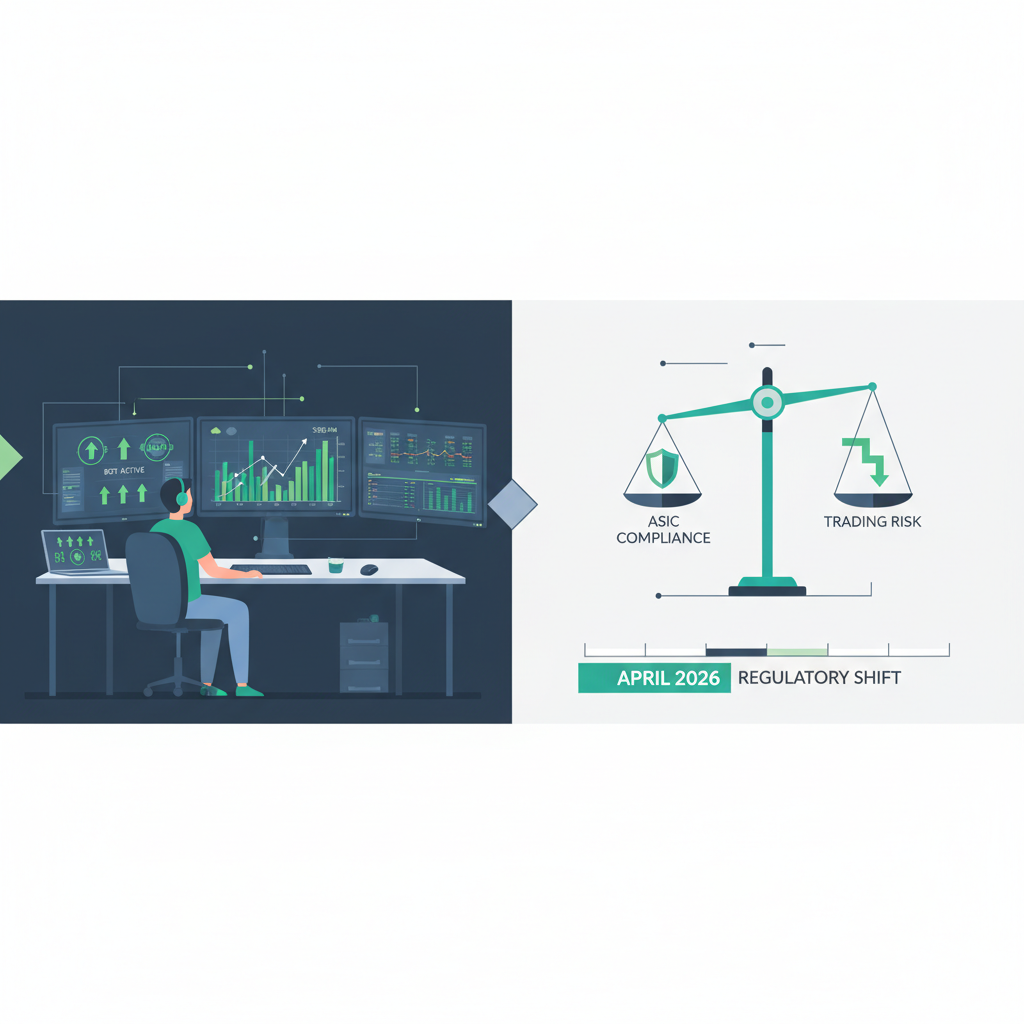
The short answer: yes, crypto algo trading itself is legal in Australia. The longer answer involves understanding which entities need to be licensed, which need to be registered, and what changed on 2 April 2026.
ASIC’s Role
ASIC regulates crypto assets and services where they constitute financial products. If a platform is offering a managed discretionary account, a derivative product over a crypto asset, or anything that looks like a financial service under the Corporations Act, it needs an Australian Financial Services (AFS) licence. ASIC’s Key Issues Outlook 2026 paper explicitly flagged crypto as a “regulatory perimeter” risk, which in plain terms means ASIC is watching for businesses operating as if they are outside the regulatory boundary when they are not.
Before using any crypto trading or algo platform, search ASIC’s professional registers at moneysmart.gov.au/scams/check-before-you-invest. If the platform manages your money, provides advice, or operates what could be described as a financial service, it should hold an AFS licence. Platforms that simply provide a trading infrastructure for you to use your own funds sit in different territory, but the line is not always obvious.
AUSTRAC and the April 2026 AML/CTF Expansion
Every business providing virtual asset services in Australia must be registered with AUSTRAC under the Anti-Money Laundering and Counter-Terrorism Financing Act. AUSTRAC describes the virtual asset sector as a high money-laundering risk, and the expanded AML/CTF laws that took effect on 2 April 2026 significantly broadened that oversight.
The April 2026 changes extend compliance obligations to a wider range of digital asset businesses and tighten requirements around customer due diligence, transaction monitoring, and suspicious matter reporting. If a platform you are using cannot demonstrate current AUSTRAC registration, walk away. You can verify registration directly on the AUSTRAC website by searching their Reporting Entities Register.
For retail traders running bots through their own exchange accounts, personal AUSTRAC registration is not required. The obligation sits with the exchange or platform operator. Your obligation is to use registered and appropriately licensed platforms.
[INTERNAL LINK PLACEHOLDER: AUSTRAC crypto registration guide → /austrac-crypto-registration]
ASIC Scam Warnings: AI Trading Bots and Fake Crypto Algo Platforms
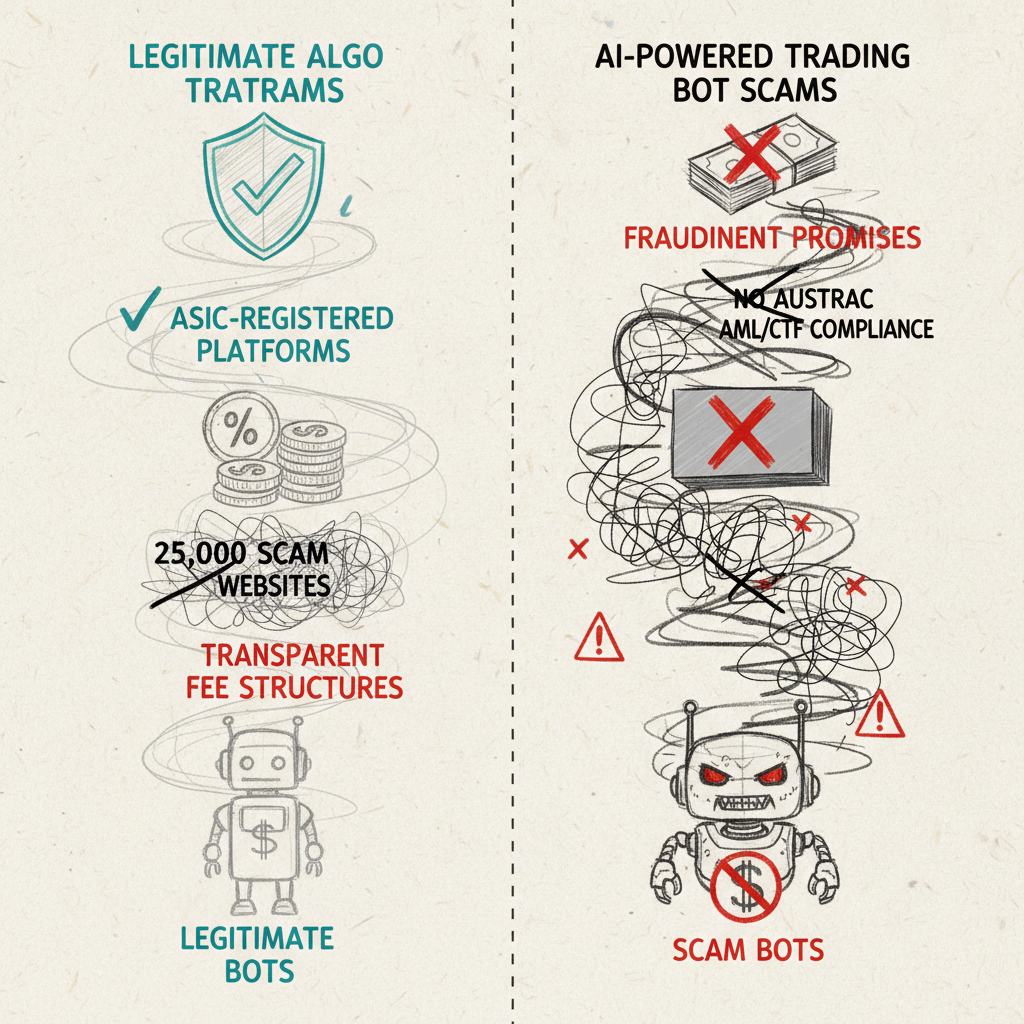
On 8 April 2026, ASIC announced a significant escalation in action against AI-powered investment scams. The specific pattern they flagged: scammers use AI to generate convincing advertisements, social media content, and even fake testimonials promoting trading bots that supposedly generate passive income with minimal risk. The claimed returns are not just optimistic, they are mathematically impossible given real market conditions.
ASIC has removed over 25,000 harmful scam websites since 2023. That is not a typo, 25,000 sites. The volume tells you something about the scale of the problem, and algo trading is a favourite disguise because automation sounds sophisticated and the pitch (“your money works while you sleep”) is genuinely appealing.
In February 2026, a 42-year-old Australian man was charged over an alleged $3.5 million crypto investment scam that defrauded more than 190 people since November 2025. The victims included elderly and vulnerable Australians. That same month, Coinbase was submitting complaints to parliament about debanking, while scammers were actively targeting ordinary Australians through fake bot platforms.
April 2026 also saw ASIC issue warning notices to four social media finfluencers for providing unlicensed financial advice and promoting high-risk products including crypto derivatives. In March 2026, ASIC specifically warned Gen Z about AI-driven financial advice, noting that 29% of younger Australians trade crypto based on influencer content. That is a lot of people making real financial decisions based on content that may have no licensing, no accountability, and no legal obligation to be accurate.
The red flags for fake crypto algo platforms are consistent across almost every case ASIC has documented. Guaranteed returns or specific percentage promises are always fabricated, no legitimate trading strategy guarantees profit. Pressure to deposit quickly, particularly urgency around a “limited window,” is a manipulation tactic. No verifiable team, no physical address, no ASIC or AUSTRAC registration. Platforms that make withdrawal difficult once you are in. Unsolicited contact through WhatsApp, Instagram, or dating apps leading eventually to a trading opportunity.
If you suspect a scam, report it to ASIC via the online complaint form at asic.gov.au and to Scamwatch at scamwatch.gov.au. Both agencies use these reports to act.
CryptoAlgo.com.au: What You Need to Know
CryptoAlgo.com.au is an Australian financial comparison and editorial site. The content here covers crypto exchanges, trading platforms, automated trading tools, and the regulatory environment for Australian traders. It is informational content, not financial advice, and where we link to platforms, we disclose affiliate relationships.
One thing worth being direct about: there is a separate site, cryptoalgorithm.net, that has been flagged as an unregulated forex broker and a potential scam. That site has no connection to CryptoAlgo.com.au. They are entirely different entities. If you have encountered cryptoalgorithm.net, treat it with caution and verify its status independently before engaging.
ASIC’s current position on finfluencers and financial content online is clear: anyone who provides financial product advice, makes recommendations, or promotes financial products without an AFS licence is potentially in breach of the Corporations Act. CryptoAlgo.com.au publishes general information and comparisons. Nothing on this site should be read as personal advice about what you should do with your money.
To independently verify any platform you encounter, use ASIC’s professional registers and AUSTRAC’s Reporting Entities Register. Both are publicly searchable and free to use. If a platform is not findable on either register when it should be, that tells you something important.
[INTERNAL LINK PLACEHOLDER: how to check ASIC and AUSTRAC registration → /verify-crypto-platform-australia]
Tax on Crypto Algo Trading in Australia: ATO Rules for 2026
The ATO treats cryptocurrency as property and classifies it as a CGT asset. Every single disposal is a taxable event. That means every trade your bot executes, every swap from BTC to ETH, every time crypto is converted to AUD, and every purchase made using crypto, all of it needs to be recorded and reported.
For algo traders, this creates a specific problem: volume. A bot running a DCA strategy might execute one or two trades a week, which is manageable. A trend-following bot on a 15-minute chart could generate hundreds of transactions in a month. Each one has a cost base (the AUD value at acquisition), proceeds (AUD value at disposal), and a resulting gain or loss. Calculating that manually is not realistic at scale.
Investor Versus Trader: Why It Matters
The ATO draws a distinction between someone who invests in crypto assets and someone who carries on a trading business. Investors are subject to CGT rules, which include the 50% discount for assets held over 12 months. Traders, by contrast, have their gains taxed as ordinary income at their marginal rate, and the 12-month discount does not apply.
Frequent, high-volume algo trading is exactly the kind of activity the ATO might classify as a business. The relevant criteria include the frequency of transactions, the commercial nature of the activity, whether it is conducted in a business-like manner, and the intention to make profit. If you are running a sophisticated bot across multiple exchanges with significant capital, “I am just a hobbyist investor” is an increasingly difficult position to sustain with the ATO.
Staking rewards are generally treated as ordinary income at the time of receipt, valued in AUD on that date. That adds another layer of record-keeping if your bots are operating on platforms that also stake idle assets.
For record-keeping, you need the date of each transaction, the type of transaction, the amount of cryptocurrency, the AUD value at the time, any fees paid, and what the other party involved was (exchange name, wallet address for transfers). Good crypto tax software that integrates with Australian exchanges makes this manageable. Koinly, CoinLedger, and Crypto Tax Calculator all support AUD reporting and connect to major Australian platforms.
Talk to a registered tax agent who has actual experience with crypto, not just one who says they are comfortable with it. The difference in advice quality is significant.
[INTERNAL LINK PLACEHOLDER: crypto tax Australia guide → /crypto-tax-australia]
Australian Bank Restrictions on Crypto Transfers: What Algo Traders Must Know
If you are funding an algorithmic trading strategy with regular AUD transfers, Australian banking restrictions are not a theoretical concern, they are a practical operational problem.
The major banks have all implemented limits on transfers to crypto exchanges, framed as fraud and scam prevention measures. Commonwealth Bank, Bank Australia, and ANZ Plus cap transfers to crypto exchanges at $10,000 per month. Established ANZ customers with standard accounts can transfer up to $25,000 per day, which is meaningfully more flexible. NAB and Westpac have their own limits and in some cases require customers to answer in-app questionnaires before a first-time crypto transfer is processed.
In February 2026, Coinbase formally submitted a complaint to the Australian parliament accusing Australia’s major banks of systematically debanking legitimate crypto companies by denying or restricting financial services. The complaint highlighted situations where even registered, compliant crypto businesses could not get basic banking infrastructure. For individual retail traders, the friction is less extreme but still real.
For algo traders specifically, funding delays are not just inconvenient. If your strategy depends on deploying capital during specific market conditions and your bank holds the transfer for a review, that opportunity is gone. Some banks place a hold on first-time transfers to a new exchange, which can take 24 to 48 hours to clear.
Practical approaches include using PayID for faster AUD transfers where the exchange supports it (most major Australian exchanges do), using BPAY as an alternative, or maintaining a float on the exchange rather than funding per-trade. Some traders use stablecoin on-ramps where available, converting fiat to USDT through a crypto-friendly channel, then moving to the target platform.
Check your bank’s current policy directly before setting up any automated funding arrangement. These policies have been updated multiple times in the last two years and what applied in 2024 may not apply now.
[INTERNAL LINK PLACEHOLDER: crypto-friendly banks Australia → /australia-crypto-friendly-banks]
Best Regulated Alternatives for Crypto Algo Trading in Australia
For Australian traders who want automation without the regulatory risk of unverified platforms, there are several well-established options worth knowing.
Kraken is the strongest choice if API access and deep liquidity are your priority. It offers a well-documented REST and WebSocket API, supports AUD deposits and withdrawals, and has a strong compliance track record in Australia. Spreads on BTC/AUD sit around 0.1% to 0.2% in normal conditions, and the platform supports sophisticated order types useful for algo strategies.
IC Markets and Pepperstone are worth considering for traders who want to access crypto through CFDs with MT4, MT5, or cTrader automation. Both are ASIC-regulated and offer tight spreads with fast execution. The distinction is that you are trading a derivative over a crypto asset, not the underlying, which has different tax and risk implications.
Swyftx is an Australian-based exchange I have used since 2022. It is not an algo trading platform in the technical sense, no bot marketplace or third-party API ecosystem, but it is a clean, AUSTRAC-registered exchange for holding and managing a crypto portfolio alongside any automated activity you run elsewhere. Over 420 assets, AUD deposits via PayID, and a genuinely useful demo mode.
Cryptohopper is the most accessible third-party bot platform for Australian retail traders. It connects to major exchanges via API and offers DCA bots, trailing features, and copy-trading. Verify that any exchange you connect it to is itself AUSTRAC-registered.
| Platform | Type | ASIC/AUSTRAC Status | AUD Support | Best For |
|---|---|---|---|---|
| Kraken | Crypto Exchange | AUSTRAC Registered | Yes | API-based algo trading |
| Swyftx | Crypto Exchange | AUSTRAC Registered | Yes | AUS-based portfolio management |
| IC Markets | CFD Broker | ASIC Licenced | Yes | MT4/MT5 automated CFD trading |
| Pepperstone | CFD Broker | ASIC Licenced | Yes | cTrader/TradingView automation |
| Cryptohopper | Bot Platform | Verify per exchange | Via connected exchange | Third-party bot management |
[INTERNAL LINK PLACEHOLDER: best crypto trading bots Australia → /best-crypto-trading-bots-australia]
Frequently Asked Questions
Is crypto algo trading legal in Australia?
Yes, algorithmic crypto trading is legal in Australia. The legal obligations fall primarily on the platforms and service providers, which must hold an AFS licence (if providing financial services) and be registered with AUSTRAC. As a retail trader using your own exchange account, you need to use regulated platforms and meet your ATO tax obligations.
How do I verify if a crypto algo trading platform is legitimate?
Check ASIC’s professional registers at moneysmart.gov.au to confirm any relevant AFS licensing, and search AUSTRAC’s Reporting Entities Register to confirm virtual asset service registration. If a platform cannot be found on either register when it should be, do not use it.
**How does the ATO tax