Algorithmic Crypto Trading in Australia: Complete 2026 Guide
Algorithmic crypto trading in Australia is no longer the exclusive domain of hedge funds and quant desks. Retail traders are running bots on exchanges from their living rooms in Ballarat and Bondi alike, and the regulatory ground beneath them just shifted significantly.
> TL;DR: Algorithmic crypto trading in Australia uses automated, rules-based strategies to execute trades in milliseconds, removing emotion and enabling round-the-clock market participation. With Australia’s new crypto licensing framework live from April 2026 and ASIC oversight expanding, choosing a compliant platform matters more than ever. This guide covers how algo trading works, the best platforms available to Australians, tax obligations, and the latest regulatory changes.
What Is Algorithmic Crypto Trading in Australia?
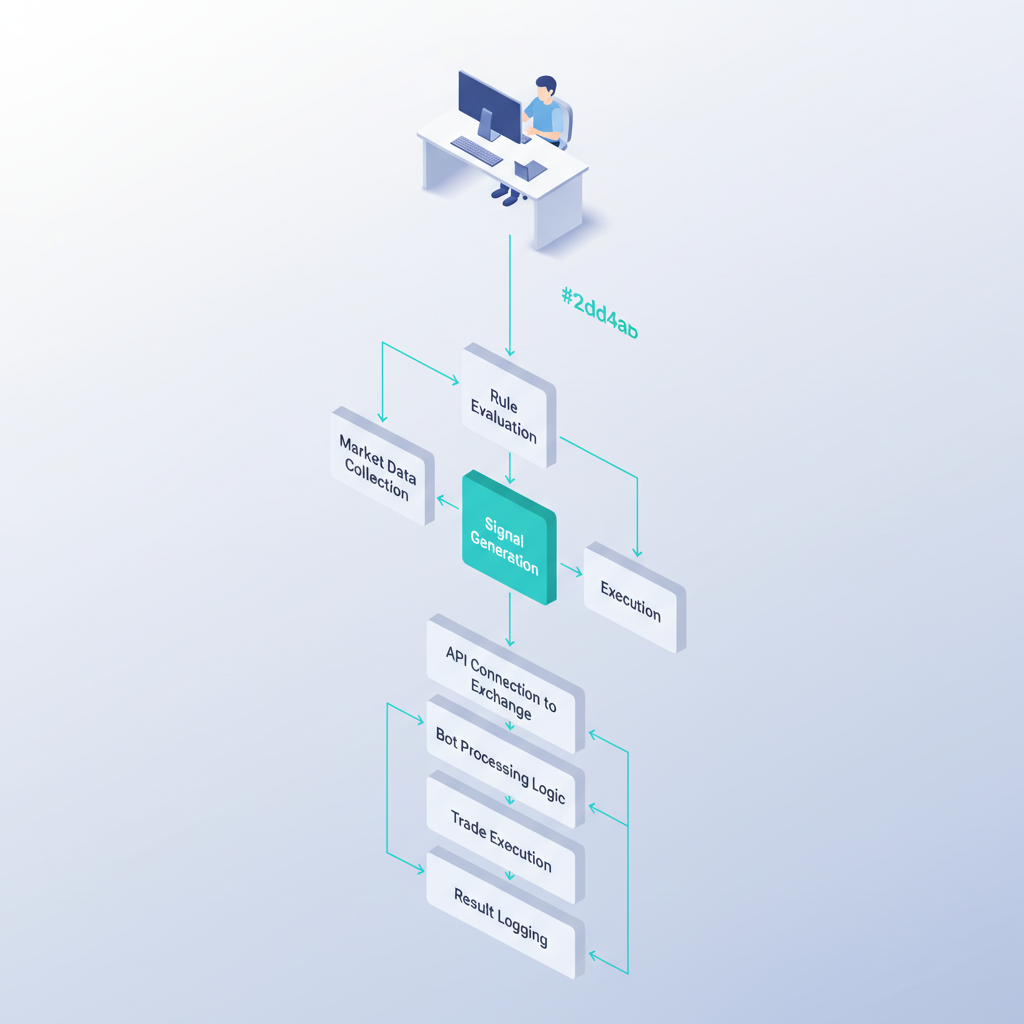
Algorithmic crypto trading in Australia means using software to execute buy and sell orders automatically based on predefined rules. Those rules might be as simple as “buy BTC when the 20-day moving average crosses above the 50-day,” or as complex as a multi-leg arbitrage strategy running simultaneously across three exchanges. Either way, the computer does the execution, not you.
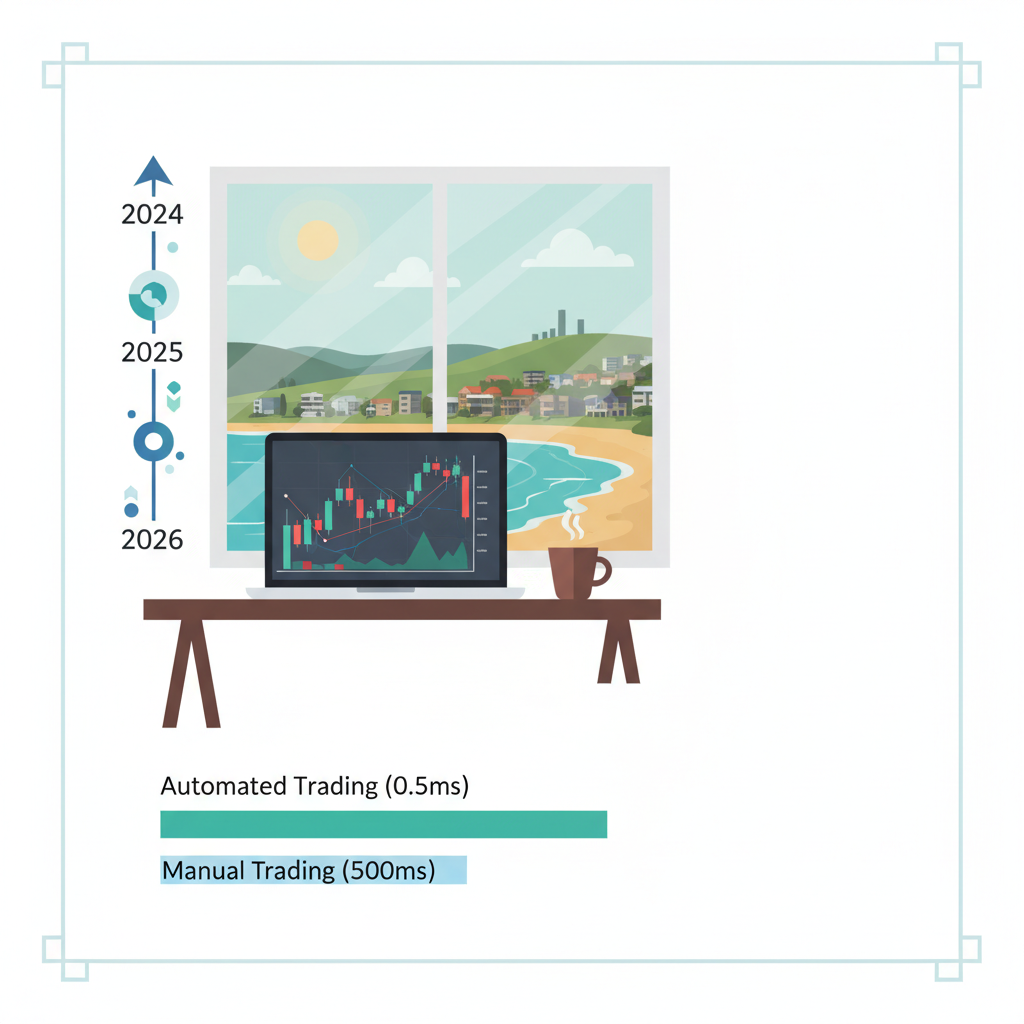
The core advantages are real, not just marketing copy. Algorithms execute in milliseconds, well before any human could click a button. They do not panic sell at 3am, they do not second-guess a stop-loss, and they do not skip a trade because footy is on. For crypto markets that run 24 hours a day, 365 days a year, that last point matters. No trader can watch every session manually.
ASIC estimates roughly 85% of all trading on Australian listed equities markets is already algorithmic. Crypto is catching up fast, and the infrastructure to support it, from exchange APIs to cloud-based bot platforms, has matured considerably over the past few years.
There is a meaningful distinction between three types of automated approaches:
Fully automated bots run without any human intervention once deployed. You set the strategy parameters, switch it on, and the bot trades independently.
Semi-automated tools generate signals or suggestions and then prompt you to confirm before executing. Useful if you want a sanity check on every trade.
API-based custom strategies are built by traders who write their own code, typically in Python, and connect directly to exchange APIs. This is the most flexible approach but requires programming knowledge.
Common strategy types include trend following, arbitrage, market making, and mean reversion. Each of these is covered in more detail in the next section.
[INTERNAL LINK PLACEHOLDER: what is algo trading → /learn/what-is-algorithmic-trading]
How Algorithmic Crypto Trading Strategies Work
Understanding what the strategy is actually doing matters before you put real AUD behind it. Here is how the main approaches work in practice.
Trend Following
Trend-following strategies attempt to identify a directional move and ride it. Moving averages are the most common tool: a bot might go long BTC/AUD when the 20-period EMA crosses above the 50-period EMA and close the position when the reverse occurs. Breakout detection and momentum signals work similarly, entering trades when price moves above a defined resistance level with sufficient volume. These strategies perform well in trending markets and give back gains in choppy, sideways conditions.
Arbitrage
Arbitrage strategies exploit price differences for the same asset across different exchanges. If BTC/AUD is trading at $135,000 on one exchange and $135,400 on another simultaneously, an algorithm can buy on the first and sell on the second, locking in a near-riskless profit. In practice, execution speed, withdrawal limits, and transfer times make pure cross-exchange arbitrage harder than it sounds for retail traders. AUD-pair arbitrage adds an extra layer of complexity given the smaller liquidity pools on local exchanges.
Market Making
Market-making bots place simultaneous limit buy and sell orders around the mid-price, collecting the spread on both sides. This works well in liquid markets with tight spreads. The risk is inventory exposure: if price moves sharply in one direction, the bot accumulates a losing position on one side.
Mean Reversion and Grid Trading
Mean reversion strategies assume that prices tend to return to a historical average. If BTC/AUD moves significantly below its 30-day average, the bot buys, expecting a bounce. Grid trading is a mechanical version of this: the bot places orders at fixed intervals above and below the current price, profiting from the oscillation regardless of direction. Grid bots have become popular on platforms like Cryptohopper because they are relatively simple to configure and perform reasonably well in ranging markets.
DCA Bots and Risk Management
Dollar-cost averaging bots execute systematic purchases at scheduled intervals, reducing timing risk through accumulation rather than trying to pick a bottom. These are less exciting than arbitrage strategies but more forgiving for traders still learning the tools.
Regardless of strategy, backtesting against historical data before committing live capital is non-negotiable. Most platforms provide this, though the quality of historical data varies. Every strategy also needs hard risk parameters: maximum drawdown limits, position sizing rules, and stop-losses. A bot without these is just a way to lose money faster.
Top Platforms for Algorithmic Crypto Trading in Australia (2026)
The platform you choose will depend on whether you want to trade spot crypto, crypto CFDs, or both, and how much of the technical setup you want to handle yourself. Here is how the main options compare for Australian traders.
Cloud-Based Crypto Bot Platforms
Cryptohopper is one of the most widely used cloud-based bot services among Australian retail traders. It connects to major exchanges via API, supports DCA, trailing stop strategies, copy trading, and AI-generated signals. The cloud-based architecture means your bot keeps running even when your laptop is off. The interface is accessible enough that non-developers can get a strategy running without writing code, though the more sophisticated configurations take time to learn properly.
Altrady offers multi-exchange integration, a portfolio tracker, and bot automation features. It appeals to traders who want to manage positions across several exchanges from one dashboard. The bot functionality is solid rather than exceptional, and the portfolio tracking is genuinely useful for CGT record-keeping purposes.
ASIC-Regulated CFD Brokers
For traders who prefer not to hold actual crypto, CFD brokers regulated by ASIC offer automated trading through MetaTrader and TradingView integrations.
Eightcap is an Australian-regulated broker with access to over 95 crypto CFDs. It supports MT4, MT5, and TradingView, which means you can run Expert Advisors or TradingView Pine Script alerts connected to automated execution. The regulatory status is clean and the crypto CFD range is broader than most ASIC-regulated competitors.
IC Markets is a go-to for Australian algo traders who want ultra-low spreads and fast execution. MT4 and MT5 are fully supported, including Expert Advisors. I have heard from traders in our community running HFT-adjacent strategies on IC Markets where the execution speed makes a material difference to results.
Pepperstone covers MetaTrader, cTrader, and TradingView automation. cTrader’s cBots are particularly well-regarded among traders who want a cleaner coding environment than MT4’s MQL4. Spreads are tight on major crypto CFDs and the ASIC regulatory status is solid.
API-First and Developer-Oriented Platforms
Interactive Brokers Australia supports algorithmic trading via Java, C++, and Python APIs, with access to a genuinely broad range of assets beyond just crypto. It is the better choice for traders who want to build multi-asset strategies or who come from a software development background.
Alpaca Trading is API-first by design and popular with developers building custom algo strategies. Free stock and ETF trading makes it cost-effective for mixed strategies, though crypto support is more limited compared to dedicated crypto platforms.
Capital.com offers TradingView integration, an AI assistant, and low CFD fees. Worth considering for traders who already live in TradingView and want to automate from there.
AUSTRAC Registration
Whatever platform you use for spot crypto trading, check its AUSTRAC registration before depositing. Any Digital Currency Exchange Provider operating in Australia is legally required to be registered with AUSTRAC and comply with AML/CTF obligations. With over 400 entities now registered, most reputable platforms are covered, but it is worth verifying directly on the AUSTRAC website rather than taking the platform’s word for it.
Platform Comparison
| Platform | Asset Types | Automation Method | ASIC/AUSTRAC Status | Indicative Fees |
|---|---|---|---|---|
| Cryptohopper | Spot crypto (via connected exchanges) | Cloud bot, API | Depends on connected exchange’s AUSTRAC status | Subscription from ~$19/mo USD |
| Altrady | Spot crypto (multi-exchange) | Cloud bot, API | Depends on connected exchange | Subscription from ~$17/mo USD |
| Eightcap | Crypto CFDs (95+), forex, indices | MT4/MT5, TradingView | ASIC-regulated | Spreads from 0.0 pips; crypto CFD spread varies |
| IC Markets | Crypto CFDs, forex, commodities | MT4/MT5 Expert Advisors | ASIC-regulated | Spreads from 0.0 pips + commission |
| Pepperstone | Crypto CFDs, forex, indices | MT4/MT5, cTrader, TradingView | ASIC-regulated | Spreads from 0.0 pips + commission |
| Interactive Brokers | Crypto, stocks, ETFs, options, futures | Java/C++/Python API | ASIC-regulated | Tiered commission structure |
| Alpaca Trading | Stocks, ETFs, crypto (limited) | REST API, WebSockets | US-regulated | Free for stocks/ETFs; crypto fees apply |
| Capital.com | Crypto CFDs, forex, indices | TradingView, MT4 | ASIC-regulated | Low CFD spreads, no commission |
[INTERNAL LINK PLACEHOLDER: best crypto exchanges australia → /best-crypto-exchanges-australia]
Fees and Costs of Algorithmic Crypto Trading in Australia
Fees matter more for algo traders than for buy-and-hold investors, because high-frequency strategies compound fee drag across hundreds or thousands of trades. Getting this wrong can turn a profitable strategy into a money-loser at scale.
Trading Fees
On Australian spot crypto exchanges, trading fees typically run between 0.1% and 1% per trade. Most exchanges use a maker-taker model: makers, who post limit orders that add liquidity to the order book, pay lower fees than takers, who fill existing orders. For algo traders running strategies that rely on limit orders, this distinction is worth paying close attention to. A maker fee of 0.1% versus a taker fee of 0.6% sounds small until you run the numbers across 500 trades a month.
Deposit and Withdrawal Fees
AUD deposits via PayID and direct bank transfer are free on most Australian exchanges. Card deposits typically attract around 1.22%, PayPal around 0.5%, and cash deposits via participating retailers around 2.5%. For algo trading purposes, bank transfer or PayID is the only sensible funding method given the fee differentials.
AUD withdrawals to Australian bank accounts are usually free or very close to it. Crypto withdrawals carry network fees that vary by blockchain. On a congested Ethereum network, gas fees can be significant enough to eat into small-position returns.
Spreads
The spread on Bitcoin against AUD on major Australian exchanges sits in the 0.1% to 0.8% range under normal conditions. In volatile markets, this can widen considerably and without warning. Some exchanges embed wider spreads into their pricing as a revenue mechanism rather than charging explicit fees, which makes direct comparisons harder. Always look at the actual buy/sell prices, not just the stated fee schedule.
Bot Subscription Costs
Cloud bot platforms charge monthly subscription fees that typically range from around $17 to $100+ USD per month depending on the feature tier. These are fixed costs that need to be covered by trading returns before a strategy is profitable. For lower-frequency strategies with modest capital, subscription costs can represent a material percentage of returns.
[INTERNAL LINK PLACEHOLDER: crypto exchange fees australia → /crypto-exchange-fees-australia]
Australian Regulatory Framework for Crypto Algo Trading in 2026
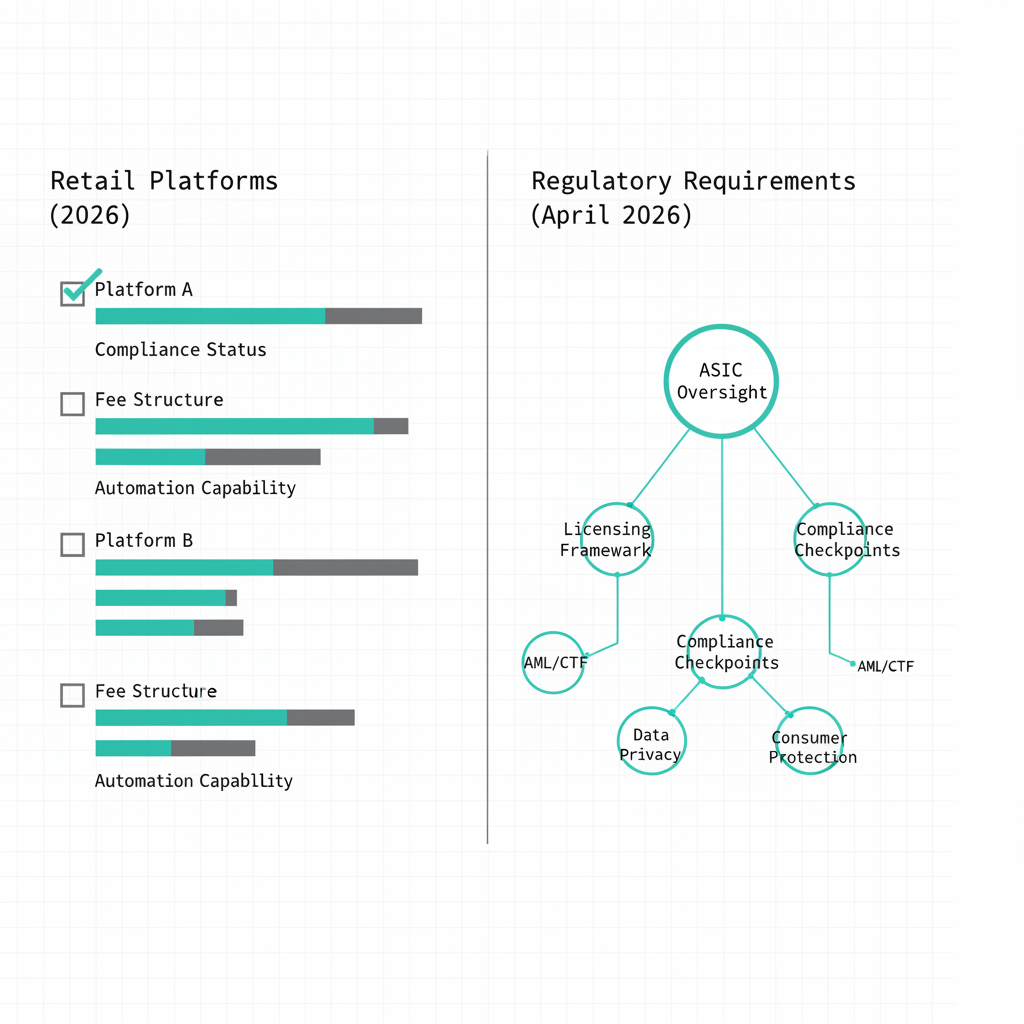
The regulatory picture for algorithmic crypto trading in Australia changed substantially on April 1, 2026, and understanding what has changed is not optional for anyone running capital through these systems.
The Corporations Amendment (Digital Assets Framework) Act 2026
Australia’s first comprehensive crypto regulation framework passed on April 1, 2026. The core requirement: all crypto exchanges and custody providers must obtain an Australian Financial Services Licence within six months of that date. This brings digital asset platforms and custody providers into the existing financial services framework, with obligations tailored to the nature of digital assets rather than copy-pasted from managed fund rules.
ASIC has provided a sector-wide no-action position until June 30, 2026, for firms that are actively pursuing licensing. After that date, unlicensed platforms operating without an AFSL will be exposed to enforcement action. ASIC’s full regulatory guidance and operational standards for digital asset platforms and tokenised custody platforms are slated to come into effect from April 2027.
Algorithmic Trading and Kill-Switch Requirements
ASIC has been modernising its market integrity rules alongside the digital asset framework, and one area of focus is algorithmic trading controls. There have been active discussions about requiring kill-switch mechanisms for algorithmic trading systems, which would allow rapid shutdown of a strategy if it begins behaving unexpectedly. Amended rules were expected around March 2026. If you are running automated strategies at any meaningful scale, this is worth monitoring as guidance develops.
AUSTRAC Obligations
AUSTRAC registration remains a separate and ongoing requirement for Digital Currency Exchange Providers. More than 400 entities, including international exchanges serving Australian customers, hold AUSTRAC registration as of 2026. AUSTRAC compliance covers AML/CTF obligations: identity verification, transaction monitoring, and suspicious matter reporting. These obligations apply to the exchange, not directly to individual traders, but they affect which platforms can legally operate here.
Enforcement
ASIC’s civil proceedings against NGS Crypto entities in April 2026 are a useful reference point for what enforcement looks like in practice. The NGS case involved allegations of unlicensed financial services, which is precisely the conduct the new framework is designed to address. The message is clear: ASIC is prepared to act, not just regulate on paper.
What Traders Should Actually Check
Before depositing on any platform, confirm: does it hold an AFSL or is it currently in the licensing process with ASIC? Is it registered with AUSTRAC? These are not difficult checks, both ASIC Connect and the AUSTRAC public register are searchable online.
On the broader picture, TRM Labs’ March 2026 report found that less than 1% of Australian crypto transactions between March 2025 and February 2026 were linked to illicit counterparties. The compliance infrastructure is working, and most Australians trading on registered platforms have nothing to worry about from a regulatory perspective.
[INTERNAL LINK PLACEHOLDER: ASIC crypto regulation australia → /asic-crypto-regulation-australia]
Banking Restrictions Australian Algo Traders Need to Know
This is the section that does not appear in enough guides, and it causes real problems for algo traders who have not planned for it.
CBA, ANZ, Westpac, and NAB all impose restrictions on transfers to crypto exchanges. The form these restrictions take varies by bank and changes over time: some apply 24-hour holds on outgoing transfers to crypto platforms, others cap monthly transfers at around $10,000, and some reject specific transfers outright. The stated justification is AML/CTF compliance and scam prevention. In February 2026, there were reports of banks tightening controls further on crypto-linked businesses.
For an algo trader, these restrictions create a specific problem: you cannot top up your exchange account quickly when you need to. If a strategy identifies an opportunity that requires additional capital, a 24-hour bank hold is not just inconvenient, it is a strategy failure.
Practical steps to manage this: use PayID for deposits wherever your exchange supports it, as PayID transfers are generally processed faster and less likely to be flagged than standard bank transfers. Keep a funding buffer on your exchange account rather than running with minimum capital. Do not wait until you need to deposit urgently to discover your bank has blocked the transfer.
Stablecoins offer a partial workaround for the fiat on/off-ramp friction. Holding a USDT or USDC balance on an exchange means you can shift capital between strategies