Crypto Algo Trading in Australia 2026: Platforms, Tax & Regulations
Crypto algo trading in Australia has moved well past the hobbyist phase. What started as a niche activity for developers running scripts on Binance has become a legitimate strategy for retail and institutional traders who want to remove emotion, run 24/7, and systematically exploit price inefficiencies in a market that never sleeps.
> TL;DR: Crypto algo trading in Australia is legal and growing fast, but any platform you use must be AUSTRAC-registered and comply with AML/CTF obligations. Profits are taxable under ATO rules, and if you hold assets for over 12 months you may qualify for a 50% CGT discount. The leading platforms for Australian algo traders in 2026 include Cryptohopper, Interactive Brokers, Alpaca, and AI-driven newcomer SaintQuant.
What Is Crypto Algo Trading in Australia?

At its core, algo trading means using pre-programmed rules, bots, or AI models to execute trades automatically, without you staring at a screen at 3am. You define the conditions, the system fires the orders. That’s the whole concept.
Within that definition there are meaningfully different approaches. Market-making bots place simultaneous buy and sell orders to capture the spread. Arbitrage bots scan for price discrepancies across exchanges and close them faster than any human can click. Trend-following strategies use technical indicators to enter and exit positions based on momentum signals. DCA (dollar-cost averaging) bots buy a fixed AUD amount of an asset on a schedule, smoothing out entry price over time. Each of these has different risk profiles, capital requirements, and fee sensitivity.
Australian retail traders are adopting these strategies for a few practical reasons. The crypto market runs around the clock, which suits automation far better than manual trading. Volatility creates genuine opportunities, but it also punishes traders who react emotionally. A well-configured bot doesn’t panic sell at 4am.
Crypto is recognised in Australia as a legitimate financial asset, just not legal tender. That distinction matters: it’s the reason ATO applies capital gains tax treatment to disposals rather than treating crypto like cash. It also means regulatory obligations sit clearly with AUSTRAC and ASIC rather than the Reserve Bank.
The sector is evolving quickly. AI-powered platforms are beginning to replace simple rule-based bots. SaintQuant, launched in April 2026, is a local example worth watching: it uses quantitative models and real-time data analysis rather than static if/then logic. More on the platforms shortly.
[INTERNAL LINK PLACEHOLDER: crypto algo trading australia → /crypto-tax-australia-guide]
Is Crypto Algo Trading Legal in Australia?
Yes, fully legal. There is no prohibition on automated crypto trading strategies in Australia, and using a bot to execute your trades carries no special legal burden beyond what applies to manual trading.
That said, the regulatory environment has tightened considerably, and if you are using a platform without understanding what sits underneath it, you can end up exposed.
AUSTRAC is the primary regulator for crypto businesses in Australia. Any business providing digital currency exchange or virtual asset services must register with AUSTRAC and comply with AML/CTF (anti-money laundering and counter-terrorism financing) laws. This is not optional, and AUSTRAC has the authority to suspend or cancel registrations where a business poses an unacceptable financial crime risk.
A significant change took effect on 2 April 2026. Under expanded AML/CTF laws, what were previously called Digital Currency Exchange (DCE) providers are now classified as Virtual Asset Service Providers (VASPs). The scope of regulated services broadened, and a searchable public VASP register was launched so consumers can verify whether a platform is legitimately registered. If your platform isn’t on that register, that’s a problem.
For businesses that commenced VASP services on or after 31 March 2026, the enrolment deadline with AUSTRAC was 28 April 2026. Any platform that started operating after that date without enrolling is already non-compliant.
ASIC takes a separate but overlapping role. Platforms that hold client assets or exceed certain operational thresholds require an Australian Financial Services Licence. This matters for algo traders because some platforms hold your crypto on your behalf, others connect to exchanges where you hold your own keys.
The virtual asset sector is explicitly categorised by AUSTRAC as high money-laundering risk. That classification shapes everything from onboarding friction to reporting obligations on platforms you use.
AUSTRAC & ASIC: What Australian Crypto Algo Traders Must Know
Before you deposit a dollar, know who regulates what and what your rights are if something goes wrong.
AUSTRAC: What It Actually Does
AUSTRAC registers virtual asset businesses, enforces AML/CTF compliance, and collects suspicious matter reports. When you onboard to any regulated Australian crypto platform, the KYC checks you go through, photo ID, proof of address, source of funds declarations, those are AUSTRAC-driven requirements, not the platform being difficult. They are legally mandated.
AUSTRAC can refuse a registration, suspend it, or cancel it entirely. They’ve done this before. A platform that loses its registration must cease operating, which leaves users in a genuinely messy situation. This is why verifying AUSTRAC status before depositing is not paranoia, it’s basic due diligence.
To check a platform, search the public VASP register at austrac.gov.au. You are looking for an active registration under the business name or ABN of the platform you’re considering. If you can’t find it, or if the registration shows as cancelled or suspended, walk away.
ASIC: The Client Asset Layer
ASIC’s concern is primarily with platforms that hold your funds. If a broker or exchange is custodying your crypto, they need an AFS Licence. ASIC also handles complaints and has consumer protection powers that AUSTRAC does not. For retail traders, ASIC oversight is a meaningful protection: it sets standards for financial product disclosure, dispute resolution, and segregation of client assets.
Some algo trading tools, particularly third-party bots that connect via API to an exchange you control, don’t hold your assets directly. In that case ASIC’s reach is narrower, but the exchange itself still needs its registrations in order.
The Scam Risk Is Real
Australians lost over $330 million to crypto-related scams in the year to 31 December 2024. A meaningful proportion of those losses involved fake or unregistered trading platforms that offered automated trading tools as the hook. High promised returns, slick dashboards, testimonials, then withdrawal requests that mysteriously fail. The VASP register exists partly in response to this. Use it.
Practical checklist before using any algo trading platform:
1. Confirm AUSTRAC/VASP registration is current and active.
2. Check for an AFS Licence on ASIC’s register if the platform holds your funds.
3. Look for an Australian address, ABN, and verifiable contact details.
4. Never deposit based solely on social media recommendations.
Top Crypto Algo Trading Platforms Available to Australians in 2026
The platforms that work well for algorithmic crypto trading in Australia fall into two broad categories: crypto-native bot platforms that connect to exchanges via API, and multi-asset brokers that offer algo capabilities across crypto, forex, and other instruments. Neither category is universally better. It depends entirely on what you’re trying to run.
Cryptohopper
Cryptohopper is a cloud-based bot platform that handles the most common retail algo strategies without requiring you to write a line of code. You get DCA bots, trailing stop-loss features, a social trading marketplace where you can copy verified strategies, and an AI-assisted configuration tool. The fact that it runs in the cloud means your strategies execute even when your computer is off.
It connects to major exchanges rather than holding assets directly, so your crypto stays on the exchange of your choice. The trade-off is that your execution speed is limited by API call latency. For trend-following or DCA strategies that’s fine. For anything trying to front-run short-term price moves, it’s a constraint worth knowing about.
Interactive Brokers Australia
Interactive Brokers Australia is a more serious tool aimed at traders who want to write their own algorithms. It supports Python, Java, C++, and several other languages through its API, and the backtesting infrastructure is genuinely capable. Fees are competitive at the institutional end of the market, and the platform is ASIC-licenced.
The limitation for pure crypto traders is that IB’s crypto offering is more limited than a dedicated exchange. It suits traders who want to run algos across multiple asset classes, equities, futures, and crypto together, rather than crypto only.
Alpaca Trading
Alpaca was identified as the top broker for algorithmic trading in Australia in 2026 by BrokerChooser, largely because of its developer-friendly API and smooth onboarding for algo use. There are no commissions on US equity trades, which is attractive if your strategy spans asset classes. The crypto offering connects cleanly to its API framework.
Alpaca is primarily a US-based platform, so Australian traders should confirm the current onboarding status and verify any applicable regulatory status before depositing. It’s best suited to developers comfortable working with REST or WebSocket APIs.
SaintQuant
SaintQuant launched in April 2026 as an AI-powered platform targeting Australian traders who want automated execution without building their own models. It uses quantitative models and real-time data analysis to manage entries, exits, and position sizing, with integrated risk management rather than leaving that entirely to the user.
It’s too new to have a long track record, but the approach is meaningfully different from a rules-based bot: it adapts to market conditions rather than running fixed logic. Worth watching, particularly as backtested performance data becomes available.
Pepperstone via cTrader
Pepperstone offers access to cTrader, which includes cBots for automated strategy execution. Execution speed is fast, spreads on major instruments are competitive, and the platform supports a wide range of financial instruments including crypto CFDs. It’s ASIC-licenced and AUSTRAC-registered.
The crypto exposure here is via CFDs, not actual asset ownership. That matters for tax treatment and for strategies that depend on taking custody of underlying assets.
Vantage via MetaTrader 4
Vantage offers MT4 with a range of crypto CFDs alongside forex and other instruments. MT4’s Expert Advisors (EAs) are the most widely used algo framework in retail trading globally, so there is a huge library of existing strategies and community support. Low latency execution suits automated strategies well.
Same caveat applies: CFD-based crypto, not spot. Read the PDS carefully before running algo strategies.
UltraAlgo
UltraAlgo takes a different angle, focusing on AI-optimised indicators and genetic algorithm-based strategy development rather than direct execution. It’s more of a strategy development and signal tool than a fully automated execution platform. Useful for traders who want to build systematic strategies but prefer to control execution manually or connect to their own infrastructure.
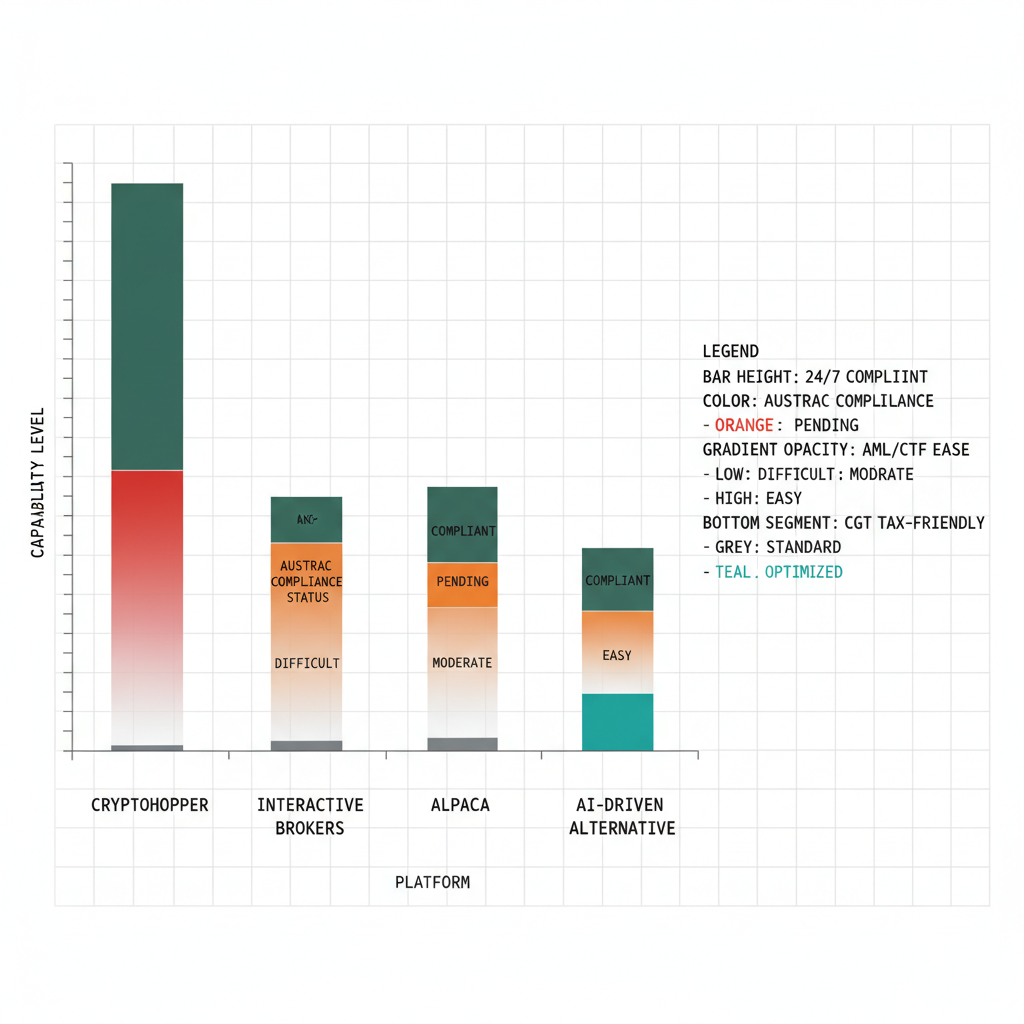
Platform Comparison Table: Crypto Algo Trading in Australia
| Platform | AUSTRAC/ASIC Status | Algo Method | AUD Support | Approx. Fees | Best For |
|---|---|---|---|---|---|
| Cryptohopper | Connects to AUSTRAC-registered exchanges | Cloud bot / DCA / copy trading | Yes (via connected exchange) | Free tier; paid plans from ~USD $19/mo | Retail traders, no-code strategies |
| Interactive Brokers AU | ASIC-licenced | API (Python, Java, C++) | Yes | 0.1%–0.25% per trade | Multi-asset algo developers |
| Alpaca | US-based; verify AU status | REST/WebSocket API | Limited AUD onboarding | Commission-free (US equities); crypto fees vary | Developers, US-market algos |
| SaintQuant | Launched April 2026; verify current status | AI / quantitative models | Yes | Not publicly disclosed | AI-driven automated execution |
| Pepperstone (cTrader) | ASIC-licenced, AUSTRAC-registered | cBots | Yes | From 0.0 pips + commission | Automated CFD / crypto CFD traders |
| Vantage (MT4) | ASIC-licenced | Expert Advisors (EAs) | Yes | Competitive spreads on CFDs | MT4 EA traders, crypto CFDs |
| UltraAlgo | Verify independently | AI indicators / genetic algo | Verify | Subscription-based; pricing varies | Strategy development, signal tools |
Verify AUSTRAC/VASP registration independently at austrac.gov.au before depositing funds on any platform. Fee data is approximate and subject to change.
Fees, Spreads & Costs: What Australian Algo Traders Actually Pay
This is where many traders underestimate their actual cost base, and where algo strategies that look profitable on a spreadsheet quietly bleed out in live trading.
Trading Fees
On Australian spot crypto exchanges, trading fees generally sit between 0.1% and 1% per trade depending on the platform and your volume tier. The maker/taker model is standard: makers, orders that add liquidity to the order book, typically pay 0.1% to 0.25%. Takers, orders that fill immediately against existing liquidity, pay more.
Instant buy, sell, and swap functions are convenient but expensive. CoinSpot’s instant buy rate is 1%, which is fine for a casual purchase but brutal if your algo is firing dozens of trades a day. Always check whether your bot is routing to the order book (maker/taker pricing) or using an instant swap function.
AUD Deposits and Withdrawals
AUD deposits via PayID, Osko, or direct bank transfer are free on most Australian exchanges. Credit card deposits typically attract fees of 1% or more, so avoid them for algo operations where you need to move capital in regularly. AUD withdrawals are generally free. Crypto network fees apply when withdrawing actual assets to a wallet, and these vary by network congestion.
Spreads
Bitcoin spreads on major Australian exchanges range from roughly 0.1% to 0.8% in normal conditions, and widen significantly during high volatility periods. If your strategy trades BTC/AUD frequently, a 0.5% average spread is 0.5% lost before your edge has a chance to work. Some platforms embed their margin in the spread rather than charging a visible commission, making the true cost less obvious.
Subscription and Platform Fees
Third-party algo tools add another cost layer. Some, like Cryptohopper, charge a monthly SaaS fee starting around USD $19 for a basic plan. Others take a percentage of profits, which aligns incentives better but can be expensive if your strategy performs well. UltraAlgo and similar signal tools have their own subscription structures. Stack these costs up before you run the numbers on a strategy’s viability.
The Fee Drag Problem
High-frequency strategies are the most vulnerable to fee drag. A strategy that makes 0.3% per trade looks strong until you add 0.2% in exchange fees, 0.1% in spread, and a monthly platform subscription. At that point you’re essentially working for the exchange. Model your net returns after all costs, not gross returns from backtesting, before going live with any strategy.
Hidden costs embedded in spreads are particularly common on CFD-based crypto platforms. The advertised commission can be zero while the spread quietly prices in the platform’s margin. Compare the mid-price to your fill price to see what you’re actually paying.
Crypto Tax in Australia for Algo Traders
[INTERNAL LINK PLACEHOLDER: crypto tax australia 2026 → /crypto-tax-australia-guide]
The ATO does not look kindly on traders who ignore crypto tax obligations, and algo trading creates more taxable events than most people expect.
CGT vs. Ordinary Income
The ATO classifies cryptocurrency as property. When you dispose of a crypto asset, whether by selling it for AUD, trading it for another crypto, or using it to buy something, that’s a CGT event. Your capital gain is the difference between the cost base and the proceeds.
For algo traders, every completed trade that realises a profit is a CGT event. A bot running 50 trades a day generates 50 potential CGT events per day. That’s not unmanageable if your accounting software is capturing the data, but it needs to be set up correctly from the start.
Income from staking, mining, and airdrops is assessed as ordinary income at the market value at the time of receipt. If your algo strategy involves staking rewards, those come in as income, not capital gains.
The 12-Month CGT Discount
Individuals who hold a crypto asset for more than 12 months before disposing of it may be eligible for a 50% CGT discount. For most algo strategies this is irrelevant because positions are opened and closed within days or hours. But if your DCA bot is accumulating and you’re also holding a longer-term stack separately, that