Algorithmic trading — algo trading — means using pre-defined rules and automated systems to make trading decisions. Instead of sitting in front of a screen deciding when to buy and sell based on gut feeling, you define the logic in advance, and a system executes it for you. Consistently, unemotionally, around the clock.
That's the concept. In practice, algo trading in crypto ranges from something as simple as setting up a recurring buy on Swyftx (which is technically an algorithm — "buy $100 of Bitcoin every Monday") all the way to sophisticated Python-based strategies running on exchange APIs with custom risk management, position sizing, and real-time signal processing.
Most people who get into algo trading start somewhere in the middle: they're tired of making emotional decisions, they've noticed that their best trades follow patterns they can describe in words, and they want a system that executes those patterns without the hesitation, fear, and second-guessing that comes with doing it manually.
If that sounds like you, this guide covers what you need to know to get started — including the strategies that actually work, the tools available, and the realistic expectations you should bring to the table.
Why crypto is well-suited to algorithmic trading
Crypto markets have a few characteristics that make them particularly interesting for algorithmic approaches.
Markets run 24/7. Unlike stocks, crypto never closes. There's no opening bell, no after-hours gap, no weekend pause. This is a problem for manual traders — you can't watch markets around the clock. It's an advantage for algorithms, because they can.
High volatility creates opportunity. Crypto is volatile by design. Bitcoin can move 5-10% in a day, and altcoins can move multiples of that. Systematic strategies that exploit predictable patterns in volatility — mean reversion, momentum, grid trading — have more raw material to work with than they would in calmer markets.
API access is standard. Almost every crypto exchange offers trading APIs, which means you can connect automated systems to your account and execute trades programmatically. This is not universally true in traditional finance, where API access is often restricted to institutional clients.
Emotional markets amplify systematic advantage. Crypto is one of the most emotionally-driven markets in existence. Panic selling, FOMO buying, leverage cascades, meme-driven pumps — these create inefficiencies that disciplined, rules-based systems can exploit. An algorithm doesn't panic when Bitcoin drops 15% overnight. It checks whether the conditions match its rules, and acts accordingly.
None of this means algo trading is easy or guaranteed to be profitable. It means the structural characteristics of crypto markets give algorithmic approaches a genuine edge over pure manual trading — if the strategies are sound and the execution is disciplined.
Common algorithmic trading strategies
There are dozens of strategies used in crypto algo trading, but most fall into a handful of core categories. Understanding these categories matters more than memorising individual strategy names, because every specific strategy is a variation on one of these themes.
Dollar-cost averaging (DCA)
The simplest algorithmic strategy: buy a fixed amount of crypto at regular intervals, regardless of price. $100 of Bitcoin every Monday. $50 of Ethereum every day. The logic is that over time, you buy more when prices are low and less when prices are high, averaging out your entry price.
DCA is not sexy. It's not going to make you rich overnight. But it's one of the most reliable long-term accumulation strategies, and it's the one most beginners should start with. Most Australian exchanges support automated recurring buys — Swyftx calls it Auto Invest.
Grid trading
Grid trading places buy and sell orders at preset intervals within a price range. If you think Bitcoin will trade between $80,000 and $100,000 for the next month, a grid bot places buy orders at $82,000, $84,000, $86,000, and sell orders at $88,000, $90,000, $92,000 — and profits from each bounce within the range.
Grid trading works well in sideways markets and poorly in strong trends. If the price breaks out of your range, you either miss the move (upside breakout) or hold a losing position (downside breakout). The strategy is best suited to range-bound conditions, which crypto experiences frequently between major trends.
Pionex has built-in grid bots that make this accessible without any coding.
Moving average crossover
A trend-following strategy: when a faster moving average (e.g., 20-period) crosses above a slower one (e.g., 50-period), buy. When it crosses below, sell. The logic is that crossovers signal the beginning of new trends.
Moving average crossovers are one of the most widely-studied strategies in trading. They work in trending markets and generate false signals in choppy markets. Most experienced algo traders use crossovers as one signal within a larger system rather than as a standalone strategy.
This is one of the first strategies you'll build when learning Pine Script on TradingView.
Mean reversion
Mean reversion assumes that prices that deviate significantly from their average will eventually return to that average. If Bitcoin is 20% below its 200-day moving average, a mean reversion strategy would buy, expecting a bounce back toward the mean.
This works more consistently for major, liquid assets (Bitcoin, Ethereum) than for small-cap altcoins, which can deviate from their mean and stay there indefinitely — or go to zero. Mean reversion on illiquid pairs is a common way for new algo traders to lose money.
Momentum
The opposite of mean reversion: momentum strategies buy assets that are already going up and sell assets that are already going down. The logic is that trends tend to persist — what's going up tends to keep going up, at least for a while.
Momentum works well in strong crypto bull and bear markets. It struggles in choppy, sideways conditions where trends don't last long enough to generate profit after fees and slippage.
Arbitrage
Arbitrage exploits price differences for the same asset across different exchanges or markets. If Bitcoin is $95,000 on one exchange and $95,200 on another, you buy on the cheaper exchange and sell on the more expensive one.
In practice, pure arbitrage in crypto is extremely competitive. The margins are thin, the speed requirements are high, and transfer times between exchanges create risk. Retail traders rarely profit from simple arbitrage — the opportunity is usually captured by professional firms with faster infrastructure. It's worth understanding as a concept, but not where most people should start.
Three levels of algo trading: find your entry point
One of the most useful frameworks for thinking about algo trading is the level of technical skill required. Not everyone needs to learn Python. Not everyone should stay on no-code platforms forever. The right entry point depends on where you are now and where you want to go.
Level 1: No-code (ready today)
No-code platforms let you configure trading bots through a visual interface — selecting a strategy, setting parameters, and connecting to your exchange — without writing any code.
Best for: Complete beginners to both trading and technology.
Platforms: Pionex (built-in exchange + bots, zero bot fees), Cryptohopper (marketplace of strategies, backtesting, exchange integration).
What you can do: Grid bots, DCA bots, trailing stop bots, copy trading, signal-based bots.
Limitations: You're constrained by the strategies and parameters the platform offers. If you want to test a custom idea, you usually can't.
For more detail on specific platforms, see our best crypto trading bots guide.
Level 2: Scripting (the sweet spot for most)
Pine Script on TradingView is the bridge between no-code and full programming. You write trading logic in a readable, purpose-built language, backtest it against historical data, and connect it to an execution platform like 3Commas via webhooks.
Best for: Traders who want to test and refine their own ideas without learning a general-purpose programming language.
What you can do: Custom indicators, custom strategies, backtesting with detailed metrics, automated execution via webhooks, multi-condition entry/exit logic.
Limitations: Pine Script runs inside TradingView's sandbox. No external data, no machine learning, no portfolio-level logic.
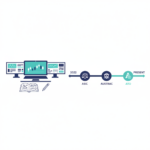
A typical Level 2 workflow: develop strategy in Pine Script → backtest on TradingView → set webhook alert → 3Commas executes on your Australian exchange.
Level 3: Full code (maximum flexibility)
Python with exchange APIs, data libraries (pandas, numpy), and backtesting frameworks (Backtrader, QuantConnect, Zipline). Full programmatic control over everything — data, logic, execution, risk management, position sizing.
Best for: Traders with programming skills who want maximum flexibility and control.
What you can do: Anything. Custom data pipelines, machine learning models, multi-exchange strategies, portfolio optimisation, sophisticated risk management.
Limitations: High learning curve. Significantly more development time. Infrastructure requirements (hosting, monitoring, error handling). More things can go wrong.
Most people don't need Level 3 to be profitable. But if you have a software engineering background, or if you're willing to invest the learning time, it gives you capabilities that no pre-built platform can match.
Risks of algorithmic trading
Algo trading reduces some risks (emotional decisions, missed opportunities, inconsistent execution) and introduces others. Being honest about these risks is important.
Strategy risk. An algorithm is only as good as the logic behind it. A bad strategy executed consistently is still a bad strategy — the algorithm just helps you lose money faster and more efficiently.
Overfitting. The most common technical mistake. Your strategy looks incredible on historical data because it was effectively optimised to fit that specific data. On new, unseen market data, it fails. Always test on out-of-sample data, and be deeply sceptical of strategies that look too good.
Market regime changes. A strategy that works in a bull market may fail in a bear market. A strategy that works in high volatility may fail in low volatility. Markets change, and algorithms don't automatically adapt unless you've designed them to.
Technical failures. APIs go down. Exchanges lag during high-volume events. Network connections drop. Your bot might send duplicate orders or miss an exit. Robust error handling and monitoring are not optional.
Over-leverage. Some platforms make it very easy to trade with leverage. An algorithm trading with 10x leverage on a volatile crypto pair can blow up your account in minutes if something goes wrong. If you're starting out, use spot trading (no leverage) until you deeply understand the risks.
False confidence from backtesting. Good backtest results feel validating. They're also the most dangerous thing in algo trading because they tempt you to commit more capital than you should. Backtests don't account for slippage, latency, partial fills, or market impact. Your live results will almost always be worse than your backtest.
Getting started in Australia: a practical path
If you're in Australia and want to start with algorithmic trading, here's a realistic path that doesn't require you to learn Python on day one.
Step 1: Understand what you're automating. Before you automate anything, make sure you understand the basic concepts — support and resistance, moving averages, what a candlestick chart represents, what a spread is. You don't need to be an expert, but you need enough understanding to evaluate whether a strategy makes sense. Automating something you don't understand is not a strategy — it's gambling with extra steps.
Step 2: Set up an AUSTRAC-registered exchange. You need somewhere to actually trade. See our guide to the best crypto exchanges in Australia for options that support API access and bot integration.
Step 3: Pick your level and start there. If you're new to both trading and technology, start with Level 1 (Pionex or Cryptohopper). If you have some trading experience and want to test your own ideas, start with Level 2 (TradingView + 3Commas). If you can code, Level 3 is open to you from the start — but even experienced developers benefit from starting with a simpler tool to understand the domain before building custom infrastructure.
Step 4: Backtest, paper trade, then start small. Test your strategy on historical data first. Then run it in paper trading mode (most platforms support this) to see how it behaves in real-time without risking money. When you do go live, start with a small amount — much smaller than you think you should. You can always scale up once you have confidence in the system.
Step 5: Track everything for tax from day one. Algo trading generates a lot of transactions, and every one of them is a potential CGT event. Set up Koinly or a similar tool before you start, not six months later when you have 2,000 trades to reconcile.
FAQ
Is algorithmic trading legal in Australia?
Yes. There are no specific restrictions on algorithmic trading in crypto for retail traders in Australia. You should use AUSTRAC-registered exchanges and report all trades for capital gains tax purposes.
Do I need to know programming?
No. Platforms like Pionex and Cryptohopper offer fully no-code bot setup. Pine Script on TradingView is a good intermediate step — it reads almost like English and doesn't require traditional programming skills.
Can I start with a small amount?
Yes. Most platforms have no meaningful minimum. You can start with $10-50 AUD while you learn. Starting small isn't just acceptable — it's the smart approach. You're paying for education, not trying to get rich on your first bot.
How much money can I make?
This is the wrong question, and any guide that gives you a specific number is misleading you. Returns depend entirely on your strategy, the market conditions, your risk management, and how much capital you deploy. Many strategies are profitable in some conditions and unprofitable in others. The realistic expectation is that your first strategies will teach you more than they earn you, and that's fine.
What's the difference between a trading bot and algorithmic trading?
A trading bot is a specific tool that executes trades automatically. Algorithmic trading is the broader discipline of using rules-based systems to trade. All trading bots are a form of algorithmic trading, but not all algorithmic trading involves a pre-built bot — you might write your own system from scratch.
Is algo trading risky?
Yes. Algorithmic trading does not eliminate risk — it changes the nature of the risk. Instead of making emotional mistakes, you risk building flawed strategies, overfitting to historical data, or experiencing technical failures. The best algo traders are disciplined risk managers first and strategy builders second.