Algorithmic Crypto Trading Australia 2026: The Complete Guide
Algorithmic crypto trading Australia is no longer the exclusive territory of hedge funds and quantitative finance desks. Retail traders across Sydney, Melbourne, and Brisbane are running automated strategies around the clock, and the regulatory ground has shifted significantly under everyone’s feet in 2026.
> TL;DR: Algorithmic crypto trading Australia describes the use of automated software to execute crypto trades 24/7 based on predefined rules, with no manual intervention required. Key benefits include millisecond execution speeds, emotion-free decision-making, and the ability to backtest strategies before risking real capital. Australian traders must understand ATO capital gains tax obligations, new ASIC licensing requirements under the Corporations Amendment (Digital Assets Framework) Act 2026, and AUSTRAC’s VASP registration rules before they start.
This guide covers how algo trading works mechanically, the main strategies in use, the platforms accessible to Australians, the tax treatment from the ATO, and what the 2026 regulatory changes actually mean for you in practical terms. No fluff.
What Is Algorithmic Crypto Trading in Australia?

At its core, algorithmic crypto trading is the use of computer software to automatically execute buy and sell orders on your behalf, triggered by conditions you define in advance. Those conditions might be a price crossing a moving average, volume spiking above a threshold, or simply a clock hitting a set time. The algorithm reads the market, decides whether your conditions are met, and fires the order, all without you touching a keyboard.
What makes this particularly useful for crypto, compared to, say, ASX equities, is the trading hours. Crypto markets run continuously, every hour of every day, including Christmas. A manual trader in Perth cannot watch a BTC/AUD chart at 3am when a significant US news event breaks. A bot can, and it will act on whatever rules you gave it.
The growth of automated crypto trading among Australian retail traders has been steady. Better tooling, cheaper cloud computing, and a handful of accessible no-code platforms have lowered the barrier from “professional quant” to “anyone willing to spend a weekend learning.”
That said, Australian traders face obligations that do not apply in every jurisdiction. The ATO has specific rules about how crypto disposals are taxed, ASIC has just passed major new licensing legislation that affects the platforms you can legally use, and AUSTRAC now requires exchanges and related service providers to be registered as Virtual Asset Service Providers (VASPs). All of that is covered in detail below.
How Algorithmic Crypto Trading Works
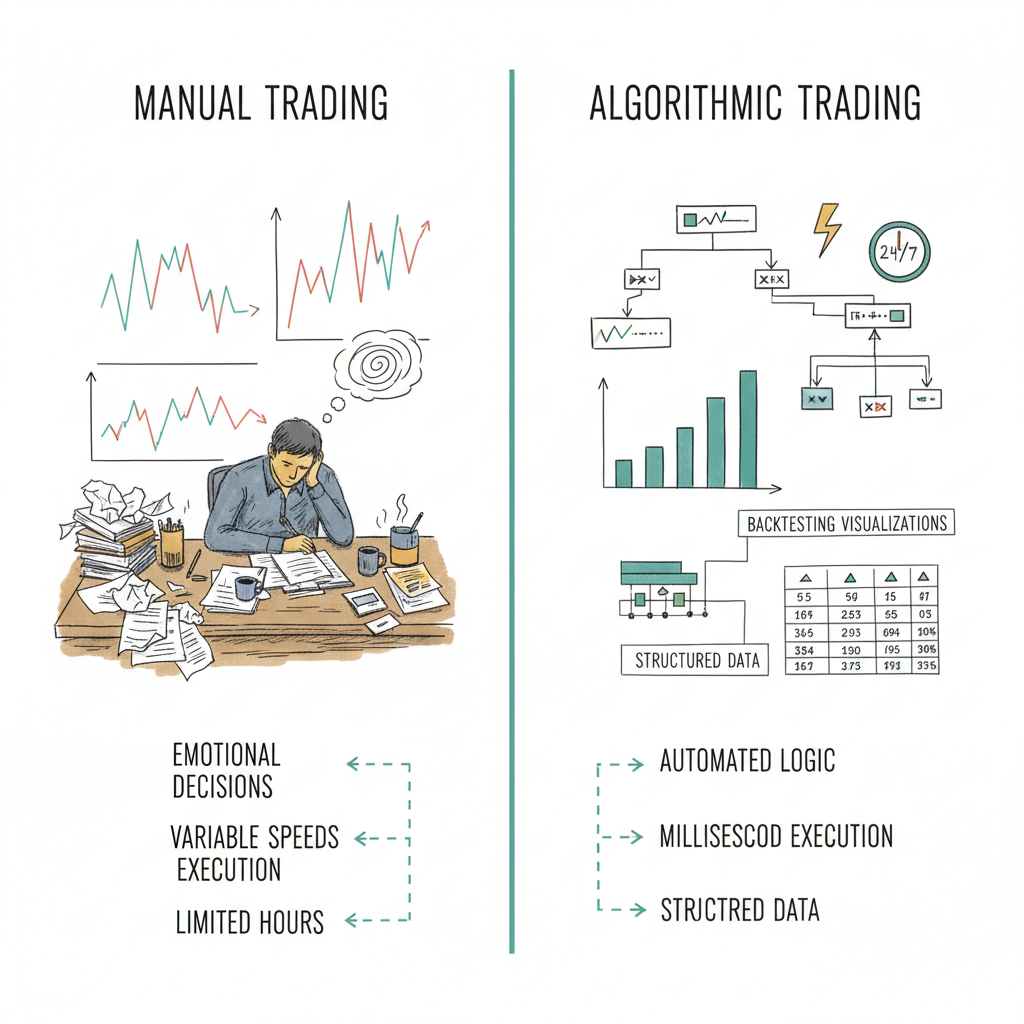
The mechanics involve four components working together: the strategy logic, the API connection to an exchange, the order execution engine, and the risk management parameters.
Strategy logic is the brain. You define the conditions: if the 50-day moving average crosses above the 200-day moving average on the BTC/AUD pair, place a market buy for $500. If price drops 8% from entry, close the position. Every rule the bot follows lives here.
API connections are how your bot communicates with the exchange. You generate an API key on the exchange, feed it into your algo platform, and that key grants the software permission to place, modify, and cancel orders on your behalf. This is also where most of the security risk sits, which I will cover in the risks section.
Order execution is the mechanical act of sending the order. A good execution engine handles order types correctly, BNBs slippage where it can, and queues orders without duplication if the API returns an error.
Risk management parameters sit across the top of everything else. Position sizing, maximum drawdown limits, daily loss caps, and exposure limits per asset are all set here. Without these, a bug in your strategy logic can drain an account faster than you can log in.
Before any of this runs on live capital, serious traders backtest the strategy against historical price data. If you are trading a BTC/AUD grid strategy, you would run it through, say, 2020 to 2024 data and see how it performed. Backtesting is not a guarantee, but it surfaces obvious flaws before they cost you real money.
Paper trading goes one step further. You run the algorithm in real time against live market data, but with simulated funds. This catches issues that backtesting misses: API latency, exchange-specific order minimum errors, and edge cases in your logic that only appear in live conditions.
Some platforms also support multi-exchange bots, meaning a single algorithm can manage positions across Binance, Kraken, and a local Australian exchange simultaneously. For arbitrage strategies especially, this matters.
If you do not code, most platforms offer pre-built algorithms or configurable templates. Cryptohopper and Tradetron both have these. You pick a strategy type, adjust parameters, and deploy. You are still making strategic decisions; you are just not writing Python.
Key Benefits of Algo Trading for Australian Crypto Traders
Speed is the most obvious. A human sees a price condition, thinks about it, opens the order screen, and types. That process takes seconds. An algorithm identifies the same condition and fires the order in milliseconds. In a volatile market, that gap matters.
Emotion-free execution is the underrated one. Fear and greed cause most retail trading losses. The algorithm does not panic-sell when BTC drops 15% in an hour. It does what the rules say. If the rules say hold, it holds. Removing that psychological variable is genuinely valuable, and I would argue it is the main reason systematic traders tend to outperform discretionary traders over long timeframes.
24/7 market participation is the obvious fit for crypto. Australian traders in the Eastern time zone are asleep when New York and London are most active. A bot solves this completely. It does not matter if you are in Darwin or Hobart, the algorithm trades whenever the market triggers your conditions.
Backtesting capability means you can stress-test a strategy before it touches real AUD. You can see maximum drawdown, win rate, and Sharpe ratio across years of data. You can compare a DCA approach against a trend-following approach on the same asset pair. This kind of evidence-based preparation is simply not available to pure manual traders.
Scalability is also real. A human trader can realistically monitor four or five charts at once. An algorithm can simultaneously watch dozens of pairs, across multiple exchanges, applying the same logic consistently to all of them.
Risks and Challenges to Understand Before You Start
Let me be direct: algo trading is not a passive income machine you set up on a Sunday afternoon.
Market volatility cuts both ways. Yes, fast execution is a benefit. But in a flash crash, an algorithm executing at market price can fill orders at prices significantly worse than intended. Stop-losses help, but they are not foolproof on illiquid pairs or during exchange outages.
API security is the risk that does not get enough attention. Your API key is effectively a password that lets software move money. If it is stored insecurely, embedded in a public GitHub repository, or generated with withdrawal permissions enabled, a compromised key means a compromised account. Always create API keys with trade-only permissions, never withdrawal permissions. Store them in environment variables or a secrets manager, not in a config file.
Technical complexity and ongoing cost surprise a lot of people. Building a working algorithm is not the hard part. Maintaining it through exchange API changes, handling error states, and adapting when market conditions shift requires ongoing attention. Subscription-based platforms remove some of this burden but add monthly costs that compound against your returns.
Over-optimisation, sometimes called curve-fitting, is where a strategy looks exceptional on historical data because it has been tuned so precisely to past conditions that it has no predictive power in live markets. If your backtest shows a 94% win rate, be sceptical, not excited.
Exchange downtime and API failures are a real operational risk. Exchanges go offline for maintenance, experience DDoS attacks, or throttle API access during high-volume periods. A bot with an open position and no ability to close it is a genuine problem.
On the profitability question: results vary widely, and anyone selling a guaranteed-return algo strategy is lying to you. Some traders run consistently profitable systems. Many do not. Commission costs, slippage, and the cost of the platform itself all erode returns, and a strategy that worked in 2023 may not work in 2026 as market structure changes.
Common Algorithmic Trading Strategies Used in Crypto
Trend-following is the most widely used approach. The algorithm tracks momentum indicators, moving average crossovers, MACD signals, or relative strength, and places trades in the direction of an established trend. It works well in markets with sustained directional moves and struggles in sideways chop.
Mean reversion operates on the opposite assumption: that prices which deviate significantly from a historical average will eventually snap back. Pairs trading and Bollinger Band strategies fall into this category. Crypto’s volatility makes mean reversion trickier than in traditional markets, but it can work on stable pairs or shorter timeframes.
Arbitrage exploits price differences for the same asset across different exchanges. If BTC is trading at $95,200 AUD on one exchange and $95,350 AUD on another, the bot buys on the cheaper side and sells on the more expensive side simultaneously. The margins are thin and the competition is fierce, but multi-exchange bot support makes it mechanically possible for retail traders.
Grid trading places a series of buy and sell limit orders at fixed price intervals above and below a base price, creating a grid. The bot profits as price oscillates within the grid. It performs well in ranging markets and bleeds in strong trending conditions.
Dollar-Cost Averaging (DCA) bots automate the simplest long-term strategy: buying a fixed AUD amount of an asset at regular intervals regardless of price. This removes timing decisions entirely and reduces the impact of volatility over time. It is not a sophisticated strategy, but for many Australian traders building long-term crypto positions, it is the right one.
Scalping involves executing many small trades in short succession, capturing incremental price movements. It requires low fees, fast execution, and significant capital to generate meaningful returns. Exchange fee structures matter a lot here.
Top Algorithmic Crypto Trading Platforms Available to Australians
Before going into specific platforms, one non-negotiable point: verify each platform’s regulatory status before depositing funds. Under the DAF Act 2026, platforms operating in Australia that exceed $10 million in annual transaction volume or hold more than $5,000 per customer will need an Australian Financial Services Licence. Some platforms on this list are offshore and may not hold one. That is your legal and financial risk to assess.
SpeedBot is built specifically for algo traders who want full control. It supports strategy crafting, order placement, backtesting, and both live and simulated bot deployment. It is a good fit for traders who want to build and own their strategy logic rather than subscribing to someone else’s signals. The interface is more technical than some alternatives, which suits experienced traders and will frustrate beginners.
Cryptohopper is the most feature-complete platform on this list for retail algo traders. It covers automated bots, portfolio management, DCA, market-making, arbitrage, and social trading (where you can follow another trader’s strategy). The range of supported exchanges is broad. Pricing starts free with significant limitations, moving to paid tiers from around USD $19/month for the Explorer plan. Australian traders should note it is a Netherlands-based company, so ASIC coverage is indirect at best.
UltraAlgo takes a signals-first approach rather than pure automation. It delivers pre-tested crypto trading indicators and strategy signals, which you then act on, either manually or through connected automation. It is better suited to traders who want analytical support without handing full execution control to a bot.
Capital.com Australia is a different category entirely. It offers CFD trading on crypto assets with MetaTrader 4 integration, which means you can run Expert Advisors (EAs) for automated CFD trading. CFDs carry risks that spot crypto does not, including leverage losses and counterparty exposure. Capital.com holds an AFSL in Australia, which is a meaningful compliance point. CFD crypto trading also has different tax treatment to spot crypto, worth discussing with your accountant.
Zignaly focuses on API security, backtesting tools, and broad exchange compatibility. It also offers profit-sharing arrangements with signal providers, where you pay a percentage of profits rather than a flat subscription. For traders who want access to external strategy providers without a fixed monthly cost, this model has appeal.
Tradetron is a strategy marketplace, meaning you can subscribe to algo strategies built by other traders rather than building your own. It includes crypto strategies alongside equities and derivatives. The subscription model varies by strategy. It originated in India and has growing international usage, but Australian traders should scrutinise the regulatory picture carefully here.
Platform Comparison
| Platform | Strategy Types | Backtesting | Multi-Exchange | Pricing Model | ASIC/AUSTRAC Notes |
|---|---|---|---|---|---|
| SpeedBot | Custom, pre-built | Yes | Limited | Subscription tiers | Offshore; verify compliance |
| Cryptohopper | DCA, grid, market-making, arbitrage, trend | Yes | Yes (major exchanges) | Free + paid from ~USD $19/mo | Netherlands-based; no AFSL |
| UltraAlgo | Signal-based, indicators | Yes (strategy signals) | No | Subscription | US-based; no AFSL |
| Capital.com AU | CFD EA/algo trading (MT4) | Limited | No | Spread-based | Holds Australian AFSL |
| Zignaly | Custom, profit-sharing | Yes | Yes | Profit-share or subscription | Offshore; verify compliance |
| Tradetron | Marketplace strategies incl. crypto | Yes | Limited | Per-strategy subscription | India-based; no AFSL |
Crypto Tax in Australia: What Algo Traders Need to Know
[INTERNAL LINK PLACEHOLDER: crypto tax australia → /guides/crypto-tax-australia]
The ATO treats cryptocurrency as property, not currency. That classification has significant consequences for algo traders, because every time your bot executes a trade that disposes of one asset, you have potentially triggered a capital gains tax event.
CGT applies when: your bot sells crypto for AUD, trades one crypto for another (BTC to ETH is a disposal of BTC), or the algorithm uses crypto to pay for a service or product.
CGT does not apply when: you transfer between your own wallets. If your bot moves funds between a hot wallet and an exchange wallet you control, that is not a taxable event.
The 50% CGT discount applies to assets held for more than 12 months. This creates an interesting consideration for algo traders: high-frequency strategies that turn over positions rapidly forfeit this discount entirely. A DCA bot accumulating BTC over 12+ months benefits from it. A scalping bot running daily trades does not.
Staking rewards are treated as ordinary income at the AUD value when received, not as capital gains. If your algo strategy incorporates staking yield, that income goes on your tax return at your marginal rate.
Record-keeping is where algo traders often get caught. A bot running 200 trades a month across 12 months generates 2,400 CGT events to report. The ATO requires you to record the AUD value at the time of each acquisition and disposal. Most serious traders use crypto tax software, Koinly, CryptoTaxCalculator, or similar, and ensure their trading platforms export transaction histories in a compatible format.
I would strongly recommend speaking to an accountant who specifically understands crypto. The rules are not complicated in principle, but volume makes them administratively intensive, and the interaction between algo trading income, staking income, and your regular income tax position is worth getting right.
ASIC and AUSTRAC: The 2026 Regulatory Landscape
Two separate frameworks operate in parallel, and most traders conflate them.
AUSTRAC covers anti-money laundering and counter-terrorism financing. Since April 2, 2026, the terminology has changed: what were called Digital Currency Exchange (DCE) providers are now formally classified as Virtual Asset Service Providers (VASPs). All VASPs must be registered with AUSTRAC and comply with AML/CTF obligations including KYC procedures, transaction monitoring, and suspicious matter reporting. Operating without registration is a criminal offence. AUSTRAC conducted a register review in late 2025 and early 2026 to remove inactive businesses, and the register is now publicly searchable. If you are evaluating a local platform, check the AUSTRAC register.
ASIC covers financial products and services. The major development is the Corporations Amendment (Digital Assets Framework) Act 2026, which passed Parliament on April 1, 2026, received Royal Assent on April 8, and commences April 9, 2027. Under this legislation, Digital Asset Platforms (DAPs) and Tokenised Custody Platforms (TCPs) will need to hold an Australian Financial Services Licence.
The immediate deadline is June 30, 2026: existing firms providing financial services involving digital asset financial products must apply for an AFSL or a variation to their existing licence by that date. Platforms exceeding $10