Crypto Algo Trading Australia 2026: Is It Legit, Safe & Worth It?
Crypto algo trading in Australia has attracted serious attention over the past two years, and with that attention has come a flood of platforms that range from genuinely useful to outright fraudulent. If you have landed here because you searched for “CryptoAlgo” or want to know whether automated trading systems are worth your time and money in the current Australian regulatory environment, you are in the right place.
> TL;DR: Crypto algo trading in Australia uses automated, rules-based systems to execute trades without manual input. While legitimate platforms exist, warning signs like hidden ownership and lack of AUSTRAC or ASIC registration are major red flags you cannot afford to ignore. All profits are subject to ATO tax rules, and the regulatory goalposts shifted significantly in early 2026. We break down the risks, regulations, fees, and the best regulated alternatives available to Australians right now.
What Is Crypto Algo Trading in Australia? A Quick Verdict
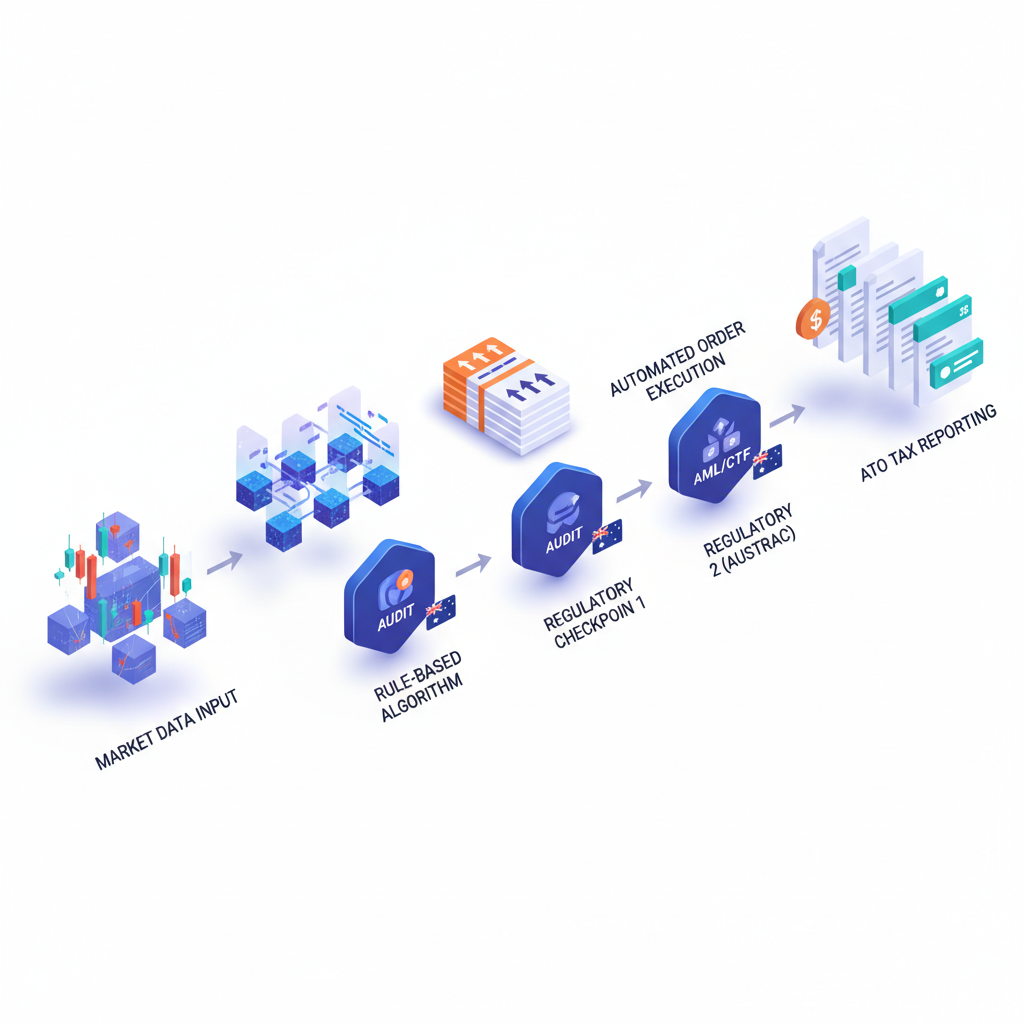
Algorithmic crypto trading means using pre-programmed instructions, mathematical models, and automated execution to trade digital assets without placing orders manually. The system watches the market, identifies conditions that match its rules, and fires off a trade in milliseconds. No hesitation, no second-guessing, no forgetting to set a stop-loss at 2am.
Australian traders have good reason to be interested. Crypto markets run 24 hours a day, seven days a week, and nobody can monitor BTC/AUD price action at 3am on a Tuesday without a bot. The emotional discipline angle also matters: fear and greed drive a lot of poor manual trading decisions, and a rules-based system simply does not have feelings about a red candle.
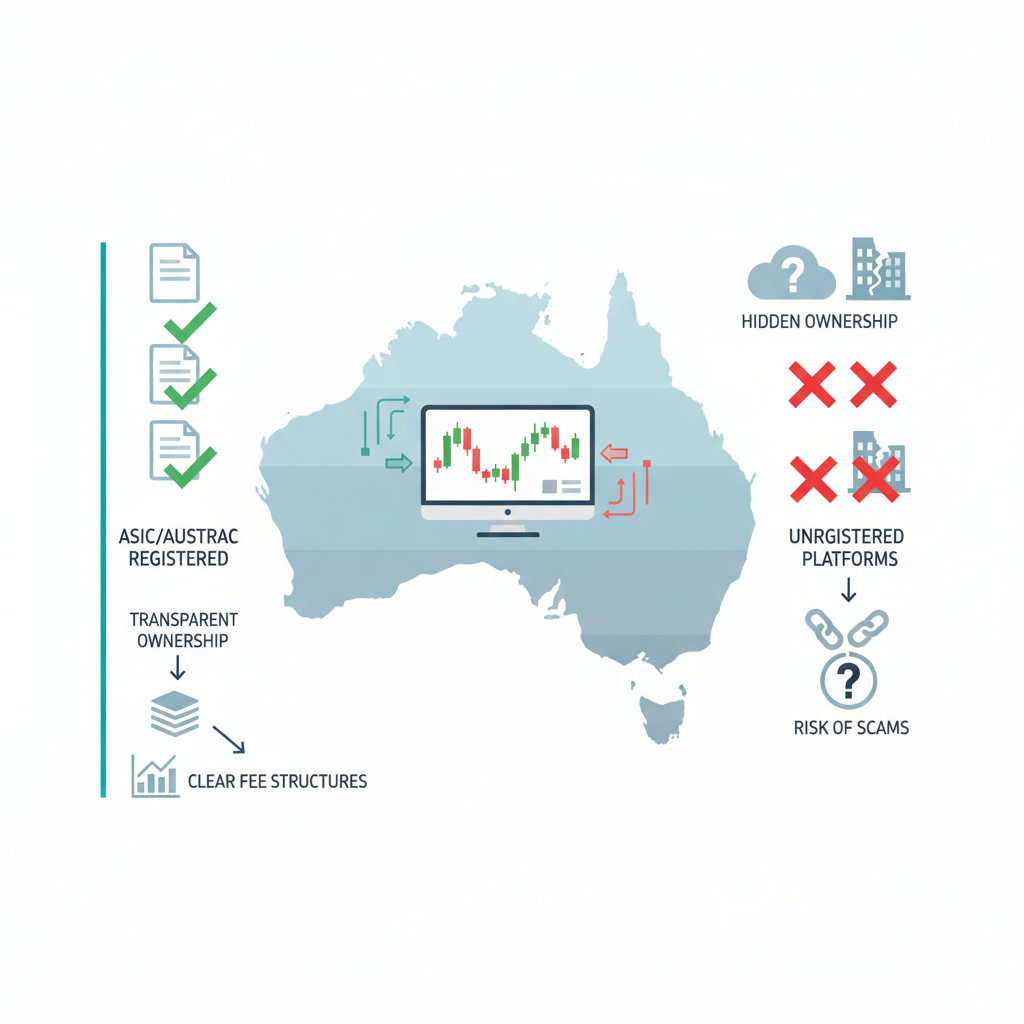
The legitimacy question is where things get complicated. For a crypto algo platform to be trustworthy in Australia it needs, at a minimum, AUSTRAC registration as a Virtual Asset Service Provider (VASP), transparent ownership, and ideally a clear pathway toward ASIC compliance under the new Digital Assets Framework.
A site that has been circulating in Australian search results, cryptoalgo.online, does not meet those standards. Scamadviser rates it with a low trust score. The website owner’s identity is hidden behind WHOIS privacy. The domain is very young, which is a well-documented indicator of fraudulent activity. There is no verifiable AUSTRAC registration and no evidence of an Australian Financial Services Licence or ASIC authorisation.
To be absolutely clear: cryptoalgo.online is a separate entity from CryptoAlgo.com.au. We are not affiliated with cryptoalgo.online and this article exists in part to help Australians distinguish between the two.
Before depositing a single dollar anywhere, check the AUSTRAC public VASP register and ASIC Connect. If the platform is not on those lists, walk away.
How Algorithmic Crypto Trading Works: The Basics
At its core, an algo trading system is a set of conditional rules. Something like: if the 14-period RSI drops below 30 and volume is 20% above the 10-day average, buy 0.01 BTC. When conditions are met, the system places the order automatically. No human in the loop.
These rules are built around price, volume, timing, or technical indicators, and they are connected to exchanges via APIs. The API is the bridge between your bot and the order book. Most major exchanges, including Kraken and Binance Australia, publish well-documented APIs for exactly this purpose.
Common Algorithmic Strategies
Trend following is the most straightforward: the bot identifies a directional move and rides it, entering long when momentum is upward and exiting when it stalls. Arbitrage exploits price differences for the same asset across different exchanges, buying on the cheaper venue and selling on the more expensive one simultaneously. Market making involves posting both bid and ask orders around the current price and collecting the spread. Mean reversion assumes prices will return to a historical average and trades against extreme moves.
Before any strategy goes live, it should be backtested on historical data. Backtesting runs your rules against past market conditions to see how they would have performed. The catch, which I will cover in the risks section, is that past performance is a genuinely unreliable guide to future results in crypto.
Speed and consistency are the headline advantages. A bot executes in milliseconds. It applies its rules identically every single time, which matters more than most new traders realise.
Key Benefits of Algorithmic Crypto Trading for Australian Investors
The practical case for automated trading is real, even if the marketing around it is often overblown.
Execution speed is the most defensible advantage. A bot can react to a price signal in milliseconds, while you are still reaching for your phone. In a volatile market, the difference between a $65,200 and $65,500 entry on BTC/AUD can matter significantly at scale.
The emotion-free angle is underrated. Most retail traders know they should not panic-sell a 15% dip, but they do anyway. A bot does not. It executes what it was told to execute, which is either a strength or a weakness depending on how well the strategy was designed.
The 24/7 coverage point is specific to crypto and genuinely valuable for Australians. The BTC/AUD market does not close for the ASX lunch break or the Sydney public holiday. A bot running on Kraken or Swyftx keeps watching while you are at work, asleep, or at the beach.
Backtesting lets you stress-test a strategy against real historical data before risking real money. Proper backtesting on Australian market data, across both bull and bear conditions, gives you a more realistic picture of expected drawdowns and win rates than any promotional material will.
Running multiple strategies simultaneously across different assets is also genuinely difficult to do manually. A bot can monitor ETH/AUD mean reversion while simultaneously running a trend-following strategy on SOL/AUD without getting confused.
Risks and Limitations You Need to Know Before You Start
Anyone selling automated crypto trading as passive income with minimal risk is either naive or lying to you.
Market instability and flash crashes are the first problem. Algorithms are designed for conditions similar to what they were trained on. A sudden market dislocation, like the kind that hit crypto markets in May 2022 or March 2020, can cause a well-backtested strategy to blow up in hours. The system keeps executing its rules while the rules stop making sense.
Security risks deserve more attention than they get. Connecting a bot to your exchange account via API key means that if the bot provider is compromised, your funds are potentially at risk. Always use API keys with trade-only permissions, never withdrawal permissions. Exchange hacks remain a real risk, and third-party bot software introduces its own attack surface.
Over-optimisation is a technical problem that trips up a lot of algorithmic traders. If you test a strategy across enough parameters and enough historical periods, you will eventually find a combination that looks extraordinary on paper. The strategy has been curve-fitted to past noise rather than actual market signal, and it will fail when conditions change even slightly.
Technical failures are more mundane but happen constantly. Exchange downtime, connectivity drops, software bugs, or API rate limiting can all cause your bot to miss entries, exit late, or hold a position it should have closed. Always have monitoring in place and understand what your bot does if it loses its connection.
The regulatory environment is shifting fast, which creates compliance uncertainty. A platform that is operating legitimately today may face new licensing requirements under the DAF Act by April 2027.
Finally, hidden fees and opaque spreads on unregulated platforms can silently erode returns. A platform charging a 1.5% spread on every trade will need to generate significant alpha just to break even, and many do not disclose this clearly. [INTERNAL LINK PLACEHOLDER: hidden crypto fees → crypto exchange fees Australia pillar]
Is CryptoAlgo.online a Scam? Red Flags Australian Traders Should Know
Crypto algo trading in Australia attracts a steady stream of fraudulent platforms precisely because the concept sounds sophisticated and the potential returns are easy to exaggerate. Cryptoalgo.online ticks several of the classic warning boxes.
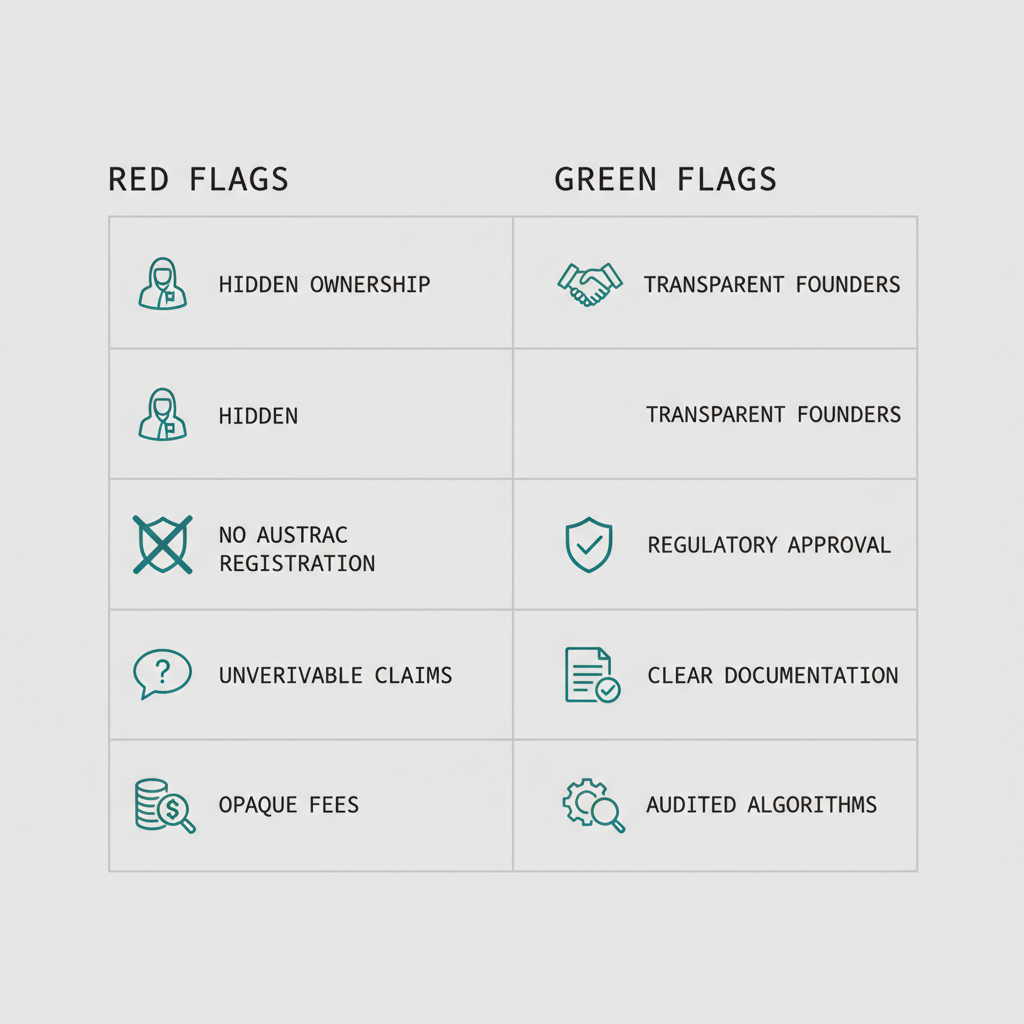
Scamadviser’s analysis gives it a low trust score. The site owner’s identity is hidden using WHOIS privacy protection, which is a significant red flag. Legitimate financial businesses do not hide who they are. The domain itself is very young, and young domains combined with hidden ownership and financial services claims is a pattern that appears repeatedly in crypto fraud investigations.
There is no verifiable AUSTRAC registration for cryptoalgo.online as a Digital Currency Exchange provider or VASP. There is no evidence of an Australian Financial Services Licence or any ASIC authorisation. Operating a digital currency exchange in Australia without AUSTRAC registration is a criminal offence, not a minor compliance issue.
To be unambiguous: cryptoalgo.online is not affiliated with CryptoAlgo.com.au in any way. We operate separately and hold a different domain specifically because we believe in transparent ownership.
How to Check Before You Deposit
Go to the AUSTRAC public VASP register at austrac.gov.au and search for the platform by name and ABN. Then check ASIC Connect for any licence or authorisation records. If neither search returns a result, stop there.
Classic Warning Signs Worth Memorising
Guaranteed returns are mathematically impossible in any trading environment. Pressure tactics and countdown timers are sales manipulation, not investment information. An unverifiable team with stock-photo headshots and LinkedIn profiles created last month is a strong indicator of fraud. Requests to recruit other investors in exchange for higher returns are the structure of a pyramid scheme, not a trading platform.
If a platform is offering you 3% daily returns with “AI-powered” trading and you cannot find them on the AUSTRAC register, the answer is no.
Australian Regulation of Crypto Algo Platforms: AUSTRAC, ASIC & the DAF Act
The regulatory picture for crypto algo trading in Australia changed substantially in the first half of 2026, and it is worth understanding the current framework in detail.
AUSTRAC: Registration Is Not Optional
Any business providing digital currency exchange services in Australia must be registered with AUSTRAC. As of April 2, 2026, AUSTRAC expanded its Anti-Money Laundering and Counter-Terrorism Financing laws to cover a broader range of crypto activities, and formally renamed Digital Currency Exchange providers to Virtual Asset Service Providers, or VASPs. This brings Australian terminology in line with international standards from the Financial Action Task Force.
AUSTRAC simultaneously launched a searchable public register of registered VASPs, which means there is now a simple, public way to verify whether any platform is legitimately registered. The register is accessible at austrac.gov.au.
AUSTRAC’s enforcement activity has also escalated. In March 2026, AUSTRAC cancelled the registrations of several VASPs, including Self Custody Pty Ltd, Jam Xchange Pty Ltd, and Coinsec Australia Pty Ltd, citing unacceptable risks of money laundering or terrorism financing. Cancellation is not a slap on the wrist. It means the platform can no longer legally operate in Australia.
ASIC and the DAF Act
ASIC’s role in crypto regulation expanded with the Corporations Amendment (Digital Assets Framework) Act 2026, which passed Parliament on April 1, 2026, and commences on April 9, 2027. Under the DAF Act, digital asset platforms will need to hold an Australian Financial Services Licence from ASIC, bringing them into the same compliance framework as traditional financial services businesses.
The transition timeline is tight. ASIC has made clear that firms needing a new AFSL or a variation to an existing licence must lodge their application by June 30, 2026. In May 2026, ASIC explicitly warned that unlicensed conduct after the no-action position expires will carry serious penalties. ASIC published its full regulatory roadmap for digital assets on April 22, 2026, which outlines how it plans to integrate crypto into the existing financial services framework.
For consumers, the practical implication is that platforms which have not applied for licensing by June 30, 2026, are either planning to exit the Australian market or are not taking compliance seriously. Both outcomes should concern you as a depositor.
[INTERNAL LINK PLACEHOLDER: ASIC crypto regulation → Australian crypto regulation 2026 pillar]
ATO Tax Obligations
Profits from algorithmic crypto trading in Australia are taxable. The ATO treats cryptocurrency as property, so each disposal event, including swapping crypto for AUD, swapping one crypto for another, or spending crypto, triggers a Capital Gains Tax event. If you have held the asset for more than 12 months before disposal, you are entitled to a 50% CGT discount.
Income from staking rewards or other crypto income is taxed as ordinary income at its fair market value when received. Detailed transaction records are mandatory, and the ATO has been increasingly active in data-matching through exchange reporting obligations. Automated trading strategies that execute hundreds of trades generate hundreds of taxable events, so purpose-built crypto tax software is not optional if you are running bots seriously. [INTERNAL LINK PLACEHOLDER: ATO crypto tax records → best crypto tax software Australia pillar]
Regulated Alternatives Worth Considering in 2026
If you want to explore automated or algorithmic crypto trading in Australia through platforms that actually exist on the AUSTRAC register, these are worth your time.
Swyftx is AUSTRAC-registered, Australia-based, and I have been using it since 2022. It does not offer native algo trading but supports API access, and its fee structure (around 0.6% spread on BTC/AUD for standard accounts) is transparent. It is a sensible base exchange for a bot strategy.
Kraken has deep liquidity on AUD pairs, a well-documented API, and is used by serious algorithmic traders globally. Its maker fees start at 0.25% and drop with volume. It supports the kind of API connectivity that most third-party bots require.
Eightcap is an ASIC-regulated Australian broker offering crypto CFDs with MT4 and MT5 support, which means full expert advisor and automated strategy compatibility. If you prefer the CFD route for algo trading rather than holding spot crypto, this is worth a look.
Interactive Brokers Australia supports algorithmic trading across multiple asset classes through its Trader Workstation platform, with API connectivity for Python, Java, and C++. It is not a crypto-native platform but offers serious infrastructure for traders who want backtesting and automation at a professional level.
For standalone bot platforms, Cryptohopper connects to major exchanges via API and offers cloud-based automated strategies with a documented pricing structure. It is not an exchange itself, which means you still need an AUSTRAC-registered exchange underneath it.
Frequently Asked Questions
Is crypto algo trading legal in Australia?
Yes. Using automated trading strategies to trade crypto is legal in Australia. What matters is that the platform or exchange you are using is registered with AUSTRAC as a VASP and, from April 2027, holds an AFSL from ASIC. The act of running a bot is not regulated; the platforms connecting you to markets are.
How is profit from automated crypto trading taxed in Australia?
Each trade executed by your bot that results in a disposal is a CGT event. If you are running a high-frequency strategy, you could generate hundreds of taxable events in a single year. The ATO requires records of the date, amount, cost base, and proceeds for every transaction. Hold an asset for more than 12 months before disposal and you qualify for the 50% CGT discount.
How do I check if a crypto platform is registered with AUSTRAC?
Go to austrac.gov.au and use the searchable public VASP register that launched in April 2026. Search by the company’s legal name or ABN. If they are not on the register, they are not legally permitted to operate a digital currency exchange in Australia.
What is the difference between cryptoalgo.online and CryptoAlgo.com.au?
They are entirely separate entities with no relationship. CryptoAlgo.com.au is an Australian financial media and review publication. Cryptoalgo.online is a separate website flagged by Scamadviser with a low trust score, hidden ownership, and no verifiable AUSTRAC registration.
Can I use a third-party crypto trading bot in Australia?
Yes, with caveats. The bot itself is software, not a financial service. Connect it only to AUSTRAC-registered exchanges using API keys restricted to trade-only permissions. Never grant an API key withdrawal access to a third-party service. Verify the bot provider’s security practices and reputation before connecting it to a live account.
Do crypto-to-crypto swaps trigger tax in Australia?
Yes. The ATO treats swapping one cryptocurrency for another as a disposal of the first asset and an acquisition of the second. This means each swap is a taxable event at the