Algorithmic Crypto Trading Australia: How It Works and What You Need to Know Before You Start
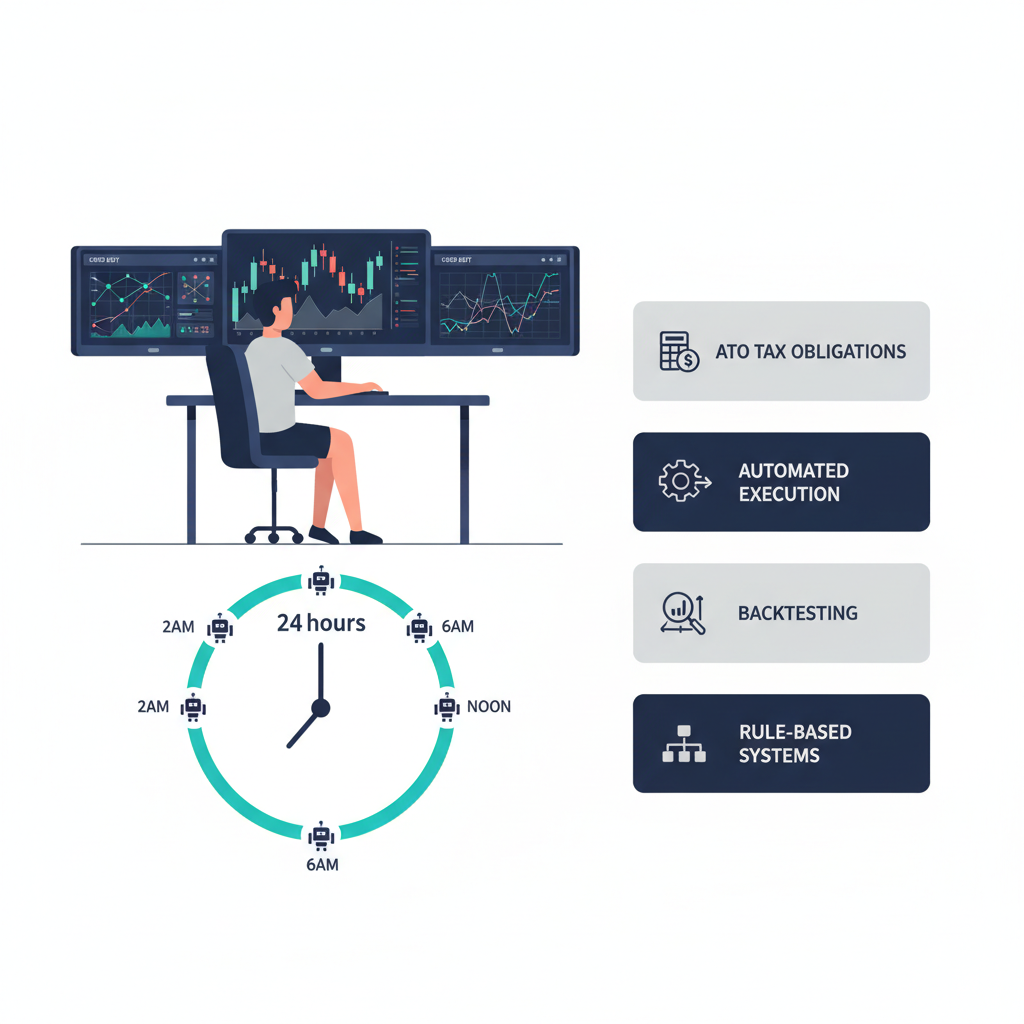
Algorithmic crypto trading Australia is not some niche pursuit for hedge funds anymore. Retail traders here are running grid bots on Kraken at 2am, backtesting mean-reversion strategies on CoinSpot’s API, and connecting TradingView alerts to automated execution layers while they sleep. The question is no longer whether you can do this in Australia. It is whether you are doing it right.
> TL;DR: Algorithmic crypto trading in Australia uses automated, rule-based systems to execute trades 24/7 without emotional bias. It is legal, but traders must manage ATO tax obligations on every bot-generated trade, use only AUSTRAC-registered exchanges, and prepare for the incoming AFSL licensing regime. Fees, spreads, and record-keeping all affect real returns in ways most newcomers underestimate.
What Is Algorithmic Crypto Trading?
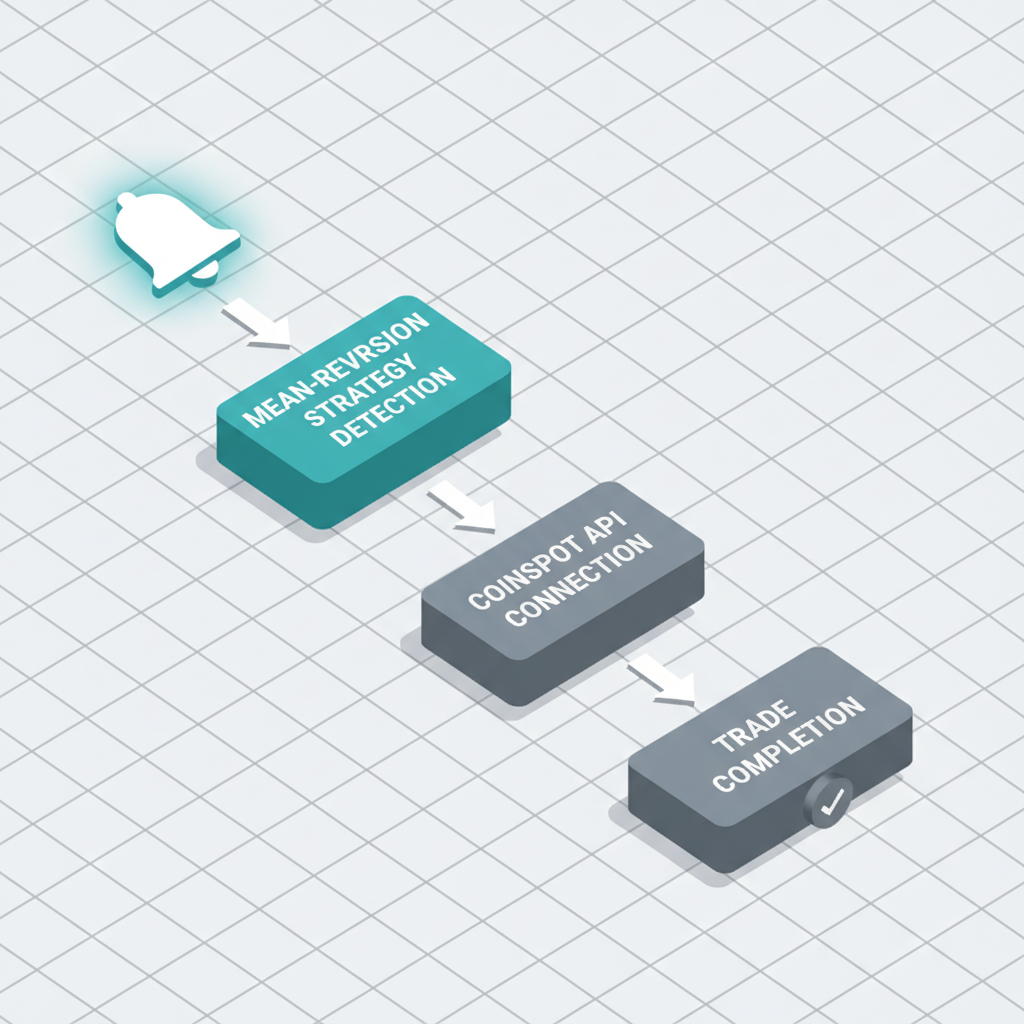
At its core, algorithmic trading means writing a set of rules, then letting a computer follow them faster and more consistently than any human could. Instead of watching a chart and deciding when to buy BTC/AUD, you define conditions: if the 20-period moving average crosses above the 50-period moving average and volume is above the 30-day average, open a long position with a 2% stop loss. The system executes the moment those conditions are met, regardless of whether it is Tuesday afternoon or 3am on a Sunday.
The strategies powering these systems vary significantly. Trend-following bots ride momentum, entering positions when an asset breaks in a clear direction and exiting when it stalls. Arbitrage bots exploit price discrepancies across exchanges, buying on one and selling on another in milliseconds. Market-making strategies place simultaneous buy and sell orders around the mid-price to collect the spread. Mean reversion bots bet that prices will return to a historical average after moving too far in one direction. Grid bots, which are especially popular on platforms like OKX, place a ladder of buy and sell orders across a price range and profit from the oscillation.
Not everything that looks automated is the same thing. A fully automated bot requires no human input after setup, executing and managing positions on its own. Semi-automated tools might generate signals that a trader then approves manually. Copy trading, available on platforms like eToro, mirrors the positions of another trader automatically but does not involve your own strategy logic. All three have their place, but they carry different risk profiles and require different levels of oversight.
The 24/7 nature of crypto markets makes automation especially appealing here. Unlike the ASX, which closes at 4pm, crypto trades continuously. A human trader cannot monitor every session. A bot can, and it does not get tired or panic when BTC drops 8% in an hour.
Is Algorithmic Crypto Trading Legal in Australia?
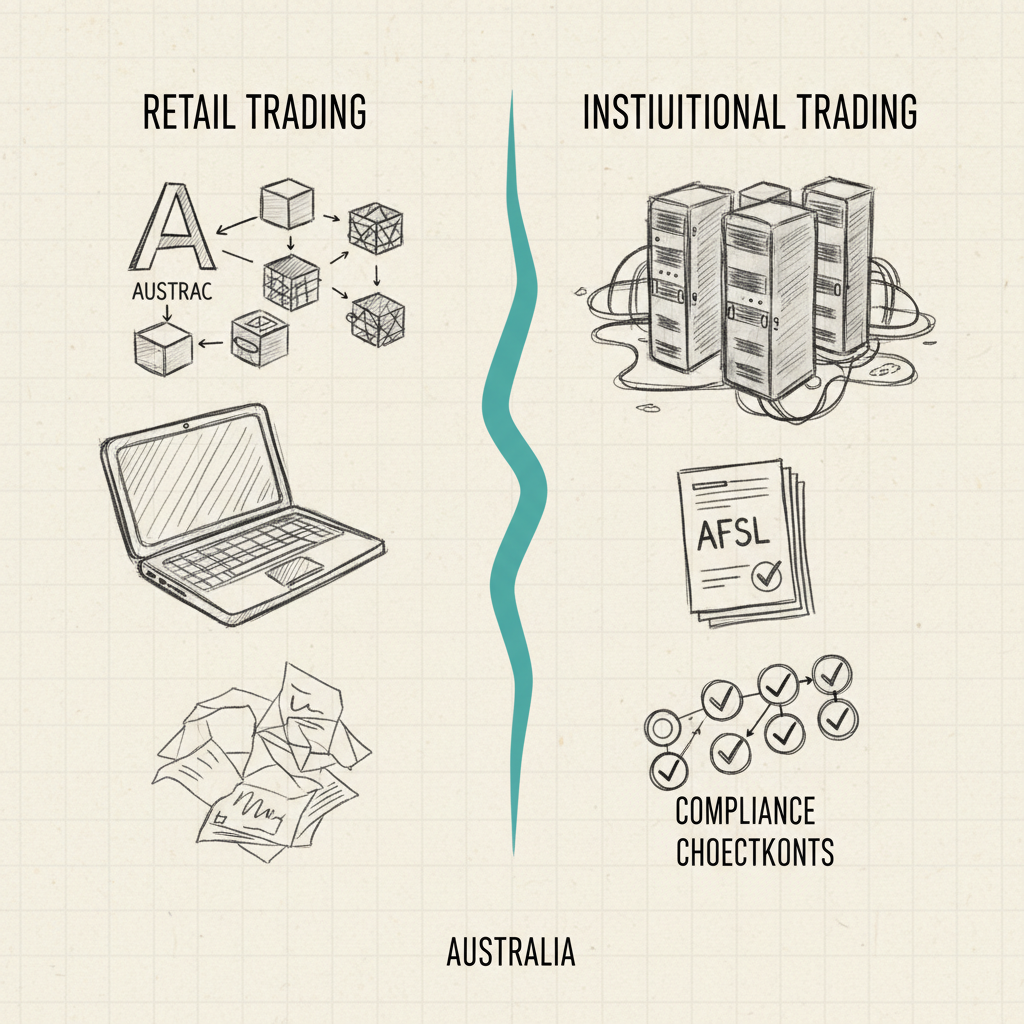
Yes, it is legal. Running a trading bot on a registered exchange is not something ASIC or AUSTRAC will come after you for, provided you are using compliant platforms and meeting your tax obligations.
The regulatory structure works in layers. Every digital currency exchange (DCE) operating in Australia must register with AUSTRAC and comply with Anti-Money Laundering and Counter-Terrorism Financing obligations. That covers exchanges like Kraken, Binance Australia, CoinSpot, and Independent Reserve. From 31 March 2026, AUSTRAC’s scope expands further to cover all Digital Asset Service Providers (DASPs), not just exchanges.
The bigger structural shift is the AFSL requirement. Parliament passed legislation in April 2026 requiring crypto exchanges and custody platforms to obtain an Australian Financial Services Licence from ASIC. The law takes effect 12 months after assent. ASIC introduced a no-action position until 30 June 2026 for firms making genuine compliance efforts, which gives the industry time to get its house in order without immediately shutting down operations mid-transition.
As a trader, you do not need a licence to run automated strategies on your own account. The burden sits with the platforms. What you do need to verify is that the exchange or tool you are using is AUSTRAC-registered and, increasingly, moving toward AFSL compliance. Binance Australia is a useful cautionary example here: it holds AUSTRAC registration but had its AFSL cancelled for complex derivative products, which limits what Australian users can access through that platform.
ASIC has also been vocal about crypto recovery scams, where fraudsters contact traders who have lost money and claim they can recover funds for an upfront fee. They cannot. If someone approaches you promising to recover losses from a failed bot strategy, it is a scam.
[INTERNAL LINK PLACEHOLDER: “AUSTRAC-registered exchanges” → pillar: best-crypto-exchanges-australia]
How the ATO Taxes Algorithmic Crypto Trading
This is where a lot of Australian algo traders get into trouble, not because the rules are hidden, but because bots generate transaction volumes that are genuinely difficult to track manually.
The ATO classifies crypto assets as property, not currency. That single classification drives everything. Every time your bot closes a trade, that is a disposal of a taxable asset. Whether it is a $40 gain on an ETH scalp or a $200 loss on a BTC grid trade, the ATO wants it recorded and reported.
The question of whether your profits are taxed as capital gains or ordinary income depends heavily on your activity level and intent. For a long-term investor who buys Bitcoin and holds it for 18 months, the capital gains framework applies, including the 50% CGT discount for assets held over 12 months. Algorithmic traders executing hundreds or thousands of trades per month are unlikely to qualify for that discount. More importantly, the ATO may classify them as conducting a business of trading, which means profits are treated as ordinary income rather than capital gains, taxed at your marginal rate, and losses can be claimed as business deductions.
There is no bright-line rule about when you tip from investor to trader. The ATO looks at frequency, scale, organisation, and commercial intent. If you have built a systematic, rule-based operation with multiple bots running across several exchanges, that looks a lot like a business.
Regardless of classification, every trade is a taxable event. Gains and losses are calculated in AUD at the time of the transaction, which means you need the AUD price at acquisition and disposal for every single bot-generated trade. If your bot makes 50 trades a day, that is over 18,000 taxable events a year.
Manual record-keeping is not realistic at that scale. I use crypto tax software to handle this automatically via API connections to exchanges, and if you are running any kind of automated strategy, you should too. Tools like Koinly or CryptoTaxCalculator connect directly to exchange APIs and pull in all transactions, calculating your CGT or income position in one place.
[INTERNAL LINK PLACEHOLDER: “crypto tax software” → pillar: best-crypto-tax-software-australia]
Banking Restrictions Australian Algo Traders Face
Funding an automated trading strategy requires a reliable way to move money between your bank and your exchange. In Australia, that is increasingly complicated.
Australian banks have been restricting, limiting, and in some cases entirely blocking transfers to crypto exchanges. This practice, called debanking, is not a conspiracy theory. In February 2026, Coinbase submitted a formal complaint to the Australian parliament, directly accusing major banks of account closures and transaction restrictions targeting crypto-related businesses and users.
The transfer limits vary by institution. Westpac currently caps crypto-related transfers at $5,000 per day. ANZ Plus imposes a $10,000 per month limit. Bank Australia, which announced its policy in May 2026, applies a $10,000 per calendar month cap across all customer accounts. These figures matter if you are planning to deploy significant capital into an automated strategy, because you may be constrained in how quickly you can fund your account.
Unilateral account closures have also been reported, where banks shut down accounts of customers using crypto exchanges without formal notice or adequate explanation. For someone running a live trading bot, having their funding source cut off without warning is a real operational risk.
The practical advice here is straightforward. Check your bank’s current crypto transfer policy before you commit capital to a strategy. PayID and direct bank transfers remain the lowest-friction funding method on Australian exchanges, with most platforms accepting them at no charge. If your bank is heavily restrictive, you may need to look at alternatives. Some traders maintain accounts with a smaller bank or neobank specifically for crypto funding purposes.
Fees and Spreads: The Real Cost of Running a Crypto Bot in Australia
Amateur algo traders focus on returns. Experienced ones obsess over costs. The difference matters enormously when you are making many small trades.
Australian exchanges typically charge between 0.1% and 1% per trade. Most operate on a maker-taker model: if your order adds liquidity to the order book (maker), you pay less than if your order removes liquidity (taker). An algo strategy designed to place limit orders rather than market orders can meaningfully reduce fee drag over time. On Kraken, maker fees start at 0.25% and drop with volume. On CoinSpot, instant buy/sell trades cost 1%, while market trades on the order book are 0.1%.
Then there are spreads. The spread on BTC/AUD on major Australian exchanges typically sits between 0.1% and 0.8%. During high-volatility periods, that spread widens. A bot that trades during a volatile session might face a 0.8% spread combined with a 0.6% taker fee, meaning the price needs to move 1.4% in your favour just to break even on a single round trip. Run that scenario 30 times a day and the maths gets ugly fast.
Deposit and withdrawal costs are worth mapping out before you start. AUD deposits via PayID and direct bank transfer are free on most Australian exchanges. Card deposits on platforms like CoinSpot carry a 1.22% fee, and PayPal deposits attract 0.5%. AUD withdrawals to Australian bank accounts are generally free. If you are moving money frequently to rebalance capital across strategies, sticking to bank transfer is the obvious call.
If you are using a third-party bot platform like Altrady or CryptoRobotics, add the subscription cost to your overhead. These platforms typically charge monthly fees, and that cost needs to be factored into your strategy’s profitability calculations before you go live.
High-frequency bots can generate the illusion of activity without generating profit. Backtesting with realistic fees and spreads, not the idealised numbers from an exchange’s marketing page, is the only way to know whether a strategy is actually viable.
Top Platforms and Tools for Algorithmic Crypto Trading in Australia
The infrastructure for automated crypto trading Australia has matured significantly. You now have choices across exchanges with API access, dedicated bot platforms, and brokerage-style tools depending on your strategy type.
Exchanges with API Access
Kraken is my starting point for most algo setups. It supports 582+ coins, offers AUD deposits and withdrawals, and has a genuinely competitive maker-taker fee structure. The API is well-documented, and the platform has maintained a clean regulatory track record in Australia.
Binance Australia offers 500+ coins and advanced trading tools. It is AUSTRAC-registered, which matters, but the AFSL cancellation for complex derivatives means some product categories are off-limits for Australian users. Check what is available before building a strategy around a specific product type.
CoinSpot is a reliable Australian option with fees from 0.1% on its order book and an OTC desk for high-volume transactions. It is well-established, AUSTRAC-registered, and has solid AUD on/off ramp functionality.
Digital Surge is worth considering for lower-volume algo strategies. Fees start at 0.1%, PayID deposits are free, and AUD withdrawals carry no fee, which keeps overhead low.
Independent Reserve is one of Australia’s largest exchanges and tends to attract more sophisticated traders. Its API access and institutional-grade infrastructure suit algo strategies well.
Dedicated Bot and Algo Platforms
Altrady is a multi-exchange terminal with TradingView integration and built-in automation tools. It is designed for traders who want to manage multiple strategies across multiple exchanges from one interface without building custom infrastructure.
CryptoRobotics offers AI-driven bots including the AI Columbus Futures bot for 24/7 automated trading. It is targeted at traders who want a more managed approach without writing their own algorithms.
OKX launched its Australian operation around mid-2024 and includes a Spot Grid Bot and DCA Martingale Bot natively within the platform. The advantage here is that the bot and the exchange are integrated, removing the API reliability risk that comes with third-party connections.
Wunderbit Trading combines copy trading with automated bot functionality and connects to major exchanges. It suits traders who want to both run their own bots and optionally follow other strategies.
Brokerage and Multi-Asset Platforms
Interactive Brokers Australia supports crypto alongside traditional assets and allows custom algorithmic strategies via its API and supported programming languages. For traders who want a regulated, multi-asset environment and are comfortable building custom solutions, it is a serious option.
Pepperstone offers cTrader, which supports automated strategy execution and advanced charting. Oanda provides API access with competitive pricing. NinjaTrader has strong backtesting and automation capabilities, though its crypto support is narrower than the exchange-native platforms.
For signal and indicator tools, TickSurfers is worth knowing about. It provides algorithmic trading indicators compatible with TradingView and TradeStation, covering crypto markets.
Social and Copy Trading
eToro holds both an AFSL and AUSTRAC registration, making it one of the more fully regulated options available to Australian traders. Its copy trading feature does not require you to write any code, and it is a reasonable starting point if you want automated exposure to a strategy without building one yourself.
Platform Comparison
| Platform | Type | AUSTRAC/AFSL Status | Trading Fees | AUD Support | Bot/API Access | Best For |
|---|---|---|---|---|---|---|
| Kraken | Exchange | AUSTRAC registered | Maker from 0.25% | Yes | Yes (API) | Experienced algo traders |
| Binance Australia | Exchange | AUSTRAC registered, AFSL cancelled (derivatives) | Maker from 0.1% | Yes | Yes (API) | High-volume, spot trading |
| CoinSpot | Exchange | AUSTRAC registered | From 0.1% (order book) | Yes | Yes (API) | Australian-first traders |
| Digital Surge | Exchange | AUSTRAC registered | From 0.1% | Yes | Yes (API) | Low-cost, simple strategies |
| Independent Reserve | Exchange | AUSTRAC registered | Variable | Yes | Yes (API) | Sophisticated/institutional |
| OKX | Exchange + Bots | AUSTRAC registered | From 0.1% | Yes | Yes (native bots + API) | Grid and DCA bots |
| eToro | Social/Copy Trading | AFSL + AUSTRAC | Variable spread | Yes | Copy trading | Hands-off automated exposure |
| Altrady | Bot Platform | N/A (connects to exchanges) | Subscription + exchange fees | Via connected exchange | Yes | Multi-exchange management |
| CryptoRobotics | Bot Platform | N/A (connects to exchanges) | Subscription + exchange fees | Via connected exchange | Yes | AI-driven automated trading |
| Interactive Brokers AU | Brokerage | AFSL | Competitive | Yes | Yes (custom algos) | Multi-asset algo traders |
| Pepperstone (cTrader) | Brokerage | AFSL | Competitive | Yes | Yes (automated strategies) | Forex + crypto algo |
Frequently Asked Questions
Is algorithmic crypto trading legal in Australia?
Yes. Automated and algorithmic crypto trading is legal for retail traders in Australia. The platforms you use must be AUSTRAC-registered and are increasingly required to hold an AFSL. You as the trader do not need a licence.
How does the ATO tax profits from crypto trading bots?
Every bot-generated trade is a taxable event. Gains are tax