Crypto Tax Australia: Your Complete Guide to CGT, Income Tax, and Algo Trading
Crypto tax in Australia catches a lot of people off guard. Every swap, every staking reward, every bot-executed trade, the ATO wants a slice, and the rules are more specific than most people realise until they’re staring down a tax return with 4,000 automated transactions to account for.
> TL;DR
> Yes, crypto tax in Australia is real and unavoidable. The ATO treats cryptocurrency as property, so disposals trigger Capital Gains Tax (CGT) and receipts like staking rewards trigger income tax. Algo traders face the same obligations as everyone else but must track hundreds or thousands of automated trades to stay compliant. The 50% CGT discount for assets held over 12 months remains intact as of mid-2026, though it is flagged for replacement from July 2027. This guide covers every taxable event, the CGT versus income tax split, and how algo traders specifically should handle their obligations.
The Short Answer: Yes, Crypto Is Taxable in Australia
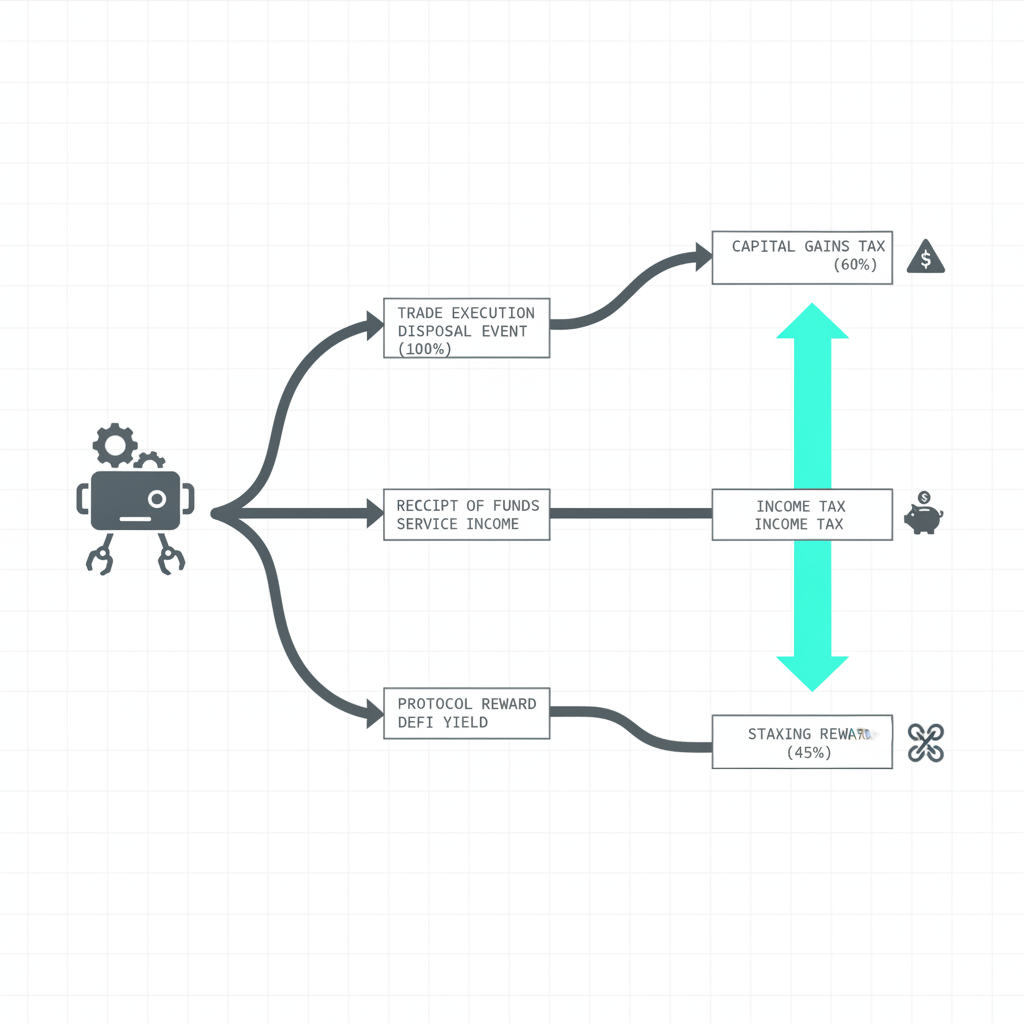
The ATO classifies cryptocurrency as property, not currency. That single classification drives everything. Because crypto is property, two tax frameworks apply: Capital Gains Tax for disposal events, and income tax for receipts. There is no special carve-out for crypto tax in Australia, no “it’s under $10,000 so it doesn’t count” threshold, and no exemption for trades executed by a bot.
Both casual investors and active algo traders operate under the same ATO framework. The difference is in the volume of events you need to record and report, not in whether you are subject to tax at all.
One thing to be clear on before we go further: this article is general information, not financial or tax advice. Australian tax law is complex and individual circumstances vary significantly. Before lodging your return, speak with a registered tax agent who has specific experience with cryptocurrency. The ATO has been explicit that crypto is within scope, and the consequences of getting it wrong compound year over year.
Capital Gains Tax vs Income Tax: Which One Applies to You?
The split between CGT and income tax in the context of crypto tax in Australia comes down to one question: are you disposing of an asset, or receiving a reward?
CGT applies when you dispose of a crypto asset. Selling BTC for AUD is the obvious example, but the definition of “disposal” is broader than most people expect. Swapping ETH for SOL is a disposal of the ETH. Using crypto to pay for a coffee is a disposal. Gifting crypto to someone else is a disposal. Each of those events triggers a CGT calculation based on the difference between your cost base (what you paid) and the proceeds (what you received, in AUD at the time of the transaction).
Income tax applies when you receive crypto as a reward or payment. Staking rewards are the most common example for retail traders, taxed as ordinary income at the AUD value on the date you receive them. The same applies to airdrops in most circumstances, mining rewards, interest earned through DeFi lending platforms, and salary or wages paid in crypto by an employer.
Where it gets more complicated is the distinction between being a “hobby investor” and carrying on a “business” of trading. The ATO does not use a bright-line test here. It weighs factors like trade frequency, whether you operate in a commercial manner, whether your activity is repetitive and systematic, and whether profit is your primary motive. Business traders report their profits as ordinary income rather than under the CGT framework, which means no access to the 50% CGT discount but also the ability to deduct trading-related expenses directly against income.
For most retail investors, the CGT framework applies. For someone running a high-frequency algo trading operation with clear commercial intent, the ATO may classify that as a business. If you are genuinely unsure which category you fall into, a registered tax agent is not optional, it is necessary.
Every Taxable Crypto Event the ATO Recognises
This is where most people underestimate their crypto tax obligations in Australia. It is not just the big sell when you cash out.
Selling crypto for AUD is the most straightforward taxable event. You calculate the capital gain or loss by subtracting your cost base (purchase price plus any acquisition costs like exchange fees) from the proceeds received. A gain is added to your taxable income, subject to the CGT discount if applicable. A loss can be used to offset other capital gains.
Crypto-to-crypto swaps trip up a lot of people. When you swap ETH for BNB, you have disposed of the ETH at its AUD market value at the time of the swap. That disposal is a CGT event. You have also acquired BNB at that same AUD market value, which becomes your new cost base. Both sides of the transaction need to be recorded. Running a grid bot that cycles between two assets all day is generating CGT events continuously.
Using crypto to pay for goods or services is a disposal at the AUD market value of the crypto at the time of payment. If you held that crypto at a lower cost base, you have a capital gain. The ATO confirmed this treatment years ago and has not changed its position.
Gifting crypto is not tax-free. The ATO treats it as a disposal at market value on the date of the gift. The recipient’s cost base becomes that market value. A lot of people learn this the hard way.
Staking rewards are taxed as ordinary income at the AUD value on the date you receive them. That value also becomes your cost base for those tokens. If they later increase in value and you sell them, you pay CGT on the gain from that cost base.
Airdrops are generally treated as income at fair market value at the time of receipt, though the ATO’s specific guidance on this is nuanced depending on whether you took an action to receive them. If there is genuinely no market value at the time of receipt, the cost base may be zero, and the full proceeds become a capital gain on disposal.
Being paid in crypto by an employer is treated as salary and wages. Your employer should apply PAYG withholding on the AUD value. For employees in this situation, the exchange rate risk sits entirely with you after receipt.
DeFi lending interest and liquidity pool rewards are treated as income tax events at receipt, similar to staking. The complexity in DeFi is establishing the AUD value at the precise moment of receipt, which is why API-connected tax software is close to mandatory for active DeFi participants.
Two things that are not taxable events: simply buying crypto with AUD and holding it, and transferring crypto between wallets you own. The transfer between your own wallets is critical to document properly, because without records, the ATO has no way to verify ownership and may treat it as a disposal.
The 50% CGT Discount: What Long-Term Holders Need to Know
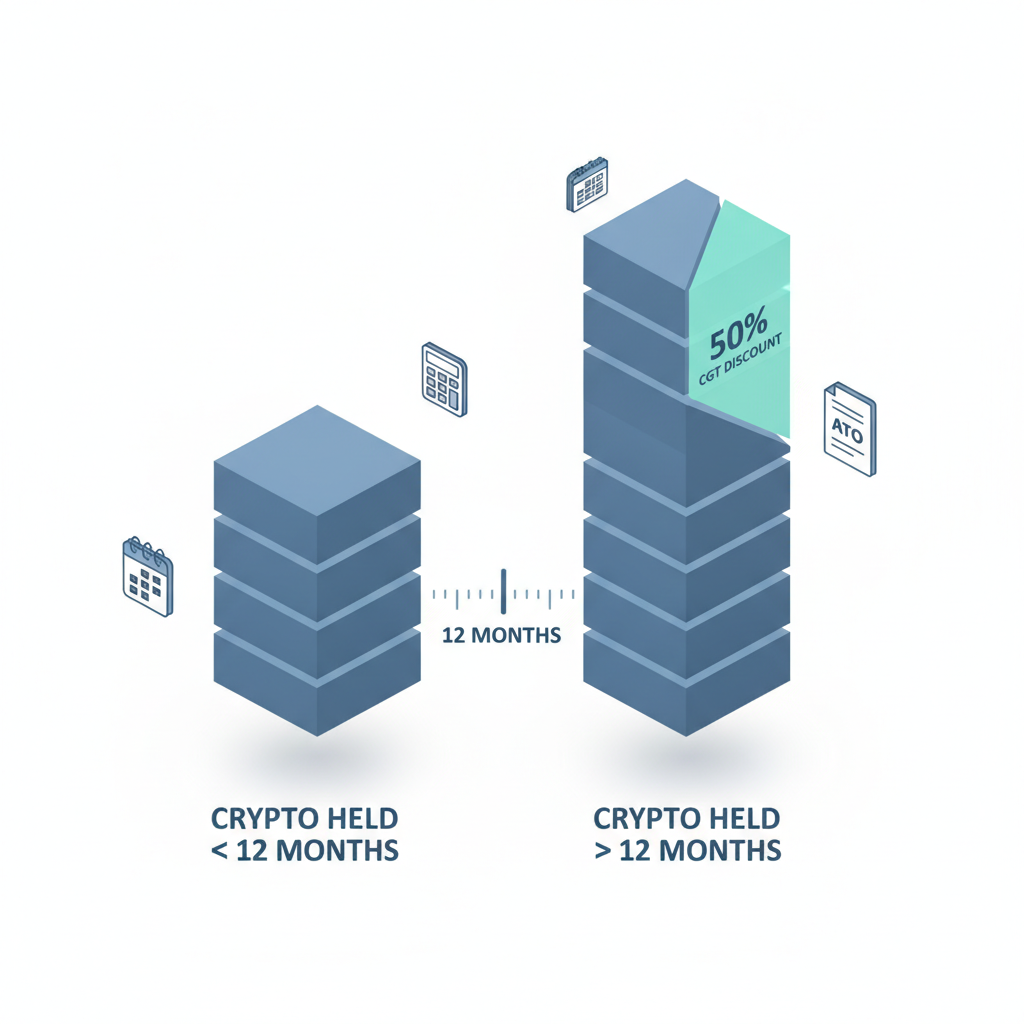
If you are an individual who holds a crypto asset for more than 12 months before disposing of it, you may be eligible for the 50% CGT discount. This is one of the most valuable concessions in the Australian tax system for investors, and it applies to crypto just as it does to shares or property.
The mechanics are straightforward. You calculate your gross capital gain, apply any available capital losses to reduce it, and then halve the remaining amount before it is added to your assessable income. On a $10,000 gain from BTC held for 18 months, only $5,000 ends up in your taxable income. At a 37% marginal tax rate, that difference is $1,850 you keep.
The acquisition date for every purchase matters enormously. If you are using a dollar-cost averaging strategy and buying weekly, each purchase lot has its own 12-month clock. Tax software handles this automatically, but if you are tracking manually, the date field is not optional.
Now, the part that has circulated wildly online in slightly garbled form. The 50% CGT discount is flagged for replacement from July 2027, when it is proposed to be replaced by an inflation-adjusted discount with a minimum 30% tax rate. As of June 2026, the 50% discount remains fully intact. If you disposed of assets before July 2027 and held them for 12 months, you access the current discount. The proposed changes do not apply retroactively. Social media posts suggesting the discount is already gone, or was removed in the last budget, are wrong.
Superannuation funds receive a one-third discount (not 50%) and companies receive no CGT discount at all. If you are holding crypto in a self-managed super fund, the tax treatment differs from your personal holdings.
Crypto Tax for Algo Traders: Handling Hundreds of Automated Trades
This is the part that matters most if you are running bots, and the part that is least covered in generic crypto tax guides aimed at the Australian market.
Every automated trade executed by a bot is a taxable event if it involves a disposal. There is no exemption for algorithmic execution. The ATO does not care whether a human or a Python script pressed the button. A grid bot running on the BTC/AUD pair, cycling through 50 buy-sell pairs per day, is generating 50 CGT events per day. Over a financial year, that is potentially 18,000 individual transactions to account for.
A DCA bot adds a different layer of complexity. Each automated buy creates a new cost base lot. When the bot eventually sells, which lot is being disposed of depends on your cost base accounting method (FIFO, HIFO, and average cost are all used, though the ATO generally expects consistency). The interaction between lots with different acquisition dates and the 12-month CGT discount threshold makes manual tracking genuinely impractical above a few hundred trades per year.
One important distinction for Australian algo traders: trading your own account algorithmically is entirely legal and falls under standard CGT or income tax rules. If you build a bot, run it on your own capital, and keep the profits, you are a self-directed trader. Running an algo service for others, whether by managing their accounts, pooling funds, or providing discretionary signals, triggers AFSL requirements under ASIC. The no-action position ASIC had for crypto financial services expired on 30 June 2026, so if you are operating in that space without a licence, that is a compliance issue now.
For the trading itself, spot market disposals are standard CGT events. Crypto derivatives and futures are treated differently, with gains potentially taxed as ordinary income rather than under the CGT framework. If your algo strategy involves perpetual futures or leveraged products, confirm the tax treatment with a specialist before assuming the 50% CGT discount applies.
On the practical side, manual record-keeping at scale is not realistic. The tools that actually work for Australian algo traders are CoinLedger, Koinly, CryptoTaxCalculator, and TokenTax. All four support Australian tax rules, handle AUD cost base calculations, and connect directly to exchange APIs to pull transaction history automatically. CryptoTaxCalculator is built specifically for the Australian market and handles DeFi events reasonably well. Koinly has the broadest exchange integration list I have seen, which matters if you are running bots across multiple platforms simultaneously.
[INTERNAL LINK PLACEHOLDER: crypto trading bot tax → /guides/crypto-trading-bot-tax-australia]
Can You Deduct Crypto Trading Expenses?
Whether you can deduct trading-related expenses against your income depends entirely on whether you are classified as a hobby investor or a business trader, and this is where the CGT versus income tax classification has real dollar consequences.
Hobby investors, meaning most retail crypto holders under the ATO’s framework, cannot deduct trading expenses against their ordinary income. Exchange fees are not a line item on your tax return. They do, however, get added to the cost base of the asset, which reduces the eventual capital gain. It is a deduction by another mechanism, but it only matters when you sell.
Business traders can deduct trading expenses directly. Platform fees, subscription costs for bots or data feeds, the portion of your home office used for trading, and professional tax advice fees all become deductible against your trading income. If your algo setup costs $200 per month in infrastructure and software, and you are classified as carrying on a business, that $2,400 per year reduces your taxable income directly.
The ATO weighs the business versus hobby question holistically. Frequency is one factor. A trader executing 10,000 automated trades per year looks more like a business than someone with 12 manual trades. Commercial intent matters too. Do you have a documented trading strategy? A separate business bank account? Do you hold yourself out as trading commercially?
Costs associated with earning staking or mining income may also be deductible if the activity constitutes a business, though again the test is applied to the specific facts.
One thing that applies to everyone regardless of classification: the ATO’s data-matching program now receives transaction data directly from Australian crypto exchanges. If your exchange is AUSTRAC-registered, and every reputable Australian exchange is, the ATO has your trading data. Omitting transactions is not a strategy, it is just a delayed problem. Keep records of every transaction including date, amount, AUD value at the time of the trade, fees paid, and which exchange was used.
[INTERNAL LINK PLACEHOLDER: best Australian crypto exchanges → /reviews/best-crypto-exchanges-australia]
Frequently Asked Questions
Is crypto taxable in Australia even if I haven’t withdrawn to my bank account?
Yes. The taxable event for CGT purposes is the disposal, not the withdrawal. If you swap crypto for another crypto without ever touching AUD, that swap is still a taxable event. The ATO does not require you to have received Australian dollars for a gain to be assessable.
Do I need to report small crypto gains?
There is no de minimis threshold in Australian crypto tax law. Every gain and every loss is reportable, regardless of size. Small transactions add up, and the ATO’s data-matching means they may already know about them.
What records do I need to keep for crypto tax?
The ATO expects you to keep records of the date of every transaction, the amount of crypto involved, the AUD value at the time of the transaction, the purpose of the transaction, and any fees paid. These records need to be kept for at least five years from when you lodge the relevant tax return.
Does the 50% CGT discount still apply in 2026?
Yes. As of June 2026, the 50% CGT discount for assets held more than 12 months remains fully in effect for individuals. Proposed changes to replace it with an inflation-based model are flagged for July 2027 and have not yet been legislated.
How do algo traders handle CGT on thousands of automated trades?
Through crypto tax software that connects directly to exchange APIs. Platforms like CryptoTaxCalculator and Koinly pull transaction histories automatically, calculate AUD cost bases, apply FIFO or other methods, and generate ATO-compatible reports. Manual tracking at scale is not viable.
Is running a crypto trading bot legal in Australia?
Trading your own capital algorithmically is legal and treated under standard ATO tax rules. Operating an algo trading service for other people’s funds without an AFSL from ASIC is not. The distinction matters, and ASIC’s previously relaxed stance on this ended 30 June 2026.
What if I received crypto as a salary from my employer?
Your employer should treat it as salary and apply PAYG withholding on the AUD value at the time of payment. For you, it is assessable income. The AUD value at the time of receipt also becomes your cost base for any future disposal.
Can I offset crypto losses against other income?
Capital losses can only be offset against capital gains, not against other income like wages or business profits. If you have more capital losses than capital gains in a given year, the excess carries forward to future years. Business traders who report crypto profits as ordinary income can offset losses against other income, subject to non-commercial loss rules.
CryptoAlgo may earn a commission if you sign up through links on this page. This does not affect our editorial independence — we only recommend platforms we have actually used and would recommend to a mate. This article is general information, not financial advice. Crypto is volatile and you can lose money. Always do your own research and consider speaking to a licensed Australian financial adviser before investing.