Algorithmic Crypto Trading Australia: Is It Legal? A Practical Guide for Self-Directed Traders
Algorithmic crypto trading in Australia is something I get asked about constantly, usually from traders who have heard the term and are not sure whether they are about to do something that will attract a regulator’s attention. The short answer is that you are almost certainly fine. The longer answer involves the ATO, AUSTRAC, and one High Court case that nobody in the space is talking about enough.
> TL;DR
> Algorithmic crypto trading in Australia is legal for self-directed traders, with no special licence required. Every trade your bot executes is still a taxable event under ATO rules, and high-frequency traders may find themselves taxed as ordinary income rather than under CGT. The new AUSTRAC Travel Rule, live from July 1 2026, adds friction for anyone withdrawing to self-custody wallets.
The Short Answer: Yes, But Here’s What That Actually Means

Algorithmic crypto trading in Australia is perfectly legal if you are running strategies on your own capital. No licence, no ASIC registration, no special paperwork. You need an account on an AUSTRAC-registered exchange, a working strategy, and a solid understanding of what you owe the ATO. That is genuinely it.
The line gets crossed when you start managing other people’s money through an automated system. At that point you are not a self-directed trader anymore. You are running something that looks a lot like a managed investment scheme, and ASIC has very clear views on what that requires: an Australian Financial Services Licence (AFSL) or formal managed investment scheme registration under the Corporations Act 2001. Running a bot on behalf of friends, family, or paying subscribers without that structure puts you in breach of the law regardless of how small the operation is.
For the purposes of this guide, we are talking about trading your own capital, which means the only compliance you face directly is:
- Using an AUSTRAC-registered exchange as your on-ramp (the exchange handles its own AML/CTF obligations, not you)
- Reporting every trade to the ATO accurately, whether a human or an algorithm triggered it
Two regulatory developments are worth flagging early. The AUSTRAC Travel Rule came into effect on July 1 2026, requiring exchanges to collect and pass payer and payee data on crypto transfers. If you regularly withdraw to a self-custody wallet, expect more verification steps. Separately, the High Court is currently considering Poulton v Conrad, a case that challenges whether Bitcoin constitutes property under Australian law. If Bitcoin is ruled to be merely information rather than property, the CGT framework that governs your bot’s trades could shift considerably. Nothing has changed yet, but it is worth watching.
How Algorithmic Crypto Trading Works in the Australian Context
At its core, algorithmic crypto trading means software executing buy and sell orders based on pre-defined rules. Those rules can be as simple as “buy $50 of ETH every Monday at 9am” or as complex as a multi-leg arbitrage strategy pulling price feeds from three exchanges simultaneously. The trader defines the logic; the machine executes it without emotion or hesitation.
The most common strategy types you will encounter as an Aussie algo trader are grid bots (which place buy and sell orders at fixed intervals above and below a set price), DCA automation (which removes timing decisions by investing fixed amounts at regular intervals), trend-following strategies (which go long or short based on indicators like moving averages or RSI), and arbitrage (which exploits price differences between exchanges or trading pairs). Each has different risk profiles, different fee sensitivities, and different suitability depending on market conditions.
Bots connect to exchanges via API keys. You generate a key pair in your exchange account, enter those credentials into your trading software, and the bot is authorised to place trades on your behalf without being able to withdraw funds (assuming you set the API permissions correctly, which you should always do). This is why the choice of exchange matters for algorithmic crypto trading in Australia. The exchange needs to be AUSTRAC-registered, have a stable and well-documented API, support the order types your strategy requires, and have enough AUD liquidity to fill orders at reasonable spreads.
Latency is less of a concern for most retail algo strategies, but it is worth knowing that Australian exchanges connect to different infrastructure than global venues. If you are running a strategy on a local exchange like CoinSpot, your execution is fine for daily or hourly timeframes, but microsecond arbitrage is not a realistic pursuit here. For strategies that need deeper liquidity, Kraken and similar globally-oriented platforms with AUD pairs will generally give you tighter spreads and more predictable fills.
On the tooling side, you do not need to write a single line of code to get started. Platforms like Cryptohopper let you build and deploy strategies through a visual interface. TradingView Premium allows you to write strategies in Pine Script and fire webhook alerts to execute trades on connected exchanges. If you are comfortable with Python, Freqtrade is a self-hosted open-source framework with a strong community and an extensive strategy library. QuantConnect sits at the advanced end, offering cloud-based execution with tick-level historical data in Python or C#.
The Regulatory Framework: AUSTRAC, ASIC, and What Each Body Actually Covers
Two regulators matter for algorithmic crypto trading in Australia, and they cover very different ground.
AUSTRAC: The Exchange’s Problem, Not Yours (Mostly)
AUSTRAC registers Digital Currency Exchange (DCE) providers under the Anti-Money Laundering and Counter-Terrorism Financing Act 2006. The key word there is providers. If you are a trader using an exchange, you do not register with AUSTRAC. The exchange does.
What this means practically is that AUSTRAC compliance obligations fall on the platform, not on you. The exchange must maintain an AML/CTF program, report suspicious matters to AUSTRAC, and file threshold transaction reports (TTRs) for cash transactions over AUD 10,000. You might be asked to complete identity verification (KYC) as part of that program, but that is the exchange meeting its obligations, not you meeting yours.
Where AUSTRAC starts to affect you directly is through the Travel Rule, effective July 1 2026. Under this rule, when you withdraw crypto to a self-custody wallet, your exchange must collect and transmit payer and payee information. In practice this means exchanges will increasingly ask for confirmation of wallet ownership before processing withdrawals, and some may impose delays or additional verification steps. If your algo trading workflow involves regular withdrawals to a hardware wallet, factor this in.
ASIC: Relevant Mainly If You Are Offering a Service
ASIC regulates crypto assets that qualify as financial products under the Corporations Act 2001. Spot Bitcoin and most major cryptocurrencies are not currently classified as financial products, which means ASIC has limited direct oversight of spot crypto trading on registered exchanges.
ASIC becomes very relevant, however, the moment you start offering automated trading services to others. Running a bot that manages third-party capital, charging fees for algorithmic signals, or operating any structure where you exercise discretion over other people’s crypto assets will likely trigger financial services licensing requirements. The test is not whether you call it a “bot subscription” or a “signal service.” The test is whether you are providing a financial service as defined in the Corporations Act. If you are, you need an AFSL.
For a self-directed trader, the practical takeaway is straightforward. You face AUSTRAC compliance indirectly through your exchange’s KYC and reporting processes, and you face ATO compliance directly on every trade. ASIC is largely not your concern unless you decide to start managing other people’s funds.
ATO Tax Treatment of Automated Crypto Trades: What Changes When a Bot Is Doing the Trading
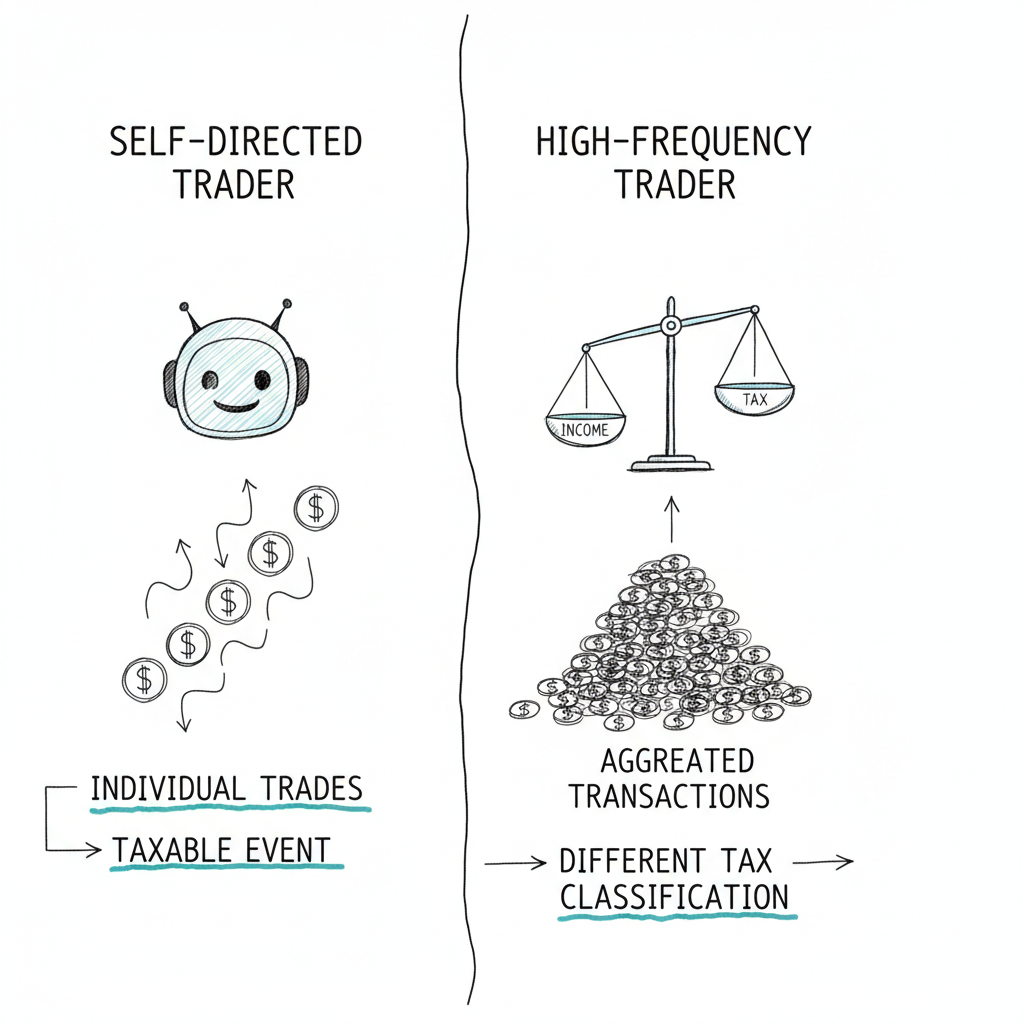
Nothing changes and everything changes. The ATO does not care whether a human or an algorithm triggered a trade. Every crypto-to-fiat conversion, every crypto-to-crypto swap, and every time you spend crypto on goods or services is a taxable event. The bot executing those trades on your behalf does not create any special exemption, and it does not create any special liability either. The same rules that apply to manual trading apply here.
What does change with algo trading is volume, and volume has real consequences for how you are taxed.
CGT Versus Ordinary Income: The 10,000-Trade Question
For manual traders holding assets for more than 12 months, the 50% CGT discount is a significant benefit. Bots, by design, trade frequently. A grid bot running on BTC/AUD might execute dozens of trades in a single day. Holding periods measured in minutes or hours do not qualify for the CGT discount, full stop.
Beyond the discount question, the ATO may classify high-frequency bot traders as carrying on a business rather than investing. There is no hard statutory threshold, but the ATO’s guidance and published precedents suggest that traders executing something in the order of 10,000 or more trades per year are in business-classification territory. Once you are classified as carrying on a business, your profits are taxed as ordinary income at your marginal rate (up to 45%), with no access to the CGT discount at all.
The upside of business classification is that you can deduct allowable business expenses. Subscription fees for trading software, the cost of a VPS to host your bot, data feed subscriptions, exchange API costs, and relevant professional fees can all be claimed against your trading income. For a serious algo trader with meaningful volume, those deductions can add up.
Record-Keeping at Scale
This is where automated trading creates a genuine operational burden. The ATO requires that for every trade you record the date and time, the asset bought and sold, the AUD value at the time of the trade, and the fee paid. For a trader executing 50 trades a month, a spreadsheet is manageable. For a bot running 50 trades a day, manual record-keeping is not realistic.
The practical solution is crypto tax software that imports your trade history directly from exchange APIs. Koinly is the one I have used most extensively for Australian clients, and it handles multi-exchange imports cleanly and produces ATO-compatible reports. CoinTracker is a solid alternative. Both integrate with the major exchanges available to Aussie traders and can handle the volume a bot generates.
Do not leave this until June. Exchange APIs sometimes have data retention limits, and reconciling 12 months of bot trades in a panic before lodgement is a horrible experience.
Poulton v Conrad: The Case Worth Watching
The High Court is currently considering whether Bitcoin constitutes property under Australian law. The ATO has intervened in this case, which tells you how significant the potential outcome is. If the court rules that Bitcoin is not property, the CGT provisions that currently govern your gains and losses may not apply in their current form. That does not mean you would owe nothing, but the legal basis for how your bot trades are taxed could require re-examination. Keep an eye on this one.
Best Platforms and Exchanges for Algo Trading in Australia
The platforms worth using for automated crypto trading in Australia fall into two broad categories: exchanges and brokers that offer API access, and automation tools that sit on top of those exchanges. Here is how the main options compare.
| Platform | Type | AUSTRAC/ASIC Status | API Support | Key Strategy Types | Approx Fees | Coding Required |
|---|---|---|---|---|---|---|
| Kraken | Exchange | AUSTRAC-registered | Full REST + WebSocket | Grid, DCA, trend, arbitrage | Maker 0.25% / Taker 0.40% | Optional |
| CoinSpot | Exchange | AUSTRAC-registered | REST API | DCA, basic automation | Market order 0.1%, Instant buy 1% | Optional |
| Pepperstone Crypto | Broker | AUSTRAC-registered, ASIC-licensed | Via MT4/MT5, cTrader | Trend, DCA, EA-based | 0.1% | Optional |
| Eightcap | CFD Broker | ASIC-regulated | MT4/MT5, TradingView | Trend, EA-based, sentiment | Spread-based | Optional |
| IC Markets | CFD Broker | ASIC-regulated | MT4/MT5 Expert Advisors | Trend, HFT-style, EA-based | Ultra-low spreads | Optional |
| Capital.com | CFD Broker | ASIC-regulated | TradingView, MetaTrader | Trend, signal-based | No commissions | Optional |
| Cryptohopper | Bot Platform | N/A (connects to registered exchanges) | Connects to Binance, Bybit, Kraken, Coinbase | Grid, DCA, signal copy | Subscription-based | No |
| TradingView Premium | Charting/Automation | N/A | Webhook alerts to exchanges | Any (Pine Script) | Subscription-based | Pine Script |
| Freqtrade | Bot Framework | N/A (self-hosted) | Python SDK | Any (custom) | Free (self-hosted) | Yes (Python) |
| QuantConnect | Quant Platform | N/A (cloud) | Python/C# | Any (institutional-grade) | Subscription/usage-based | Yes (Python/C#) |
Exchanges: API Access and AUD Liquidity
Kraken is the exchange I point most algorithmic traders towards first. Over 600 assets, a well-documented REST and WebSocket API, proof of reserves, and maker/taker fees of 0.25%/0.40% that are competitive at retail scale. It is not the cheapest exchange in the world but the infrastructure reliability and liquidity depth make it worth the fee difference for anything running automated strategies.
CoinSpot is Australia’s most established exchange and genuinely easy to use, but its API has historically been more limited than international alternatives. The market order fee of 0.1% is excellent, though the instant buy/sell fee of 1% plus spread makes it expensive for bots that use market orders at execution. Use limit orders if you automate on CoinSpot.
Pepperstone Crypto is worth a mention as a Melbourne-based AUSTRAC-registered broker with a proper forex background. The 0.1% fee structure is clean and the platform’s infrastructure is more stable than some pure-crypto exchanges. Access is through their existing broker stack rather than a dedicated crypto exchange interface, which suits traders already familiar with MT4/MT5.
CFD Brokers: ASIC-Regulated and Algo-Ready
Eightcap offers over 95 crypto CFDs with MT4/MT5 automation support and TradingView integration. As an ASIC-regulated broker it carries different risk and leverage characteristics than a spot exchange, which is worth understanding before you build a strategy on it. Their CryptoCrusher sentiment tool is a useful addition for signal-based approaches.
IC Markets is the broker I see most experienced Australian algo traders already using, primarily because of the tight spreads and MT4/MT5 Expert Advisor support. Ultra-low spreads matter at scale and IC Markets delivers there consistently.
Capital.com supports over 100 crypto CFDs with no commissions, TradingView and MetaTrader integration, and an AI-powered assistant that is more useful than most AI trading tools I have tested. Good entry point for traders who want automation without the complexity of self-hosted tools.
Automation Tools: From No-Code to Full Python
Cryptohopper is the most accessible no-code option for Australian traders wanting to automate without writing code. It connects to Binance, Bybit, Kraken, and Coinbase, supports signal subscriptions, and lets you copy strategies from other traders. Bear in mind that Binance operates in Australia under ongoing regulatory scrutiny, so check the current status of any exchange you connect to.
TradingView Premium with webhook alerts is my preferred middle-ground option. You write strategies in Pine Script, set up alert conditions, and configure webhooks to fire orders at a connected exchange. The barrier to entry is low, the backtesting environment is solid, and the tooling is actively maintained.
Freqtrade is the serious hobbyist’s choice. It is open-source, Python-based, self-hosted, and has a community producing strategies and documentation that rivals commercial platforms. The setup requires more technical comfort than Cryptohopper, but you own the infrastructure and there are no subscription fees.
QuantConnect sits at the top of the complexity curve.