Algorithmic Crypto Trading Australia: What You Need to Know Before You Start
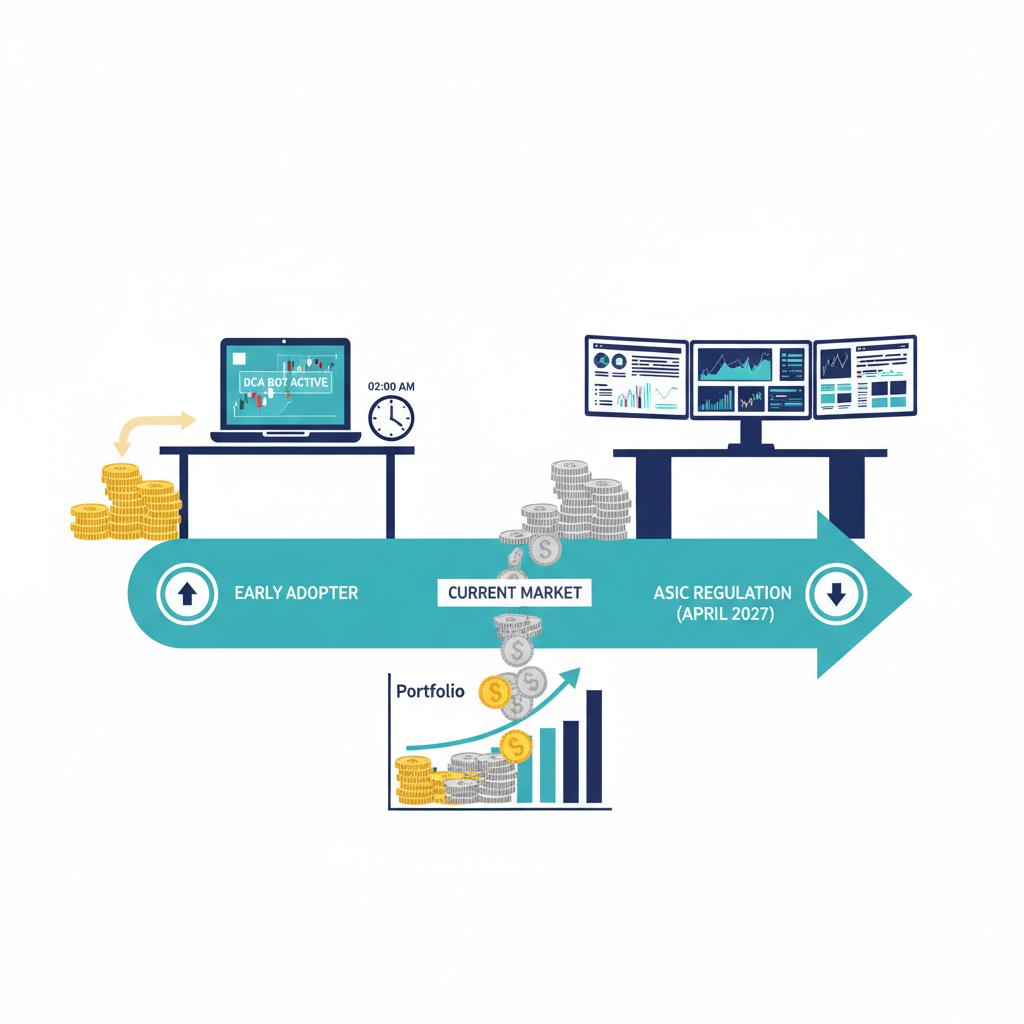
Algorithmic crypto trading in Australia has moved well past the “early adopter tinkering” phase. Right now, retail traders are running DCA bots on Swyftx at 2am, institutional desks are firing EAs through IC Markets’ API, and ASIC is circling with new licensing requirements that will reshape the whole space by April 2027. If you are thinking about automating your crypto strategy, this is the moment to understand what you are actually getting into, legally, technically, and financially.
> TL;DR
> Algorithmic crypto trading in Australia uses pre-programmed rules to execute trades automatically, offering speed, discipline, and round-the-clock market access without you staring at a screen. The regulatory environment is tightening fast: new legislation passed in April 2026 requires exchanges to hold an AFSL from April 2027, and AUSTRAC now oversees all virtual asset service providers under strengthened AML/CTF rules. This guide covers how algorithmic crypto trading in Australia works, which platforms are worth using, what the law requires right now, and what fees and taxes will actually cost you.
What Is Algorithmic Crypto Trading and Why Does It Matter?
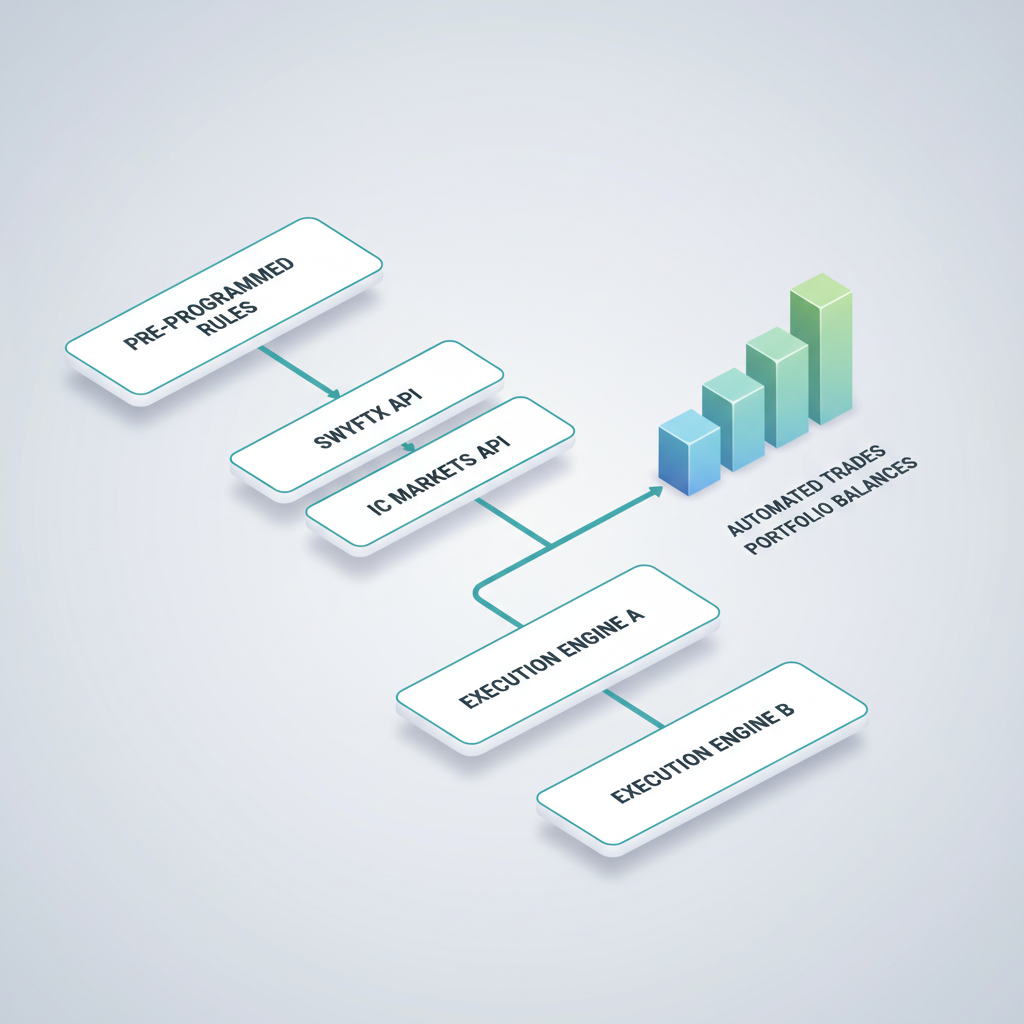
At its core, algorithmic crypto trading means using coded rules and mathematical models to automatically analyse market data and execute buy or sell orders without you touching a keyboard. You define the logic — “buy BTC/AUD when the 50-day moving average crosses above the 200-day, sell when RSI exceeds 75” — and the system handles execution, often in milliseconds.
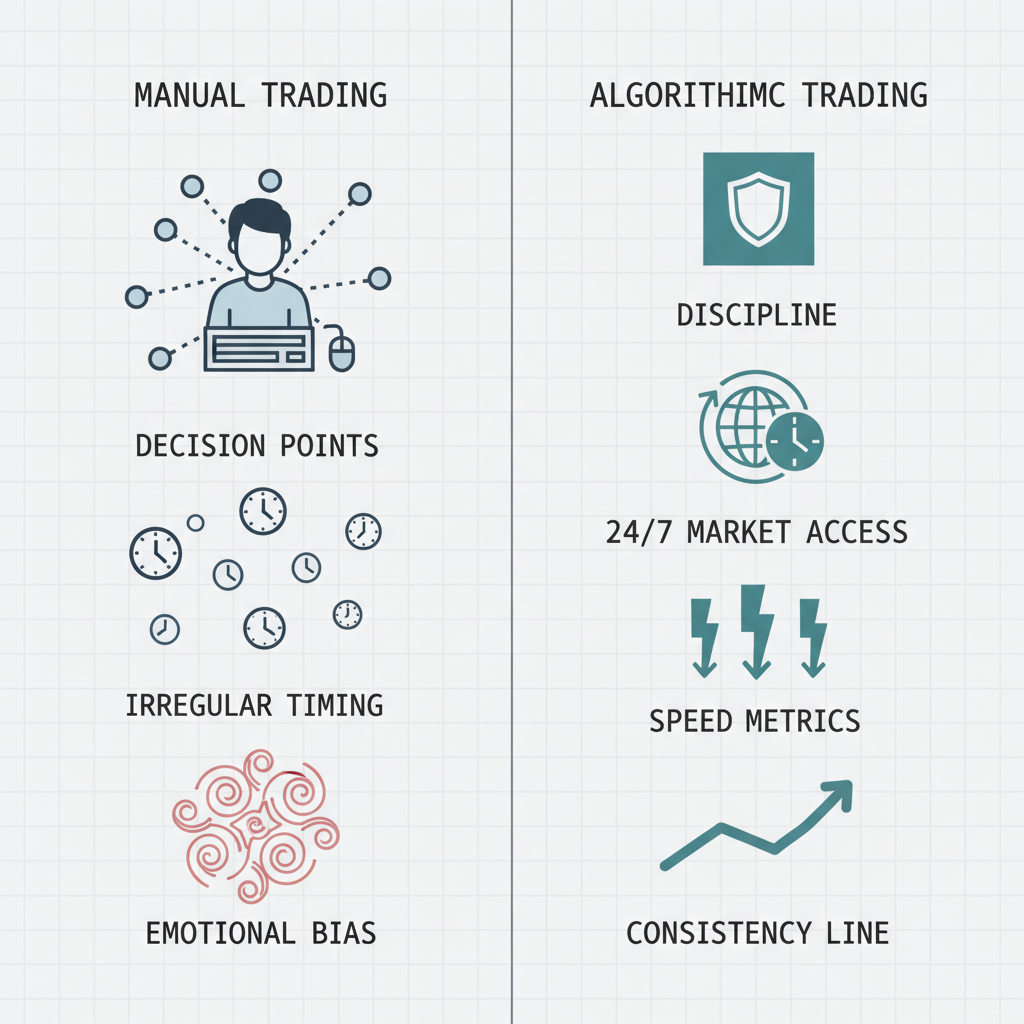
The speed advantage is real. A human watching a chart and clicking “buy” might take three to five seconds to execute. An algorithm does it in under 100 milliseconds. In a market where arbitrage windows close in seconds and momentum trades evaporate quickly, that gap matters.
Beyond speed, the discipline argument is probably more relevant for most retail traders. Algorithms do not panic-sell at 3am when Bitcoin drops 8% in twenty minutes. They follow the rules you gave them. Whether those rules are any good is a separate question, but at least the execution is consistent.
Common strategy types you will encounter:
Trend-following strategies buy assets moving in a sustained direction and hold until the trend breaks. Mean reversion strategies assume prices return to an average after extremes, so they buy dips and sell spikes. Arbitrage bots exploit price differences for the same asset across different exchanges simultaneously. Market-making bots post both buy and sell orders to capture the spread. DCA (dollar-cost averaging) bots buy fixed amounts on a schedule regardless of price.
Crypto is particularly well-suited to automation because markets run 24 hours a day, seven days a week, across dozens of pairs. No human can monitor all of that. A bot can.
Before running any real capital, you should backtest your strategy against historical data. Most serious platforms let you do this, and it is the difference between “I think this works” and “I have evidence this works in specific market conditions.” Past performance does not guarantee future results, but it will filter out obviously broken strategies quickly.
Australian traders have one extra layer to consider: the regulatory and tax environment here shapes how and where you can run these strategies. More on both below.
Australia’s Crypto Regulatory Landscape in 2026
This section matters more than most traders realise. Platform choice is now a compliance decision, not just a features decision.
The New Licensing Framework
The Corporations Amendment (Digital Assets Framework) Act 2026 passed on April 1, 2026, received Royal Assent on April 8, and commences April 9, 2027. From that date, all crypto exchanges and custody providers operating in Australia must hold an Australian Financial Services Licence (AFSL). This is the same licence framework that applies to stockbrokers and managed fund operators, and it carries the same teeth.
ASIC issued an urgent warning on May 4, 2026, giving firms a hard deadline of June 30, 2026, to apply for an AFSL or a variation to an existing authorisation. Miss that window and you are not just operating in a grey area. You are exposed to serious civil and criminal penalties, including fines up to 10% of annual turnover. That is not a warning designed to be ignored.
The current situation is uncomfortable: only around 10% of the approximately 400 crypto platforms registered in Australia hold ASIC registration. The other 90% are either preparing applications, hoping for extensions, or gambling that enforcement will be slow. For traders, the practical implication is straightforward. By mid-2027, platforms that have not secured licensing will either shut down Australian operations or face legal action. If your trading capital is sitting on one of them, you want to know which category they fall into before April 2027, not after.
On April 22, 2026, ASIC published a roadmap outlining how digital assets will be integrated into the broader financial services framework over the next 12 months. The direction is clear: crypto is being absorbed into mainstream financial regulation, not carved out of it.
AUSTRAC and the VASP Regime
Separately from ASIC, AUSTRAC oversees anti-money laundering and counter-terrorism financing compliance for all virtual asset service providers. In April 2026, AUSTRAC renamed digital currency exchange (DCE) providers to Virtual Asset Service Providers (VASPs), aligning Australian terminology with FATF international standards and reflecting the expanding range of services covered.
Operating without AUSTRAC registration is a criminal offence, full stop. Registered VASPs must implement a full AML/CTF programme: KYC procedures for all customers, suspicious matter reporting, and threshold transaction reporting. AUSTRAC classifies the virtual asset sector as high money-laundering risk, which means scrutiny is ongoing, not just at registration.
AUSTRAC’s “Use It or Lose It” initiative resulted in 62 businesses exiting the register in 2026. Platforms that were registered but not actively operating were removed, which is actually a good sign for traders because the register is becoming more meaningful.
The Binance Australia Fine: A Cautionary Note
On April 1, 2026, the Federal Court fined Binance Australia Derivatives AU$10 million after the company admitted to misclassifying a majority of its local retail clients. Those misclassified clients ended up exposed to products that were not appropriate for retail investors and incurred significant losses and fees as a result. The fine is a reminder that regulatory status is not just a bureaucratic checkbox. Platform classification decisions have real financial consequences for users.
How Australian Tax Law Applies to Algo Trading Profits
The ATO’s position on crypto has been consistent since at least 2014: cryptocurrency is property, not currency, and disposals are taxable events. Automated trading does not change that. Every trade your bot executes is a disposal that may generate a taxable gain or loss.
CGT vs. Income Tax
If you are classified as an investor, profits on crypto held for more than 12 months before disposal attract the 50% CGT discount. Your net gain is halved before being added to your income and taxed at your marginal rate. Marginal rates in Australia currently run from 0% (below the tax-free threshold of $18,200) up to 45% for income above $180,000, plus the 2% Medicare levy.
For algo traders running short-term strategies, the 12-month discount is largely irrelevant. DCA bots are an exception if they are accumulating rather than cycling, but arbitrage bots, trend-following strategies, and most active automated approaches are turning positions over in days or hours. You will not be holding for 12 months, so plan your tax on the assumption of full marginal rate taxation.
Investor vs. Trader Classification
If the ATO determines you are running a trading business rather than holding investments, profits are treated as ordinary assessable income rather than capital gains. This means no CGT discount even on positions held longer than 12 months, and the income is taxed at your marginal rate (or corporate rate if you operate through a company). The distinction depends on factors like frequency of trades, commercial intent, and whether you are organised in a business-like manner. High-volume algo operations are more likely to be classified as trading businesses.
Record-Keeping in Practice
This is where algo trading actually has an advantage over manual trading. Your platform should be exporting complete trade logs automatically. Every entry, exit, timestamp, pair, AUD value at execution, and fee paid needs to be in your records. Most serious platforms let you download CSV exports. Tools like Koinly or CryptoTaxCalculator can ingest these exports and produce ATO-compliant reports.
The AUD deposit and withdrawal trail that Australian exchanges provide simplifies reconciliation significantly compared to trading on overseas platforms where you need to track your own AUD equivalent values.
If you are running bots across multiple exchanges, engage a crypto-specialist accountant. The compliance workload is real, and getting it wrong is expensive.
Top Platforms for Algorithmic Crypto Trading in Australia
There are two broad categories here: spot crypto exchanges that support automation through APIs and built-in bot features, and CFD or derivatives brokers that support algorithmic trading through MetaTrader, cTrader, or proprietary tools. A third category, dedicated bot platforms, sits across the top of both.
Spot Exchanges With Bot and API Support
Swyftx is where I have been running recurring buys since 2022. It is the most accessible Australian exchange for automating simple strategies: recurring buys (DCA), stop-loss orders, and a clean API for more custom work. It supports SMSFs, trusts, and companies, which matters for traders operating through structures. Fees start at 0.6% spread on BTC/AUD for standard accounts, reducing with volume. AUSTRAC registered, and working toward AFSL compliance ahead of the 2027 deadline.
CoinSpot charges 0.9% on instant buys and offers a wide range of AUD payment methods including PayID, POLi, and BPAY. It is not the cheapest, but the interface is straightforward and the AUD integration is reliable. API access is available, though the documentation is more basic than some competitors.
Independent Reserve is an exchange that does not get enough attention. Flat fees, strong security track record, and a well-documented API. The coin selection is narrower than Swyftx or CoinSpot, but if you are running BTC or ETH strategies, that may not matter. One of the more institutionally oriented Australian exchanges.
Digital Surge offers trading fees from 0.1% on buy, sell and swap, with automatic discounts for higher volume traders and no AUD withdrawal fees (network fees still apply on crypto). Worth considering if your strategy is executing frequently and fee drag is a concern.
Binance Australia offers 0.1% trading fees and the highest liquidity of any exchange accessible to Australian traders, which matters for strategies that depend on tight spreads and deep order books. After the April 2026 AU$10 million fine, the compliance situation warrants monitoring. I would not be moving significant capital there until their AFSL status is clarified.
CFD Brokers With Automation Tools
Eightcap is an ASIC-licensed broker offering 95+ crypto CFDs. The MT4 and MT5 platforms support Expert Advisors, and TradingView integration is solid. Their CryptoCrusher tool is designed specifically for crypto algo strategies. Spreads on BTC start around 0.2% in normal conditions.
Pepperstone is the tightest spread option among Australian-regulated CFD brokers for crypto. MetaTrader 4, MetaTrader 5, cTrader, and TradingView are all supported for automated strategies. The execution speed is genuinely fast, which matters for time-sensitive algorithms.
IC Markets is the choice for traders who want to build custom algorithms from scratch. Full API access, MT4 and MT5 Expert Advisors, ultra-low spreads, and co-location options. If you are writing your own strategies in Python or running complex EAs, this is where the infrastructure holds up.
Capital.com has 100+ crypto CFDs, no commissions on trades (spread-based pricing), an AI assistant for strategy ideas, and connects to both TradingView and MetaTrader. The interface is more polished than most, which can help if you are running multiple screens.
Interactive Brokers Australia sits in its own category. Exchange-level access to crypto markets, full API support in Python, Java, and C++, and the compliance infrastructure of a decades-old global broker. The interface is dense, but for sophisticated automated trading strategies, the tools available here are unmatched.
Dedicated Bot Platforms
Cryptohopper connects to most major exchanges and supports DCA bots, trailing stop mechanisms, AI-assisted strategy selection, and copy trading. There is a free starting tier, which makes it a reasonable place to test before committing to a subscription. It is not the most powerful tool available, but the learning curve is manageable.
Altrady offers multi-exchange management, a TradingView terminal, and a Quick Scanner that identifies trading signals across multiple pairs simultaneously. The interface is more technical than Cryptohopper, which suits traders who are already comfortable with charting.
eToro deserves a mention for copy trading specifically. If you want automated exposure to someone else’s strategy rather than building your own, eToro lets you replicate the trades of specific traders automatically. It is not traditional algo trading, but it achieves a similar outcome.
TickSurfers offers indicators and algo systems compatible with TradingView and TradeStation. Better suited to traders who want to automate signals they are already using manually.
Platform Comparison Table: Algo Trading Features and Fees
The fee structures here differ significantly by platform type. Spot exchanges charge per-trade fees ranging from 0.1% to 0.9%. CFD brokers earn through spreads, typically 0.1% to 0.8% on BTC under normal conditions. Bot platforms like Cryptohopper charge monthly subscriptions, with a free tier available to start.
| Platform | Type | Fees / Spread | Algo / Bot Support | AUD Deposits | Regulatory Status | Best For |
|---|---|---|---|---|---|---|
| Swyftx | Spot Exchange | 0.6% spread | Recurring buys, stop-loss, API | Yes | AUSTRAC registered, AFSL pending | Beginners to intermediate, SMSFs |
| CoinSpot | Spot Exchange | 0.9% instant buy | API (basic) | Yes (PayID, BPAY, POLi) | AUSTRAC registered | Wide coin selection, AUD ease |
| Binance Australia | Spot Exchange | 0.1% trading fee | Full API, advanced order types | Limited (see regulatory note) | AUSTRAC registered, AU$10M fine April 2026 | High-volume, liquidity-dependent strategies |
| Digital Surge | Spot Exchange | From 0.1% | API available | Yes, no AUD withdrawal fees | AUSTRAC registered | Fee-sensitive, frequent traders |
| Independent Reserve | Spot Exchange | Low flat fees | API, OTC desk | Yes | AUSTRAC registered | Institutional, BTC/ETH focus |
| Eightcap | CFD Broker | ~0.2% spread BTC | MT4/MT5 EAs, TradingView, CryptoCrusher | Yes | ASIC licensed | Crypto CFD algo, mid-level traders |
| Pepperstone | CFD Broker | Tight spreads | MT4/MT5/cTrader/TradingView | Yes | ASIC licensed | Speed-sensitive automated strategies |
| IC Markets | CFD Broker | Ultra-low spreads | MT4/MT5 EAs, full API | Yes | ASIC licensed | Custom algo development, advanced traders |
| Capital.com | CFD Broker | No commissions, spread-based | TradingView, MetaTrader, AI assistant | Yes | ASIC licensed | User-friendly CFD automation |
| Interactive Brokers AU | Multi-asset Broker | Variable, exchange-level | Full API (Python/Java/C++) | Yes | ASIC licensed | Sophisticated custom algorithms |
| Cryptohopper | Bot Platform | Free tier, paid from ~$19/mo | DCA, trailing, AI, copy trading | Via connected exchange | N/A (connects to exchanges) | Entry-level bot automation |
Before depositing, verify each platform’s current AFSL application status directly with