Crypto Algo Trading Australia 2026: Complete Beginner’s Guide
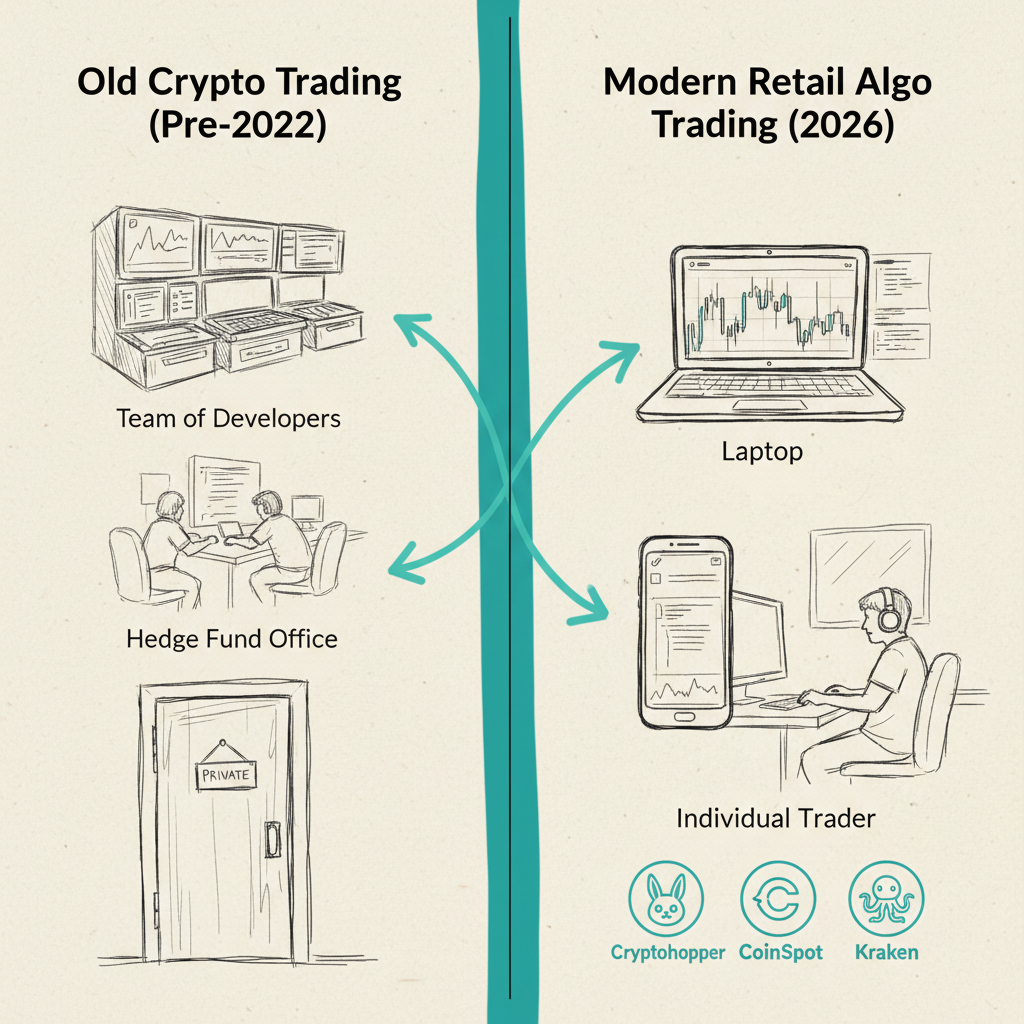
Crypto algo trading in Australia is no longer the exclusive domain of hedge funds and quant desks. I’ve watched the space shift dramatically since 2022, and right now, retail Aussie traders have access to tools that would have required a Bloomberg terminal and a dev team five years ago.
> TL;DR: Crypto algo trading Australia refers to automated, programmed strategies that execute trades 24/7 without emotional interference. With Australia’s crypto market projected to reach 1.2 billion AUD by 2026, platforms like Cryptohopper, CoinSpot, and Kraken give local traders a real edge — but only if you understand AUSTRAC registration requirements, ASIC licensing rules, and your ATO obligations before you deploy a single bot.
What Is Crypto Algo Trading in Australia? (Quick Answer)
Crypto algo trading Australia, at its core, is the use of programmed strategies and mathematical models to execute buy and sell orders automatically, based on predefined conditions. The bot doesn’t think. It just follows rules you set: “buy BTC when the 50-day moving average crosses above the 200-day moving average, sell when it drops back below.” No hesitation, no second-guessing at 2am.
That 2am detail matters more for Australian traders than for most. Crypto markets run continuously, and Sydney and Melbourne sit in time zones that are awkward relative to peak liquidity windows in the US and Europe. A bot running on Kraken or Binance doesn’t care that it’s 3:17am on a Tuesday. It executes exactly as programmed.
The core advantage isn’t just convenience. It’s consistency. Human traders deviate from their own rules under pressure. Algo systems don’t. Once your risk parameters and position sizing are locked in, the strategy runs as designed, which enforces the kind of discipline most discretionary traders only aspire to.
Australia’s adoption rate makes this relevant at scale. Projections suggest over 40% of Australians will be involved in crypto by 2026, with the local market expected to hit 1.2 billion AUD. That’s a lot of people who could benefit from systematic approaches, and a lot of people who could get hurt if they don’t understand what they’re running.
Before deploying any bot or automated strategy here, Australian traders need to know which platforms are registered with AUSTRAC and what ASIC’s new Digital Assets Framework means for the services they use. I’ll cover both in detail below.
How Algorithmic Crypto Trading Works: Step-by-Step
The mechanics are less intimidating than most people expect. Here’s what actually happens when an algo strategy is live.
Step 1 — Strategy design. You define the logic: entry conditions, exit conditions, stop-loss levels, position sizing rules. This is the most important step and the one most beginners rush. A poorly designed strategy backtests well by accident and fails in live markets. Take the time here.
Step 2 — Backtesting. Before risking a dollar, you run the strategy against historical price data to see how it would have performed. Good backtesting platforms let you adjust for slippage and fees so the results aren’t artificially flattering. [INTERNAL LINK PLACEHOLDER: backtesting crypto strategies → pillar: crypto backtesting guide australia]
Step 3 — API connection. The bot connects to your chosen exchange via an API key. You generate the key on the exchange, enter it into the bot platform, and set permissions (usually trade-only, never withdrawal access). Platforms like CoinSpot and Kraken both offer API access for this purpose.
Step 4 — Live execution. The algorithm monitors real-time market data, identifies signals that match your predefined conditions, and places orders at speeds no human trader can match. Arbitrage opportunities that exist for milliseconds, momentum signals that appear and disappear, micro-price inefficiencies — bots catch them; humans don’t.
Step 5 — Performance tracking and optimisation. Running a bot isn’t set-and-forget. Market conditions change. A strategy that worked in a trending 2024 market may bleed in a ranging 2026 market. Ongoing monitoring, regular performance reviews, and periodic strategy adjustments are non-negotiable if you’re taking this seriously.
The processing advantage is worth emphasising. A well-configured algo can ingest order book depth, price action across multiple pairs, volume signals, and external data feeds simultaneously. A human trader looking at two charts on a laptop doesn’t come close.
6 Most Common Crypto Algo Trading Strategies for Aussie Traders
Choosing a strategy before choosing a platform is the right order of operations. The platform should fit the strategy, not the other way around.
Trend-following is where most beginners should start. The logic is simple: buy when price moves above a moving average, sell when it falls back below. It won’t catch tops and bottoms, but it keeps you on the right side of sustained moves. Cryptohopper handles trend-following bots well and doesn’t require coding knowledge to configure.
Arbitrage exploits price differences for the same asset across different exchanges. If BTC/AUD is trading at $142,500 on CoinSpot and $142,800 on Binance, the spread is theoretical profit. In practice, execution speed and transfer fees eat most of it. Effective arbitrage at retail level in Australia is hard, but cross-exchange opportunities do appear during volatile periods.
Mean reversion operates on the assumption that prices revert to a historical average after deviating significantly. It performs well in ranging, sideways markets and poorly when prices trend strongly in one direction. Know which market regime you’re in before running this one.
Momentum trading rides assets that are accelerating in price, entering after a breakout and exiting when momentum stalls. This pairs particularly well with bot automation because the entry signals are objective and the exits can be programmed with trailing stops.
Market making involves placing simultaneous buy and sell limit orders on both sides of the order book, profiting from the spread between them. It requires deeper exchange integration, higher capital, and tolerance for inventory risk. Not beginner territory.
High-frequency trading (HFT) executes thousands of trades per second, exploiting tiny price discrepancies at institutional speed. The infrastructure requirements — co-located servers, sub-millisecond latency, direct exchange connections — put genuine HFT out of reach for retail Australian traders. Brokers like IC Markets and Pepperstone offer low-latency crypto CFD infrastructure that approaches this space, but it’s not the same thing.
If you’re new to algorithmic crypto trading in Australia, start with trend-following or a simple dollar-cost averaging (DCA) bot. Get comfortable with API connections, performance tracking, and the emotional reality of watching a bot take losses according to plan before you progress to anything more complex.
Best Platforms and Bots for Crypto Algo Trading in Australia (2026)
The Australian market has matured enough that you’re not limited to international platforms with no local support. Here’s what’s actually worth your attention.
Bot Platforms
Cryptohopper is the most accessible dedicated bot platform for Australian retail traders. It supports DCA bots, trailing stop features, AI-powered signals, and copy trading, so you can mirror the strategies of more experienced operators while you learn. No coding required for basic setups, and it connects via API to most major exchanges Australians use. The subscription pricing starts at a level most retail traders can justify if they’re trading a reasonable stack.
cryptoresults.com.au is worth knowing about if you want structured education alongside the tooling. They run an Australian-focused program called Bitsgap Accelerator that walks users through bot setup, capital protection, and performance tracking. Their TrustScore sits at 4.5 out of 5 from 51 reviews, which is solid for a niche program. It’s beginner-friendly without being condescending.
Alpaca Trading is the pick for developers. The API is clean, documentation is thorough, fees are low, and it’s consistently cited by Australian algo traders who want to write their own strategies in Python rather than use a GUI-based bot platform. If you’re comfortable with code, Alpaca gives you more control.
Australian Exchanges with Strong API Access
CoinSpot is the largest Australian exchange and AUSTRAC-registered. It lists 490+ coins, charges 0.1% on market orders, and supports PayID deposits at no cost. The API is functional for bot integration, and having AUD liquidity on a local exchange reduces the friction of getting money in and out. The instant buy/sell fee of 1% is steep, so make sure your bot is configured to use market orders, not the instant buy function.
Swyftx suits beginners running simpler automated strategies. It supports stop-loss orders and recurring buys natively, lists 430+ tokens, and has a cleaner interface than most. I have been using Swyftx since 2022 and the AUD on-ramp has been consistently reliable. The 0.6% spread on BTC/AUD is transparent, which is more than you can say for some platforms that bury costs in spreads.
Kraken is the strongest option for traders who want low fees, high security, and a professional-grade API. Kraken Pro’s API is well-documented and suitable for more sophisticated algo strategies. The spread on a $1,000 AUD Bitcoin purchase runs to around $1.00 (approximately 0.1%), which is competitive. Kraken is not an Australian exchange but it accepts AUD deposits and has a solid compliance track record.
Binance offers the widest asset range and one of the most developed API ecosystems available. Fees are low and the infrastructure for bot integration is mature. The regulatory situation between Binance and Australian authorities has had its complications, so verify current AUSTRAC registration status before depositing significant funds.
CFD Brokers for Algo-Adjacent Strategies
IC Markets and Pepperstone both offer crypto CFD products with infrastructure built for active trading. Pepperstone charges a flat 0.1% commission per trade with no spread mark-up on crypto CFDs. If you’re running strategies that require low-latency execution and you’re comfortable with the CFD structure (including the fact that you don’t own the underlying asset and leverage applies), these platforms are worth considering.
A note on CryptoAlgo (cryptoalgo.com): the site states it does not allow US investors to access its platform, but specific operational details for Australian users are unverified. Conduct your own due diligence before engaging.
Platform Comparison Table
| Platform | Type | Fees | API Available | AUSTRAC Registered | Best For |
|---|---|---|---|---|---|
| CoinSpot | AUS Exchange | 0.1% market orders, 1% instant | Yes | Yes | AUD on-ramp, local support |
| Swyftx | AUS Exchange | 0.6% spread | Yes | Yes | Beginners, recurring buys |
| Kraken | Global Exchange | ~0.1% Kraken Pro | Yes | Verify current status | Low fees, advanced API |
| Binance | Global Exchange | Low (varies by tier) | Yes | Verify current status | Wide asset range, dev tools |
| Cryptohopper | Bot Platform | Subscription-based | Connects via API | N/A (not an exchange) | No-code bot automation |
| Alpaca Trading | Algo Platform | Low | Yes | N/A | Developer-built strategies |
| Pepperstone | CFD Broker | 0.1% flat commission | Yes | ASIC licensed | Low-latency, CFD strategies |
| IC Markets | CFD Broker | Competitive | Yes | ASIC licensed | HFT-adjacent, low latency |
AUSTRAC and ASIC Rules for Crypto Algo Trading in Australia 2026
This is the section most guides skip or oversimplify. Don’t.
AUSTRAC: The VASP Registration Requirement
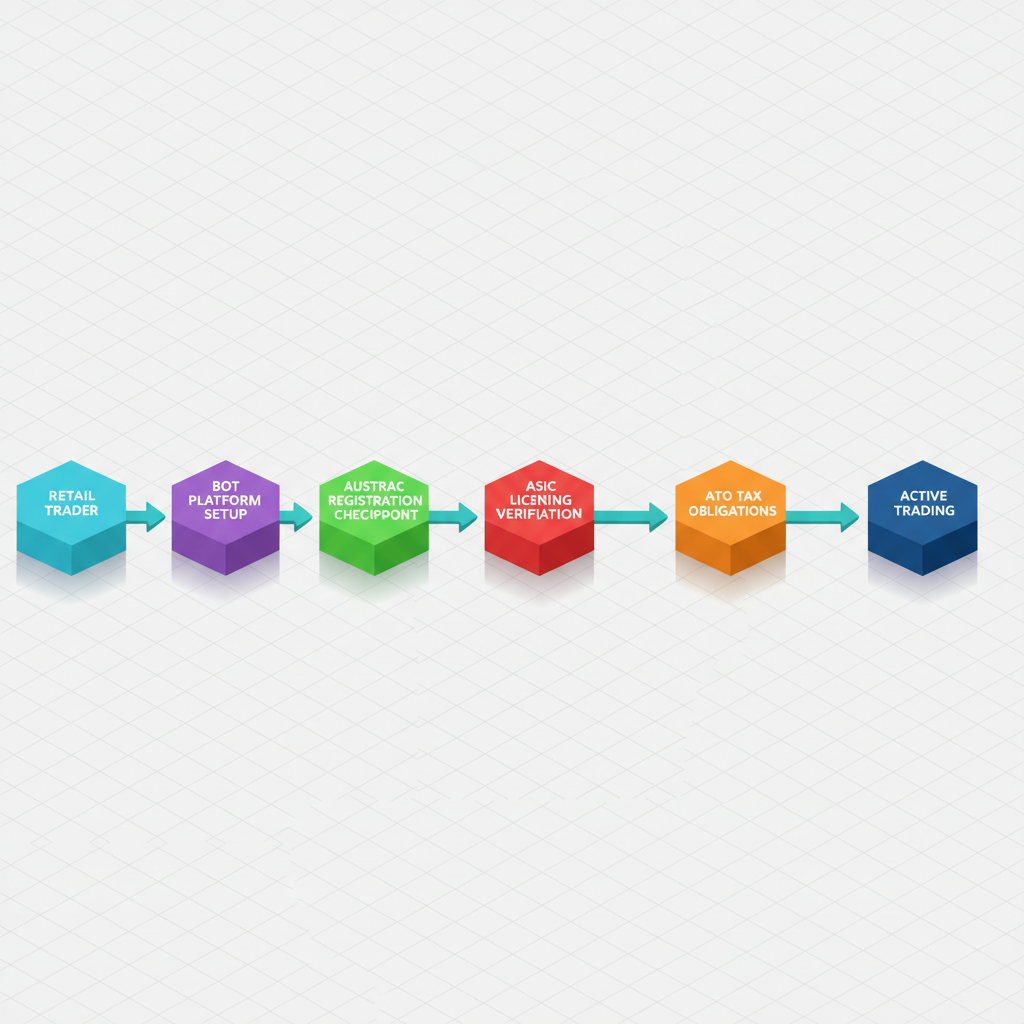
As of April 2, 2026, Australia’s AML/CTF laws have been expanded and updated. The term “Digital Currency Exchange provider” has been replaced with “Virtual Asset Service Provider” (VASP), and the scope of regulated services has broadened. Any business providing virtual asset services in or from Australia must now enrol and register with AUSTRAC under the updated framework.
New providers had until April 28, 2026, to enrol. Missing that deadline doesn’t just mean a fine. It means potential registration cancellation and, critically, loss of banking access. AUSTRAC’s ability to cut a business off from payment service providers is the real teeth in this regime. In March 2026, AUSTRAC cancelled the registration of Coinsec Australia Pty Ltd. Reserve Currency of Australia Pty Ltd lost its registration in February 2026. AUSTRAC has been actively cleaning up its register, engaging with 128 inactive businesses and removing 62 from the sector.
For retail traders using bots, the practical implication is this: you personally don’t need to register with AUSTRAC to run a bot on your own account. The platform you’re using must be registered. Before depositing funds anywhere, check the AUSTRAC VASP register. It takes two minutes and it’s the first line of defence against the kind of scam that saw an Australian man charged in February 2026 over an alleged $3.5 million fraud that directed victims to deposit into a fake platform called NEXOpayment. Always verify before you deposit. [INTERNAL LINK PLACEHOLDER: how to check AUSTRAC registration → pillar: crypto exchange safety australia]
ASIC: The Digital Assets Framework Act 2026
The Corporations Amendment (Digital Assets Framework) Act 2026 received Royal Assent on April 8, 2026. From April 9, 2027, digital asset platforms operating in Australia must hold an Australian Financial Services (AFS) licence. That’s an 18-month implementation window, and the industry is currently in transition.
Crypto-assets that qualify as financial products under existing law — managed investment schemes, derivatives, securities — already require an AFS licence. If you’re using a platform that offers leveraged crypto products, structured crypto portfolios, or anything that looks like a managed fund, the licensing requirement is not a future concern. It applies now.
ASIC also finalised new class relief in December 2025 for intermediaries involved in the secondary distribution of certain stablecoins and wrapped tokens, which indicates the regulator is trying to build workable pathways rather than simply restrict innovation. The Digital Finance Cooperative Research Centre estimated in March 2026 that regulatory uncertainty risks costing Australia $17 billion in annual crypto opportunity. The message to Canberra is clear, even if the response has been slow.
The Tax Position: ATO and CGT
The ATO treats cryptocurrency as property, not currency. Every time an algo bot executes a sell order, it’s a potential capital gains event. If your bot is running a high-frequency strategy and turning over dozens of trades per day, you could be generating hundreds of taxable events annually. Keep records of every trade, including acquisition cost, disposal proceeds, date, and the AUD value at the time of each transaction. Most major platforms allow you to export transaction histories; use them. [INTERNAL LINK PLACEHOLDER: crypto tax australia guide → pillar: crypto tax australia ATO]
If you’ve held a position for more than 12 months before disposal, you may be eligible for the 50% CGT discount. Most algo strategies trade on shorter timeframes and won’t qualify, but it’s worth structuring longer-term holdings separately from your active bot trades if the CGT discount is relevant to your situation. Speak to a tax professional who understands crypto before your first tax return in this space. The cost of getting it wrong is much higher than the cost of an accountant.
Frequently Asked Questions
Do I need AUSTRAC registration to run a crypto bot in Australia?
No, not as a retail trader running bots on your own account. The registration requirement applies to businesses providing virtual asset services, not individual traders. You do need to ensure that any exchange or platform you connect your bot to is properly registered with AUSTRAC as a VASP.
Is crypto algo trading legal in Australia?
Yes. Algorithmic trading of cryptocurrency is legal in Australia. The regulatory requirements around it relate to the platforms providing services (AUSTRAC registration, and from April 2027, ASIC AFS licensing for digital asset platforms) rather than to individual traders using those platforms