Crypto Algo Trading Australia 2026: Complete Guide for Australian Traders
Crypto algo trading Australia has moved well past the hobbyist phase. In 2026, Australian traders are running automated strategies on platforms ranging from locally-built exchanges to institutional-grade tools with full API access, and the regulatory ground has shifted significantly underneath all of it.
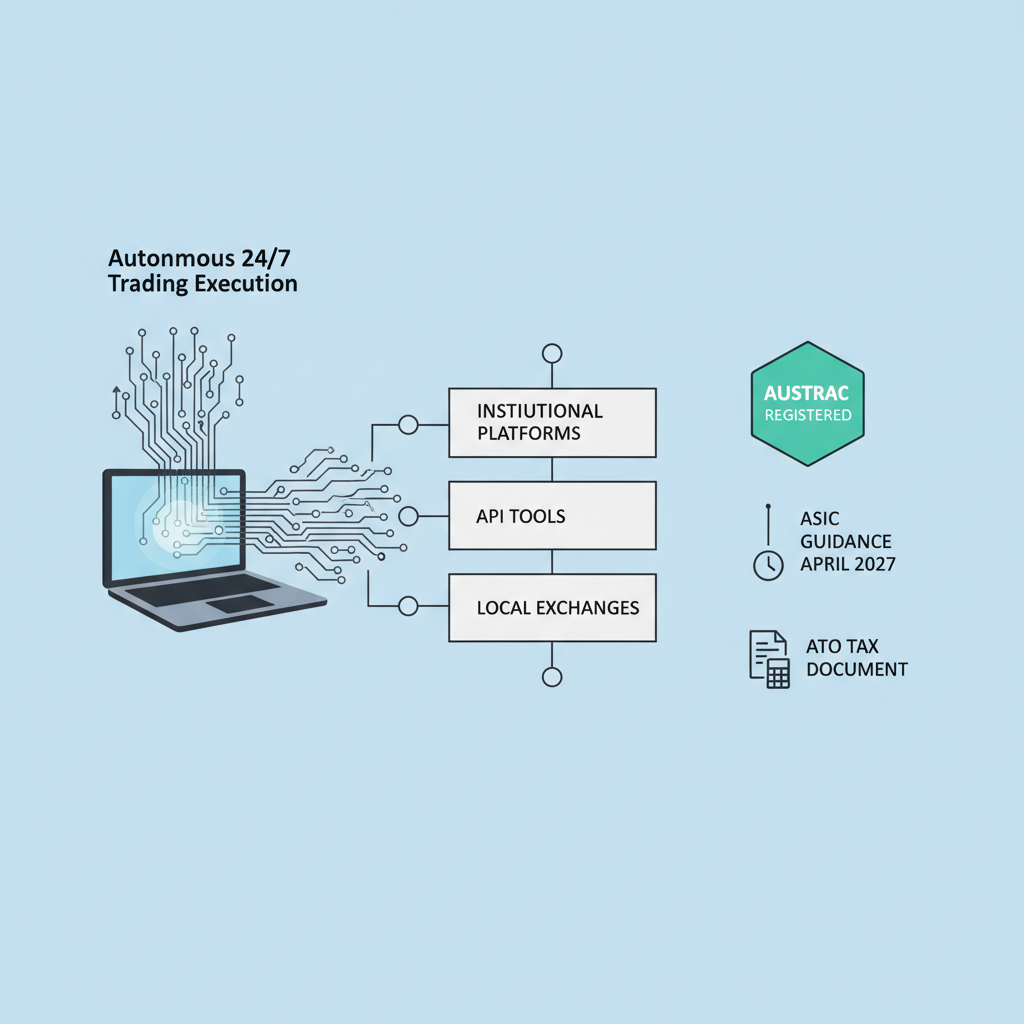
> TL;DR: Crypto algo trading Australia covers automated strategies that execute 24/7 using pre-programmed rules, removing emotion and human error from the process. Top platforms include Cryptohopper, QuantConnect, Alpaca, and Australian exchanges like Swyftx and Independent Reserve with API support. AUSTRAC registration is mandatory for any platform you use, ASIC licensing reforms kick in April 2027, and the ATO taxes most algo trading gains at your full marginal rate since positions rarely qualify for the 12-month CGT discount.
What Is Crypto Algo Trading in Australia?
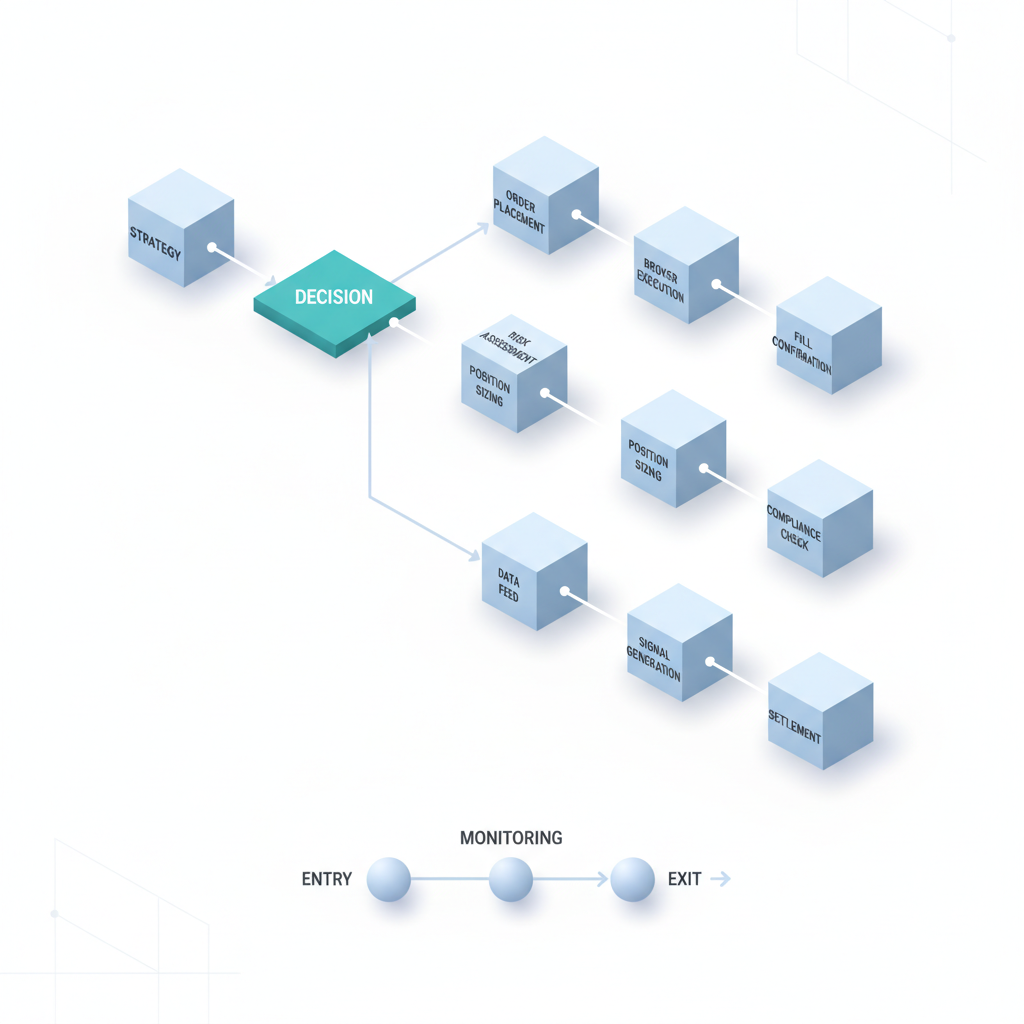
Algorithmic trading means your computer executes trades for you based on a set of pre-defined rules. Price hits X, volume crosses Y threshold, RSI drops below Z — the bot acts. No hesitation, no second-guessing, no staring at a chart at 2am.
In traditional equity markets, algo trading has been around for decades. In crypto, the same logic applies but the context is different. Crypto markets run 24 hours a day, seven days a week, including Christmas Day and tax time. That continuous operation is exactly why automation matters so much here. A manual trader cannot watch BTC/AUD every hour of every day. An algorithm can.
In the Australian market specifically, crypto algo trading operates within a two-regulator framework. AUSTRAC handles anti-money laundering and counter-terrorism financing obligations for any business providing virtual asset services. ASIC covers the financial products and services layer. As of April 2026, AUSTRAC has formally renamed Digital Currency Exchange (DCE) providers to Virtual Asset Service Providers (VASPs) under expanded AML/CTF reforms. The ASIC licensing regime for digital asset platforms kicks in from April 2027 under the Corporations Amendment (Digital Assets Framework) Act 2026.
For traders rather than platforms, the practical implication is this: use a platform that is on AUSTRAC’s public VASP register, understand that the tax treatment of automated trading is generally less favourable than long-term holding, and treat any overseas platform without Australian registration as a material risk to your capital and your legal standing.
[INTERNAL LINK PLACEHOLDER: “AUSTRAC VASP register” → AUSTRAC compliance pillar page]
Key Benefits of Algorithmic Crypto Trading
The most obvious advantage is speed. An algorithm can respond to a price movement in milliseconds. By the time you’ve noticed the candle, unlocked your phone, and opened the exchange app, the opportunity has already closed. For strategies that depend on tight entry and exit windows, that latency gap between human and machine is the whole game.
The second advantage is psychological. Fear and greed are genuinely destructive forces in trading. Most traders know exactly what they should do and then do something else when the chart goes red. An algorithm does not experience drawdown anxiety. It executes the rules you gave it, full stop. That consistency is worth a lot.
Backtesting is the third major benefit and one that’s underused by retail traders. Platforms like QuantConnect let you run a strategy against years of historical price data before risking a single dollar. You find out that your mean reversion idea worked brilliantly in 2020 and collapsed completely in 2022 — before you find out live.
Running multiple strategies simultaneously is also practical with automation in a way that’s simply not possible manually. You can have a DCA bot accumulating ETH/AUD on dips, a trend-following strategy running on BTC/AUD, and an arbitrage script watching the spread between two exchanges, all at the same time.
Common Algorithmic Trading Strategies Used in Crypto Markets
High-Frequency Trading and Arbitrage
High-frequency trading (HFT) in crypto involves capturing tiny price discrepancies across thousands of trades per second. In practice, retail traders in Australia are not competing in true HFT, which requires co-location infrastructure and direct market access at the exchange level. What retail algos can realistically do is exploit slower arbitrage opportunities: price differences between Kraken and Binance, or between spot and futures on the same exchange.
Arbitrage sounds risk-free. It is not. By the time your order reaches both exchanges, prices may have converged. Transaction fees, withdrawal limits, and transfer times all eat into the theoretical spread. That said, triangular arbitrage within a single exchange, cycling between three trading pairs, can work with the right setup and low enough fees.
Mean Reversion and Trend Following
Mean reversion bets that prices return to a historical average after deviating. You identify an asset that has moved two standard deviations from its 20-day mean and take the opposing position. It works reasonably well in range-bound markets and fails spectacularly when a genuine trend takes hold.
Trend following and momentum strategies do the opposite: they identify assets that are moving strongly in one direction and ride the move. Simple moving average crossovers (the 50-day crossing the 200-day, for example) are the classic version. More sophisticated implementations use ADX filters to confirm trend strength before entering.
DCA Bots and Copy Trading
Dollar-cost averaging bots are the most accessible entry point for Australian traders new to automation. You tell the bot to buy $50 of BTC/AUD every Tuesday regardless of price. Platforms like Cryptohopper extend this with trailing features: the bot keeps buying as price falls and stops when momentum shifts. It’s simple, it’s mechanical, and it removes the paralysis that comes with trying to time entries.
Copy trading platforms like eToro take a different approach. Instead of coding your own strategy, you mirror the positions of a selected trader automatically. The strategy is still algorithmic in execution, but the decision-making is outsourced. Signal-based automation through Cryptohopper’s marketplace works similarly.
Market Making
Market-making algorithms place simultaneous buy and sell orders on either side of the order book, collecting the spread as profit. On major pairs with tight spreads and high volume, this can generate consistent small gains. The risk is inventory: if price moves sharply in one direction, you end up holding a depreciating position. Market making on illiquid altcoin pairs on smaller exchanges is a fast way to lose money.
Best Platforms for Crypto Algo Trading in Australia 2026
The platforms worth knowing fall into two categories: dedicated algo tools that connect to exchanges via API, and Australian exchanges that offer their own API access for custom automation.
Dedicated Algo Trading Platforms
Cryptohopper is the most approachable option for traders who want automation without writing code. It’s cloud-based, so the bot runs even when your computer is off. It supports DCA, trailing stop-loss, grid trading, and has a copy trading marketplace where you can subscribe to signal providers. AI-assisted strategy building was added in recent versions. The catch: subscription costs add up, and the paper trading environment doesn’t fully replicate real market conditions. Plans start at around USD $19/month and scale up from there.
QuantConnect is the serious coder’s tool. It’s open-source, supports Python and C#, and has a unified API that spans equities, futures, forex, and crypto. The backtesting engine runs against granular historical data and the platform allows live trading deployment through supported brokers. It has a steep learning curve but the research environment is genuinely excellent. I’ve used it to backtest BTC strategies using Bitfinex historical data going back to 2014.
Alpaca Trading was identified as the top broker for algorithmic trading in Australia for 2026 by multiple industry sources, and the reason is straightforward: its API is exceptionally clean and developer-friendly, documentation is thorough, and it supports both paper trading and live deployment. If you’re building a custom algo in Python and want a broker that gets out of your way, Alpaca is the starting point.
LuxAlgo operates differently. Rather than a bot platform, it’s an AI-driven indicator and strategy builder that integrates with TradingView. You use it to build signals and automate strategy logic across crypto, stocks, and forex. The Premium and Ultimate plans differ primarily in AI credit allocations for the strategy generation features. It’s genuinely useful if TradingView is already your charting environment.
Interactive Brokers gives you full API control and exchange-level access with the ability to build completely custom automation. It supports crypto trading through its platform, though the asset range is narrower than dedicated crypto exchanges. The advantage is institutional-grade infrastructure, proper risk management tools, and access to multiple asset classes from one account. Not beginner-friendly, but extremely capable.
Pepperstone is the right choice if you want CFD-based crypto exposure with tight spreads and MetaTrader, cTrader, or TradingView automation. It’s ASIC-regulated, which matters. Spreads on BTC/USD CFDs can be competitive during liquid hours. Be clear that CFDs are not the same as holding spot crypto: you do not own the underlying asset, there are overnight funding costs on held positions, and the tax treatment differs.
Australian Exchanges With API Support
For traders who want to hold actual crypto (not CFDs) and run bots against it, these are the Australian exchanges with meaningful API support.
Swyftx has had API access available for some time and is AUSTRAC-registered. I have been using Swyftx since 2022 and fees sit between 0.1% and 0.6% depending on the pair. The API is functional for basic automation, though it’s not designed for high-frequency use. AUD deposits via PayID are free and settle quickly.
Independent Reserve is the most API-serious of the Australian-first exchanges. It’s used by institutional clients and OTC desks, which tells you something about the infrastructure. Fees range from 0.02% to 0.5% with volume discounts, and the API documentation is more thorough than most domestic competitors.
BTC Markets has been running since 2013 and has a straightforward API. Fees are reasonable and it’s been consistently AUSTRAC-compliant. The asset selection is narrower than Swyftx or Kraken, but if BTC/AUD and ETH/AUD are your primary pairs, it does the job.
Kraken operates in Australia with AUSTRAC registration and offers one of the best API environments of any exchange available to Australian traders. Maker fees can go as low as 0% for high-volume traders and taker fees start at 0.1%. The advanced order types and WebSocket feeds are well-suited to algo strategies.
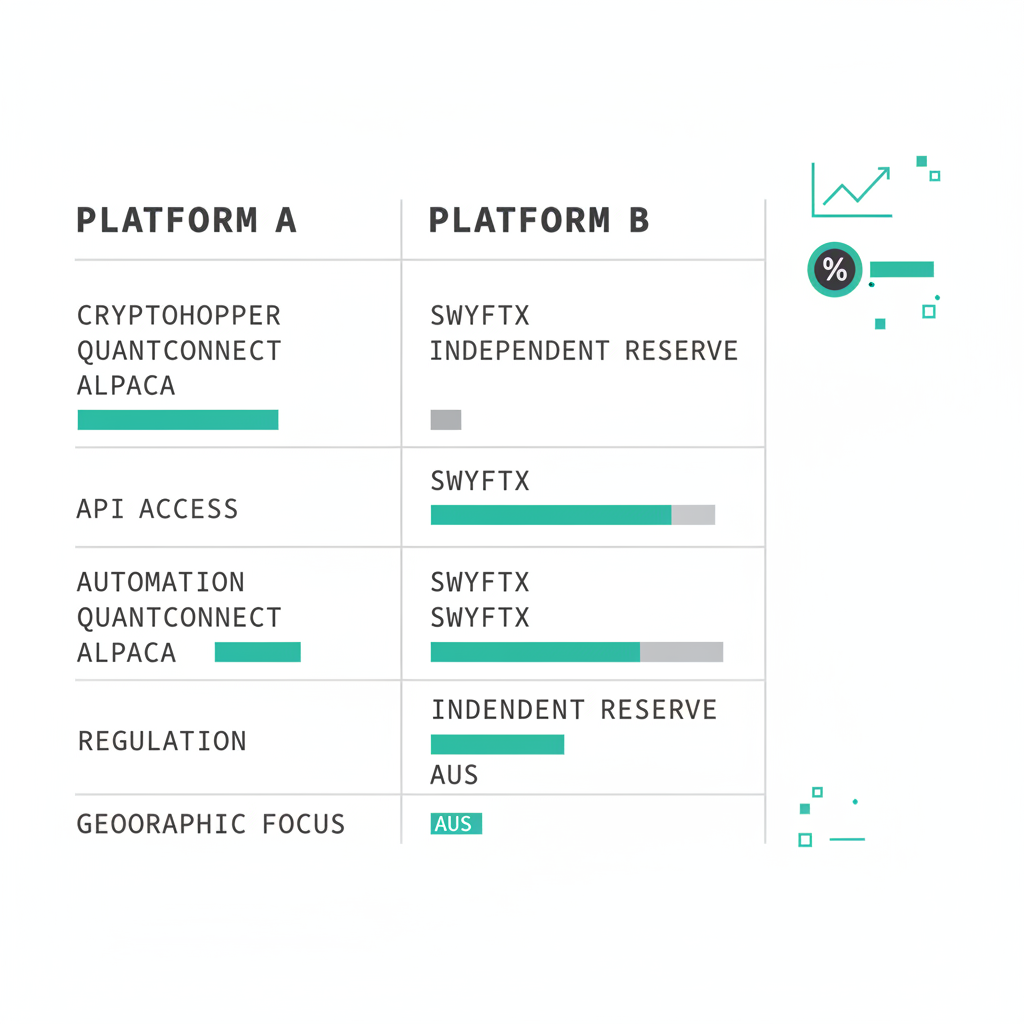
Platform Comparison Table
| Platform | API Available | Typical Fees | AUSTRAC/ASIC Status | Best For |
|---|---|---|---|---|
| Cryptohopper | Yes (connects to exchanges) | From ~USD $19/mo subscription | N/A (tool, not exchange) | No-code bot automation, copy trading |
| QuantConnect | Yes (unified multi-asset API) | Free tier + paid plans | N/A (research/deployment tool) | Developers, backtesting, multi-asset |
| Alpaca | Yes (developer-first REST API) | Low; varies by asset | Not AU-registered exchange | Developer-built custom algos |
| LuxAlgo | Via TradingView integration | Subscription (Premium/Ultimate) | N/A (strategy builder) | TradingView users, signal building |
| Interactive Brokers | Yes (full custom automation) | From 0.1% + platform fees | ASIC-regulated | Institutional-grade multi-asset algos |
| Pepperstone | Yes (MT4/5, cTrader, TV) | Tight spreads on CFDs | ASIC-regulated | CFD crypto, MT4/5/cTrader automation |
| Swyftx | Yes | 0.1%–0.6% | AUSTRAC-registered | Australian spot trading, beginners |
| Independent Reserve | Yes (thorough docs) | 0.02%–0.5% | AUSTRAC-registered | Institutional use, API-first trading |
| Kraken | Yes (WebSocket + REST) | 0%–0.1% maker / 0.1% taker | AUSTRAC-registered | Advanced traders, low fees, API depth |
| BTC Markets | Yes | Competitive | AUSTRAC-registered | BTC/ETH focus, long-standing AU platform |
[INTERNAL LINK PLACEHOLDER: “Swyftx review” → Swyftx detailed review page]
[INTERNAL LINK PLACEHOLDER: “Independent Reserve review” → Independent Reserve detailed review page]
AUSTRAC and ASIC: Regulatory Requirements for Australian Crypto Traders
AUSTRAC and the VASP Regime
From April 2, 2026, AUSTRAC expanded Australia’s AML/CTF laws and formally renamed Digital Currency Exchange providers to Virtual Asset Service Providers. The change is not just cosmetic: the scope of what counts as a regulated virtual asset service has broadened, and compliance obligations have increased accordingly.
Any platform providing virtual asset services to Australians must be registered on AUSTRAC’s VASP register. AUSTRAC launched a public, searchable version of this register specifically to make it harder for criminals to use unregistered platforms to launder money. You can and should check this register before depositing funds on any platform. New VASP providers must apply for registration by July 29, 2026.
AUSTRAC has also cancelled several VASP registrations in early 2026, citing unacceptable money laundering and terrorism financing risks. The message is clear: registration is not a formality, and AUSTRAC is actively enforcing. If a platform you’re using loses its registration, your funds are at significant risk and you lose most of your legal recourse.
ASIC and the April 2027 Licensing Deadline
ASIC’s role covers crypto assets and services that qualify as financial products. For most spot crypto exchanges, that threshold has historically not been met — crypto itself is not a financial product under current law. That changes under the Corporations Amendment (Digital Assets Framework) Act 2026.
From April 2027, digital asset platforms will require an Australian Financial Services Licence (AFSL) to operate. ASIC has granted a no-action position until June 30, 2026, for firms that have applied for the necessary licences. This gives the industry a transition window, but the direction of travel is clear: if a platform is operating in Australia without moving toward AFSL compliance, it is taking a regulatory risk that ultimately sits with its customers as much as itself.
For algo traders specifically, this matters when choosing a platform. CFD providers like Pepperstone are already ASIC-regulated. Offshore platforms without Australian registration sit outside this framework entirely, and if something goes wrong, your options for recovery are limited.
[INTERNAL LINK PLACEHOLDER: “AUSTRAC VASP register search” → AUSTRAC external link or compliance guide]
Australian Crypto Exchange Fees and Hidden Costs Explained
The headline fee is rarely the real cost. Understanding what you actually pay requires looking at three components: trading fees, spreads, and withdrawal/deposit costs.
Trading Fees
On Australian exchanges, trading fees generally sit between 0.1% and 1% per trade. The maker/taker model is standard: maker fees (orders that add liquidity to the order book) are typically lower than taker fees (orders that take existing liquidity). Kraken charges 0% to 0.1% maker and 0.1% taker for higher volume tiers. Independent Reserve starts at 0.5% and drops to 0.02% for very high monthly volume. Coinspot starts at 1%, which is materially higher than most competitors. Digital Surge starts from 0.1%. Swyftx sits in the 0.1% to 0.6% range depending on the pair.
For algorithmic trading, fees compound fast. A strategy executing 20 trades per day at 0.5% per trade is paying 10% of position size daily in transaction costs. That is an enormous hurdle to clear. This is why fee level is not an aesthetic preference in algo trading, it is a fundamental constraint on which strategies are viable.
Spreads: The Invisible Cost
Spreads are the gap between the price you can buy at and the price you