CrypAlgo Review Australia 2026: AI Crypto Trading Signals for Australian Traders
If you have spent any time on TradingView looking for an edge in the crypto market, you have probably noticed the ecosystem of signal indicators that promise to do the heavy lifting. CrypAlgo review Australia searches have picked up noticeably in 2026, and for good reason: it is one of the few signal services that embeds directly into TradingView as a proprietary indicator rather than spamming you on Telegram at 2am.
I have been testing AI signal tools across Australian-accessible exchanges since 2022, and CrypAlgo’s approach is genuinely different from the Telegram-group noise that dominates this space. That does not automatically make it worth your $30 USD a month, but it does make it worth a proper look.
> TL;DR
> CrypAlgo review Australia in a nutshell: this is an AI-powered crypto signal service delivering buy and sell setups via TradingView for around $30 USD/month (roughly $46–48 AUD at current rates). It does not touch your funds or require API key access, which removes a major risk category. Australian traders should know that crypto gains remain fully taxable under ATO rules, and new ASIC licensing laws that took effect April 1, 2026 have reshaped the compliance picture for platforms operating in this market.
CrypAlgo Review Australia: What Is It and Who Is It For?

CrypAlgo is an AI-powered crypto signal provider that operates entirely within TradingView. Instead of sending alerts through a separate app or Telegram channel, it appears as a proprietary indicator overlaid directly on your charts, generating buy and sell signals in real time, 24 hours a day, seven days a week.
The target audience is retail and semi-professional crypto traders who want algorithmically generated trade setups without surrendering control of their funds to a third-party bot. That distinction matters. You are not connecting an API key that gives an external service permission to execute trades on your behalf. You see the signal, you decide whether to act on it, and you place the trade yourself. Or, if you are comfortable with TradingView’s automation features, you can build your own alert-to-webhook pipeline.
The signals themselves include three key pieces of information: an entry point, a stop-loss level, and a take-profit target. That structure suits traders who already understand position sizing and risk management but want an external data source to identify setups they might otherwise miss.
CrypAlgo supports major exchange pairs on Binance, Coinbase, Kraken, and Bybit, which covers the main venues Australian traders use.
One flag worth raising upfront: CrypAlgo’s status as an Australian entity is unverified. The company does not appear on ASIC’s public registers, and I could not confirm an ABN or ACN. That does not make the product unusable, but it does mean you are dealing with a service that is likely based offshore. More on the regulatory implications in the compliance section below.
[INTERNAL LINK PLACEHOLDER: “AI signal tools” → /best-crypto-signal-services-australia]
How CrypAlgo Works: The Algorithm Behind the Signals
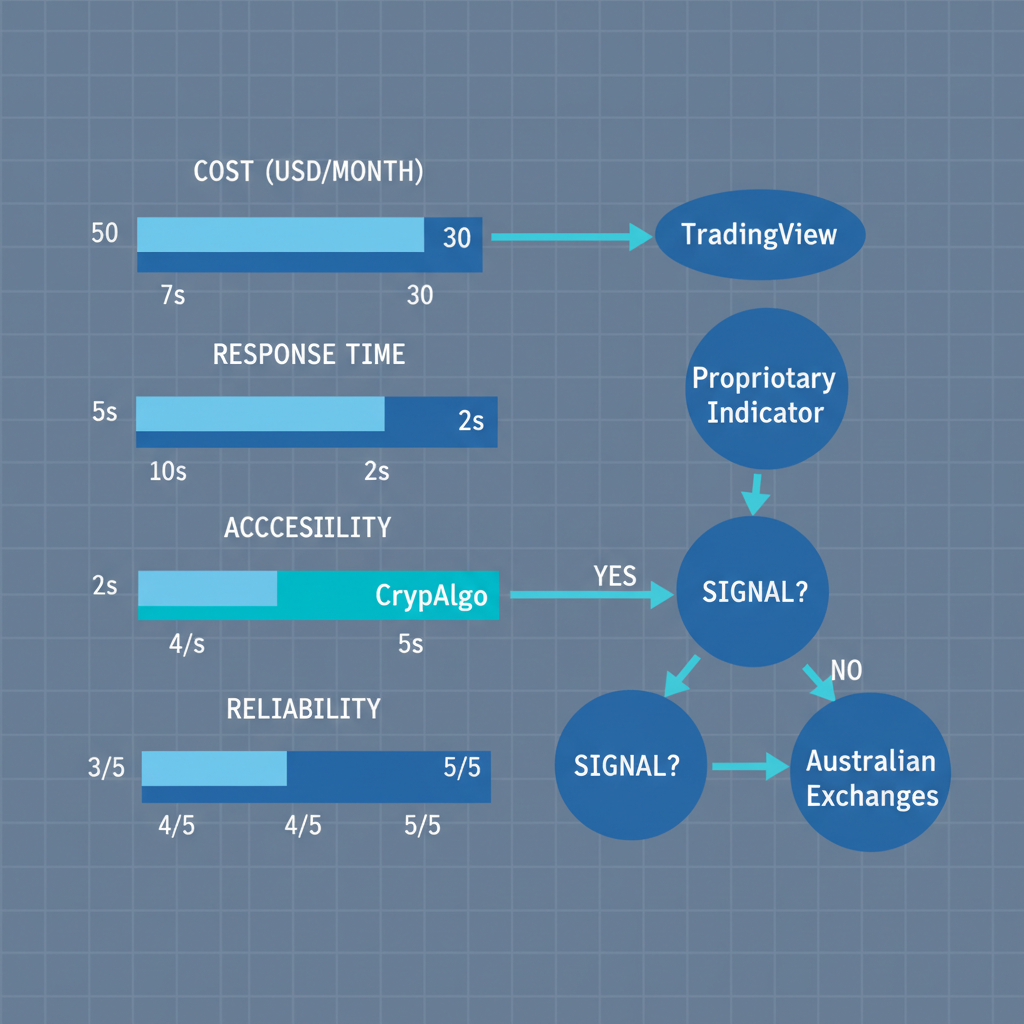
The signal generation engine combines three inputs: machine learning models, classical technical analysis, and market sentiment data. That combination is increasingly standard among serious signal providers, but the implementation quality varies enormously.
On the technical analysis side, the algorithm is reading price action, volume, and indicator crossovers across multiple timeframes. The machine learning layer is where it gets more interesting. Rather than hard-coding entry rules, the model is trained to recognise market conditions that historically precede significant moves. Sentiment data, which typically draws from social media volume, derivatives funding rates, or news flow, adds a fourth dimension that pure price-action systems miss.
How Signals Appear on TradingView
Once you subscribe and apply the CrypAlgo indicator to your TradingView chart, signals appear directly on the chart as overlay markers. A long signal will show you a specific entry price, a stop-loss level below the entry, and one or more take-profit targets above it. Short signals work in reverse. The visual clarity is genuinely useful, particularly if you are running multiple pairs simultaneously.
Critically, CrypAlgo does not require API key access to your exchange account. Your funds stay on your exchange. The service has no ability to move, trade, or custody your assets. This is a meaningful security distinction from full-automation bots like Cryptohopper or 3Commas, where API access is required by design.
The service covers all major crypto pairs available on Binance, Coinbase, Kraken, and Bybit. For Australian traders, that means BTC/USDT, ETH/USDT, and most of the liquid altcoin pairs you would actually want to trade.
[INTERNAL LINK PLACEHOLDER: “TradingView for crypto” → /how-to-use-tradingview-crypto-australia]
CrypAlgo Pricing: Plans and Value for Australian Traders
The monthly subscription is listed at $30 USD per month. At the time of writing, that converts to approximately $46–48 AUD depending on the exchange rate. A quarterly plan is also mentioned on their site, though the specific pricing is unverified at the time of publication, so treat any figures you see elsewhere with appropriate scepticism. A lifetime access option is also available; again, exact pricing is unverified and you should confirm directly with CrypAlgo before committing.
There is no exchange fee charged by CrypAlgo. Your only cost from the service itself is the subscription. However, there is a practical additional cost to keep in mind: TradingView has its own subscription tiers, and to use custom indicators like CrypAlgo, you will likely need at minimum a TradingView Pro plan, which starts at around $14.95 USD/month. Add that to your CrypAlgo subscription and you are looking at roughly $45 USD per month, or approximately $68–72 AUD all in.
Compared to Learn2Trade, which charges around $35 USD/month for its premium Telegram signal service, CrypAlgo is in the same pricing bracket. CryptoSignals.org sits at a similar price point and reports an 82% accuracy rate for 2026, though accuracy claims in this industry should always be treated with some healthy suspicion.
The value proposition for CrypAlgo specifically is the TradingView integration. If you are already paying for TradingView and spending time on charts, having signals embedded in your existing workflow has genuine friction-reducing value. If you are not a TradingView user, the combined subscription cost warrants more thought.
CrypAlgo vs Competitors: How It Compares to Other Crypto Signal Services
CrypAlgo’s TradingView-native delivery model is its clearest differentiator. Most competing services, including Learn2Trade and CryptoSignals.org, push signals through Telegram. That works, but it means switching between apps and copy-pasting prices while the market moves. Having the signal already on your chart, attached to the exact instrument you are about to trade, is a meaningfully different experience.
The more substantive comparison is against full automation platforms. Cryptohopper and 3Commas both offer bot automation where trades are executed automatically via API connection. CrypAlgo is signal-only, which means execution is on you. That is either a feature or a limitation depending on your preference. If you want genuine automation, CrypAlgo is not the right tool. If you want to stay in control of every trade while still benefiting from algorithmic analysis, it fits well.
Pionex takes a different approach entirely, offering 16 built-in trading bots with no subscription fee, generating revenue through small trading fees instead. For set-and-forget traders, Pionex is more convenient. For active traders who want to cherry-pick setups, CrypAlgo’s model makes more sense.
altFINS is the closest comparable in terms of positioning, offering AI-generated chart patterns and customisable signals, though its pricing and exact feature set is partially unverified.
| Platform | Signal Type | Price/Month (USD) | Exchange Integration | TradingView | AI-Powered | Automation Level |
|---|---|---|---|---|---|---|
| CrypAlgo | AI buy/sell signals | ~$30 | Binance, Coinbase, Kraken, Bybit | Yes (native) | Yes | Manual (signal only) |
| Learn2Trade | Human + TA signals | ~$35 | Most major exchanges | No | Partial | Manual (Telegram) |
| CryptoSignals.org | TA signals | ~$40 | Most major exchanges | No | No | Manual (Telegram) |
| Cryptohopper | Bot automation + signals | $19–$99 | 17+ exchanges | No | Yes | Full automation |
| 3Commas | Bot automation + signals | $37–$59 | 15+ exchanges | No | Partial | Full automation |
| Pionex | Built-in bots | Free (trading fees) | Pionex only | No | Yes | Full automation |
| altFINS | AI chart patterns + signals | ~$19–$59 [UNVERIFIED] | Multiple | No | Yes | Semi-automated |
Pricing and features accurate as of May 2026. Some figures marked [UNVERIFIED] — confirm directly with the provider.
[INTERNAL LINK PLACEHOLDER: “best crypto bots Australia” → /best-crypto-trading-bots-australia]
Is CrypAlgo Safe to Use in Australia? Security and Fund Safety
The most important security fact about CrypAlgo is also its simplest: the service never touches your money. No API key is required, no withdrawal permissions are granted, and CrypAlgo has no technical pathway to your exchange balance. You are subscribing to a signal indicator, not a managed account.
That means the security question shifts to your exchange, not to CrypAlgo. The four supported exchanges sit at different points on the compliance spectrum for Australian users. Binance and Kraken are registered with AUSTRAC as digital currency exchanges. Coinbase operates in Australia and has previously held AUSTRAC registration, though its relationship with Australian banks has been contentious. Bybit has had a more complicated regulatory history in Australia, and you should verify its current AUSTRAC status before depositing significant funds.
Under AUSTRAC’s expanded AML/CTF laws that came into effect April 2, 2026, digital currency exchanges have been renamed to Virtual Asset Service Providers (VASPs), and a searchable public VASP register is now live. Before depositing money anywhere, it takes about 90 seconds to check whether the platform appears on that register. Do it.
CrypAlgo itself is not a regulated financial service provider in Australia. The signals it generates are informational, not personal financial advice. That is a legally meaningful distinction. It also means there is no AFSL holder standing behind the recommendations, no compensation scheme if the signals perform poorly, and no ASIC oversight of the signal methodology. None of that is unusual for this category of product, but you should go in clear-eyed about what you are and are not getting.
Australian Regulations: What Crypto Signal Users Need to Know in 2026
2026 has been a genuinely significant year for crypto regulation in Australia, and if you are using AI trading signals, it is worth understanding the framework you are operating in.
The New AFSL Requirements
On April 1, 2026, the Corporations Amendment (Digital Assets Framework) Bill 2025 passed into law. The practical effect is that Digital Asset Platforms (DAPs) and Tokenised Custody Platforms (TCPs) now need to hold an Australian Financial Services Licence if they hold client interests in digital tokens or issue tokens representing rights to underlying assets. That is the language of exchanges and custodians, not signal providers. CrypAlgo, as a service that does not hold client assets or provide personal advice, likely falls outside the AFSL requirement. But the boundary conditions are still being clarified by ASIC, and that may change.
ASIC’s 2026 Corporate Plan explicitly designates crypto and AI as critical regulatory risks. The commission is focused on unlicensed operations and misleading advertising, which is worth keeping in mind given that many AI signal services make performance claims that would be difficult to substantiate under scrutiny.
AUSTRAC and the VASP Register
AUSTRAC’s expanded AML/CTF laws from April 2, 2026 renamed DCEs to VASPs and introduced the public register mentioned above. Enrolment for newly regulated virtual asset-related services opened March 31, 2026. The practical implication for users: some Australian banks may block or flag transfers to platforms that do not appear on the register. If your bank is already twitchy about crypto transfers, using an unregistered or recently registered platform could trigger additional friction.
Commonwealth Bank caps crypto transfers at $10,000 per month and holds initial transfers for 24 hours. Westpac requires a SaferPay questionnaire. These restrictions exist regardless of which signal service you use, but they become relevant if you are actively trading based on signals and need to move funds quickly.
[INTERNAL LINK PLACEHOLDER: “AUSTRAC crypto registration” → /austrac-crypto-exchange-australia]
Tax Implications of Using Crypto Trading Signals in Australia
Using an AI signal service does not change your tax obligations at all. Every trade you execute based on a CrypAlgo signal is a taxable event under ATO rules, full stop.
The ATO classifies crypto as property. When you sell, swap, or trade a crypto asset, you trigger a capital gains event. If you held the asset for less than 12 months, the gain is taxed at your marginal income tax rate. Hold for more than 12 months and you become eligible for the 50% CGT discount, though in practice, signal-based trading tends to generate positions held for days or weeks, not years, so most signal users will rarely qualify for that discount.
When Gains Become Ordinary Income
Active trading at high frequency, particularly where the ATO determines you are operating a business of trading rather than investing, can result in gains being classified as ordinary income rather than capital gains. That removes the CGT discount entirely and means you are taxed at your full marginal rate on every profitable trade. The threshold for this classification is not a specific number of trades; it is a holistic assessment of your conduct, intention, and frequency. If you are executing multiple trades per week based on signals, it is worth getting advice from a tax professional who understands crypto.
Staking rewards and any crypto received as payment are treated as ordinary income at the market value on the date of receipt, regardless of what happens to the asset price afterward.
The ATO runs data-matching programs with exchanges. If you are trading on Binance, Coinbase, or Kraken, there is a reasonable probability the ATO already has your transaction history. Compliance is not optional, and the penalty regime for crypto tax non-disclosure has tightened.
Keep a trade journal. Record every signal-prompted trade with the date, pair, entry price, exit price, and AUD value at execution. Tools like Koinly and CoinTracking automate most of this by connecting to your exchange via read-only API and calculating your CGT position. Both support Australian tax reporting and are worth the cost, particularly if you are trading frequently.
[INTERNAL LINK PLACEHOLDER: “crypto tax Australia guide” → /crypto-tax-australia]
FAQ
Is CrypAlgo available to Australian traders?
Yes. Australians can subscribe to CrypAlgo and use it with exchanges including Binance, Coinbase, Kraken, and Bybit. There are no Australia-specific restrictions on accessing the service, though you should verify CrypAlgo’s entity status independently.
Does CrypAlgo require access to my exchange account?
No. CrypAlgo does not use API keys and has no access to your funds. You receive signals on TradingView and execute trades manually.
How much does CrypAlgo cost in AUD?
The monthly plan is $30 USD, which converts to approximately $46–48 AUD at current rates. A separate TradingView Pro subscription (from around $14.95 USD/month) is likely required to run the indicator.
Is CrypAlgo regulated by ASIC?
No. CrypAlgo does not appear to hold an AFSL and is not a regulated financial service provider in Australia. Its signals are informational. This is common for signal providers but means you have no regulatory recourse if the signals underperform.
Are crypto trading signal gains taxable in Australia?
Yes. Every trade you execute based on a signal is a taxable event. The ATO treats crypto as property, and your gains are subject to CGT or ordinary income