Crypto Algo Trading Australia 2026: The Complete Guide
Crypto algo trading in Australia has moved well past the hobbyist phase. In 2025 I watched a friend run a simple moving-average crossover bot on Swyftx for six months straight, never touched it, and walked away with cleaner records than anything he’d managed manually. That’s the pitch in one anecdote.
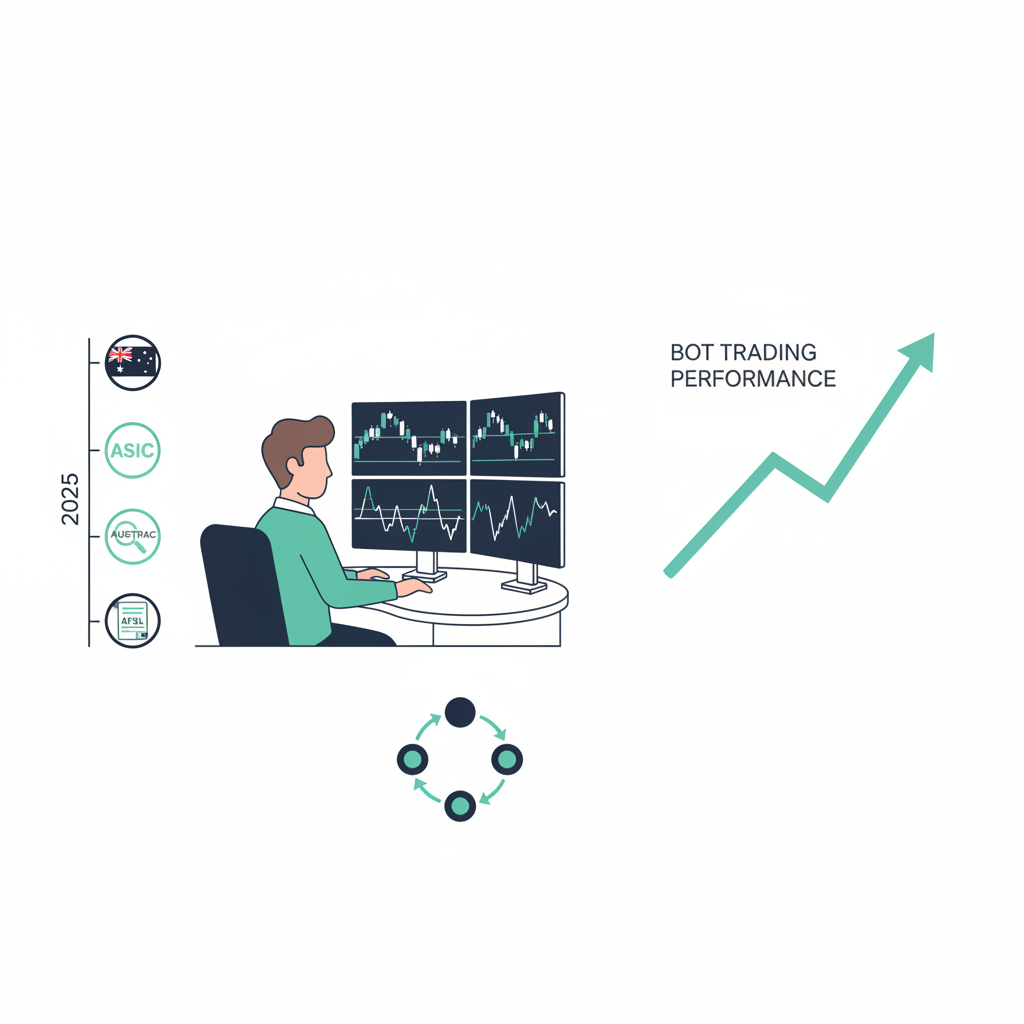
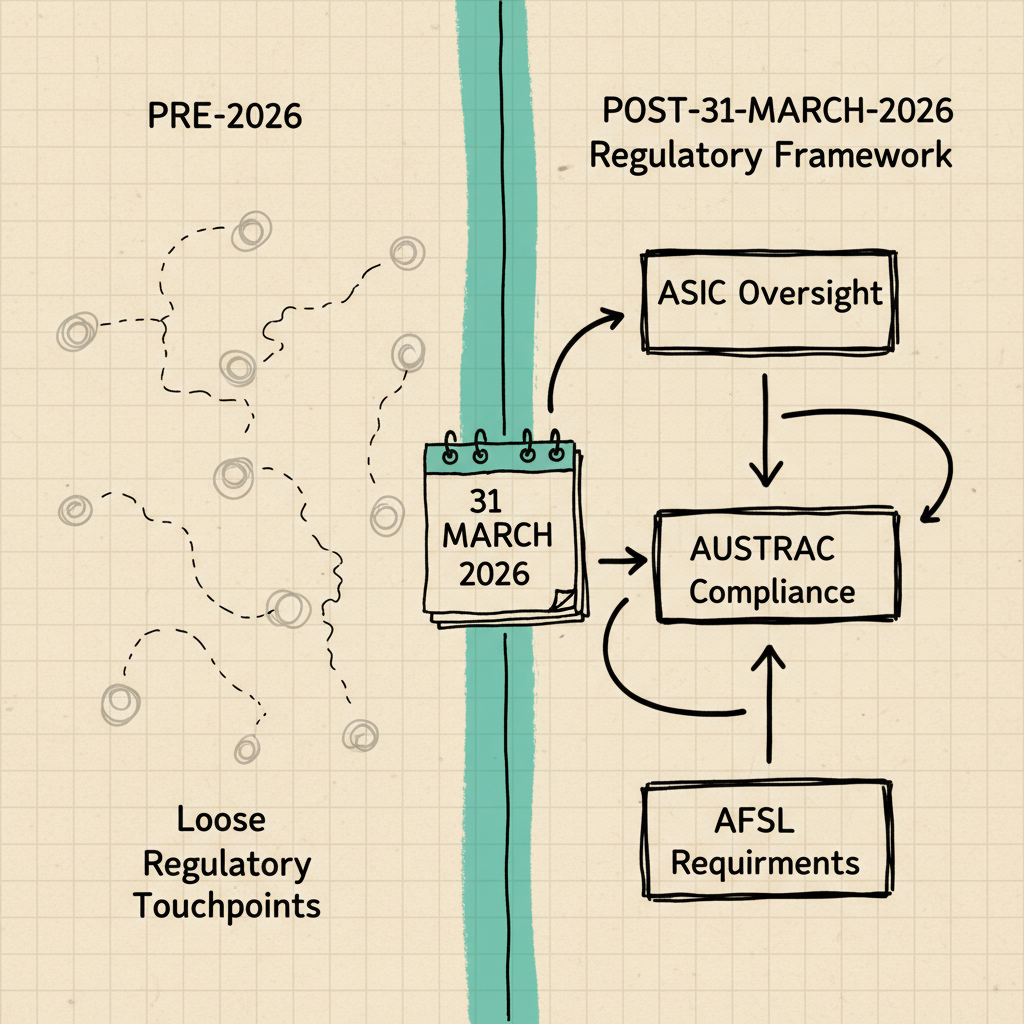
But there’s more to it than setting a bot loose and waiting. ASIC flagged crypto and AI-driven financial services as critical regulatory risks in January 2026. AUSTRAC is expanding its scope to cover all digital asset service providers from 31 March 2026. Draft legislation proposed in November 2025 could require platforms to hold an AFSL. The environment is maturing fast, and traders who understand the rules will be far better positioned than those who don’t.
This guide covers everything: how it works, the legal framework, how the ATO will tax you, and which platforms are actually worth using in 2026.
> TL;DR
> Crypto algo trading Australia is completely legal. Automated bots can run 24/7 via API connections to AUSTRAC-registered exchanges like Swyftx and Digital Surge. Tax treatment hinges on trading frequency — high-volume bot traders are generally assessed on ordinary income, not CGT. ASIC is tightening oversight across the board in 2026, so platform compliance matters more than ever. Top tools include Cryptohopper, QuantConnect, and Altrady for strategy execution, with Australian exchanges providing the API infrastructure.
What Is Crypto Algo Trading in Australia?

Crypto algo trading in Australia refers to the use of coded instructions, running on automated systems, to execute cryptocurrency trades without any manual input at the moment of execution. You define the rules. The algorithm does the work.
At its core, an algo trading setup has three moving parts. First, the strategy logic: a set of conditions that determine when to buy and when to sell — something like “buy ETH when the 20-day moving average crosses above the 50-day moving average.” Second, an API connection to an exchange, which is the bridge that lets your bot actually place orders. Third, the execution engine itself, whether that’s a cloud-based bot platform or code you’ve written and host yourself.
What separates this from manual trading is speed, consistency, and availability. A human trader watching BTC/AUD at 2am is making decisions with tired eyes and shaky conviction. A bot running the same parameters at 2am is doing exactly what it was told to do, no more, no less.
Australian traders have solid access to both global platforms and local exchanges that support automation. AUSTRAC-registered exchanges including Swyftx, Digital Surge, Crypto.com, and CoinSpot all offer API access, which is what bot platforms need to execute trades on your behalf.
The accessibility bar has also dropped considerably. Platforms like Cryptohopper and SpeedBot offer visual, no-code strategy designers where you drag and drop conditions rather than write Python. If you want to go deeper, QuantConnect gives you a full quantitative research environment. There’s a genuine entry point now for traders at every technical level.
[INTERNAL LINK PLACEHOLDER: “AUSTRAC-registered exchanges” → Australian Crypto Exchanges Guide]
Key Benefits of Algorithmic Crypto Trading
The most obvious advantage is speed. In a volatile crypto market, the difference between a good fill and a bad one can be a matter of seconds. Algorithms can respond to market conditions in milliseconds — far faster than any human can read a chart, decide, and click.
The less-talked-about benefit is the emotional cleanliness of it. Manual traders know the feeling: you set a stop-loss at $42,000 BTC, the price drops to $42,050, you convince yourself it’ll bounce, and then it doesn’t. A bot doesn’t have that conversation with itself. It executes the rule.
Crypto markets trade 24 hours a day, every day of the year. That’s both the opportunity and the exhaustion point for manual traders. An automated strategy runs overnight, over weekends, and through public holidays without complaint. This matters particularly for Australian traders, where US and Asian market hours often generate the biggest moves while we’re asleep.
Backtesting is another genuine edge. Before risking a single dollar, you can run your strategy against years of historical price data to see how it would have performed. No guarantees about future results, but it’s a far better starting point than trading on gut feel.
Algorithms also allow you to run multiple strategies across different pairs simultaneously. You might have a trend-following bot on BTC/AUD, a mean-reversion strategy on ETH/AUD, and an arbitrage scanner watching price discrepancies across exchanges, all running in parallel. That kind of multi-strategy deployment is simply not feasible for a single manual trader.
Common Crypto Algo Trading Strategies Explained
Trend-Following
This is the most common strategy for retail algo traders. The idea is straightforward: identify an uptrend using indicators like moving averages or the MACD, enter a long position, and exit when the trend reverses. Many beginners start here because the logic is intuitive and the parameters are easy to backtest. The drawback is that trending markets are the minority — crypto chops sideways more often than most people expect.
Arbitrage
Arbitrage bots exploit price discrepancies for the same asset across different exchanges. If BTC is trading at $95,200 on one exchange and $95,450 on another, an arbitrage bot buys on the cheaper venue and sells on the more expensive one simultaneously. In practice, the windows are narrow and close quickly. Execution speed and transaction costs — including withdrawal fees and network gas — are the critical variables. This strategy is more accessible for institutional players with the capital and infrastructure to act fast, though retail tools like Cryptohopper do include arbitrage modules.
Mean Reversion
Mean reversion strategies bet that prices will return to their historical average after extreme moves. If ETH/AUD spikes 8% in an hour with no news catalyst, a mean reversion bot might short the move, expecting a pullback. The risk in crypto is that “extreme” moves can become even more extreme before reverting — position sizing and stop-losses are non-negotiable here.
Momentum Trading
Momentum algorithms enter positions when price movement accelerates in a particular direction, often confirmed by volume. Unlike trend-following, which looks for established trends, momentum trading is hunting for the initial breakout. These strategies can perform well in volatile markets but suffer badly in choppy, low-volume conditions.
Market Making
A market-making bot places simultaneous limit buy orders below the current price and limit sell orders above it, capturing the spread as other traders fill those orders. This works best in liquid markets with tight spreads. It’s a viable strategy for sophisticated retail traders using platforms like Altrady, though you’re competing with well-capitalised professional market makers on the major pairs.
High-Frequency Trading (HFT)
HFT executes thousands of trades per second, exploiting micro-inefficiencies across order books. True HFT requires co-located servers, institutional-grade infrastructure, and substantial capital. For retail traders, this is largely out of reach. If someone is selling you “HFT for retail,” read the fine print carefully.
Is Crypto Algo Trading Legal in Australia?
Yes, categorically. Cryptocurrency is legal in Australia — individuals can buy, sell, trade, and hold it freely. Algorithmic trading adds no special legal complexity to that baseline. There is no law in Australia that prohibits automated crypto strategies.
That said, the regulatory environment around the broader ecosystem is tightening, and it matters which platforms you use.
ASIC’s 2026 position. ASIC released its oversight strategy on 27 January 2026, explicitly naming cryptocurrencies and AI-driven financial services as critical regulatory risks for the year. The focus is on unlicensed financial services operations and misleading conduct, not on individual traders running bots. ASIC INFO 225 already clarifies how existing financial services laws apply to blockchain and crypto-assets. If a platform is offering financial products or advice, it likely needs an Australian Financial Services Licence (AFSL). Draft legislation from November 2025 proposes extending that AFSL requirement to digital asset platforms more broadly.
AUSTRAC requirements. Any business providing digital currency exchange services in Australia must be registered with AUSTRAC and comply with AML/CTF obligations, including customer identification and transaction monitoring. From 31 March 2026, AUSTRAC’s scope expands to cover all Digital Asset Service Providers (DASPs), not just fiat-to-crypto exchangers. This is relevant for traders because it means the platforms you use will face stricter obligations, which is actually a good thing for consumer protection.
As a trader, the practical implication is simple: use AUSTRAC-registered exchanges. Platforms operating outside this framework expose you to potential account freezes, withdrawal complications, and a lack of recourse if things go wrong.
[INTERNAL LINK PLACEHOLDER: “AUSTRAC-registered exchanges” → Best Australian Crypto Exchanges 2026]
How Crypto Algo Trading Is Taxed in Australia
The ATO classifies cryptocurrency as property and a Capital Gains Tax asset. Every time a bot executes a trade that results in a disposal — selling crypto for AUD, or swapping one crypto for another — that disposal is potentially a taxable event. Your bot might execute 200 trades in a week. Each one of those is on the ATO’s radar.
For most retail investors, profits from crypto disposals are subject to CGT. If you hold an asset for more than 12 months before disposing, you’re entitled to the 50% CGT discount as an individual. This is the standard treatment for someone running a moderate automated strategy with lower trade volumes.
For high-frequency bot traders, the picture changes. The ATO considers trading frequency, volume, and intent when determining whether your activity constitutes a business or investment. Traders executing 10,000 or more trades, or running strategies clearly oriented toward short-term profit-taking rather than long-term investment, are typically assessed as running a trading business. In that case, profits are taxed as ordinary income at your marginal rate, with no 50% CGT discount available. Losses, however, can be offset against other income.
The record-keeping burden for algo trading is significant. You need the AUD market value of every asset at the time of acquisition and at the time of disposal. Manually reconciling that from exchange APIs across hundreds of trades is not a reasonable task. I’d strongly recommend using crypto tax software that connects directly to your exchange API — tools like Koinly or CoinTracking handle Australian tax formatting and ATO-compliant reporting. Alternatively, find an accountant who specifically understands ATO crypto guidance, not just a generalist who’s read the ATO website once.
The ATO’s own guidance on crypto is at ato.gov.au and is worth reading directly. It’s more straightforward than most people expect.
[INTERNAL LINK PLACEHOLDER: “crypto tax Australia” → Crypto Tax Australia: Complete ATO Guide]
Top Crypto Algo Trading Platforms for Australian Traders
Here’s how the market actually breaks down. There are three categories worth considering: dedicated algo and bot platforms, Australian exchanges with API and automation support, and CFD brokers that support automated strategies via MetaTrader or similar.
Dedicated Algo and Bot Platforms
Cryptohopper is the most accessible entry point for most Australian retail traders. It’s cloud-based, which means your bot runs even when your computer is off. The Strategy Designer is genuinely no-code — you build logic with a visual interface rather than writing code. There’s also a marketplace where you can buy or subscribe to pre-built strategies and signals from other traders. Copy trading functionality lets you mirror another trader’s positions. Free tier available, paid plans unlock more simultaneous positions and advanced features.
QuantConnect is the serious end of the spectrum. It’s open-source, built for quantitative researchers, and supports multiple asset classes including crypto. You write strategies in Python or C#, backtest against decades of data, and deploy live to connected exchanges. The learning curve is steep but the depth is unmatched. This is the platform if you want to build something genuinely proprietary.
Altrady is a multi-exchange platform with a solid suite of automation tools: signal bots, a QFL (Quick Fingers Luc) bot for specific reversal setups, and a paper trading mode for testing strategies without real capital. The interface is cleaner than Cryptohopper’s for traders who prefer a trading terminal feel.
SpeedBot sits in the no-code camp alongside Cryptohopper, with a focus on backtesting. It supports multiple asset classes including crypto and lets you build strategies using a drag-and-drop creator. Useful for traders who want to iterate quickly on strategy ideas.
LuxAlgo is different from the others — it’s not a bot platform but an AI-powered indicator and strategy generation tool that integrates with TradingView. If you’re already charting in TradingView and want AI-generated signals feeding into your manual or automated approach, this is worth examining.
Australian Exchanges with API and Automation Support
Swyftx is my primary Australian exchange recommendation for algo traders. It’s AUSTRAC-registered, Australian-owned, supports 420+ assets with AUD pairs, and offers auto-invest features for systematic strategies. I have been using Swyftx since 2022 and the API reliability has been consistently solid. The fee structure is competitive — typically around a 0.6% spread on BTC/AUD — and PayID deposits land in seconds.
Digital Surge is worth considering specifically for its trigger order functionality, which lets you automate conditional trades directly on the exchange without a third-party bot. AUSTRAC-registered, 400+ cryptos, instant PayID deposits. Fees from 0.1% on maker orders.
Crypto.com is AUSTRAC-registered with API access and advanced order types. The platform supports more sophisticated order structures than Swyftx, which matters if you’re running a strategy that requires trailing stops or OCO orders natively on the exchange.
CoinSpot is Australia’s largest exchange by user count and has been AUSTRAC-registered since 2013. It has 510+ cryptocurrencies. API access exists but the documentation is less developer-friendly compared to the alternatives above. Better for buy-and-hold automation than active algorithmic strategies.
CFD Brokers for Algo Traders
A quick but important distinction: CFD brokers let you trade derivatives that track crypto prices, not actual cryptocurrency. You don’t own the underlying asset. This has different tax treatment and different risk characteristics.
Eightcap is an ASIC-regulated Australian broker with 95+ crypto CFDs. It supports automation via MT4 and MT5, and has deep TradingView integration. Solid choice if you want to run Expert Advisors or Pine Script strategies on crypto without managing actual exchange wallets.
IC Markets is another ASIC-regulated option with ultra-low spreads and fast execution. Expert Advisors work well here. If you’re running a high-frequency strategy where spreads are a meaningful cost, IC Markets is worth benchmarking against Eightcap.
Capital.com has an AI assistant built into the platform and MetaTrader integration. No commissions on CFDs. The AI features are genuinely useful for idea generation, though they’re not a substitute for your own strategy logic.
Platform Comparison Table
| Platform | Type | AUSTRAC / ASIC Regulated | API / Bot Support | No-Code Option | Key Feature | Best For |
|---|---|---|---|---|---|---|
| Cryptohopper | Bot Platform | No (global) | Yes | Yes | Strategy marketplace | Retail beginners to intermediate |
| QuantConnect | Algo Platform | No (global) | Yes | No | Open-source quant research | Advanced / institutional |
| Altrady | Bot Platform | No (global) | Yes | Partial | Multi-exchange, paper trading | Intermediate traders |
| SpeedBot | Bot Platform | No (global) | Yes | Yes | No-code + backtesting | No-code strategy builders |
| LuxAlgo | Indicator/AI Tool | No (global) | Via TradingView | Yes | AI-generated signals | TradingView users |
| Swyftx | Exchange | AUSTRAC | Yes | Auto-invest | AUD-first, 420+ assets | Australian retail traders |
| Digital Surge | Exchange | AUSTRAC | Yes | Trigger orders | Trigger orders, PayID | Automation on local exchange |