Crypto Algo Trading Australia 2026: Platforms, Bots & What You Need to Know
Crypto algo trading in Australia has moved well past the hobbyist phase. In 2026, you have Australian-registered AI platforms executing millions of trades, a federal licensing framework that just cleared parliament, and the ATO sitting firmly in the loop on every swap your bot makes. If you are still running manual trades while your exchange offers a grid bot, or you have heard about these tools but are not sure what is legal and what is not, this guide covers everything you actually need to know.
> TL;DR
> Crypto algo trading Australia is legal but increasingly regulated. As of 2026, new ASIC licensing rules and AUSTRAC VASP registration requirements apply to platforms and bots operating here. This guide covers the top platforms, how bots are taxed by the ATO, what Australian banks allow, key risks, and how to compare your options.
What Is Crypto Algo Trading in Australia?
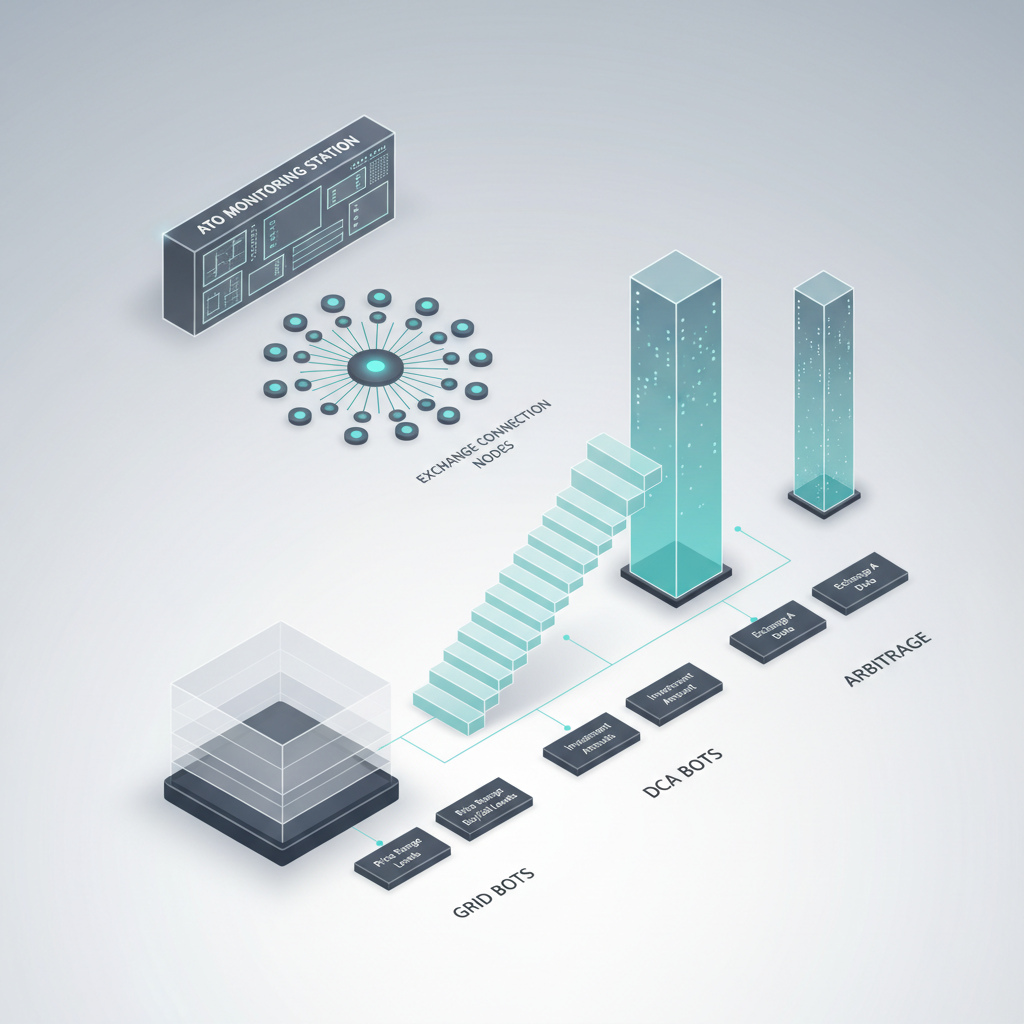
Crypto algo trading Australia refers to the automated execution of buy and sell orders based on pre-set rules or AI-driven strategies, without you manually clicking through a trade each time. The algorithm watches price movements, volume, or other signals and fires orders when its conditions are met. At its most basic, that might be a grid bot buying every time BTC drops $500 and selling when it rises $500. At the more complex end, it is a quantitative strategy trained on historical data and adjusting dynamically to market conditions.
It helps to be clear on the three distinct categories in this space, because Australians are being sold all three under similar-sounding names.
First, there are algo trading platforms: services that run strategies directly, often with their own infrastructure. SaintQuant is a current Australian example. Second, there are third-party bots that connect to an exchange you already use via API, executing trades on your behalf. Bitsgap is the underlying platform here, and several Australian-facing services have built products on top of it. Third, there are educational courses that teach you how to set bots up yourself. cryptoresults.com.au’s Bitsgap Accelerator sits in this category.
The distinctions matter because ASIC, AUSTRAC, and the ATO treat these differently. A platform executing live trades may have licensing obligations. A course teaching you to run your own bot probably does not constitute a financial service, but that also means it comes with less consumer protection. Growing retail interest and the new 2026 regulatory framework have made Australia one of the more active markets for this kind of automation, and the major exchanges including Binance, Bybit, Kraken, and KuCoin all offer API access that underpins most of these tools.
Top Crypto Algo Trading Platforms and Bots Available in Australia (2026)
SaintQuant
SaintQuant launched on 2 May 2026 as an Australian-registered AI-driven quantitative trading platform. It offers a free AI crypto trading bot for retail investors, which is notable given that most comparable services charge monthly subscription fees. As of launch it had already executed over 4 million trades for more than 150,000 active traders globally, with over 10 quantitative strategies available. It connects to eight major exchanges via API, with read-and-trade permissions only, meaning no withdrawal access. That is a sensible security architecture that more platforms should copy.
cryptoresults.com.au — Bitsgap Accelerator
This is not a trading platform. It is a course, and being clear about that upfront is important. Cryptoresults.com.au sells a program called the Bitsgap Accelerator, currently priced at $1,497, designed to teach you how to set up and optimise Bitsgap bots yourself. It includes step-by-step video lessons, guidance on coin pair selection, capital protection strategies, and timing bot launches. The community has over 200 members, with live weekly Q&A sessions. Trustpilot gives it 4.5 out of 5 from 51 reviews.
Worth noting: some reviews flag that the course is mostly pre-recorded and that the “passive income” framing oversells the reality. Bots still need monitoring, and falling crypto prices can eat gains faster than any bot can compensate. It is also explicitly independent of Bitsgap — no official affiliation with the platform it teaches. Business name SCMF is associated with it. Given the significant price drop from a reported AUD $7,200 in early 2024 to $1,497 now, it appears to be repositioning itself in a more competitive market.
Cryptohopper
An international bot with AI features and copy trading, accessible to Australians via API connections to major exchanges. It supports a wider range of exchanges than most and has been around long enough to have a track record. Not Australian-registered, so AUSTRAC and ASIC status should be independently verified.
CryptoRobotics
Another AI-driven bot available to Australian traders. Less prominent in the Australian market than SaintQuant or Cryptohopper but worth knowing exists if you are comparing options.
Exchange-Native Bot Tools
Binance, Bybit, Kraken, and KuCoin all offer built-in bot or algorithmic trading tools directly within their platforms. Binance grid bots and Bybit’s strategy trading tools are the most commonly used in Australia. These are simpler to set up than third-party solutions and reduce the risk surface of handing API keys to an external service.
Alpaca Trading and Interactive Brokers Australia
For traders who want algo strategies across a broader asset class including crypto, Alpaca and Interactive Brokers Australia both offer programmatic trading APIs. These skew toward more technically sophisticated users writing their own code.
Platform Comparison Table: Crypto Algo Options for Australians
A note before you use this table: regulatory status changes. Verify AUSTRAC registration independently using the public VASP register at austrac.gov.au before depositing funds with any platform.
| Platform / Service | Type | Cost | Exchanges Supported | AUSTRAC / ASIC Status | Beginner-Friendly | Key Feature |
|---|---|---|---|---|---|---|
| SaintQuant | Live algo platform | Free | 8 (incl. Binance, Bybit, OKX, KuCoin, Bitget, BingX) | Australia-registered; VASP status — verify independently | Moderate | 10+ quant strategies, no withdrawal API access |
| cryptoresults.com.au — Bitsgap Accelerator | Educational course | $1,497 one-off | N/A (teaches Bitsgap setup) | Not a financial service; no AFSL/VASP applicable | Moderate (not ideal for complete beginners) | 200+ member community, live Q&A |
| Cryptohopper | Third-party bot | From ~USD $19/month | 15+ exchanges | Non-Australian; verify independently | Moderate | AI strategy + copy trading |
| CryptoRobotics | Third-party bot | Free tier + paid plans | Major exchanges | Non-Australian; verify independently | Moderate | AI bot with strategy marketplace |
| Binance (grid bots) | Exchange-native bot | Trading fees only (0.1% standard) | Binance only | AUSTRAC VASP — verify register | Yes | Built-in grid and DCA bots |
| Bybit (strategy trading) | Exchange-native bot | Trading fees only | Bybit only | AUSTRAC VASP — verify register | Yes | Grid, DCA, and options bots |
| Alpaca Trading | API trading platform | Free (pay per trade) | US equities + some crypto | Non-Australian; no AFSL | No — requires coding ability | Commission-free equity algo trading |
ASIC and AUSTRAC: 2026 Regulatory Rules for Crypto Algo Trading
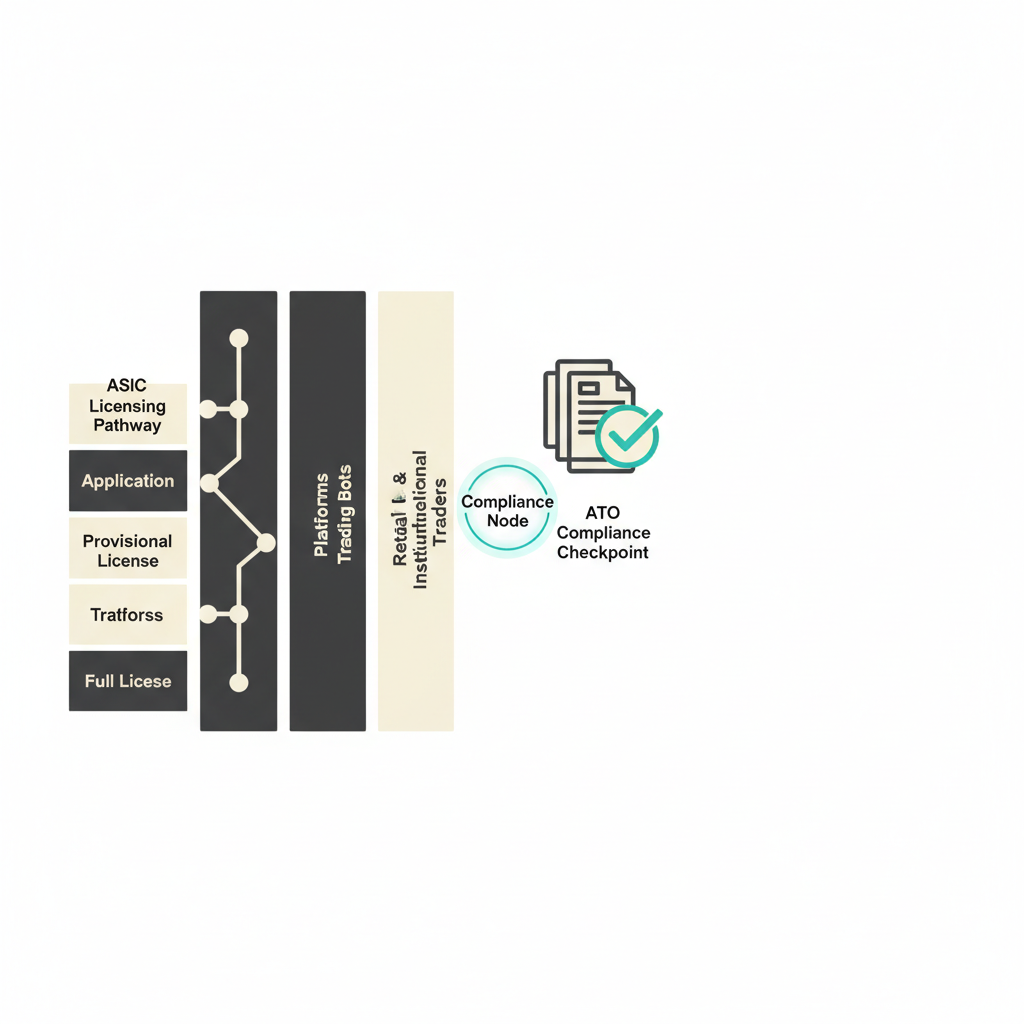
Australia now has the most significant crypto regulatory change in its history sitting on the books. Parliament passed the country’s first full crypto regulation framework in April 2026. From that point, all exchanges and custody providers have six months to apply for an Australian Financial Services Licence, with the new regime fully active from April 2027. That puts digital asset platforms under the same licensing rules as fund managers and brokers, which is a substantial shift from the previous informal oversight.
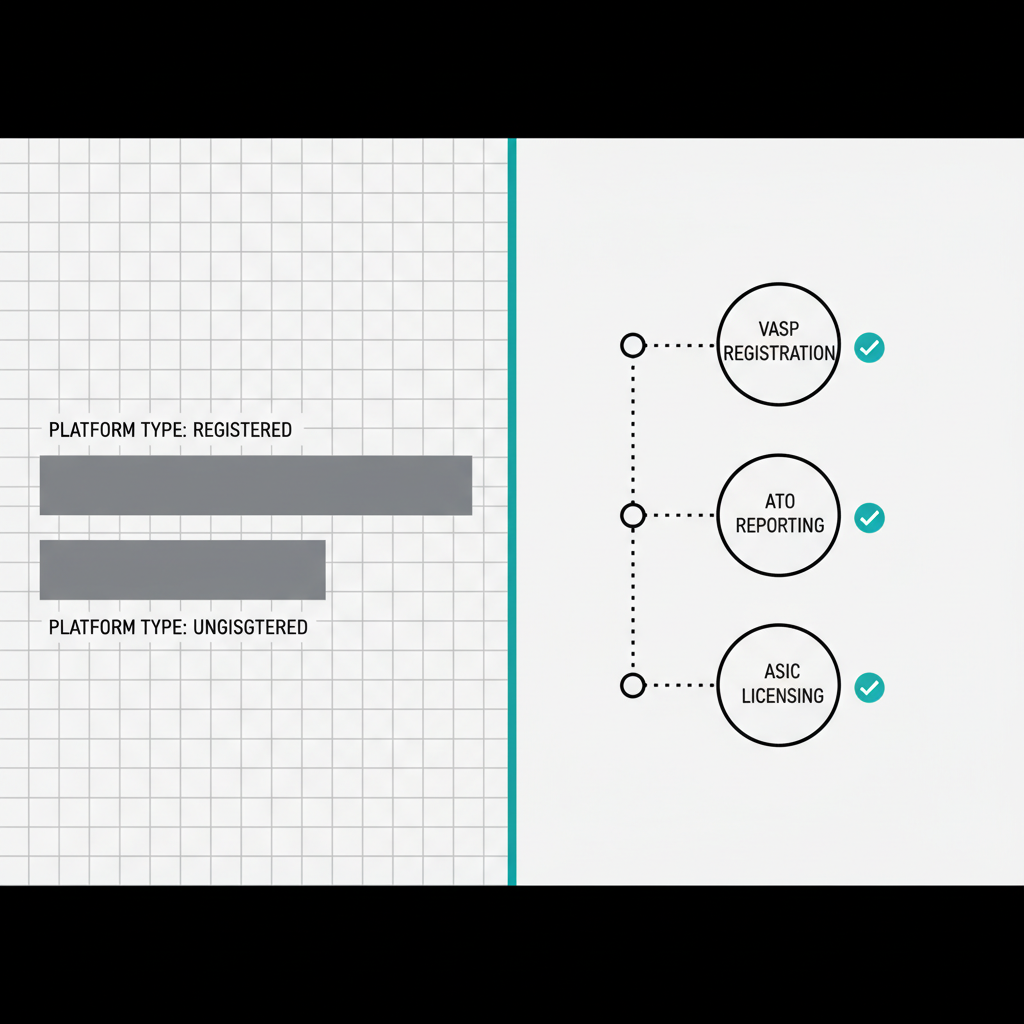
Separately, AUSTRAC’s expanded AML/CTF laws came into effect on 31 March 2026. The old terminology of Digital Currency Exchange provider has been replaced by Virtual Asset Service Provider, or VASP. There is now a searchable public register of VASPs on the AUSTRAC website, and operating without registration is a criminal offence. The practical implication for anyone considering an algo trading platform: search the register before you move money. Takes two minutes, could save you everything.
The question of whether a specific algo trading platform or bot falls under these rules is not always straightforward. If a platform facilitates crypto transactions on behalf of users, it may need VASP registration. If it constitutes the provision of a financial product or service, ASIC’s AFSL obligations kick in. SaintQuant, being Australian-registered, is the clearest case to evaluate. For offshore bots, the obligation to comply with Australian law technically still applies if they are servicing Australian residents, but enforcement is harder.
Educational courses like the Bitsgap Accelerator sit outside financial services regulation. Teaching someone to operate their own bot is not the same as operating one for them. That distinction reduces compliance overhead for course providers but also means no Australian consumer protection framework applies if things go wrong.
The ASIC scam crackdown is worth mentioning here. ASIC has been aggressively closing investment scam websites, including crypto schemes. In February 2024 the Australian Cybercrime Squad charged a man over a $3.5 million crypto fraud. Retail interest in algo trading makes it a natural magnet for scammers promising guaranteed returns. Any platform advertising consistent double-digit monthly returns from bots should be treated with significant scepticism.
[INTERNAL LINK PLACEHOLDER: “AUSTRAC VASP registration” → AUSTRAC compliance guide pillar]
ATO Tax Rules for Crypto Algo and Bot Trading in Australia
This is where a lot of Australian bot traders get surprised, usually unpleasantly.
The ATO treats cryptocurrency as a CGT asset by default. When you dispose of crypto, including swapping one coin for another, that is a taxable event. Your bot executing a trade between USDT and ETH is a disposal. If your bot runs 500 trades a month, that is 500 taxable events a month, each requiring a recorded cost base, disposal proceeds, and calculated gain or loss.
The 12-month CGT discount, which reduces your taxable gain by 50% if you held the asset for over a year, is theoretically available but practically irrelevant for most algorithmic crypto trading Australia scenarios. Bots designed to capitalise on short-term price movements rarely hold assets that long. If you are running a grid bot with a two-day cycle, you are not getting that discount.
High-frequency bot traders are at risk of being reclassified by the ATO as running a trading business rather than investing. The threshold is not firmly defined in legislation, but traders executing thousands of trades annually are the ATO’s clearest examples of business activity. That matters because business income is taxed as ordinary income at your marginal rate, with no CGT discount available at all, but losses become deductible against other income.
The ATO data-matching programme means the exchanges are reporting your activity whether you declare it or not. AUSTRAC registration requirements have increased the formal obligations on exchanges, and that data flows to the ATO. The days of ignoring crypto gains on a tax return were already numbered before 2026 and are firmly over now.
Practically, running a bot that executes hundreds or thousands of trades through the year means you need proper record-keeping software. Koinly and CryptoTaxCalculator both integrate with the major exchanges via API and will generate an ATO-compatible tax report. I would not attempt to reconcile thousands of bot trades manually in a spreadsheet. The API import takes an afternoon to set up and saves weeks at tax time.
For high-frequency trading scenarios specifically, speaking to a tax accountant who has dealt with crypto trading clients is worth the cost. The difference between correct and incorrect classification can be substantial.
[INTERNAL LINK PLACEHOLDER: “crypto tax Australia” → crypto CGT guide pillar]
Frequently Asked Questions
Is crypto algo trading legal in Australia?
Yes, it is legal. Australian residents can use algo trading bots and platforms. The legal obligations fall primarily on the platforms themselves, which must comply with AUSTRAC’s VASP registration and, from April 2027, ASIC’s AFSL requirements. As a user, your main obligations are tax-related: declaring all disposals to the ATO regardless of whether they were made manually or by a bot.
Do I need to register with AUSTRAC if I run my own crypto bot?
Generally no, if you are trading your own funds. AUSTRAC obligations apply to businesses providing virtual asset services to others. Running a personal algo bot on your own exchange account does not make you a VASP. The platforms and exchanges you connect to need to be registered.
How are crypto bot profits taxed by the ATO?
Each trade your bot executes is a taxable disposal. For most bot traders, profits are assessed as capital gains. If the ATO determines you are running a trading business, gains are treated as ordinary income. Crypto tax software like Koinly or CryptoTaxCalculator can pull your trade history directly from exchange APIs and calculate your tax position.
What is the Bitsgap Accelerator and is it worth it?
The Bitsgap Accelerator is a course by cryptoresults.com.au that teaches you to set up and manage Bitsgap trading bots. At $1,497 it is a meaningful upfront cost. It has a 4.5/5 Trustpilot rating from 51 reviews, a 200-member community, and weekly Q&A sessions. It is not affiliated with Bitsgap directly and is not a financial service. Whether it is worth it depends heavily on how much capital you are deploying. At a small account size, bot gains may not justify the course cost for some time.
Is SaintQuant regulated in Australia?
SaintQuant is registered in Australia and launched in May 2026. For the most current AUSTRAC VASP registration status, check the public register at austrac.gov.au directly. The platform uses read-and-trade API permissions only, meaning it cannot withdraw funds from your exchange accounts.
Which Australian banks allow transfers to crypto algo trading platforms?
The major banks (CBA, ANZ, NAB, Westpac) permit transfers to registered crypto exchanges but do not allow direct crypto purchases within their banking apps. CBA enforces a $10,000 monthly limit on payments to crypto exchanges and may impose a 24-hour hold on first transfers. If you are funding a bot through an exchange, bank transfers or PayID to that exchange are the standard route. Banks monitor these transactions.
Can a crypto bot run at a loss and reduce my tax?
Yes. If your bot trades result in a net capital loss, that loss can be used to offset capital gains in the same or future financial years. It cannot be offset against other income (like salary) unless the ATO classifies you as running a trading business. Losses still need to be declared and recorded accurately.
CryptoAlgo may earn a commission if you sign up through links on this page. This does not affect our editorial independence — we only recommend platforms we have actually used and would recommend to a mate. This article is general information, not financial advice. Crypto is volatile and you can lose money. Always do your own research and consider speaking to a licensed Australian financial adviser before investing.