Crypto Algo Trading in Australia: Complete Guide for 2026
Crypto algo trading in Australia has moved well past the “enthusiast only” phase. Everyday traders are running bots on Binance, backtesting moving-average strategies in Freqtrade, and waking up to completed trades they set in motion the night before. If you have been curious about automating your crypto strategy but are not sure where to start, or what the ATO thinks about it, this guide covers everything you need to know.
> TL;DR: Crypto algo trading in Australia lets you automate buy and sell orders using pre-set rules or bots. It is legal, increasingly popular, and available on platforms accessible to Australian residents. Key considerations include choosing a regulated exchange, understanding your CGT obligations, and selecting a strategy that suits your actual risk profile.
What Is Crypto Algo Trading in Australia?

At its core, crypto algo trading is the automated execution of buy and sell orders based on a coded set of rules. Instead of manually watching charts and placing trades, you define a strategy, connect it to an exchange via API, and let software handle the execution. The strategy might be simple (“buy when the 50-day MA crosses above the 200-day MA”) or deeply complex, involving multiple indicators, position sizing formulas, and dynamic risk controls.
The distinction between fully automated, semi-automated, and manual algo approaches matters. A fully automated bot runs without any input once it is live. A semi-automated setup might generate signals that you still approve before execution. Manual algo strategies, which some traders overlook, involve following a clearly defined rule set yourself, without software. All three are valid, and which one suits you depends on your technical skills and how much time you want to spend monitoring.
Australian traders have been gravitating toward automated approaches for a few practical reasons. The AUD/USD time zone problem is real: peak volatility on BTC and ETH often occurs during US market hours, which is the middle of the Australian night. Automation solves that. Crypto markets also run 24 hours a day, seven days a week, with no close, no circuit breakers, and no lunch break. Human traders cannot compete with that schedule. Bots can.
Australian tax and regulatory context applies throughout all of this. Every automated trade can be a CGT event under ATO rules, and the platform you choose needs to be accessible under Australian law. Both topics get their own sections below.
[INTERNAL LINK PLACEHOLDER: “CGT event” → /tax/crypto-cgt-australia]
How Crypto Algorithmic Trading Works: A Plain-English Breakdown
The basic flow has four stages: data in, signal generated, order placed, position managed.
Your bot or platform connects to an exchange’s market data feed, pulling in real-time price information, order book depth, and trade history. The strategy logic then processes that data, looking for conditions that match its rules. When a condition is met, a signal is generated and an order is sent to the exchange via API. From there, the risk management layer monitors open positions, triggering stop-losses, take-profit orders, or position scaling as required.
Strategy logic is where you define what triggers a trade. Risk management rules determine how large each position is and when to exit. A backtesting engine lets you run your strategy against historical price data to see how it would have performed, before you risk real money.
The API connection is the plumbing. Exchanges like Independent Reserve and Binance issue API keys that give your bot permission to place orders on your behalf. You set the permissions carefully, usually restricting to trading only, with no withdrawal rights, to limit exposure if a key is ever compromised.
Before going live, paper trading (or sandbox testing) is worth taking seriously. Several bot platforms offer a simulation mode where trades are logged but no real capital is moved. Running paper trades for two to four weeks gives you a realistic read on whether your live performance matches your backtest. Spoiler: it usually does not match exactly, and knowing that gap ahead of time is valuable.
A simple way to picture the flow: market data → strategy checks conditions → signal fires → API sends order to exchange → risk rules manage the open trade → trade closes → result logged for tax purposes.
Popular Algo Trading Strategies Used by Australian Crypto Traders
Trend Following
This is the most common starting point. The idea is straightforward: identify a directional move and ride it. Moving average crossovers are the classic implementation. A bot using a 50/200-day MA crossover buys when the short MA crosses above the long MA and sells when it crosses back below. Momentum indicators like RSI above 50 or MACD signal line crossovers are often layered on top. Trend following works well in strongly directional markets, which crypto provides often enough to be useful, but gets chopped up badly in sideways conditions.
Mean Reversion
Where trend following assumes price will keep moving in one direction, mean reversion assumes it will snap back. Bollinger Band strategies, for instance, buy when price touches the lower band and sell near the mean. RSI-based strategies buy when RSI drops below 30 and exit when it recovers above 50. Mean reversion suits ranging markets but can be brutal during genuine breakouts. Knowing which market regime you are in is half the battle.
Arbitrage
Arbitrage exploits price differences for the same asset across different exchanges. BTC/AUD pricing on Independent Reserve is occasionally a few dollars off from Kraken’s BTC/USD equivalent when converted. The window is usually small and closes fast, so execution speed matters enormously. Triangular arbitrage, where you exploit pricing inefficiencies within a single exchange across three trading pairs, is another variant some Australian traders pursue. It is harder to execute than it looks in backtests.
Grid Trading and DCA Bots
Grid trading automates a buy-low-sell-high approach within a defined price range. You set an upper and lower price band, the bot places a ladder of limit orders throughout that range, and profits accumulate from the spread as price oscillates. Platforms like Pionex have this built in natively.
Dollar-cost averaging bots are arguably the most accessible entry point for Australian traders who want automation without complexity. A DCA bot places regular buys at set intervals regardless of price, removing emotional timing decisions. For passive, long-horizon investors, this is low-maintenance and tax-efficient when held beyond 12 months, assuming the asset qualifies for the CGT discount.
Market Making
Placing limit orders on both sides of the order book to capture the spread is market making. It is sophisticated territory, requiring deep understanding of order book dynamics, inventory risk, and exchange fee structures. It is worth mentioning as a strategy category, but for most Australian retail traders this is not the right starting point.
Best Platforms and Tools for Crypto Algo Trading in Australia
Exchange-Native Options
Independent Reserve is the standout for Australian-based algo traders who want a local, AUSTRAC-registered exchange with a reliable API. The REST and WebSocket APIs are well-documented, latency to Sydney servers is low, and AUD deposits via PayID are fast. I have been using their API endpoints for strategy testing since late 2022 and rarely hit rate limit issues during normal trading hours.
CoinSpot is popular for casual buyers but its API capabilities are limited for algo purposes. You can place and cancel orders, but the depth of market data available programmatically is thin compared to what Binance or Independent Reserve offer. If your strategy needs real-time order book data, CoinSpot will frustrate you.
Post-2023, Binance Australia’s fiat on-ramp situation changed after the Binance AUSTRAC settlement and the departure of their Australian banking partners. Direct AUD deposits became unreliable for a period. As of 2024, some traders route through third-party payment providers, but it adds friction. Binance’s API is excellent, the liquidity is deep, and the range of pairs is unmatched, but you need to factor in the access complications.
Third-Party Bot Platforms
3Commas connects to multiple exchanges via API and gives you access to DCA bots, grid bots, and signal-based trading. The interface is accessible for non-coders. Pricing starts around USD $29/month, which is not nothing, but the time saving is real if you are running multiple strategies.
Pionex is an exchange with 16 free built-in trading bots. The grid bot is particularly well-implemented. For Australian traders, KYC is required and AUD deposits are not direct, but USDT deposits from another exchange work reliably.
Cryptohopper offers a cloud-based bot with a visual strategy editor, making it more accessible for traders who are not comfortable with code. The backtesting is decent, though not as granular as running Freqtrade locally.
Open-Source and Code-First Options
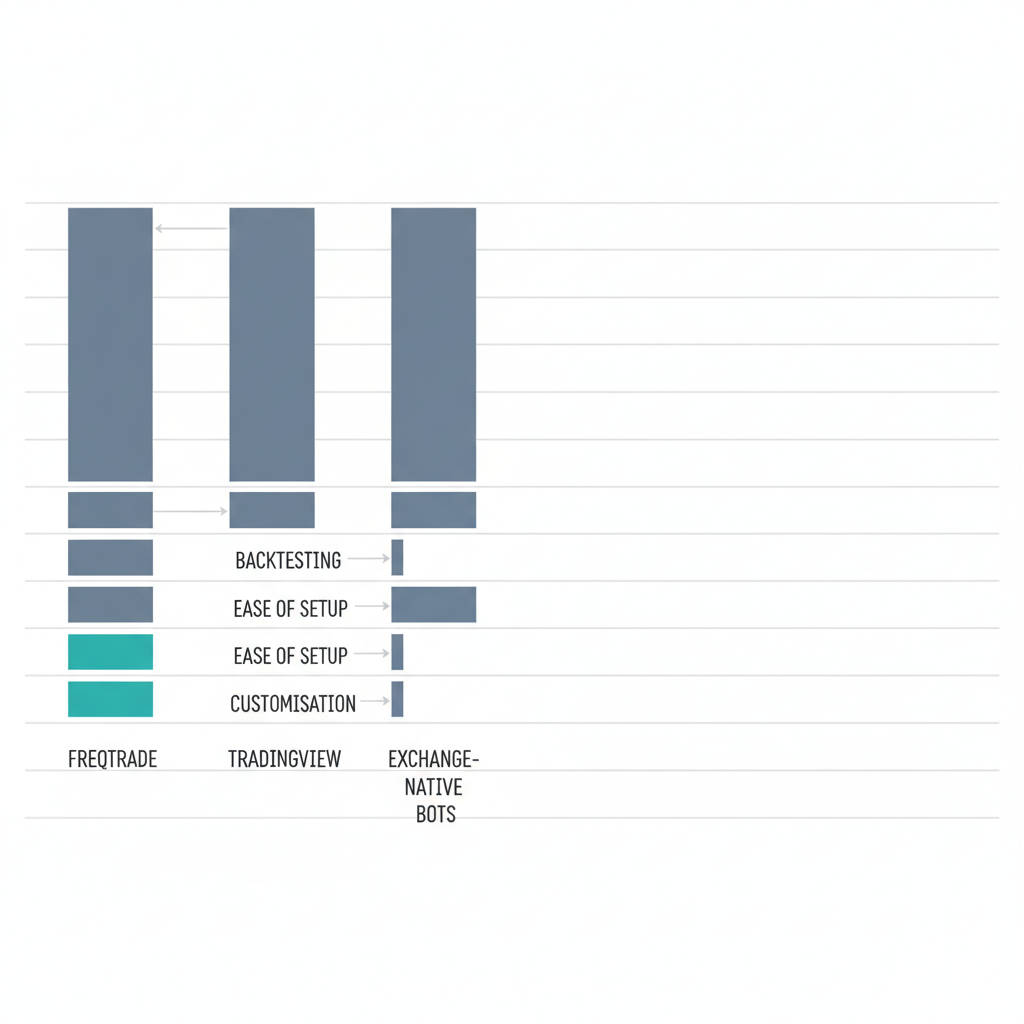
Freqtrade is the most capable free, open-source crypto bot framework available to Australian traders. It runs on Python, supports backtesting with detailed metrics including Sharpe ratio and max drawdown, and connects to most major exchanges via the CCXT library. The learning curve is real but the control you get is worth it if you have any Python background.
The Jesse framework is a newer alternative with a cleaner syntax, designed specifically for crypto strategy development and backtesting. It is less mature than Freqtrade but gaining ground.
Key criteria when choosing a platform for Australian use: AUD deposit support (or a clean USDT pathway), low API latency, documented rate limits, and full KYC/AML compliance. Some international bot-as-a-service platforms have quietly geo-restricted Australian users following ASIC guidance on unlicensed financial services. Check before you subscribe.
[INTERNAL LINK PLACEHOLDER: “best crypto trading bots Australia” → /bots/best-crypto-trading-bots-australia]
Australian Tax Implications of Algo Trading Crypto
This section is the one most Australian algo traders underestimate until tax time arrives.
The ATO treats crypto as property, not currency. Every disposal of a crypto asset is a CGT event. That includes every sell order, every trade from one crypto to another, and every swap executed by your bot. If your grid bot completes 200 trades in a week, you have 200 CGT events to account for. This is not hypothetical. It is how the ATO has consistently ruled, and automated trading does not create any carve-out.
The trading stock question is significant. If the ATO determines that your algo trading activity constitutes carrying on a business or treating crypto as trading stock rather than as an investment asset, the tax treatment changes. Instead of CGT rules applying, ordinary income tax applies to profits. The 12-month CGT discount, which reduces your taxable gain by 50% for assets held over a year, is not available on assets classified as trading stock. High-frequency strategies that cycle in and out of positions rapidly are more likely to attract this characterisation. There is no hard threshold, but frequency, intent, and organisation of the activity are all factors the ATO considers.
For most retail algo traders running a grid bot or DCA strategy with moderate frequency, CGT treatment applies. The 12-month discount is rarely accessible for short-term algo strategies regardless, because positions are typically held days or weeks, not years.
Transaction records are not optional. Bots generate trade logs, and most platforms, including 3Commas, Pionex, and Freqtrade, export CSV files that can be fed directly into tax software. Set this up from day one.
For crypto tax calculation, three tools dominate the Australian market. Koinly has the most polished UI and handles complex DeFi and bot trading histories well. CryptoTaxCalculator is built by an Australian team and has strong ATO-specific rule logic. CoinTracker is a solid alternative. All three import from major exchanges and most bot platforms.
Consulting a crypto-aware Australian accountant before you scale up is genuinely worth the fee. Not all accountants understand the trading stock vs. CGT distinction or know how to handle hundreds of automated transactions. Find one who does.
[INTERNAL LINK PLACEHOLDER: “crypto tax Australia” → /tax/crypto-tax-australia-guide]
Regulation and Legal Considerations for Australian Algo Crypto Traders
Crypto is legal in Australia. Algo trading crypto for your own account requires no specific licence or government registration. That is the simple version, and it is accurate for the majority of retail traders reading this.
The broader regulatory picture is worth understanding. ASIC oversees market integrity and investor protection in Australia’s financial markets. AUSTRAC handles anti-money laundering and counter-terrorism financing obligations, and requires crypto exchanges operating in Australia to register. You, as an individual trader using a registered exchange, are not required to register with AUSTRAC.
Where it gets more complex: if you develop an algo trading strategy or bot and offer it as a service to other people, taking fees or a cut of profits, you may be providing a financial service under the Corporations Act. That potentially requires an Australian Financial Services Licence (AFSL). Running signals for a fee without appropriate licensing is an area ASIC has shown increasing interest in. If you are moving from personal trading into anything resembling a managed account or signals service, get legal advice first.
Market manipulation via algorithms is illegal under the Corporations Act. Wash trading (placing matching buy and sell orders to create artificial volume) and spoofing (placing large orders with no intention of filling them to move price) are prohibited. These rules apply to crypto markets, not just traditional securities.
Australia’s regulatory framework for digital assets was in active development throughout 2023 and into 2024. The government’s token mapping exercise and the consultation on a Digital Assets framework signal that more formal regulation is coming. The direction is toward bringing crypto exchanges under a licensing regime similar to traditional financial services. For algo traders, the practical impact will primarily be felt at the exchange level, not in how you personally operate your strategy.
Risks of Crypto Algo Trading Every Australian Should Know
Backtesting Looks Better Than Reality
Overfitting is the most common trap. You build a strategy, run it over three years of historical BTC data, and it shows a 200% return with a Sharpe ratio of 2.1. Then it goes live and loses money in the first month. What happened is that you tuned the parameters to the historical data so precisely that the strategy learned noise, not signal. The fix is out-of-sample testing: reserve a chunk of historical data that you never use during optimisation, and test against that separately.
API and Exchange Downtime
Exchange APIs go down. Rate limits get hit. During high-volatility events, exchanges have historically struggled under load, right at the moment your bot most needs to execute. An open position with a bot that cannot reach the exchange is a real risk. Most robust algo setups include fallback logic and alerting so you know immediately if a connection drops.
Security: API Key Theft
Your API keys are credentials. If someone gets access to them, they can trade your account. Restrict keys to trade-only permissions, never enable withdrawals via API, store keys in environment variables rather than in code files, and use IP whitelisting where the exchange supports it.
Market Liquidity and Thin Markets
Algos running on lower-cap altcoin pairs can amplify losses when liquidity dries up. A strategy that performs well on BTC/USDT with deep order books may behave very differently on a thinly traded pair where your own orders move the price.
Over-Automation
There is a psychological risk in setting a bot running and then ignoring it. Markets change regime, BTC enters a macro bear trend, and a strategy optimised for ranging conditions keeps buying dips all the way down. Active monitoring, even of automated strategies, is not optional. Check in daily. Set alerts.
Start small. Allocate capital you can afford to lose entirely while you learn how your strategy behaves in live conditions.
How to Get Started with Crypto Algo Trading in Australia: Step-by-Step
Step 1: Choose a regulated exchange with API access.
For Australian traders, Independent Reserve is the most straightforward option: AUSTRAC-registered, AUD support, solid API documentation. If you need broader pair selection, Binance is the other serious option, with the access caveats noted above.
Step 2: Select your tools.
If you have Python skills, start with Freqtrade. It is free, powerful, and has a large community. If you want a no-code starting point, Pionex or 3Commas are the most accessible options for Australians.
Step 3: Define your strategy and risk parameters.
Before writing a line of code or configuring a bot, write down in plain English exactly what your strategy does, what triggers an entry, what triggers an exit, how large each position is, and what your maximum drawdown tolerance is. If you cannot explain it clearly in writing, you cannot implement it correctly.
Step 4: Backtest on historical data.
Use at least 12 months of data, preferably two to three years if available. Review Sharpe ratio, maximum drawdown, win rate, and average trade duration. Then run it on out