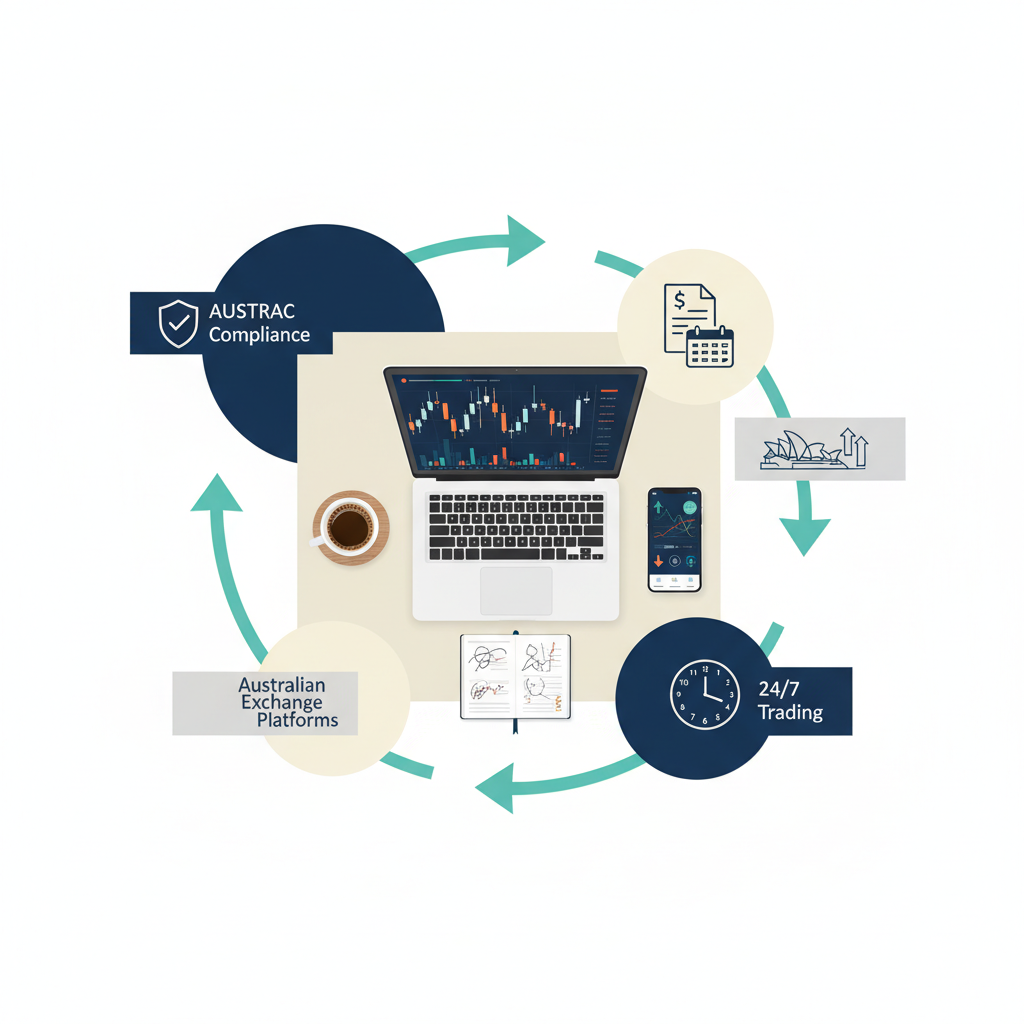
Crypto Algo Trading Australia: Your Complete 2026 Guide
If you have typed “crypto algo trading Australia” into Google at 2am while watching a bot misfire on a BTC/AUD position, this guide is for you. I have been running automated strategies on Australian exchanges since 2022, and the landscape in 2026 looks meaningfully different from what most outdated guides describe. New regulation, new platforms, new tax traps. Let’s get into it.
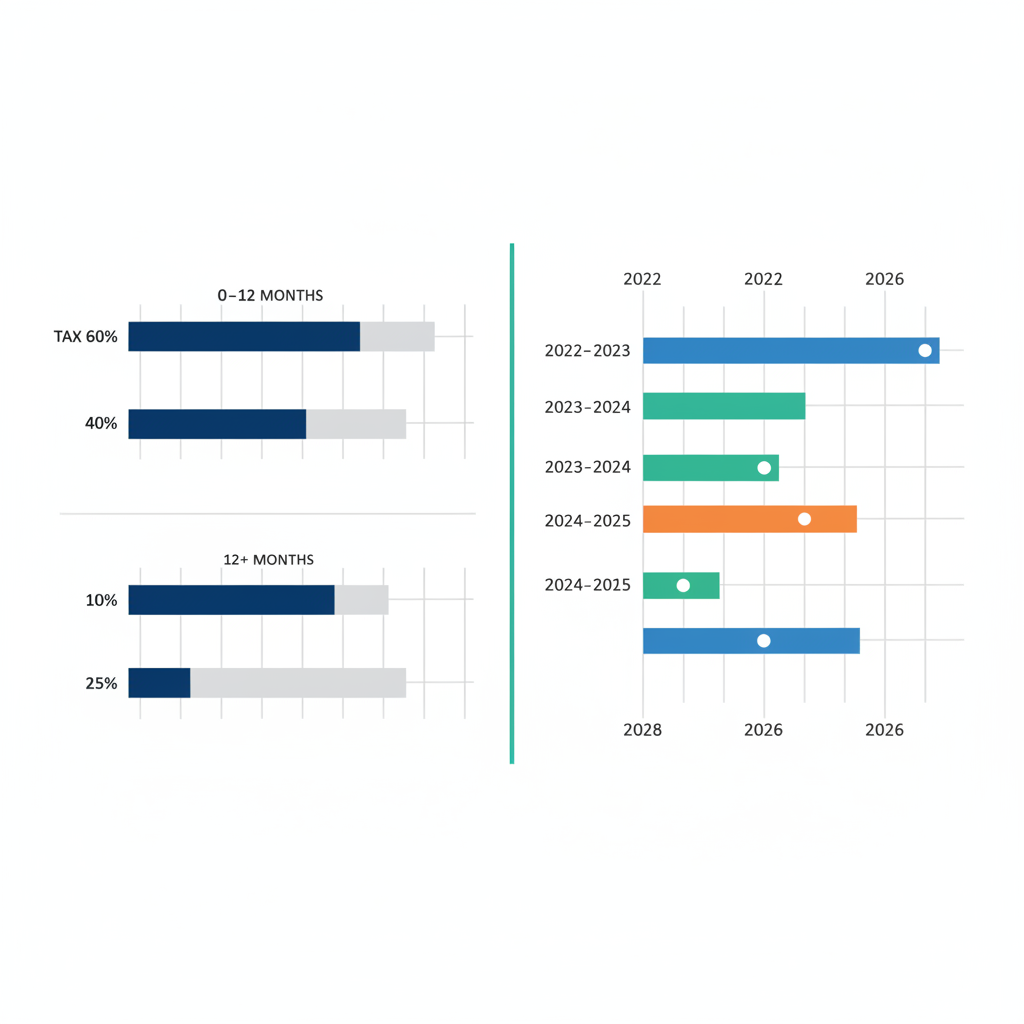
> TL;DR: Crypto algo trading Australia involves automated, rule-based systems executing trades 24/7 without you lifting a finger. As of 2026, you must use AUSTRAC-registered, AFSL-licensed exchanges or face real legal exposure. Capital gains tax applies to every bot-executed disposal, with a 50% discount only if you hold an asset over 12 months (which most algo strategies won’t do). Top platforms include Pepperstone Crypto, Independent Reserve, and Swyftx, with dedicated bot tools like Cryptohopper and Bitsgap sitting on top.
What Is Crypto Algo Trading in Australia?
Crypto algo trading Australia, at its core, is simple: you write a set of rules, a computer follows them, and trades happen automatically. No emotion, no sleep deprivation, no panic-selling at 3am. The algorithm watches price conditions, volume thresholds, or technical indicators and fires orders through an exchange API the moment conditions are met.
The reason crypto suits this approach better than most other asset classes comes down to three things. First, markets run 24 hours a day, seven days a week, including Christmas Day. No human can monitor that effectively. Second, crypto prices move fast and with genuine volatility — BTC/AUD can swing 5% in an hour — and algorithms react in milliseconds where a human reacts in seconds. Third, liquidity is fragmented across dozens of exchanges, creating price discrepancies that algorithms can systematically exploit.
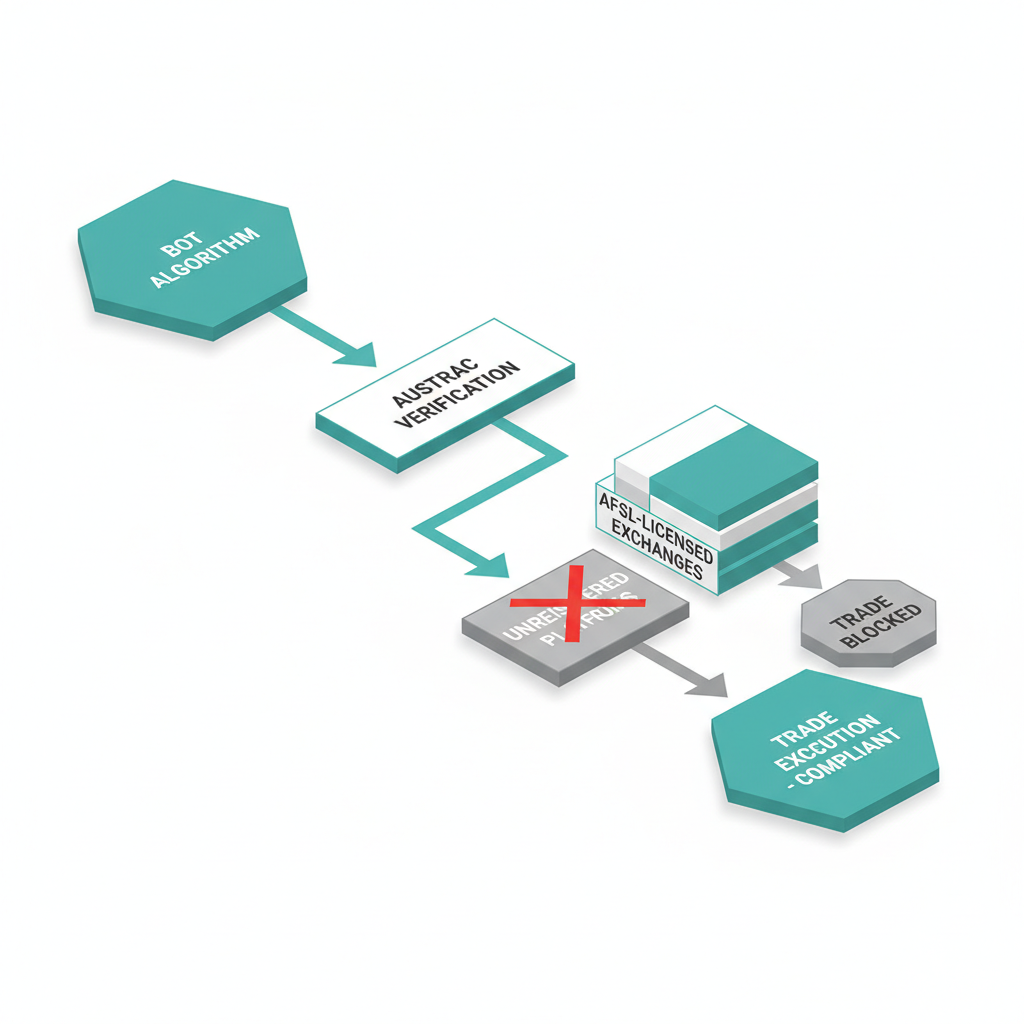
For Australian traders specifically, there is an additional layer to understand. Not all platforms offering algorithmic crypto services are legitimate. A site called cryptoalgorithm.net has been widely flagged as an unregulated scam operation. The fact that something calls itself an “Australian algo trading service” means nothing without AUSTRAC registration and, from April 2026, an AFSL. Throughout this guide, I will only refer to verified, compliant platforms.
The rest of this guide covers how these systems actually work, the main strategies in use, risk management you cannot skip, the best platforms for Australian traders in 2026, the new regulatory framework, and what the ATO expects from your bot’s activity.
[INTERNAL LINK PLACEHOLDER: “new regulatory framework” → crypto-regulation-australia-pillar]
How Algorithmic Crypto Trading Works: Core Concepts
Before you hand money to a bot, you need to understand what the bot is actually doing. This section covers the mechanics without getting lost in code.
Signal Generation
Every algorithm starts with a signal: a condition that tells the system to act. That might be a moving average crossover on the ETH/AUD 4-hour chart, a volume spike exceeding 200% of the 20-day average on BTC, or an RSI reading below 30 on a specific pair. The algorithm watches these inputs continuously and triggers an action when conditions are satisfied.
Order Execution
Once a signal fires, the algorithm places an order through the exchange’s API. The order type matters. Market orders execute immediately at the current price but can slip during volatile periods. Limit orders sit on the book at your specified price and only fill if the market comes to you. Stop orders close a position automatically if price moves against you beyond a set threshold. Good algo systems use all three in combination.
Backtesting and Paper Trading
Before risking real capital, any strategy worth using gets backtested against historical data. You feed the algorithm several years of price data and see how it would have performed. The catch: past performance is genuinely not predictive, and backtesting can overfit to historical quirks. That is why paper trading, running the strategy in real-time with simulated funds, is the next validation step. Swyftx has a demo mode that works well for this. Cryptohopper also offers paper trading before you go live.
Latency and Hosting
Latency, the time between a signal and the executed order, matters more in arbitrage strategies than grid bots, but it is always relevant. Cloud-hosted bots running on servers physically close to exchange infrastructure will execute faster than a bot running on your home computer. For most retail algo traders in Australia, cloud-hosted solutions like Bitsgap or Cryptohopper provide adequate latency without needing to manage your own server infrastructure.
Common Algorithm Types
The main categories you will encounter are trend-following (ride the momentum), mean-reversion (bet on return to average), grid bots (buy and sell at fixed intervals), and arbitrage (exploit price differences across exchanges). Each has a different risk profile, which the next section covers in detail.
Popular Algo Trading Strategies for Crypto Markets
Different strategies suit different market conditions. Running the wrong strategy in the wrong market is one of the most common ways automated trading accounts blow up.
Trend-Following (Momentum)
Trend-following algorithms buy when an asset is rising and sell when it falls, using signals like moving average crossovers or breakout confirmations. A classic example: buy BTC/AUD when the 20-day moving average crosses above the 50-day, exit when it crosses back below. These strategies perform well in strong directional markets but generate a lot of false signals during sideways price action. Transaction costs accumulate quickly during choppy periods, so fee minimisation matters. Independent Reserve with fees as low as 0.02% is worth considering for high-frequency trend strategies.
Mean-Reversion
Mean-reversion strategies assume that extreme price movements will correct back toward an average. Common signals include Bollinger Band touches, RSI readings below 30 or above 70, and statistical arbitrage across correlated pairs. ETH/AUD and BTC/AUD, for instance, tend to move together, so when they diverge significantly, a mean-reversion bot might short the outperformer and long the underperformer simultaneously. These strategies work well in range-bound markets but get crushed in strong trends, so defining the regime you are trading in is critical.
Grid Trading
Grid bots place buy orders at fixed price intervals below the current price and sell orders at fixed intervals above it, profiting from the oscillation. If BTC/AUD is trading at $100,000, a grid bot might place buys at $98,000, $96,000, and $94,000, with corresponding sells at $102,000, $104,000, and $106,000. Grid trading is most effective in sideways, volatile markets. It requires a decent capital base to fund multiple open orders, and during a sustained downtrend, you will accumulate an increasingly large bag at progressively worse prices. Pionex has grid bots built directly into the exchange with no additional subscription required.
Arbitrage
Arbitrage exploits price differences for the same asset across different exchanges. If BTC is trading at $99,800 on Swyftx and $100,200 on Kraken, an arbitrage bot buys on the cheaper exchange and sells on the more expensive one. The challenge: by the time you factor in withdrawal fees, transfer time, and execution latency, most retail arbitrage opportunities disappear. True arbitrage at scale requires fast API access, low fees, and capital pre-positioned on multiple exchanges.
DCA Bots
Dollar-cost averaging bots execute scheduled buys at fixed intervals regardless of price, say $200 of BTC/AUD every Monday at 9am. This is less a trading strategy and more an accumulation strategy, but it is automated and systematic, which qualifies it as algo trading. DCA removes timing risk and emotional decision-making. The tax implication is that each purchase creates a separate CGT parcel, which adds record-keeping complexity. More on that below.
Across all these strategies, realistic expectations are not optional. Most retail algo traders do not beat a simple BTC buy-and-hold over a full market cycle. The primary goal of any automated system should be capital preservation first, growth second.
Risk Management Rules Every Australian Algo Trader Needs
Automated trading without tight risk management is how accounts go to zero without you even being awake to stop it. These are the rules I treat as non-negotiable.
Maximum Drawdown Limits
Set a maximum drawdown threshold, typically 10–20% of starting capital, at which the bot stops entirely and alerts you. This prevents a strategy that has stopped working from continuing to execute bad trades while you are asleep. Most dedicated bot platforms like Cryptohopper and Bitsgap have configurable drawdown stops built in. If yours does not, walk away from it.
Position Sizing
Never risk more than 1–2% of total trading capital on a single trade. If you have $10,000 allocated to algo trading, a single position should not expose more than $100–$200 to loss before the stop-loss fires. This sounds conservative until you watch a bot open 15 concurrent positions during a flash crash and lose 30% of the account in four minutes.
Stop-Loss and Take-Profit Automation
Every trade the algorithm opens should have a corresponding stop-loss and take-profit embedded in the order logic, not as an afterthought. Relying on the bot to “know when to exit” based on signals alone without hard stops is a mistake that costs people real money.
Diversification Across Pairs and Strategies
Running a single strategy on a single pair means correlated risk. If the strategy breaks, everything breaks simultaneously. Running a trend-following bot on BTC/AUD, a grid bot on ETH/AUD, and a DCA accumulator on a small-cap pair gives you exposure to different market conditions, reducing the chance that all positions lose at the same time.
Volatility Filters
During extreme market events, such as exchange hacks, regulatory announcements, or sudden macro shocks, normal trading relationships break down completely. A volatility filter pauses the bot when ATR (Average True Range) or similar volatility measures exceed a set threshold. This avoids the scenario where your mean-reversion strategy keeps buying a coin that is in genuine freefall because the RSI “looks oversold.”
Paper trading before scaling to full capital is also essential. I ran my current grid strategy on Swyftx‘s demo mode for six weeks before putting real money in. The live performance differed from paper results by about 15% due to slippage and fill rates, which is useful information to have before you are committed.
Best Platforms for Crypto Algo Trading in Australia 2026
The platform you choose determines your fee structure, API quality, asset selection, and regulatory exposure. Here is how the main options stack up.
Comparison Table
| Platform | AUSTRAC/AFSL | API Access | Maker Fee | AUD Support | Algo Features |
|---|---|---|---|---|---|
| Pepperstone Crypto | ASIC-regulated | Yes | 0.1% flat | PayID, free deposits | Via third-party bots |
| Independent Reserve | AUSTRAC registered | Full API | 0.02–0.5% | Free deposits/withdrawals | Full API, SMSF support |
| Swyftx | AUSTRAC registered | Yes | 0.1–0.6% | PayID, BPAY | Demo mode, 420+ assets |
| CoinSpot | AUSTRAC registered | Basic API | 0.1% market orders | Free via BPAY/POLi | 400+ assets |
| Kraken | AUSTRAC registered | Advanced API | ~0% maker | AUD deposits | Pro-grade API for bots |
| OKX Australia | AUSTRAC registered | Advanced API | 0.07–0.1% | Growing AUD support | Strong API ecosystem |
| Cryptohopper | N/A (bot layer) | Connects to exchanges | N/A | Via connected exchange | AI-assisted, paper trading |
| Bitsgap | N/A (bot layer) | Connects to exchanges | N/A | Via connected exchange | Grid, DCA, arbitrage bots |
| Pionex | AUSTRAC registered | Built-in | 0.05% | AUD via linked banks | Built-in grid and DCA bots |
Pepperstone Crypto
Pepperstone Crypto comes from an ASIC-regulated broker background, which gives it a compliance credibility that pure crypto-native exchanges are still building toward under the new AFSL framework. The fee structure is a flat 0.1% with no hidden spread mark-up, which is genuinely competitive for algo trading where costs compound across hundreds of trades. PayID deposits land instantly with no fee. The main limitation is that you will need a third-party bot platform sitting on top, as Pepperstone does not offer native algo tools.
Independent Reserve
Independent Reserve has been running since 2013, which in Australian crypto terms makes it ancient. Fees slide from 0.5% down to 0.02% based on 30-day volume, so active algo traders naturally move into the lower tiers. The full API is well-documented and stable, it is ISO 27001 certified, and it is one of the few Australian exchanges that properly supports SMSF accounts. If you are running algo strategies with serious capital, this is the exchange I would prioritise.
Swyftx
Swyftx has over 700,000 Australian users and is the most beginner-accessible option that still offers meaningful API functionality. The demo mode is genuinely useful for validating bot strategies without capital at risk. Fees range from 0.1% to 0.6% depending on spread, which is acceptable for lower-frequency strategies but adds up if you are running high-turnover momentum bots. The 420+ asset selection is the widest of the local exchanges.
CoinSpot
CoinSpot is Australia’s largest exchange by user count and has a basic API. Market orders at 0.1% are competitive, but watch the instant buy/sell fee, which hits 1% and will destroy the economics of an active algo strategy if you are not careful about order type. Better suited as a long-term holding platform than an active trading engine.
Kraken
Kraken is the global platform that serious algo traders in Australia default to when local exchanges cannot offer the API sophistication they need. Maker fees approach zero at higher volume tiers, and the API documentation is among the best in the industry. The trade-off is that AUD on-ramp friction is higher than the local alternatives, and support response times for Australian users can be slow.
OKX Australia
OKX Australia offers 0.07–0.1% fees and has been building local presence. The API is strong and widely supported by third-party bot platforms. Worth watching as it matures in the Australian market, though it is not yet as embedded in the local ecosystem as Independent Reserve or Swyftx.
Dedicated Bot Platforms
Cryptohopper, Bitsgap, and Pionex sit on top of exchanges rather than being exchanges themselves. Cryptohopper offers a marketplace of pre-built strategies and AI-assisted configuration, which suits traders who want automation without writing their own code. Bitsgap specialises in grid and arbitrage bots with clean cross-exchange management. Pionex has grid bots built directly into the exchange interface with a 0.05% fee, making it the cheapest entry point for grid trading specifically.
One firm warning: avoid any platform that cannot demonstrate AUSTRAC registration or an AFSL. If a site claims to be an Australian algo trading service and the AUSTRAC public register does not show it, do not connect your funds.
[INTERNAL LINK PLACEHOLDER: “best crypto exchanges australia” → best-crypto-exchanges-australia-pillar]
Australian Crypto Regulation in 2026: What Algo Traders Must Know
April 1, 2026 was the date Australian crypto finally got its proper regulatory framework. The laws passed, and the implications for anyone running automated trading strategies are significant.
The New AFSL Requirement
All exchanges and digital asset custody providers now need to obtain an Australian Financial Services Licence within six months of the April 2026 commencement date. Digital asset platforms are being regulated directly under the Corporations Act 2001, which brings them into the same compliance framework as traditional financial services businesses. This is a meaningful shift from the previous situation where AUSTRAC registration was the primary credential.
For algo traders,