Crypto Algo Trading in Australia 2026: Complete Guide
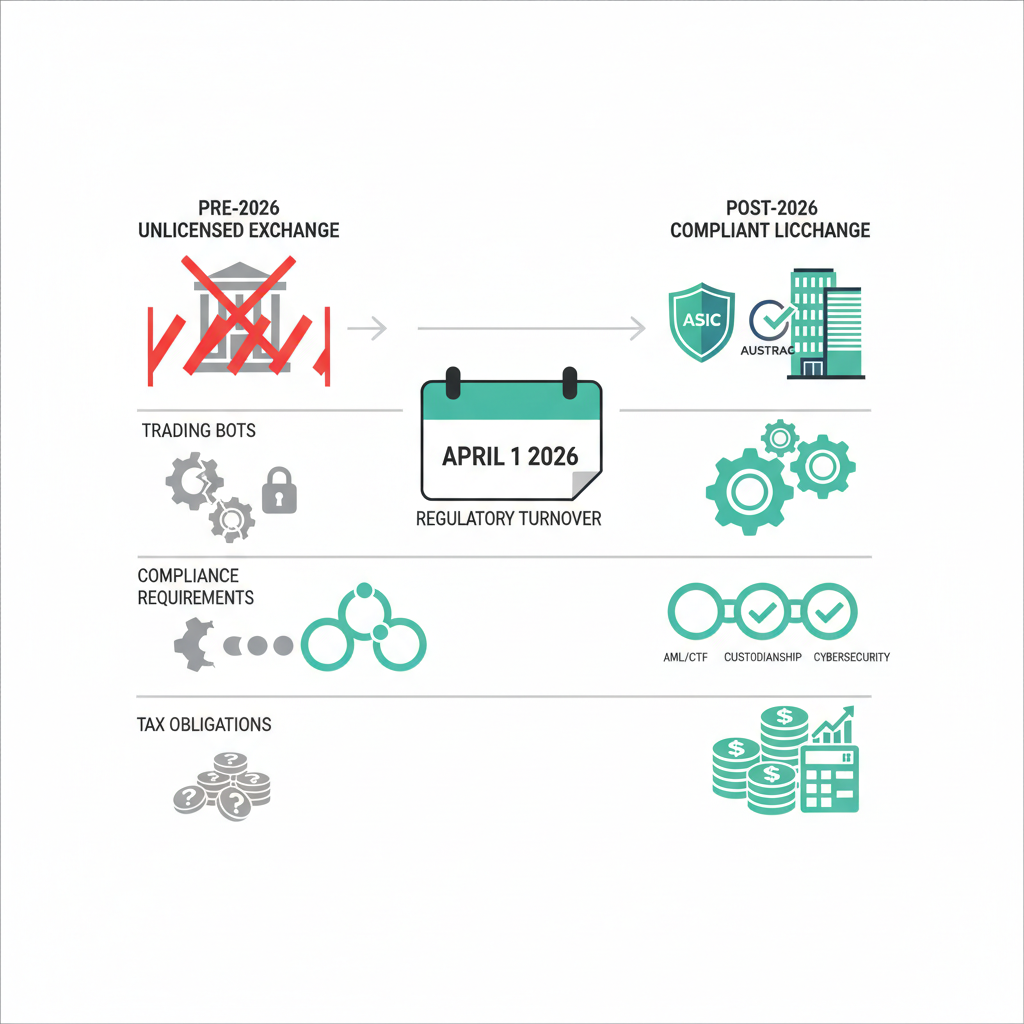
Crypto algo trading in Australia changed permanently on 1 April 2026, the day the country’s first comprehensive crypto licensing framework came into force. If you are running a bot on an unlicensed exchange right now, you are taking on regulatory risk that did not exist twelve months ago.
> TL;DR: Crypto algo trading in Australia uses automated, rules-based strategies to execute trades 24/7 without you watching a screen. As of 2026, all exchanges must hold an AFSL from ASIC or be in the process of obtaining one. The ATO taxes crypto gains and staking income regardless of whether a human or a bot placed the trade. Scams are rife, so stick to AUSTRAC-registered, AFSL-licensed platforms and keep meticulous records from day one.
What Is Crypto Algo Trading in Australia?
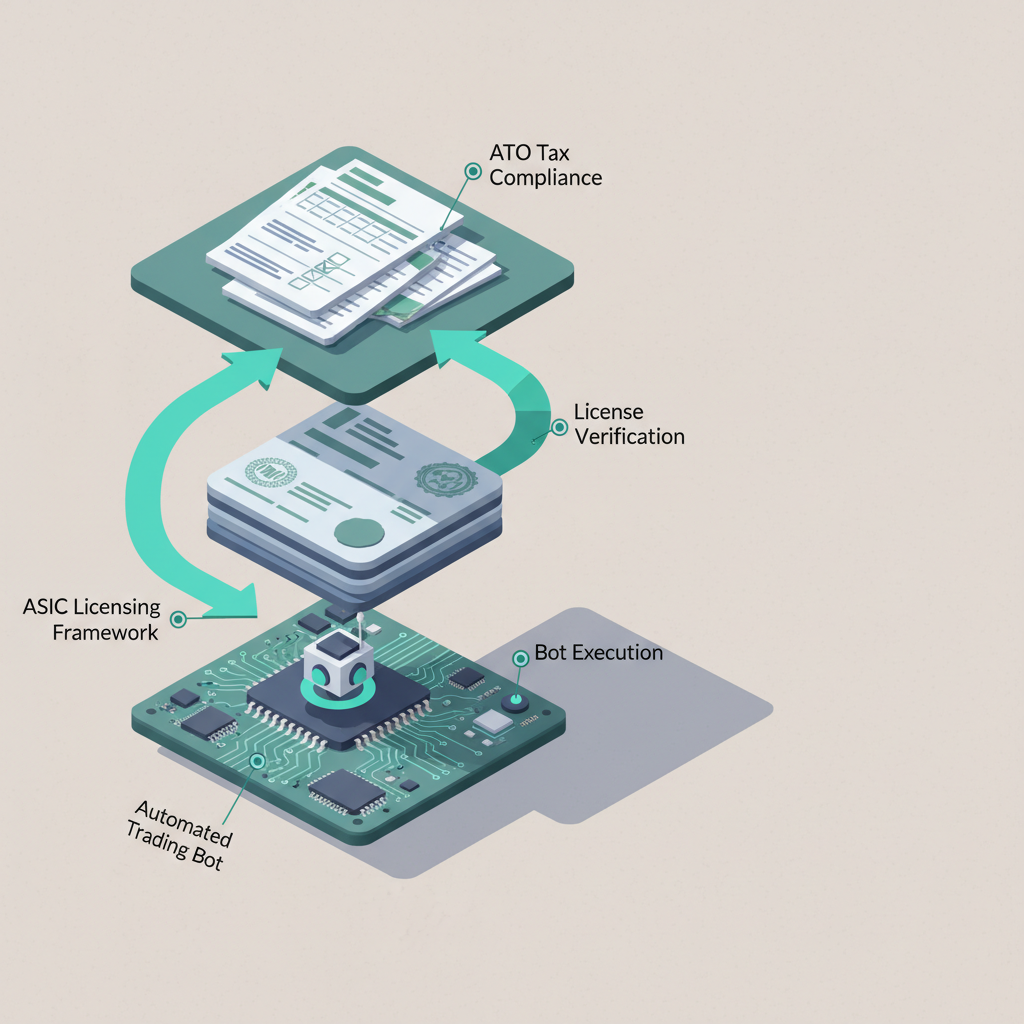
Crypto algo trading in Australia is exactly what it sounds like: you write (or buy) a set of rules, hand them to software, and that software executes trades on your behalf around the clock. No second-guessing. No panic-selling at 2 am because Bitcoin dropped 8% and you were half-asleep doom-scrolling.
The core appeal is straightforward. Algorithms react in milliseconds, they do not have feelings about a losing position, and they keep working while you sleep through a New York session. For Australian traders, that last point matters more than most, given that peak liquidity in major pairs often falls outside business hours here.
The most common strategy types you will encounter are trend-following (buying when an asset breaks upward, selling when it breaks down), arbitrage (exploiting price differences across exchanges), market-making (posting both buy and sell orders to capture the spread), and DCA bots (buying a fixed AUD amount on a schedule regardless of price). Each has a different risk profile and a different infrastructure requirement.
Australian adoption has grown steadily over the past three years, partly because retail tooling has improved dramatically. Platforms like Cryptohopper and Altrady have made strategy deployment accessible without a computer science degree. But the bigger driver heading into 2026 is the new regulatory environment. The licensing framework has pushed some dodgy operators out of the market, which has made traders who stayed more confident about putting serious capital to work algorithmically.
The regulation piece deserves its own section, because the rules now affect which platforms you can legally use, how your profits are taxed, and what happens if something goes wrong.
[INTERNAL LINK PLACEHOLDER: what is algo trading → beginner guide to algorithmic trading]
Australia’s 2026 Crypto Regulation: What Algo Traders Must Know
On 1 April 2026, Australia passed its first full crypto regulation framework, and the industry has not looked the same since.
The headline requirement is straightforward: every exchange and custody provider operating in Australia must obtain an Australian Financial Services Licence (AFSL) from ASIC within six months of the framework passing. That deadline sits around October 2026, which means right now you should be checking whether your platform has either secured its AFSL or is publicly on record as having applied. If neither is true, move your funds.
AUSTRAC registration is separate and pre-existing. Exchanges have been required to register with AUSTRAC and comply with Anti-Money Laundering and Counter-Terrorism Financing (AML/CTF) obligations for several years now. More than 400 entities currently hold AUSTRAC registration, including international exchanges operating Australian-facing products. AUSTRAC registration alone is no longer sufficient comfort, though. The new AFSL layer adds capital adequacy requirements, custody standards, and dispute resolution obligations that AUSTRAC never covered.
ASIC has made clear it will enforce this. The civil proceedings against NGS Crypto are the clearest example in recent memory. NGS targeted Australian investors with unlicensed crypto mining products, the company collapsed, and hundreds of investors collectively lost more than A$160 million. ASIC’s proceedings, reported in April 2026, came after a liquidation order in December 2025. The lesson for retail traders is not subtle: unlicensed operators can disappear, and your recourse is almost nothing.
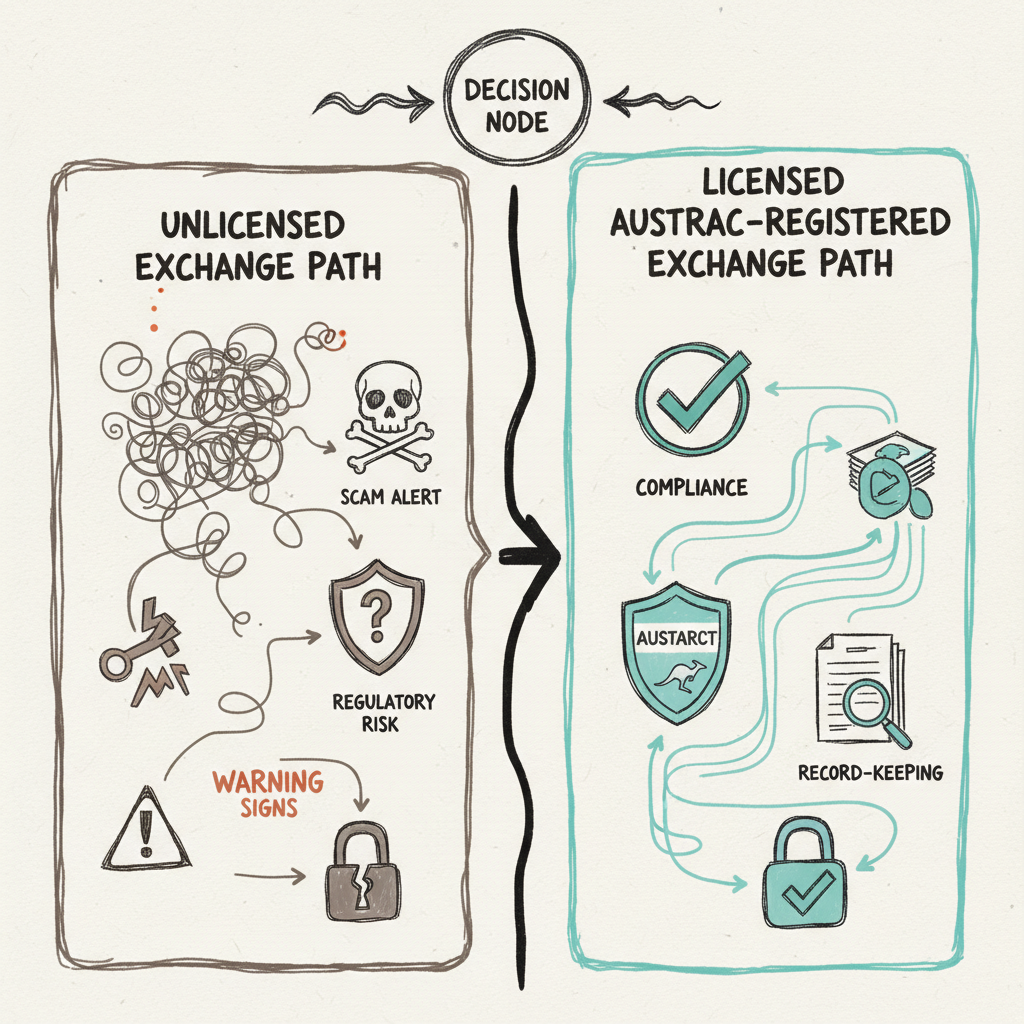
To verify a platform before depositing, check ASIC’s professional registers at moneysmart.gov.au and the AUSTRAC public registration list. Any platform that cannot produce an AFSL number or a clear statement of its application status should be treated as a red flag.
The broader economic picture is worth noting. Treasury modelling suggests the new framework could unlock an A$24 billion annual economic opportunity as institutional capital, which has been sitting on the sidelines waiting for regulatory clarity, starts flowing in. More institutional participation tends to mean more liquid markets for algorithmic strategies to operate in, so this is genuinely good news for serious algo traders.
[INTERNAL LINK PLACEHOLDER: ASIC crypto regulation → Australian crypto regulation explainer]
Top Platforms for Crypto Algo Trading in Australia 2026
Not every platform that markets itself as “algo-friendly” actually supports the kind of automation Australian traders need. Some offer a single DCA bot and call it algorithmic trading. Others have solid API infrastructure but no AUSTRAC registration. The table below covers the platforms worth serious consideration, followed by the context you need to make sense of it.
| Platform | AUSTRAC Registered | AFSL Status (mid-2026) | Algo Features | Min Deposit AUD | Trading Fees | Best For |
|---|---|---|---|---|---|---|
| Cryptohopper | Via connected exchange | N/A (bot layer) | DCA, trailing, AI, copy trading | ~A$50 via exchange | Subscription from ~A$30/mo | Beginners to intermediate bot traders |
| Altrady | Via connected exchange | N/A (bot layer) | Signal bots, QFL bot, scanner | ~A$50 via exchange | Subscription from ~A$25/mo | Active multi-exchange traders |
| Interactive Brokers | Yes | AFSL held | Full API, custom automation | A$0 | Commission-based, varies by asset | Serious quant traders |
| Alpaca Trading | Varies by jurisdiction | Under review | REST/WebSocket API, paper trading | A$0 | Commission-free (US equities/crypto) | Developers building custom bots |
| Pepperstone | Yes | AFSL held | cTrader, cBots, Expert Advisors | A$200 | From 0.0 pips + commission | CFD algo traders using cTrader |
| Capital.com | Yes | AFSL held | TradingView integration, MT4, AI assistant | A$20 | 0% commission (spread applies) | Beginners wanting CFD exposure |
| Binance Australia | Yes | Applied | Spot API, trading bots | A$15 | 0.1% spot (BNB discount available) | Experienced spot traders |
| Swyftx | Yes | Applied | Basic recurring buys, API access | A$10 | ~0.6% spread on BTC/AUD | AUD on-ramp, beginner friendly |
A few things that table cannot fully convey:
Binance Australia no longer offers derivatives to retail users. Crypto CFDs and futures are off the table for Australian residents. What remains is spot trading and some bot functionality via their API. If you were running a futures algo on Binance, you need a different venue.
Cryptohopper and Altrady are not exchanges. They sit on top of exchanges via API connections. Your AUSTRAC and AFSL exposure comes from whichever underlying exchange you connect. Both platforms are subscription services, not brokers, so assess them on their feature set and reliability rather than their regulatory standing directly.
eToro’s copy trading deserves a mention as a semi-automated option for traders who are not ready to run their own bots. You select a trader to copy, set an allocation, and eToro mirrors their positions in your account automatically. It is not algorithmic trading in the technical sense, but the outcome (automated position-taking based on someone else’s rules) is similar enough to be worth considering for beginners. [INTERNAL LINK PLACEHOLDER: eToro review → eToro Australia review]
I have been using Swyftx since 2022 primarily as an AUD on-ramp, not as an algo trading venue. The spread is transparent and the PayID deposits are fast, but if you want serious bot infrastructure, you will need to connect a more capable platform on top.
When a platform is not on this list, check ASIC’s MoneySmart register and Scamwatch before depositing anything. Platforms promising guaranteed returns from algorithms, operating from offshore jurisdictions only, and unable to produce a licence number are almost always fraudulent.
How to Start Crypto Algo Trading in Australia: Step-by-Step
Getting from “I want to try this” to a live, running strategy is a seven-step process. None of the steps are technically complex, but skipping any of them tends to be expensive.
Step 1: Choose a properly licensed platform. Check AUSTRAC registration and AFSL status before anything else. Use the links in the previous section. If the platform is not on ASIC’s register or is not demonstrably in the application process, stop there.
Step 2: Complete KYC. Every AUSTRAC-registered platform is legally required to verify your identity before allowing deposits or withdrawals. You will need a government-issued photo ID (driver’s licence or passport) and proof of address. This is not optional, and it is not a red flag. A platform that lets you trade without KYC is the one you should be worried about.
Step 3: Fund your account in AUD. Most Australian exchanges accept bank transfer (free, 1 to 2 business days), PayID (fast, often instant), and debit card (instant but sometimes carries a fee of around 0.5 to 1.5%). Avoid credit card funding if you can. The ATO may treat credit-funded purchases differently, and several major banks now block or delay credit card payments to crypto exchanges.
Speaking of banks: CBA, ANZ, NAB, and Westpac have all imposed various forms of friction on crypto transfers. Monthly caps of A$10,000 are common, and holds of 24 hours on first transfers are routine. This is not illegal, but it is annoying. Plan your capital deployment accordingly. PayID tends to experience less friction than direct bank transfer with some institutions.
Step 4: Select or build your algorithm. Pre-built bots on platforms like Cryptohopper are the lowest-friction starting point. You pick a strategy template, configure the parameters, and connect it to your exchange via API. Custom strategies via direct exchange APIs (Binance’s REST/WebSocket API is well-documented) give you full control but require Python or similar. Know your skill level honestly before deciding.
Step 5: Backtest before going live. Every credible algo platform offers backtesting against historical price data. Run your strategy across at least twelve months of data, ideally across multiple market regimes (bull, bear, sideways). A strategy that only works in a bull market is not a strategy, it is luck with extra steps.
Step 6: Set risk parameters and do not skip this. Decide your maximum position size, your stop-loss levels, and your daily drawdown limit before the bot touches real money. A runaway algorithm with no loss limit can blow an account in minutes during a flash crash. Most platforms let you set a daily loss cap that halts trading automatically.
Step 7: Monitor performance and keep records. Automated trading does not mean set-and-forget. Review performance weekly at minimum, and keep a detailed log of every trade the bot executes. You will need that log for your tax return. The ATO does not accept “my bot handled it” as a record-keeping strategy.
[INTERNAL LINK PLACEHOLDER: backtesting guide → how to backtest a crypto trading strategy]
Crypto Algo Trading Tax in Australia: ATO Rules Explained
The ATO does not care whether a human or an algorithm placed your trade. If a disposal happened, CGT applies.
The basic framework: The ATO classifies cryptocurrency as property. Every time you sell crypto, swap it for another coin, gift it, or convert it to AUD, you trigger a Capital Gains Tax event. You calculate your gain (or loss) as the difference between the AUD value at disposal and the AUD cost base at acquisition. High-frequency algo trading means potentially hundreds or thousands of taxable events per year.
The 12-month discount: If you hold an asset for more than twelve months before disposing of it, individuals can apply a 50% CGT discount to the gain. Most active algo traders will never see this discount because their holding periods are measured in minutes or days, not years. DCA bot users who hold accumulation positions long-term are an exception.
Staking income: If your strategy involves staking rewards, those rewards are treated as ordinary income at their AUD market value on the date you receive them. They are then added to your cost base for CGT purposes when you eventually dispose of them.
What is not a taxable event: Moving crypto between two wallets you own is not a disposal. Buying crypto with AUD is not a taxable event. The tax moment comes when you sell, swap, or otherwise transfer ownership.
Record-keeping is the hard part. For every trade, you need the AUD value at time of acquisition, the AUD value at time of disposal, fees paid (which can be added to cost base or deducted from proceeds depending on context), and timestamps. Doing this manually for a bot executing fifty trades a day is not realistic.
Use a dedicated crypto tax tool. Koinly integrates directly with most Australian exchanges and supports ATO-compliant reporting. CoinTracking is another option. Both can import transaction histories via API or CSV and generate an EOFY report your accountant can actually use.
Strongly recommend consulting a registered tax agent who has worked with crypto clients before. The intersection of algo trading frequency and ATO rules has enough edge cases (wash sales, wrapping tokens, staking derivatives) that generic tax advice will miss things that matter.
[INTERNAL LINK PLACEHOLDER: crypto tax Australia → complete guide to crypto tax in Australia]
Risks of Crypto Algo Trading in Australia and How to Avoid Scams
Australians lost more than A$330 million to crypto scams in the twelve months to 31 December 2025. That number has not improved materially year on year, and algo trading has its own particular fraud patterns layered on top of the usual investment scams.
The scam that is circulating right now follows a consistent script. A coworker, acquaintance, or online contact pitches you access to a proprietary algorithm and a prop firm. They show you screenshots of returns. When you ask for the trading account credentials or an audited track record, they refuse, citing “security reasons.” A Reddit user reported exactly this pattern in Australia in April 2026. If you cannot independently verify a live account’s performance, the performance does not exist.
Platform risk is real. Even outside outright fraud, exchanges can fail. FTX was solvent on a Tuesday and insolvent by the weekend. Only use exchanges with proper AFSL licensing, adequate capital requirements, and a clear custody arrangement. If your bot is running on an unlicensed offshore exchange and that exchange goes under, you are an unsecured creditor in a foreign jurisdiction. Recovery rate: close to zero.
Algorithm risk is less discussed but equally dangerous. Over-optimisation (curve-fitting) is the most common failure mode. A strategy that was tuned exhaustively to perform on historical data often collapses in live trading because the market regime shifts slightly. Flash crashes are another issue: a bot with no circuit breaker can execute a full account’s worth of sell orders in seconds during a liquidity event and not recover.
ASIC has specifically warned about SMSFs and cryptocurrency. If you are thinking about running an algo strategy inside your self-managed super fund, get specialist advice first. The trustee obligations, SIS Act requirements, and ATO scrutiny of crypto in super create a genuinely complex compliance environment.
On anonymity: The Australian Federal Police accessed a crypto wallet valued at A$9 million in October 2025 as part of a criminal investigation. The assumption that crypto activity is untraceable is wrong, and it has been wrong for years. The AFP has the tools and the legal authority to follow the money.
Red flags to watch for:
- No AUSTRAC registration or AFSL number (or application on record)
- Guaranteed or “risk-free” returns from any algorithm
- Requests to deposit via gift cards, crypto peer-to-peer, or wire to a personal account
- Offshore-only jurisdiction with no Australian regulatory presence
- Pressure to recruit others or add more capital before withdrawals are permitted
If you suspect a scam, report it to ASIC at asic.gov.au/report-misconduct, to the AC