Crypto Algo Trading Australia 2026: Platforms, Rules & Tax Guide
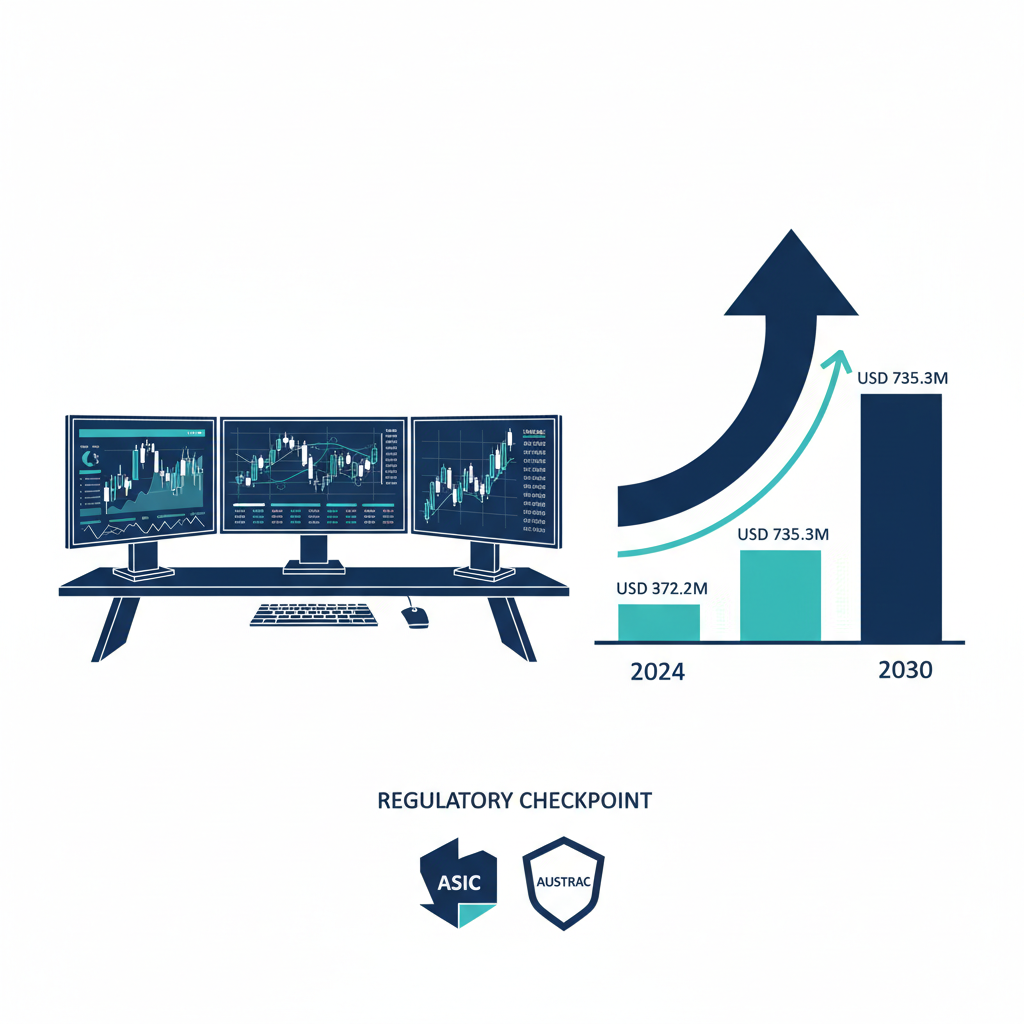
Crypto algo trading in Australia is no longer a niche hobby for quants with Bloomberg terminals. The local algorithmic trading market generated USD 372.2 million in 2024, and that figure is projected to double to USD 735.3 million by 2030. That kind of growth attracts serious money, serious platforms, and, as of April 2026, serious regulation.
> TL;DR
> Crypto algo trading Australia is a booming sector, with the market projected to reach USD 735.3 million by 2030. The 2026 regulatory framework now requires exchanges to hold an AFSL from ASIC and register with AUSTRAC as VASPs. Top platforms for automated trading include OKX, Pionex, Swyftx, and Cryptohopper, the ATO taxes profits as CGT or income (with a 50% discount for assets held over 12 months), and AFCA can help if something goes wrong with a licensed exchange.
What Is Crypto Algo Trading in Australia?
At its core, algorithmic crypto trading means your trades are executed automatically based on pre-set rules, whether that is a price threshold, a timing pattern, a technical signal, or a combination of all three. You build or subscribe to a strategy, connect it to an exchange via API, and the bot does the work while you sleep, commute, or argue about the cricket.
The most common strategies you will encounter as an Australian trader are grid bots (which place buy and sell orders at fixed intervals above and below a set price), DCA bots (which buy a fixed dollar amount of an asset at regular intervals to smooth out your entry price), martingale bots (which increase position size after a loss, high-risk and not for the faint-hearted), and arbitrage systems that exploit price differences across exchanges. Copy trading, where you mirror the positions of a verified trader automatically, sits somewhere between algo and social trading.
The Australian algorithmic trading market generated USD 372.2 million in revenue in 2024 and is on track to reach USD 735.3 million by 2030, growing at a compound annual rate of 12.2%. That is not a projection pulled from thin air. It reflects genuine institutional adoption, a maturing retail market, and the fact that 24/7 crypto markets are essentially purpose-built for automation.
Automated crypto trading in Australia is legal, but it sits inside a regulatory perimeter that got significantly tighter in 2026. Platforms need AUSTRAC registration and increasingly an AFSL from ASIC. The ATO expects you to report every taxable event your bot generates, and there can be a lot of them. Both exchanges with built-in bots like Pionex and OKX, and standalone bot platforms like Cryptohopper and CryptoRobotics, serve the local market. The right choice depends on how hands-on you want to be.
Australia’s 2026 Crypto Regulation: What Algo Traders Must Know
The single biggest shift in the Australian crypto regulatory environment happened on April 1, 2026. That is when Parliament passed the Corporations Amendment (Digital Assets Framework) Bill 2025, which requires crypto exchanges and digital asset custody platforms to obtain an Australian Financial Services Licence from ASIC. This brings crypto exchanges under the same regulatory framework as traditional financial services providers for the first time.
The practical implications are significant. Platforms must meet what the legislation describes as “bank-grade” capital standards, meaning they need adequate financial buffers to absorb losses. They are required to safeguard client assets, provide transparent disclosures about risks and fees, and maintain proper dispute resolution processes. For algo traders, this means the platforms hosting your bots should, in theory, have stronger structural protections around your funds than they did eighteen months ago.
ASIC issued a no-action position until June 30, 2026, for firms making genuine and demonstrable compliance efforts. Platforms that simply ignore the new requirements are exposed. Any exchange you are considering should be able to tell you clearly where they stand in the licensing process.
AUSTRAC and the Rebrand to VASPs
Alongside the AFSL requirement, AUSTRAC expanded Australia’s AML/CTF laws in April 2026 and formally renamed Digital Currency Exchange providers to Virtual Asset Service Providers. AUSTRAC now maintains a searchable public register of VASPs, which you can check before depositing a single dollar. Obligations include a documented AML/CTF program, KYC verification of customers, and reporting of suspicious transactions.
The Travel Rule commences July 1, 2026. From that date, reporting entities conducting value transfer services must develop counterparty due diligence procedures and build the tooling to collect and report relevant information on the parties involved in transfers. If you are moving crypto between exchanges as part of an arbitrage strategy, this will be increasingly relevant to how those platforms process your transactions.
Cold Wallets and Proof of Reserves
The 2026 regulations require exchanges to store at least 90% of customer crypto in cold wallets, meaning offline storage that cannot be reached by an online attack. Annual Proof of Reserves audits are also mandated. These are direct responses to exchange collapses globally and, closer to home, the January 2026 DAEX failure, where Australian traders were left uncertain about fund recovery after the exchange entered voluntary liquidation.
If something does go wrong with a licensed exchange, consumers now have the right to escalate complaints to the Australian Financial Complaints Authority. AFCA is the same body that handles disputes with banks and insurers, which is a meaningful upgrade from the previous situation where your options were essentially limited to civil court or social media.
Top Platforms for Crypto Algo Trading in Australia (2026 Comparison)
The platforms worth considering for algorithmic crypto trading in Australia fall into two broad categories: exchanges with native bots built directly into the interface, and standalone bot platforms that connect to exchanges via API. Each has trade-offs.
OKX Australia is the most feature-rich option for traders who want bots and a full exchange in one place. The Spot Grid Bot and DCA Martingale Bot are solid implementations, and OKX supports over 350 assets with maker/taker fees of 0.08% and 0.10% respectively. It is AUSTRAC registered, offers derivatives trading, and the interface, while not beginner-friendly, gives you genuine control over strategy parameters.
Pionex takes a different approach. Rather than being a full-featured exchange, it is built around its 16 free built-in trading bots and taps into liquidity from major exchanges in the background. The trading fee is 0.05% across the board, which is competitive. Grid and DCA strategies work well here. The trade-off is that asset selection is narrower than OKX or Binance, and the platform is less useful if you want manual trading features alongside your bots.
Cryptohopper is the best-known standalone bot platform available to Australians. It connects to major exchanges via API, supports DCA, trailing stop strategies, AI-generated signals, and copy trading from a marketplace of strategy providers. Pricing is subscription-based, starting from around AUD 30 per month depending on the plan. Because it is a third-party platform layered on top of your exchange, you need to assess both the bot platform and the exchange it connects to.
KuCoin offers grid, rebalancing, DCA, and martingale bots natively, plus a user strategy marketplace where you can browse and copy verified trader configurations. For experienced algo traders who want to browse community strategies rather than build from scratch, this is genuinely useful.
CryptoRobotics targets Australian users specifically with fully automated bots across multiple strategies. The pricing model is either a profit-sharing arrangement or a flat USD 25 per month subscription. Worth considering if you want automation without paying a subscription fee on months where the bot underperforms.
Swyftx is not a bot-native platform, but I have been using it since 2022 and it is worth including for Australian traders who are starting out. It offers 420+ assets, a 0.6% fee structure, integrated tax reporting, and a demo mode that lets you test strategies with play money before risking real AUD. It also has solid PayID support, which matters for fast deposits. If your algo ambitions are modest and you want a regulated, Australian-based home for your crypto, it is a reasonable starting point. Swyftx
Binance has the largest asset selection of any platform available to Australians and the full suite of advanced trading tools. It is AUSTRAC registered. Fees are competitive. The regulatory history around derivatives in Australia is complex, so check what products are available to local users before assuming full access.
eToro pioneered copy trading and holds both an AFSL and AUSTRAC registration in Australia. It is the most straightforward regulated option if copy trading is your primary strategy. eToro
Platform Comparison Table
| Platform | AUSTRAC/ASIC Status | Bot Types | Maker/Taker Fees | AUD Support | Best For |
|---|---|---|---|---|---|
| OKX | AUSTRAC registered | Grid, DCA Martingale, derivatives | 0.08% / 0.10% | Yes (bank transfer) | Advanced traders, multi-strategy |
| Pionex | AUSTRAC registered | 16 built-in bots (grid, DCA, etc.) | 0.05% / 0.05% | Limited | Bot-first traders, low fees |
| Cryptohopper | Third-party (exchange-dependent) | DCA, trailing, AI signals, copy | Subscription from ~AUD 30/mo | Via connected exchange | Strategy marketplace, flexibility |
| KuCoin | AUSTRAC registered | Grid, DCA, martingale, rebalancing | 0.10% / 0.10% | Yes | Community strategy browsing |
| CryptoRobotics | Third-party | Fully automated multi-strategy | Profit-share or USD 25/mo | Via connected exchange | Set-and-forget automation |
| Swyftx | AUSTRAC registered, AFSL seeking | Limited (demo mode) | 0.6% | Yes (PayID, bank) | AUS beginners, tax reporting |
| Binance | AUSTRAC registered | Advanced bots, grid, DCA | 0.10% / 0.10% | Yes | Asset selection, volume traders |
| eToro | AFSL + AUSTRAC registered | Copy trading | Spread-based | Yes | Regulated copy trading |
[INTERNAL LINK PLACEHOLDER: OKX Australia review → /reviews/okx-australia]
[INTERNAL LINK PLACEHOLDER: Swyftx review → /reviews/swyftx]
[INTERNAL LINK PLACEHOLDER: Best crypto trading bots Australia → /guides/best-crypto-trading-bots-australia]
How to Choose an Algo Trading Platform in Australia
The first check is non-negotiable: verify AUSTRAC registration before depositing anything. The public VASP register is searchable and takes about ninety seconds to use. If a platform is not on it, stop there. No registration means no AML/CTF obligations, which means no real accountability.
After that, check AFSL status. The no-action period runs until June 30, 2026, so some legitimate platforms are still in the process of obtaining their licence. That is fine, provided they can demonstrate they have actually lodged an application and are making progress. “We are working on it” with zero specifics is a red flag.
Fees and Costs
Fee structures in algo trading compound quickly because bots generate more transactions than manual trading. A 0.1% maker fee sounds trivial until your grid bot has executed 400 trades in a month. Run the numbers on expected trading volume before committing to a platform. Also check for spread costs on top of stated fees, some Australian exchanges advertise low fees but recoup margin through the spread. Swyftx, for example, charges 0.6% per trade but is transparent about it. Some platforms appear cheaper on paper but quietly widen the spread.
Deposit and withdrawal fees matter too. AUD withdrawals are free on most major Australian exchanges. AUD deposits via PayID or bank transfer are typically free. Credit card deposits are not: Swyftx charges 1.99%, which is not unusual.
Matching Bot Type to Strategy
Grid bots work well in sideways, range-bound markets. DCA bots suit long-term accumulators who are not trying to time entries. Martingale strategies can recover losses in trending conditions but can also accelerate them in a sustained downturn. Copy trading suits traders who want exposure to someone else’s strategy without building their own. Be honest about which category you fall into and choose a platform that does that thing well, rather than one with the longest feature list.
Cold Storage and Dispute Resolution
Given the 90% cold wallet requirement now embedded in Australian regulation, ask platforms directly how they store customer funds. An exchange that cannot or will not answer that question clearly should not be holding your crypto. Check also whether the platform is a member of AFCA. That membership is a baseline for any licensed Australian financial services provider.
The January 2026 DAEX collapse is worth sitting with. Traders who had funds on that exchange when it entered voluntary liquidation are still waiting. Unregulated or poorly capitalised exchanges fail quietly, and your recourse once they do is limited. That is not a theoretical risk.
Banking Restrictions on Crypto in Australia: What Algo Traders Face
If you have tried to fund a crypto exchange account from a CBA, ANZ, Westpac, or NAB account in the last year, you have probably hit a wall. All four major banks have implemented restrictions on transfers to crypto platforms, ranging from outright blocks on certain exchanges to monthly caps on total transfers.
CBA and ANZ have both implemented AUD 10,000 monthly limits on transfers to crypto platforms. The stated justification is scam prevention. There is something to that argument, crypto-related scams are a genuine problem in Australia, but the blunt instrument of blanket monthly caps affects legitimate traders just as much as the people the banks claim to be protecting.
In February 2026, Coinbase formally lodged a complaint with the Australian parliament, accusing the major banks of systematic debanking of legitimate crypto businesses. The complaint describes cases where crypto companies cannot get or maintain basic banking services, which flows downstream to consumers who find their transfers blocked or delayed.
Practical Workarounds
The most reliable approach for Australian algo traders is to use an exchange with PayID support. PayID transfers from most institutions process quickly and are less likely to be flagged than standard BSB and account number transfers. Some traders have had better results using smaller credit unions or neobanks like Up or Revolut, where crypto restrictions are less aggressive, though policies change frequently.
Avoid using a credit card to deposit to a crypto exchange unless you have no alternative. Beyond the exchange fees (typically around 1.99%), some card providers classify crypto deposits as cash advances, which attract higher interest rates from the moment of transaction. AUD withdrawals from exchanges back to your bank account are generally unaffected by these restrictions, most major Australian exchanges process AUD withdrawals for free.
[INTERNAL LINK PLACEHOLDER: Best Australian crypto exchanges for AUD deposits → /guides/best-crypto-exchanges-australia]
Crypto Tax in Australia 2026: What Algo Traders Owe the ATO
This section matters more for algo traders than for buy-and-hold investors, because every trade your bot executes is a potential taxable event.
The ATO treats crypto as property, not currency. When you dispose of crypto, whether by selling it for AUD, swapping it for another token, or spending it, you trigger a capital gains event. Your capital gain is the difference between your cost base (what you paid) and your proceeds (what you received). If you have held the asset for more than 12 months before disposal, individuals are entitled to a 50% CGT discount on the gain. Algo bots that trade frequently will rarely accumulate 12-month holding periods, which means most of your bot-generated gains will be taxed at your full marginal income tax rate.
Staking rewards, yield farming returns, and airdrop income are generally treated as ordinary income at the time you receive them, based on the AUD value at receipt. You then have a new cost base for CGT purposes when you eventually dispose of those tokens.
The ATO operates a data-matching program with Australian exchanges. AUSTRAC-registered platforms report user transaction data, which means the ATO has a reasonable picture of your trading activity. Keeping your own records, trade-by-trade, is not optional if you want to calculate your CGT position accurately. Tools like Koinly, CoinTracking, and CryptoTaxCalculator integrate with most major exchanges and can save significant time at tax time.
[INTERNAL LINK PLACEHOLDER: Crypto tax Australia guide → /guides/crypto-tax-australia]
FAQ
Is crypto algo trading legal in Australia?
Yes. Algorithmic and automated crypto trading is legal in Australia. Platforms offering these services must be registered with AUSTRAC and, as of the April 2026 legislation, are required to obtain an AFSL from ASIC. Individual traders have no separate licensing requirement, but all profits and taxable events must be reported to the ATO.
**Which platforms