Crypto Algo Trading Strategies Australia: A 2026 Guide
Crypto algo trading strategies in Australia looked very different three years ago. Back then, you could spin up a bot on an unregistered exchange, run a grid strategy overnight, and worry about the tax implications later. In 2026, that approach will get you into trouble fast, either with the ATO, ASIC, or both.
This guide covers what actually works right now: the strategies, the compliant platforms, the tax obligations you cannot ignore, and the risk management basics that separate traders who last from traders who blow up.
> TL;DR
>
> Crypto algo trading strategies in Australia involve using automated, rules-based systems to execute trades without manual intervention on every order. As of 2026, Australian investors must account for new AFSL licensing requirements, AUSTRAC VASP registration, and ATO capital gains tax obligations that trigger on every single disposal. This guide covers the top strategies, the best compliant platforms, and the regulatory and tax context you need to trade algorithmically in Australia without getting caught out.
What Are Crypto Algo Trading Strategies in Australia?
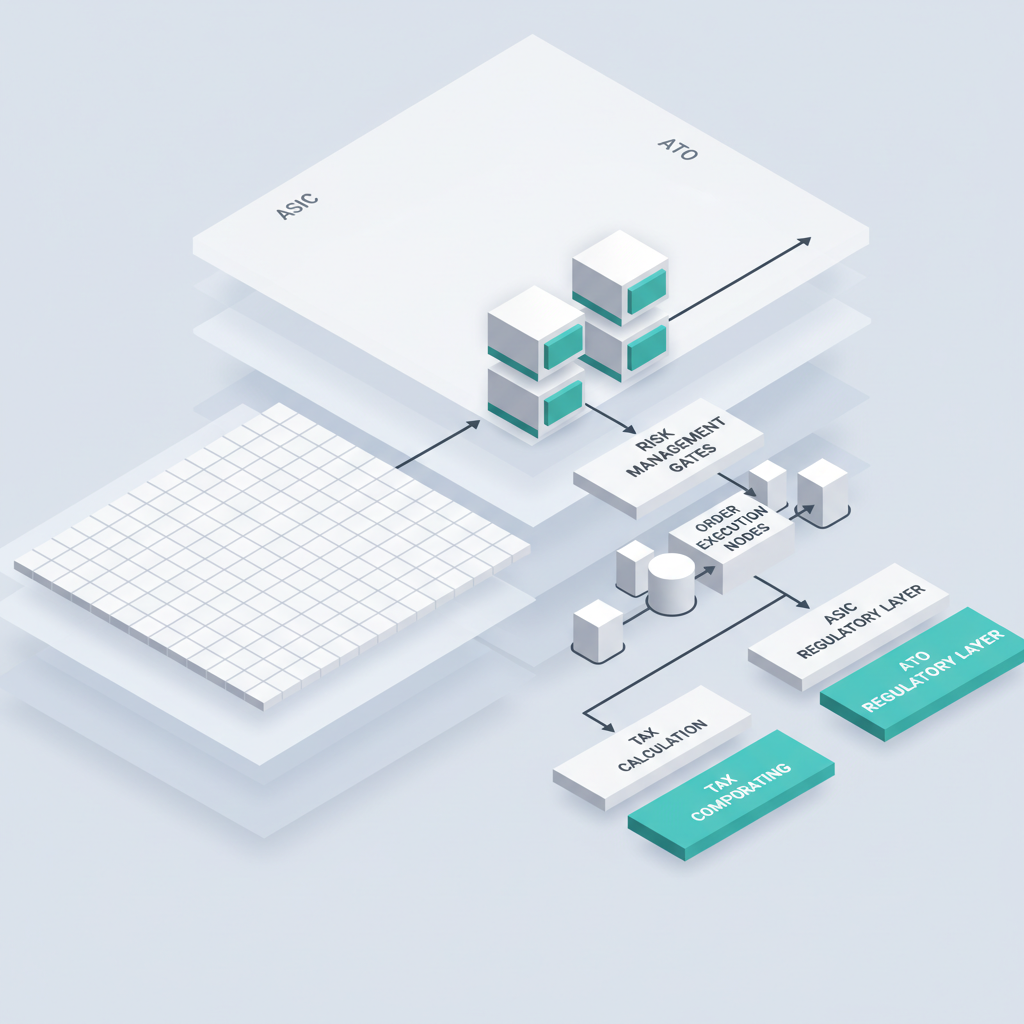
Algorithmic trading means using pre-programmed rules to enter and exit trades automatically. Instead of watching a chart and clicking buy, you define the logic beforehand — “buy BTC/AUD when the 50-day moving average crosses above the 200-day, sell when it crosses back” — and software executes it for you.
The appeal is obvious. Bots do not panic during flash crashes. They do not chase green candles at 2am. They execute the rules you set, consistently, without the emotional noise that destroys most retail traders.
That is also the risk. A poorly designed algo executes its bad rules just as faithfully as a good one.
Among Australian retail and institutional investors, interest in algorithmic crypto trading has grown sharply since 2023. Lower barriers to entry from cloud-based platforms, better API access on local exchanges, and the maturation of the local crypto market have all contributed. Some traders use simple bots with two or three conditions. Others run multi-strategy systems across a dozen pairs.
What none of them can do is guarantee outperformance. Crypto markets are fast-moving and structurally different from equity markets. A strategy that prints money during a trending bull run can destroy capital during a ranging, choppy market if you have not accounted for those conditions.
Australian regulations now directly shape which platforms you can legally use for automated trading. Choosing a platform without checking its AFSL and AUSTRAC status is not just a compliance risk, it is a capital risk. Unlicensed operators have been liquidated by Federal Court order, taking client funds with them.
This guide covers the main strategies worth understanding, the compliant platforms available in 2026, the tax treatment the ATO applies to algo trading activity, and the risk management principles that keep automated systems from doing serious damage.
[INTERNAL LINK PLACEHOLDER: “automated crypto trading platforms” → best-crypto-exchanges-australia]
Australia’s 2026 Crypto Regulatory Landscape for Algo Traders
The regulatory environment that Australian algo traders operate in changed fundamentally on 1 April 2026. That is when Australia’s first comprehensive digital asset regulatory framework commenced, and the grace period for pretending it does not apply to you is short.
AFSL Requirements for Digital Asset Platforms
Under the new framework, Digital Asset Platforms (DAPs) and Tokenised Custody Platforms (TCPs), meaning any platform that holds crypto on behalf of users, now require an Australian Financial Services Licence from ASIC. This brings crypto exchanges under similar obligations as traditional financial services businesses: client asset safeguarding, disclosure requirements, and ongoing compliance obligations.
ASIC has granted a sector-wide no-action position until 30 June 2026, giving firms transition time to apply for their AFSL. After that date, trading on an unlicensed platform carries real risk. As an Australian trader, you should be asking any platform you use whether they hold or are in the process of obtaining an AFSL.
AUSTRAC and VASP Registration
Separately, AUSTRAC officially renamed Digital Currency Exchange (DCE) providers to Virtual Asset Service Providers (VASPs), effective 2 April 2026. VASP registration is mandatory for any business providing crypto exchange services in Australia, and it comes with specific obligations: customer verification (KYC), transaction monitoring, and suspicious matter reporting.
AUSTRAC’s “Use It or Lose It” initiative removed 62 inactive businesses from the crypto register before the April deadline. That housekeeping matters because a registration number on an old register was previously easy to fake or claim. The new searchable public VASP register makes it straightforward to check.
The NGS Crypto case is worth knowing about. In December 2025, a Federal Court ordered the liquidation of NGS Crypto and associated companies after they operated an unlicensed financial services business. Hundreds of Australians lost millions of dollars. These are not hypothetical risks.
Before you connect a trading bot to any platform, check two things: AFSL status on the ASIC register, and VASP registration on the AUSTRAC register. If either is missing, keep looking.
[INTERNAL LINK PLACEHOLDER: “AUSTRAC registered crypto exchanges” → austrac-registered-exchanges-australia]
Top Crypto Algo Trading Strategies Explained
There is no single best approach. Different strategies suit different market conditions, capital sizes, and risk tolerances. Here are the six most commonly used in Australian crypto algo trading, with honest notes on where each one tends to come undone.
Trend Following
Trend following is the most widely used strategy in crypto algo trading, and for good reason. When BTC/AUD is in a sustained uptrend, a system that buys on momentum and rides the move can generate strong returns. Common tools include moving average crossovers (e.g., 50-day over 200-day), Bollinger Bands, and RSI-based momentum signals.
The problem is that crypto trends reverse fast and with little warning. A trend-following system that worked beautifully during the 2024-2025 bull run can generate a string of whipsaw losses in a sideways market. If you are running a trend-following algo, you need a clear drawdown limit that halts the system when conditions deteriorate.
Mean Reversion
Mean reversion strategies assume that when price deviates significantly from a statistical average, it will eventually return to that average. In crypto, this plays out in pairs trading, Bollinger Band reversal setups, and RSI oversold/overbought signals.
This strategy tends to work well in ranging markets and poorly in sustained trends, which is roughly the opposite of trend following. Running both together as part of a diversified algo approach is worth considering.
Arbitrage
Arbitrage involves simultaneously buying an asset on one exchange and selling it on another where the price is slightly higher, pocketing the difference. In theory, it is risk-free. In practice, execution speed, withdrawal limits, and transfer times make true arbitrage difficult for retail traders.
Triangular arbitrage — exploiting price discrepancies across three trading pairs on the same exchange — is more accessible but requires fast execution and tight fee structures to be profitable after costs.
Market Making
Market making means placing both a buy and a sell limit order around the current price, collecting the spread each time both sides fill. Professional market makers on Kraken or similar platforms with 0% maker fees can run this profitably. For retail traders on higher-fee platforms, the maths gets difficult quickly, especially when a large directional move runs through your orders.
Grid Trading
Grid trading places buy and sell orders at preset intervals above and below a set price. As price oscillates, the grid fills orders on both sides and accumulates small profits. Several Australian-accessible platforms offer built-in grid bots.
Grid strategies are relatively easy to set up but can suffer badly if price trends sharply in one direction and never returns. Many traders have been caught holding a stack of coins that kept falling through every grid level.
Scalping
Scalping runs a high volume of short-duration trades, each targeting a small price movement. Profitability depends on extremely low fees and fast execution. At scale, the CGT implications become significant — every disposal is a taxable event, and if you are running hundreds of trades per day, your tax records will reflect that.
Backtesting any of these strategies on historical data before deploying real capital is not optional. It is the baseline. Even then, a strategy that looks clean in backtesting can fail live due to slippage, liquidity differences, or changed market conditions. More on that in the risk section.
[INTERNAL LINK PLACEHOLDER: “backtesting crypto strategies” → backtesting-crypto-strategies-australia]
Best Platforms for Crypto Algo Trading in Australia 2026
Platform selection for algo trading comes down to three things: API quality and strategy support, fee structure, and regulatory compliance. Here are the platforms worth considering in 2026.
UltraAlgo
UltraAlgo is a cloud-based platform that supports algo trading across crypto, stocks, options, and forex from a single interface. The standout features for Australian traders are real-time market data, one-click strategy optimisation, a solid backtesting engine, and paper trading mode for testing without real capital. It is not built exclusively for crypto, which is either a limitation or a feature depending on your goals.
IC Markets
IC Markets is a well-regarded Australian-regulated broker that supports Expert Advisors via MT4 and MT5. If you have already built strategies in MetaEditor, IC Markets offers ultra-low spreads and fast execution to run them. It holds an AFSL and is a strong choice for traders who want the MT5 ecosystem with local compliance.
Pepperstone
Pepperstone charges a flat 0.1% commission on crypto trades with no hidden spread mark-ups and offers free instant AUD deposits via PayID. It is AFSL-licensed, which matters more in 2026 than it did two years ago. TradingView integration means you can run Pine Script-based strategies via webhooks.
Capital.com
Capital.com offers over 100 crypto CFDs with no commissions and integrates with both TradingView and MetaTrader. The built-in AI-powered assistant is useful for newer algo traders trying to understand strategy logic. Note that you are trading CFDs here, not spot crypto, which has different tax and risk implications.
Kraken
Kraken is the closest thing to a professional-grade spot exchange with AUD support available to Australian traders. At high volume, maker fees drop to 0% and taker fees to 0.1%. It supports staking, has robust API documentation for building custom bots, and accepts AUD deposits. Kraken maintains VASP registration and has been operating in Australia since well before the 2026 regulatory changes.
Eightcap
Eightcap provides crypto CFDs with low spreads, no deposit fees, and reliable execution. It integrates with MT4/MT5 and TradingView, making it compatible with most existing algo setups. Worth checking current AFSL status directly given the transitional period.
Platform Comparison
| Platform | Strategy Support | AUD Deposit | Fees | AFSL / AUSTRAC | Key Feature |
|---|---|---|---|---|---|
| UltraAlgo | Multi-strategy, backtesting, paper trading | Via connected broker | Varies by broker | Check current status | One-click optimisation |
| IC Markets | MT4/MT5 Expert Advisors | Yes, free bank transfer | Ultra-low spreads | AFSL licensed | Fast execution, EA support |
| Pepperstone | TradingView webhooks, MT4/MT5 | Yes, free via PayID | Flat 0.1% crypto | AFSL licensed | Zero hidden spreads |
| Capital.com | TradingView, MetaTrader | Yes | 0% commission (CFD) | Regulated (check AU) | AI assistant, 100+ crypto CFDs |
| Kraken | Custom API, Pro interface | Yes, AUD | 0% maker / 0.1% taker (high vol) | VASP registered | Best spot fees at volume |
| Eightcap | MT4/MT5, TradingView | Yes, no deposit fees | Low spreads | Check current AFSL | Reliable execution |
When selecting any platform for algorithmic crypto trading in Australia, confirm both AUSTRAC VASP registration and AFSL status before depositing funds. The regulatory transition period runs until 30 June 2026, and the landscape will clarify further after that date.
Risk Management for Australian Crypto Algo Traders
Automated systems do not reduce risk. They execute your risk management rules, or your absence of them, at speed. Getting this right before you go live matters more than the strategy itself.
Loss Limits and Position Sizing
Set a maximum daily loss limit and hard-code it into your system. When the algo hits that limit, it stops. This sounds obvious, but plenty of traders skip it and watch a bug or a bad market condition drain an account overnight. Per-trade position sizing should be conservative, particularly given crypto’s volatility relative to equities. Overleveraging in a leveraged crypto product during a 20% overnight move is a fast way to end an algo trading career.
Backtesting Honestly
Backtesting is necessary but not sufficient. The two failure modes to watch for are overfitting, where you have tuned your strategy so specifically to historical data that it has no predictive power on new data, and data snooping, where you have unconsciously selected the time period that makes your strategy look good.
Past performance in crypto backtests is particularly unreliable because the structural conditions of the market change fast. A strategy that worked from 2021 to 2023 operated in fundamentally different liquidity and volatility conditions than today.
Paper trading, running your strategy on real market data without real capital, is the next honest test. If it cannot make money in paper trading over a meaningful period, deploying real capital will not fix it.
Execution Risk
Automated systems introduce risks that manual trading does not: slippage between backtest assumptions and live execution, API rate limits that cause missed orders, exchange downtime during volatile periods, and latency issues if your bot is not co-located with exchange servers. Monitor your live system. An algo running unattended is not the same as an algo running correctly.
Diversifying across multiple uncorrelated strategies, rather than running one system with all your capital, reduces the impact when a single strategy stops working, which they all eventually do.
Crypto Algo Trading Tax Obligations in Australia
The ATO’s position on cryptocurrency has not changed in 2026: crypto is property and a CGT asset, not currency. What has changed is that the ATO has significantly improved its data-matching capabilities, including exchanges now reporting user data under new VASP obligations.
How CGT Works for Algo Traders
Every time you dispose of a crypto asset — sell it, trade it for another crypto, swap it, gift it, or convert it to AUD — you trigger a CGT event. The gain or loss is calculated as the difference between your cost base (what you paid, in AUD, at the time of acquisition) and your proceeds (what you received, in AUD, at the time of disposal).
For high-frequency algo trading, this creates a significant record-keeping challenge. A scalping strategy running 200 trades per day generates 200 CGT events per day. Each one needs to be documented with the date, AUD value at time of acquisition, AUD value at time of disposal, and the nature of the transaction.
The 12-Month CGT Discount
A 50% CGT discount applies to assets held for more than 12 months before disposal. If you are running an algo strategy that turns over positions in minutes, hours, or even days, you will not qualify for this discount. Every gain will be taxed at your full marginal rate.
Traders who take a longer-term position-based approach — holding for more than 12 months as a deliberate strategy — can access that discount. Active algo traders, by definition, generally cannot.
Income Tax on Crypto Receipts
Crypto received as income is taxed differently from capital gains. Staking rewards, for example, are assessed as ordinary income at the time of receipt, at your marginal tax rate, based on the AUD value at that moment. If you later sell those staking rewards, a separate CGT event occurs on the disposal.
Transferring crypto between your own wallets is not a taxable event. This is worth knowing if you are moving funds between a hot wallet and a cold wallet, or between two exchange accounts both owned by you.
Record Keeping and Tax Software
Manual record-keeping for an active algo strategy is impractical. Crypto tax software like Koinly, CoinTracker, or CryptoTaxCalculator can import trade history via API and calculate your CGT position automatically. Even with software, I would strongly recommend working with a registered tax agent who has specific experience with digital assets. The interaction between algo trading frequency, CGT events, and marginal tax rates is not straightforward, and getting it wrong is expensive.
[INTERNAL LINK PLACEHOLDER: “crypto tax Australia” → crypto-tax-australia-guide]