Crypto Algo Trading Australia 2026: Strategies, Platforms & Regulation
Crypto algo trading in Australia has changed considerably since the first bots started running on local exchanges, but 2026 is genuinely different: for the first time, there is actual legislation requiring platforms to hold an Australian Financial Services Licence. If you are running automated strategies or paying for a bot service, the regulatory ground has shifted under your feet.
> TL;DR: Crypto algo trading Australia is now operating under a formal licensing regime, with all exchanges and custody providers required to obtain an AFSL following legislation passed April 1, 2026. Automated strategies like trend-following, arbitrage, and mean reversion are accessible to retail traders, but platform selection and tax record-keeping matter more than ever. Stick to AUSTRAC-registered, ASIC-compliant platforms and get your CGT reporting sorted before your bot fires off its first thousand trades.
What Is Crypto Algo Trading in Australia?
Crypto algo trading is exactly what it sounds like: you write a set of rules (or subscribe to someone else’s), and software executes trades automatically when those conditions are met. A simple example is a moving average crossover bot that buys BTC/AUD when the 50-day MA crosses above the 200-day MA, then sells when the reverse occurs. No sitting at the screen at 3am. No panic-selling because the feed looks ugly.
The appeal in Australia is tied directly to market structure. Crypto trades 24 hours a day, seven days a week, across exchanges spanning every time zone. Manual traders either exhaust themselves or miss moves overnight. A well-configured algo keeps working when you are asleep, on holiday, or simply not watching.
There is also the emotional-discipline argument. Bots do not freeze when BTC drops 8% in an hour. They execute the rule you set. Whether that rule is correct is a separate question, but at minimum, you eliminate the freeze-and-do-nothing problem that costs a lot of manual traders money during sharp corrections.
What algos do not do is remove risk. A badly designed strategy will lose money faster and more consistently than a manual trader who at least hesitates occasionally. Backtesting on historical data can produce results that evaporate in live markets, particularly in crypto where liquidity conditions can change within a single session.
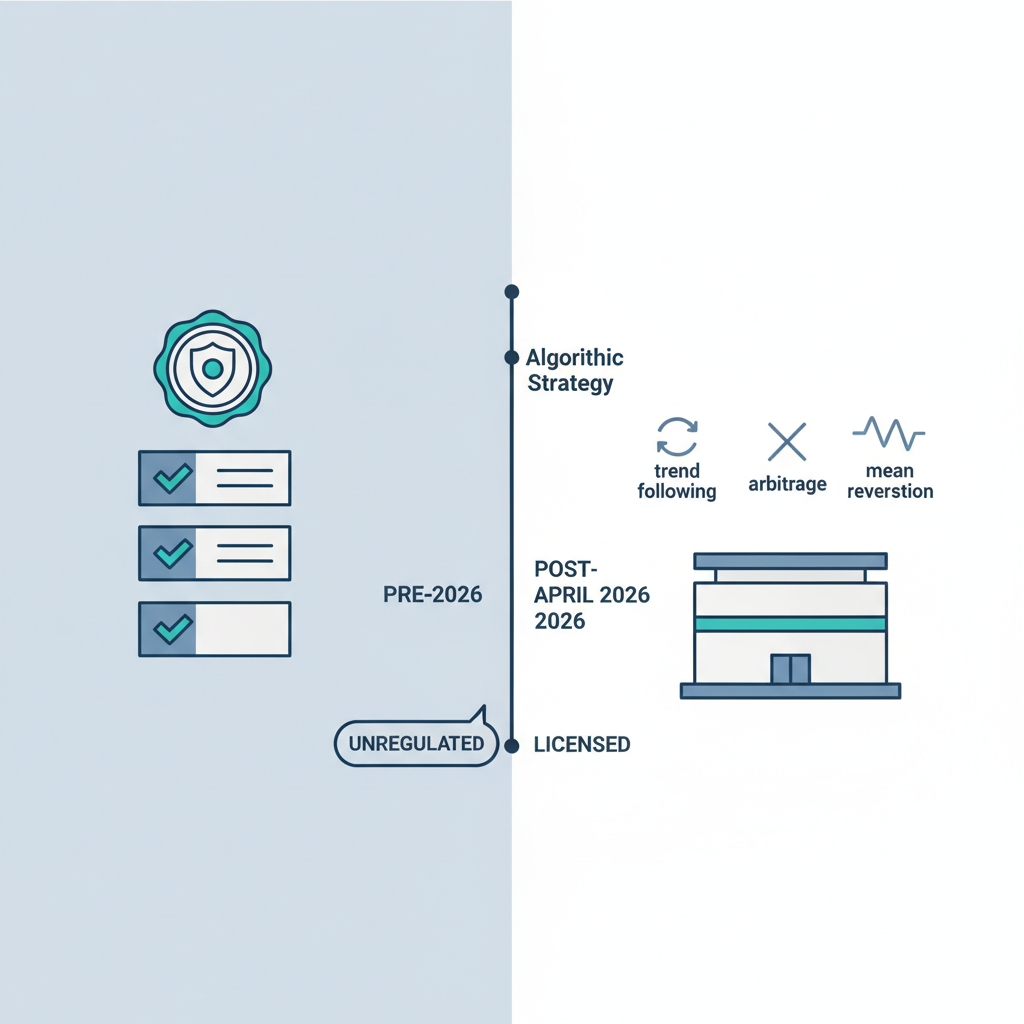
Australia’s regulatory environment adds an additional layer of context. The Australian Securities and Investments Commission (ASIC) oversees conduct and licensing. AUSTRAC handles anti-money laundering and counter-terrorism financing registration. As of April 2026, a new framework requires all crypto exchanges and custody providers to hold an AFSL, bringing Australian crypto closer to the standards that apply to traditional financial services. For anyone using automated trading tools here, that regulatory backdrop is not background noise. It is the difference between trading on a legitimate platform and handing money to a scheme that will disappear.
[INTERNAL LINK PLACEHOLDER: understanding crypto regulation → regulatory-guide-pillar]
Australia’s Crypto Regulation in 2026: What Algo Traders Must Know
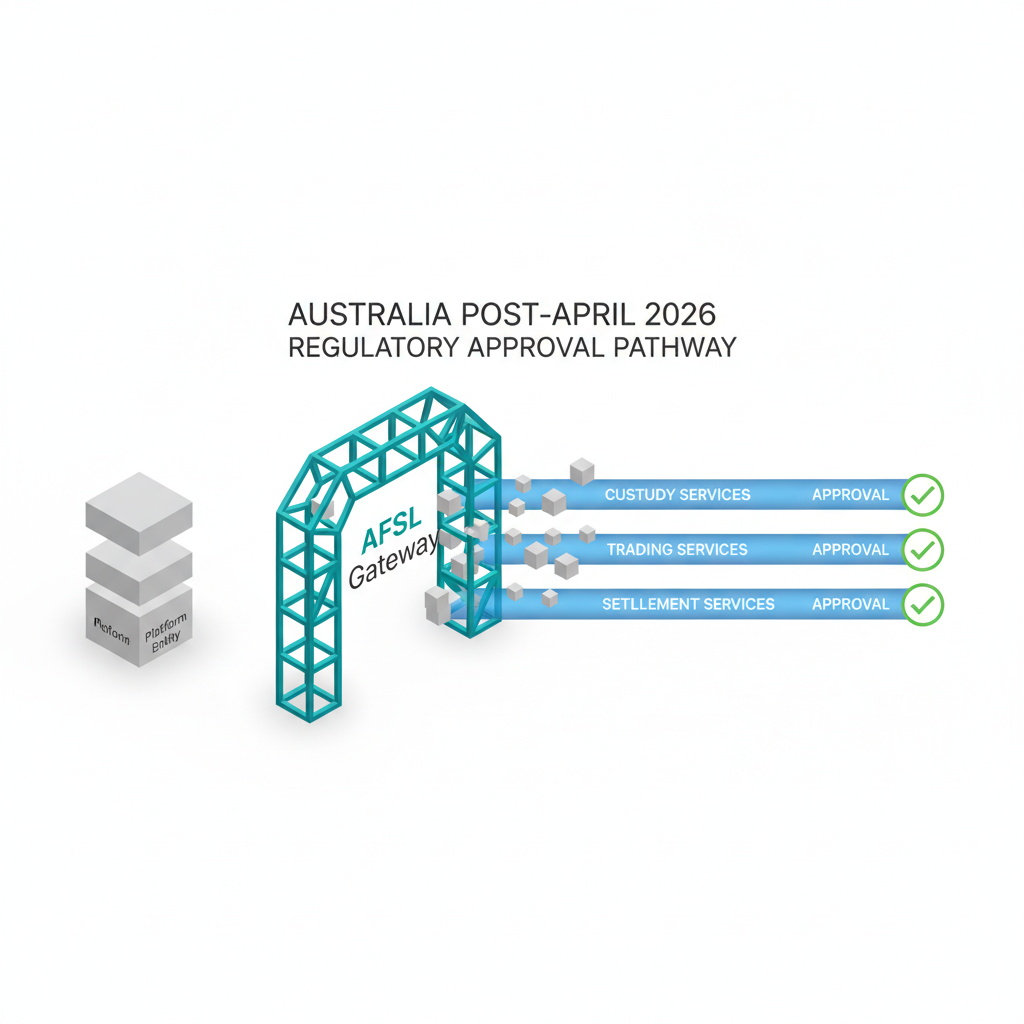
On April 1, 2026, Australia passed its first comprehensive crypto regulation framework. The headline requirement: all exchanges and custody providers have six months to obtain an Australian Financial Services Licence. This is not a minor administrative update. It means platforms must meet ASIC’s conduct, disclosure, and risk management obligations, the same standards that apply to managed funds and stockbrokers.
ASIC’s Role
ASIC has been circling the crypto industry for years, mostly through enforcement rather than legislation. The NGS Crypto civil proceedings are the clearest example: ASIC alleged the company operated without a licence and caused significant losses to Australian investors. The outcome sent a clear signal that operating at the edges of existing financial services laws was no longer a reliable strategy.
In January 2026, ASIC published its Key Issues Outlook, which flagged crypto as a “regulatory perimeter” risk. The specific concern was AI-driven financial services: platforms using algorithmic signals to manage investor funds without holding the licences that would apply to a fund manager. If you are using a third-party algo service that accepts your funds and trades on your behalf, that distinction matters legally.
AUSTRAC’s Role
Separately, all businesses providing virtual asset services in Australia must be registered with AUSTRAC. This covers exchanges, custody providers, and any business facilitating crypto transactions. AUSTRAC maintains a public, searchable register. Check it before depositing anything.
AUSTRAC has specifically flagged crypto ATMs as one of the highest-risk channels for money laundering and has issued fines to operators for compliance failures, including late reporting of large cash transactions and weak risk assessments. The broader AML/CTF expansion introduced alongside the April 2026 framework tightened obligations further.
Debanking
Australian banks have a well-documented history of closing accounts associated with crypto businesses and, in some cases, individual traders. This is a practical risk worth knowing before you route AUD through an exchange with any regulatory ambiguity. Established, AUSTRAC-registered platforms with clear compliance histories are less likely to trigger bank concerns.
How to Verify a Platform
Check three things. First, search the ASIC register at moneysmart.gov.au for the platform’s name and any AFSL number they claim. Second, search the AUSTRAC reporting entities register. Third, look for a physical Australian address and ABN. Any platform that cannot pass those three checks deserves serious scepticism, regardless of what their Trustpilot page says.
Common Crypto Algo Trading Strategies Used in Australia
Most retail algo traders in Australia are running one of a handful of core strategies. Understanding what they are and what they require in practice is useful before you pay for a subscription or start configuring a bot.
Trend-Following
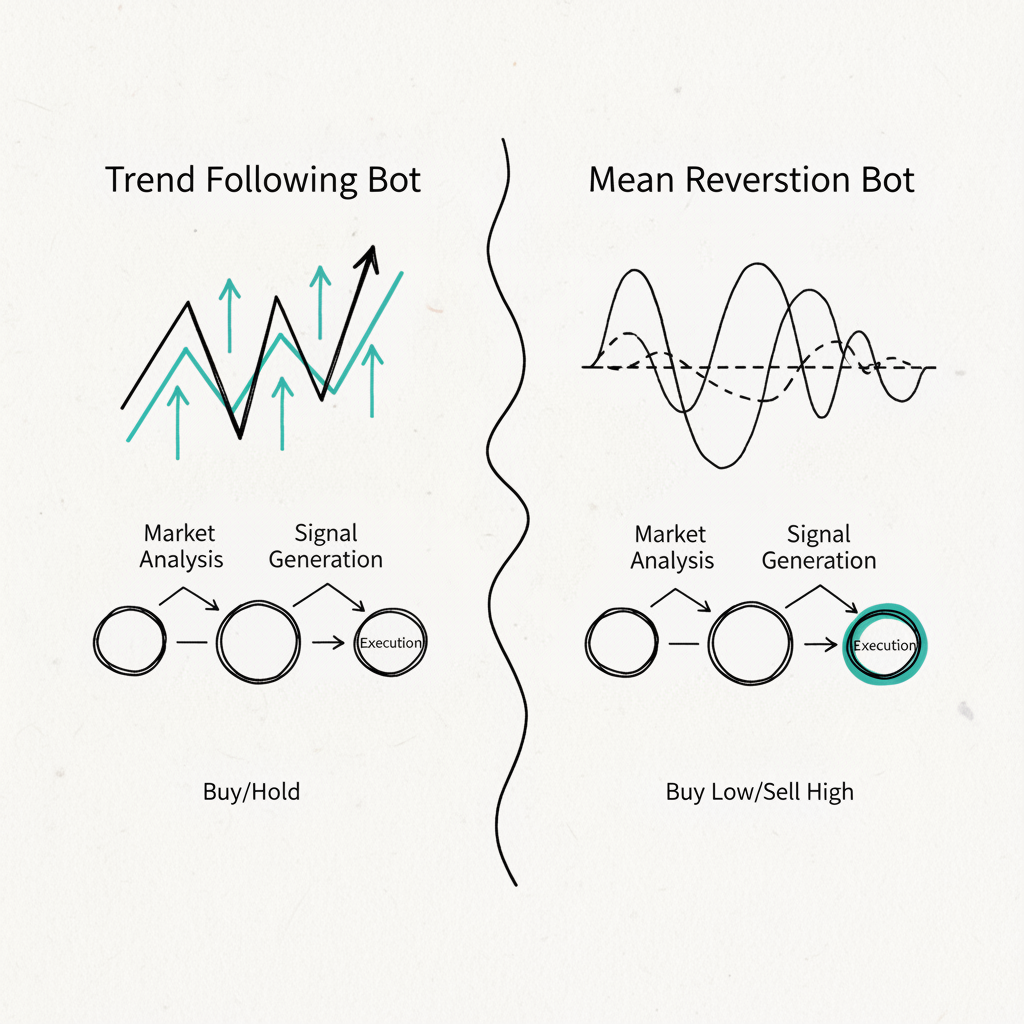
The most common starting point. These strategies use indicators like moving averages, MACD, or RSI to identify when an asset is trending and enter in the direction of that trend. In crypto, trend-following can work well during extended bull runs and tends to produce false signals in choppy, sideways markets. The strategy is accessible to retail traders through most bot platforms and does not require custom code.
Arbitrage
Arbitrage involves exploiting price differences for the same asset across two or more exchanges. In traditional markets, institutional players have compressed these opportunities to near-zero. In crypto, they still exist, particularly between Australian-based exchanges and offshore venues, or between centralised and decentralised exchanges. The catch is execution speed and transaction costs. By the time you factor in maker/taker fees and blockchain gas fees on both legs, many apparent arbitrage opportunities disappear. Genuinely profitable arb in crypto requires fast execution and programmatic order routing, tools like Hummingbot are built specifically for this.
Mean Reversion
Mean reversion strategies assume that prices that have moved far from their historical average will revert. In crypto, this can work in range-bound conditions but gets destroyed during trending markets. It requires careful parameter setting and stop-loss discipline, because the key risk is that a “stretched” price simply keeps stretching.
Momentum and Market Making
Momentum strategies ride short-term price surges, entering positions after a move has started and exiting when momentum fades. Market making is different: the bot places simultaneous buy and sell orders around the current price, capturing the spread on each fill. Market making requires meaningful capital to generate returns at typical crypto spreads and is most effective on high-volume pairs like BTC/AUD or ETH/AUD.
High-Frequency Trading
HFT in the traditional sense, where firms operate co-located servers with sub-millisecond latency, is almost entirely institutional in Australia. Australian retail traders do not have the infrastructure or exchange access to compete in that space. Retail-accessible “high-frequency” strategies are better described as short-interval momentum or scalping, and they carry proportionally higher fee drag.
For DIY traders interested in building strategies without purchasing a commercial platform, Hummingbot is an open-source Python framework that runs on both CEX and DEX environments and has genuine community support.
Top Platforms Supporting Crypto Algo Trading in Australia
Platform selection for crypto algo trading Australia requires thinking about three things simultaneously: regulatory standing, algo support, and cost structure. Here is how the main options compare.
| Platform | AUSTRAC/ASIC Status | Algo/Bot Support | AUD Deposit Methods | Maker/Taker Fees | Key Feature |
|---|---|---|---|---|---|
| Eightcap | AFSL holder (ASIC regulated) | MT4/MT5 EAs, TradingView | Bank transfer | Spread-based (CFDs) | 95+ crypto CFDs, regulated broker |
| IC Markets | AFSL holder (ASIC regulated) | MT4/MT5 EAs | Bank transfer | From 0.0% + commission | Ultra-low spreads, fast execution |
| CoinSpot | AUSTRAC-registered | Limited API | PayID, BPAY, card | 0.1% market / up to 1% instant | 530+ cryptos, AUD-native |
| Swyftx | AUSTRAC-registered | API, demo mode | PayID, bank transfer | 0.6% spread BTC/AUD | Demo mode, strong AU support |
| Digital Surge | AUSTRAC-registered | API access | PayID instant | From 0.1% | Fast AUD settlement, 400+ assets |
| Kraken | AUSTRAC-registered | Kraken Pro API | Bank transfer | 0.16%/0.26% maker/taker | Staking, pro interface, low fees |
| Cryptohopper | Third-party bot platform | Full bot suite | Via connected exchange | Subscription + exchange fees | Strategy marketplace, AI signals |
| Hummingbot | Open-source tool (no custody) | Full CEX/DEX support | N/A (self-hosted) | Exchange fees only | Free, open-source, DEX capable |
A few things worth unpacking from that table.
Eightcap and IC Markets are ASIC-regulated brokers, which means they hold AFSLs and operate under the conduct obligations that come with that. The important distinction: they offer crypto CFDs, not spot crypto. You are trading price exposure, not owning the underlying asset. For algo traders using MetaTrader Expert Advisors, that setup is familiar and well-supported. For traders who want to actually hold BTC or ETH, CFDs are not the right instrument.
I have been using Swyftx since 2022 for spot trading. The 0.6% spread on BTC/AUD is not the absolute tightest in the market, but the platform reliability and the quality of Australian customer support have made it worth it. The demo mode is genuinely useful for testing a strategy before going live with real AUD.
Cryptohopper is a cloud-based bot platform that connects to your existing exchange accounts via API. It does not hold your funds. You configure strategies (or copy from their marketplace), it executes on your behalf via the connected exchange. The paid subscription tiers start at roughly USD $19/month and go up from there depending on the number of positions and features. It is the most accessible entry point for retail traders who want algo functionality without writing code.
Platforms with unclear regulatory status, including cryptoalgorithm.net, should be avoided entirely. No AUSTRAC registration, no AFSL, no verifiable Australian address: none of those boxes are ticked, and the research suggesting it may be an unlicensed scheme is consistent with what ASIC has warned about repeatedly.
[INTERNAL LINK PLACEHOLDER: Swyftx review → swyftx-review]
[INTERNAL LINK PLACEHOLDER: Eightcap review → eightcap-review]
Fees, Spreads and Subscription Costs for Australian Algo Traders
Fees matter more for algo traders than for most other participants because bots generate volume. A strategy that fires 50 trades a week at 0.25% per side is costing you 25% in annual fees before any spread, gas, or subscription cost is counted. Running the numbers is not optional.
On reputable Australian exchanges, maker/taker fees typically sit between 0.1% and 0.25%. Instant buy and sell functions, which execute at market price without order placement, generally charge closer to 1%. Crypto withdrawals carry gas fees set by the blockchain, not the exchange, and these vary significantly. Withdrawing ETH during network congestion can cost more in gas than a small position is worth.
AUD deposit costs are inconsistent across platforms. PayID and direct bank transfers are generally free. CoinSpot charges 2.5% for cash deposits, 1.22% for card, and 0.5% via PayPal, which can meaningfully affect the maths if you are funding regularly. AUD withdrawals range from free to $25 depending on the platform and threshold.
Bitcoin spreads on major Australian exchanges run from about 0.1% to 0.8% in normal market conditions. During volatile periods, that spread widens, sometimes sharply. A mean reversion bot entering and exiting positions during a high-volatility session can get badly hurt by spread alone, independent of whether the directional call was right.
Bot subscription costs add another layer. Cryptohopper runs paid tiers from roughly USD $19 to $107/month. LuxAlgo has its own subscription model for its signal and strategy tools. If you are running a strategy that generates modest returns, a $100/month subscription fee requires a minimum account size and strategy return to break even, work that out before subscribing.
One practical point: some platforms describe themselves as offering “algo trading” but are simply providing automated signals that prompt you to manually confirm trades. That is not algorithmic trading. Real algo execution means the order goes to the exchange without your confirmation on each trade. Make sure you understand which model you are signing up for.
Tax Implications of Crypto Algo Trading in Australia
The ATO does not have a special category for algorithmic trading. What it has is a distinction between holding crypto as an investment, which attracts CGT, and running a trading business, which is taxed differently.
If you are running a bot that executes hundreds of trades per month with a clear profit-making intent, a defined strategy, and you are spending regular time managing it, the ATO may classify your activity as a trading business rather than passive investment. The practical consequence is that profits are assessable as ordinary income rather than capital gains, which removes the 50% CGT discount available to assets held for more than 12 months. On the upside, you can also deduct business expenses: subscriptions, hardware, internet costs, and potentially a portion of a home office.
The CGT vs trading business distinction is genuinely ambiguous in some situations and has not been tested extensively in Australian courts for crypto-specific cases. A crypto-aware accountant is worth the cost here, particularly before you scale up a strategy.
Regardless of classification, the ATO requires an AUD valuation for every taxable event. Every trade, every swap, every disposal. A bot running 200 trades a month generates 200 separate taxable events that need to be recorded with AUD values at the time of execution. Doing that manually is not realistic.
Tax software that integrates with exchange APIs is the practical solution. Koinly and CoinLedger both support Australian exchanges and produce ATO-compatible reports. TradingSTO specifically offers ATO-aligned tax reporting as part of its platform. Upload your API data, generate the report, hand it to your accountant.
Staking rewards and DeFi income are also taxable in Australia, assessed as ordinary income at the time of receipt. If your algo strategy includes staking positions, those rewards need to be tracked separately.
[INTERNAL LINK PLACEHOLDER: crypto tax Australia guide → crypto-tax-australia]
FAQ
Is crypto algo trading legal in Australia?
Yes, crypto algo trading is legal in Australia. There are no laws prohibiting the use of automated trading strategies for personal trading. The regulatory requirements apply to the platforms and services facilitating that trading: they must be AUSTRAC-registered and, from April 2026, hold an AFSL if they operate as an exchange or custody provider.
How do I verify if a crypto platform is legitimate in Australia?
Check the ASIC register at moneysmart.gov.au for any claimed AFSL number. Search the AUSTRAC reporting entities register for the business name. Look for a verifiable Australian ABN and physical address. If any of those checks fail, treat the platform as unverified regardless of reviews.
What is the difference between spot crypto algo trading and CFD-based crypto algo trading?
Spot trading means you own the underlying asset. CFD trading means you have a contract that tracks the asset’s price, but you do not hold the crypto itself. ASIC-regulated brokers like Eightcap and IC Markets offer CFD-based crypto trading via MT4/MT5. Spot exchanges like Swy