Crypto Algorithmic Trading Australia 2026: Complete Guide
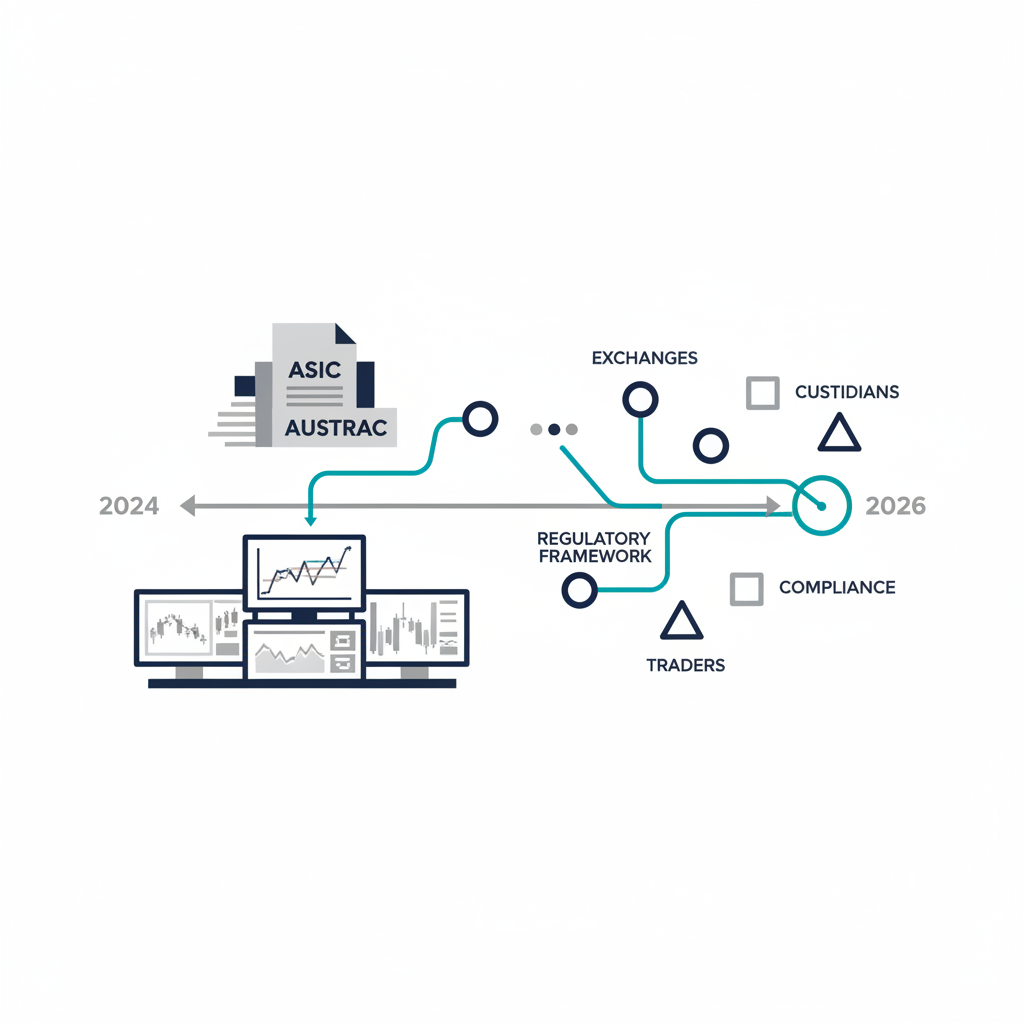
Crypto algorithmic trading in Australia has moved well past the hobbyist phase. In 2026, there are regulated platforms, a new licensing framework, and enough retail interest that ASIC has named crypto a critical regulatory risk in its Corporate Plan. If you are running bots or considering it, the rules have changed significantly in the past six months.
> TL;DR
> Crypto algorithmic trading Australia is legal and growing, but 2026 brings major regulatory changes under the Corporations Amendment (Digital Assets Framework) Bill 2025. Exchanges and custody providers now need an AFSL, AUSTRAC has renamed DCE providers to VASPs and launched a searchable public register, and the ASIC no-action period ends June 30, 2026. Algo traders must manage CGT obligations on every trade, use only AUSTRAC-registered platforms, and navigate banking restrictions that can delay AUD deposits.
What Is Crypto Algorithmic Trading in Australia?
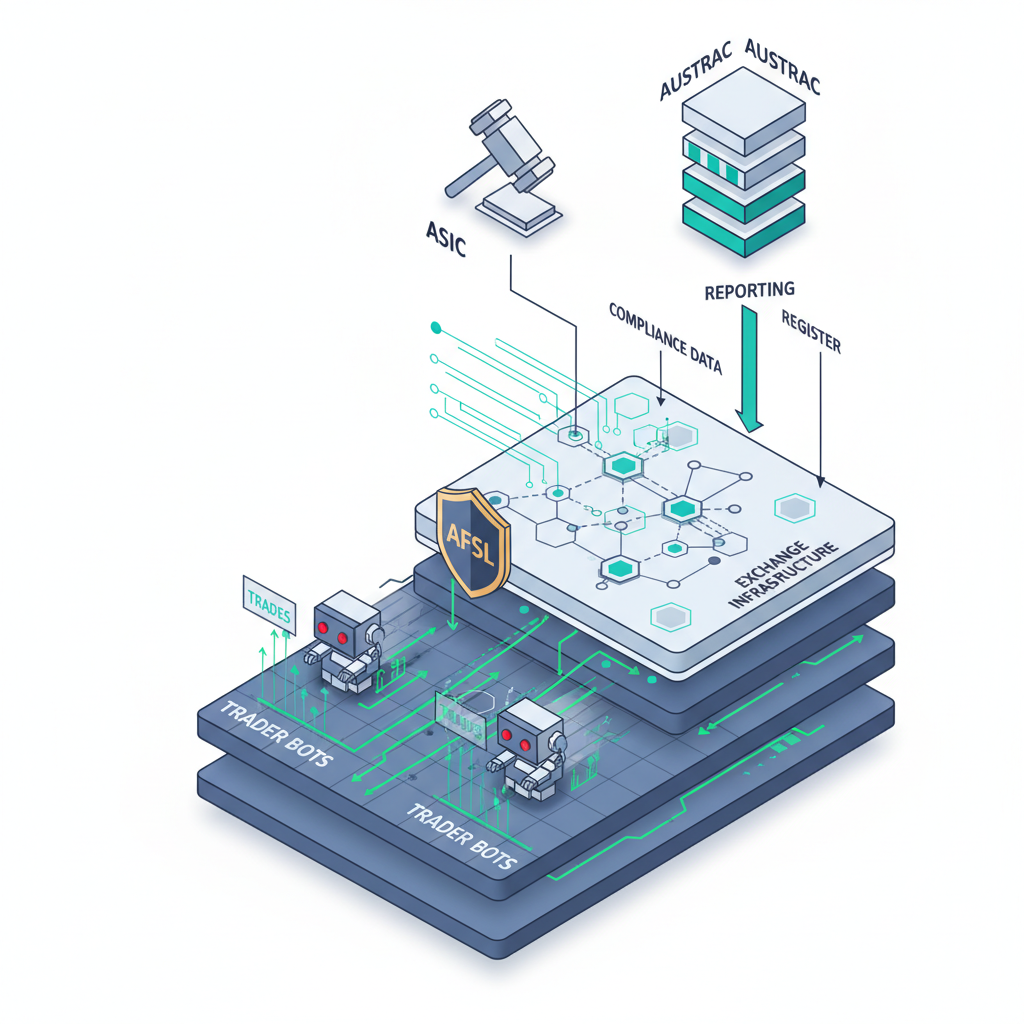
Crypto algorithmic trading is the automated execution of buy and sell orders using pre-programmed rules based on price, volume, time, or other market data. The bot does what you tell it to do, consistently and without the emotional second-guessing that costs discretionary traders money. You set the logic. It runs.
This is distinct from copy trading, where you replicate the live positions of another trader on a platform like eToro. Copy trading involves judgment by a third party. Algo trading involves your own rules, or rules you have explicitly chosen from a strategy library, executed automatically via API.
Australian retail interest in automated crypto trading has been growing steadily since 2022, driven by a maturing exchange ecosystem, better API documentation, and frankly, enough people getting burned by manual trading during volatile sessions to want a more systematic approach. Institutional interest is also rising, with the new AFSL framework giving larger players the legal clarity they have been waiting for.
The regulatory context matters here. The Corporations Amendment (Digital Assets Framework) Bill 2025, passed April 1, 2026, means the platform you use to run your bots must now hold an AFSL or be working toward one. The ATO’s position has not changed: all crypto is property subject to Capital Gains Tax, and every trade your bot executes is a taxable event. Frequency matters for your tax bill.
This guide covers strategies, compliant platforms, tax rules, and what has changed in 2026 in plain language.
2026 Australian Crypto Regulation: What Algo Traders Must Know
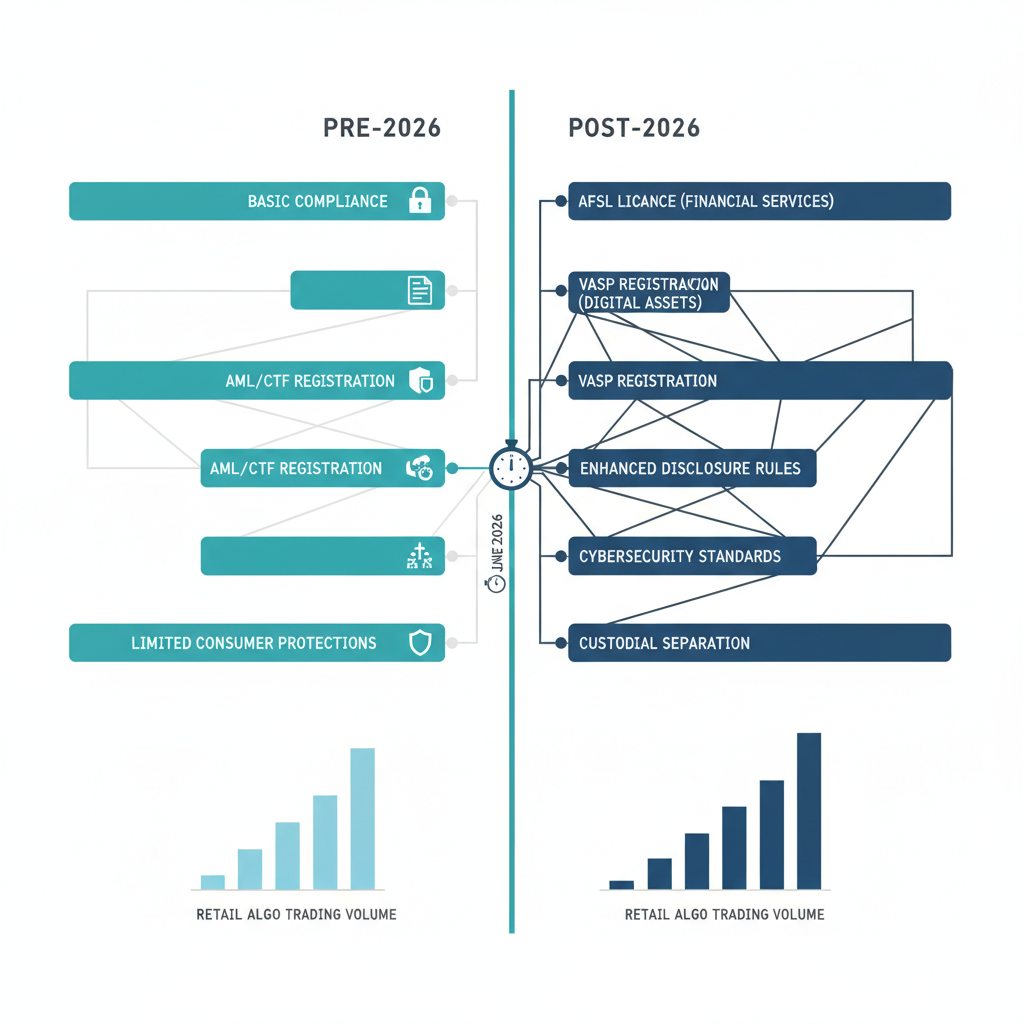
The single biggest change for anyone doing automated crypto trading Australia in 2026 is the AFSL requirement. On April 1, 2026, the Australian Parliament passed the Corporations Amendment (Digital Assets Framework) Bill 2025. From that point, crypto exchanges and custody providers are required to hold an Australian Financial Services Licence, the same class of licence that applies to managed funds, stockbrokers, and financial product dealers.
ASIC has a no-action position until June 30, 2026, for firms that are demonstrably working toward compliance. After that date, expect enforcement action against unlicensed operators. ASIC flagged crypto and AI as critical regulatory risks in its 2026 Corporate Plan, published January 27, 2026, which signals active surveillance, not passive monitoring.
AUSTRAC’s New VASP Framework
AUSTRAC’s expanded AML/CTF laws came into effect March 31, 2026. The old Digital Currency Exchange (DCE) category has been replaced with Virtual Asset Service Provider (VASP), which covers a broader range of services. There is now a public searchable register of VASPs, which is worth bookmarking.
All VASPs must obtain pre-approval before commencing operations. Ongoing obligations include KYC procedures, Threshold Transaction Reports (TTRs) for cash transactions over A$10,000, and Suspicious Matter Reports (SMRs) filed within 72 hours. AUSTRAC cancelled several VASP registrations in early 2026, including refusing to renew TRANSFAST SERVICES PTY LTD in January, so the register changes. Check it before you deposit.
Smaller platforms get some breathing room: those holding under A$5,000 per customer and processing under A$10 million in annual transactions are exempt from the full AFSL requirements, though AUSTRAC registration still applies.
Banking Restrictions: Still a Real Problem
Coinbase formally complained to the Australian parliament in February 2026 about major banks systematically debanking crypto companies. CBA still enforces a fixed A$10,000 monthly cap on transfers to crypto exchanges. ANZ, Westpac, and NAB all apply their own restrictions and some place 24-hour holds on initial crypto transfers.
This directly affects algo traders because delayed AUD deposits mean missed trade windows. Factor this into your setup, especially if you are topping up a bot account from a CBA account.
Watch List: Scam Platforms
The site cryptoalgorithm.net has been identified as an unregulated, unauthorised operation with no ASIC record. It is not a grey area. Before depositing funds anywhere, check two things: the AUSTRAC VASP register and ASIC’s professional registers at moneysmart.gov.au. If a platform is not on both, walk away.
Common Crypto Algo Trading Strategies Used in Australia
Trend Following
The most widely used bot strategy in Australian crypto markets. The bot detects upward or downward price momentum and enters positions aligned with the trend, typically using moving average crossovers or breakout signals. It works well in BTC/AUD and ETH/AUD markets during sustained directional moves but bleeds slowly in choppy conditions. Most retail algo setups I have seen start here because the logic is straightforward to code and backtest.
Arbitrage
Arbitrage bots exploit price differences across exchanges. If BTC is trading at A$142,000 on Binance and A$142,400 on CoinSpot, a bot can buy on one and sell on the other. In practice, you need low-latency execution and AUD already sitting on both exchanges, because by the time a bank transfer clears, the gap has closed. Cross-exchange arbitrage is harder than it sounds but still viable with the right infrastructure.
Mean Reversion
This strategy assumes that prices return to a historical average after deviating from it. In range-bound markets, it can be very effective. The bot buys when price drops significantly below a moving average and sells when it returns. It falls apart quickly in trending markets, which is why some traders combine it with a trend filter to switch strategies based on market conditions.
Momentum and Market Making
Momentum trading buys assets showing strong recent performance over shorter horizons than trend-following, often measured in hours rather than days. Market making sits at the other end of the risk spectrum: the bot simultaneously places buy and sell limit orders either side of the mid-price, collecting the spread repeatedly. Market making requires significant capital and reliable API access. Most Australian retail traders running market-making bots use Binance or Kraken due to their API depth.
High-frequency trading at institutional scale, thousands of executions per second, is largely out of reach for retail traders in Australia due to infrastructure costs and co-location requirements. Some sophisticated retail traders run lower-frequency versions, but it is not where most people start.
Tax Reality Check
Every strategy above generates CGT events in Australia. A bot running 50 trades a day is creating 50 separate disposal events. Each one needs to be recorded with the AUD value at time of trade, cost base, and gain or loss. This is where tools like Koinly or CoinTracker become essential, not optional. If you hold a position for over 12 months you are eligible for the 50% CGT discount, but most algo strategies churn positions far faster than that. [INTERNAL LINK PLACEHOLDER: CGT on crypto trading → crypto-tax-australia-guide]
Best Platforms for Crypto Algorithmic Trading in Australia 2026
The platform you choose determines your execution quality, your API options, and whether you are operating on a compliant exchange after June 30, 2026. Below is a comparison of the main options available to Australian algo traders, followed by notes on each.
| Platform | AFSL/AUSTRAC Status | Trading Fees | API/Bot Support | AUD Support | Best For |
|---|---|---|---|---|---|
| Binance | AUSTRAC registered | 0.1% maker/taker | Yes, full API | PayID deposits | Multi-strategy bots, large asset range |
| Kraken | AUSTRAC registered | 0.16%/0.26% maker/taker | Yes, full API | AUD deposits/withdrawals | Advanced traders, reliable execution |
| Coinbase | AUSTRAC registered | 0.4%/0.6% maker/taker | Yes, Coinbase Advanced API | AUD support | Liquidity, institutional-grade depth |
| Pepperstone Crypto | AFSL holder | 0.1% flat commission | API access | AUD | Regulated, transparent pricing |
| IC Markets | AFSL holder | Raw spreads, low commission | MT4/MT5, API | AUD | Experienced traders, MT4 bots |
| Altrady | Via partner exchanges | Subscription-based | Built-in bots, multi-exchange | AUD deposit support | Bot-first traders, multi-exchange management |
| CoinSpot | AUSTRAC registered | 0.1% market orders | Limited API | Free PayID deposits | AUD on/off ramp, simpler strategies |
| Swyftx | AUSTRAC registered | ~0.6% spread on BTC/AUD | Basic API | AUD | Beginners, education-first approach |
| Jaaims | Australian-built | Subscription model | AI buy/sell signals | AUD | Retail users wanting guided automation |
| Alpaca | Check current status | Low, API-driven | Developer-grade API | USD primary | Technical traders building custom bots |
Binance
Binance has the deepest liquidity and the most comprehensive API documentation of any exchange accessible to Australians. Its bot ecosystem is extensive, with support for all major strategy types and WebSocket connections for real-time data. AUD deposits via PayID are available and generally fast. The caveat is that Binance has had a complicated regulatory history globally, and you should confirm its current AUSTRAC status before opening a new account.
Kraken
I have been using Kraken since 2022 for more systematic strategies and it remains the most reliable exchange I have tested for uptime during high-volatility periods, which matters when your bot is running. The AUD deposit and withdrawal functionality works cleanly, maker fees are 0.16%, and the API documentation is thorough. Not the most beginner-friendly interface, but that is not who Kraken is for.
Pepperstone Crypto Spot
Pepperstone launched its crypto spot exchange on April 23, 2026, and it is worth paying attention to for one reason: it already holds an AFSL. The fee structure is a flat 0.1% commission with spreads published upfront, which is genuinely more transparent than most crypto exchanges. For traders who want regulatory certainty after June 30, 2026, this is a serious option. The asset range is narrower than Binance, but it is growing.
IC Markets
IC Markets is better known for forex and CFDs, but its MetaTrader 4 infrastructure supports crypto CFDs with API and Expert Advisor (EA) bot access. Raw spreads and low commissions make it cost-effective for high-frequency strategies in that format. It is an AFSL holder, which ticks the compliance box. The limitation is that you are trading CFDs on crypto, not spot, which has different risk and tax treatment.
Altrady
Altrady is purpose-built for algo traders who want to manage bots across multiple exchanges from one dashboard. It integrates with Binance, Kraken, Coinbase, and others via API, and includes built-in bot templates for grid trading, DCA strategies, and signal-based execution. It is not an exchange itself, so its regulatory status depends on the underlying exchanges you connect. AUD deposit support runs through the connected exchanges.
CoinSpot
CoinSpot is the most widely used Australian exchange for retail traders. Its API is limited compared to Binance or Kraken, which makes it less suitable for sophisticated algo strategies. Where it excels is as an AUD on/off ramp: free PayID deposits, reliable AUD withdrawals, and a straightforward tax reporting export. If you are running bots on Binance but want to hold AUD locally, CoinSpot is a sensible pairing.
Swyftx
Swyftx is beginner-friendly and has good educational resources, but its basic API limits what you can automate. The BTC/AUD spread sits around 0.6%, which is acceptable for manual trading but adds up quickly at bot-level trade frequency. Best suited to traders who are learning the space before moving to more API-capable platforms. [INTERNAL LINK PLACEHOLDER: Swyftx review → swyftx-review-australia]
Jaaims
Jaaims is an Australian-built platform that uses AI-generated buy and sell signals rather than traditional rule-based algo execution. It is aimed squarely at retail users who want automation without writing code or configuring API keys. The signal quality is something each user needs to evaluate independently. It operates on a subscription model and supports AUD.
Alpaca
Alpaca is popular with developers building custom bots from scratch. Its API is clean, fees are low, and the documentation is genuinely good. The primary currency is USD rather than AUD, which creates currency conversion costs for Australian users. Confirm its current AUSTRAC/AFSL status before using it for crypto specifically, as its core business is equities.
The June 30 Deadline
The ASIC no-action period expires June 30, 2026. Platforms not compliant by then are candidates for enforcement action. Before you invest time configuring a bot strategy on any platform, check that it appears on the AUSTRAC VASP register and, for larger platforms, that it has applied for or holds an AFSL. This is not paranoia. ASIC cancelled multiple registrations in the first quarter of 2026 and has explicitly flagged crypto as a surveillance priority.
Frequently Asked Questions
Is crypto algorithmic trading legal in Australia?
Yes. There is no law against automated or algorithmic trading of cryptocurrency in Australia. The legal requirements relate to the platforms you use, which must be AUSTRAC-registered VASPs, and increasingly must hold an AFSL. Your own trading activity is legal provided you meet your ATO tax obligations.
Do I pay tax on every trade my bot makes?
Yes. The ATO treats each disposal of cryptocurrency, including swapping one coin for another, as a CGT event. If your bot executes 200 trades in a financial year, you have 200 CGT events to calculate and report. The 50% CGT discount for assets held over 12 months rarely applies to active algo trading strategies because positions are held for days or hours, not years.
What happens to my exchange account after June 30, 2026?
If a platform you use fails to obtain an AFSL and ASIC takes enforcement action, it could be forced to suspend Australian operations. Your funds could be locked during that process. The practical step is to use platforms that already hold an AFSL (Pepperstone, IC Markets) or are demonstrably compliant (Binance, Kraken, Coinbase).
Can my bank block my crypto exchange transfers?
Yes, and they do. CBA has a fixed A$10,000 monthly limit on transfers to crypto exchanges. ANZ and other major banks apply their own restrictions and some hold initial transfers for 24 hours. This affects bot trading because it limits how quickly you can fund a position. Using a PayID-compatible exchange like CoinSpot or Swyftx helps with transfer speed once the account is established.
What is the difference between a VASP and a DCE in Australia?
DCE (Digital Currency Exchange) was the old AUSTRAC registration category. From March 31, 2026, it was replaced by VASP (Virtual Asset Service Provider), which covers a broader range of digital asset services including custody and some DeFi-adjacent services. The AUSTRAC public register now lists VASPs, so that is where you check a platform’s status.
Is copy trading the same as algo trading?
No. Copy trading replicates the live positions of another trader, typically via a platform like eToro. Algorithmic trading executes trades based on rules you have set, or a strategy you have selected, via automated