Crypto Algo Trading in Australia: Platforms, Rules & Tax Guide (2026)
My inbox gets the same question about three times a week: “Is it legal to run a bot on a crypto exchange in Australia, and how do I do it without getting destroyed at tax time?” The short answer is yes, it is legal, and the tax situation is manageable if you keep decent records. The longer answer is what follows.
> TL;DR: Algorithmic crypto trading is legal in Australia for retail and professional traders, but platforms must now be registered with AUSTRAC as Virtual Asset Service Providers (VASPs) following the April 2026 reforms. ASIC is moving toward requiring an AFSL for digital asset platforms, with a no-action window closing 30 June 2026. The ATO taxes most crypto disposals as CGT events, with a 50% discount for assets held longer than 12 months.
What Is Crypto Algo Trading and Why Does It Matter for Australians?

Algorithmic trading means your computer executes trades for you based on a predefined set of rules. You write the logic, or you subscribe to someone else’s strategy, and the system handles order placement, position sizing, and exit conditions automatically. No sitting at a screen at 2am watching a BTC candle.
The practical benefits are real. Execution is faster than any human, which matters when you are trading thin spreads or volatility events. Bots do not panic-sell because they saw a scary headline, and they will run a grid strategy across a weekend when you are at a barbecue in Noosa. The ability to process multiple data streams simultaneously, across multiple pairs, is simply not achievable manually at any reasonable scale.
The risks are equally real. A poorly designed algorithm on a volatile coin does not lose money slowly. It loses money at machine speed. I have seen traders backtest a strategy beautifully on 2021 data and then watch it get demolished in a ranging 2023 market. The algorithm does exactly what you told it to do, which is the problem when what you told it to do was wrong.
For Australians specifically, 2026 is a meaningful year. The regulatory framework has shifted materially, with AUSTRAC renaming and re-registering all digital currency businesses as VASPs from April 2, 2026, and ASIC moving closer to formal AFSL requirements for crypto platforms. That matters when you are choosing where to run your strategies. This guide covers the platforms worth considering, the regulatory obligations you need to understand, the tax treatment the ATO applies to algo-generated trades, and the very real banking friction you will encounter along the way.
Is Crypto Algo Trading Legal in Australia?
Yes, algorithmic crypto trading is legal in Australia for both retail and professional traders. There is no regulation that prohibits automating your trading strategy, and the ATO has clear published guidance on how the resulting gains and income get taxed.
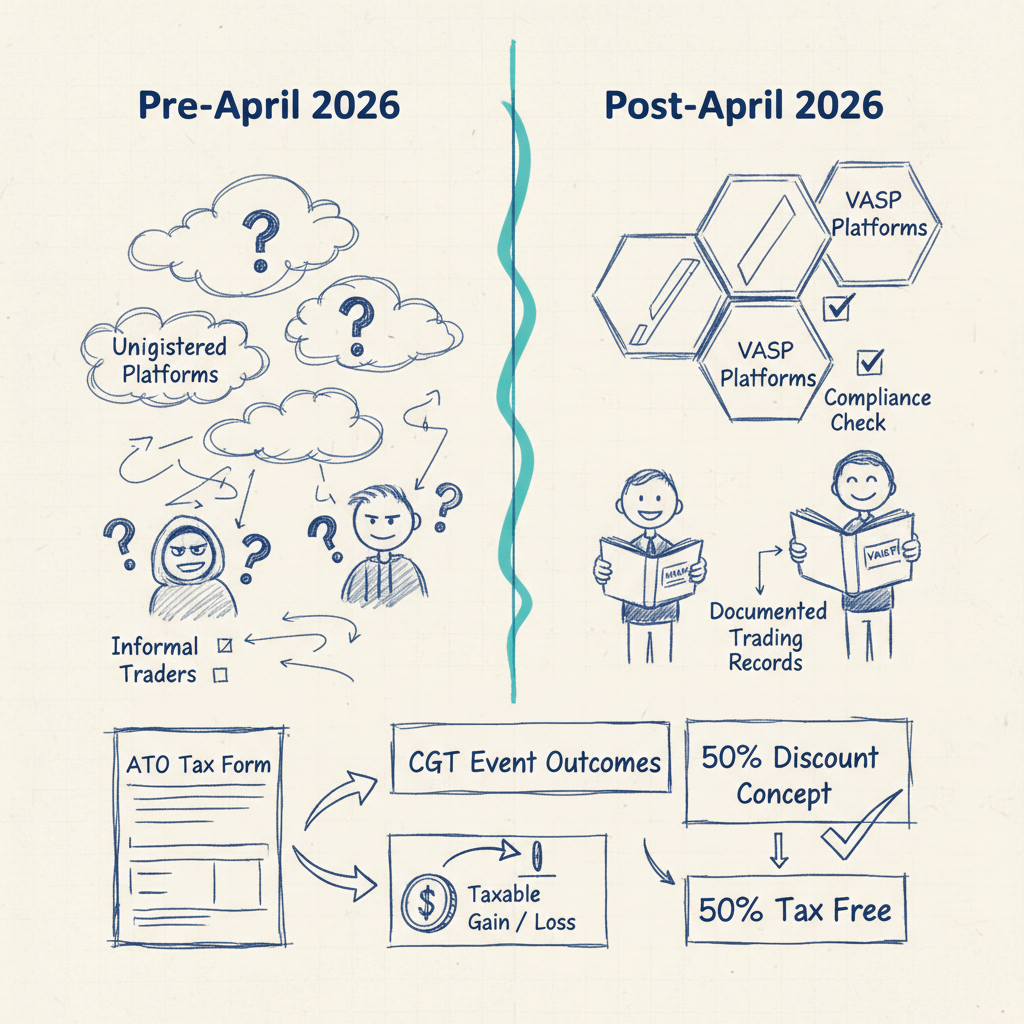
The compliance obligations, though, sit primarily with the platforms you use, and that is where Australian traders need to pay attention. Any platform operating as a Virtual Asset Service Provider in Australia must be registered with AUSTRAC. As of April 2, 2026, what were previously called Digital Currency Exchanges (DCEs) are now formally categorised as VASPs under Australia’s updated AML/CTF framework. Operating without registration after March 31, 2026 carries criminal penalties for the platform, not the trader, but trading on an unregistered platform exposes you to counterparty risk you do not need.
ASIC sits alongside AUSTRAC with a separate but overlapping mandate. Where a crypto asset or trading service constitutes a financial product, ASIC’s licensing requirements apply. The proposed government reforms currently working through the system would bring most significant digital asset platforms under the existing financial services framework, meaning they would need an Australian Financial Services Licence. ASIC granted a sector-wide no-action position until June 30, 2026, giving firms time to assess their obligations and apply for licences. After that date, the expectation is enforcement.
ASIC’s 2026 Key Issues Outlook, published in January, specifically called out unlicensed activity and misleading conduct as top risks in the digital assets space. That is a signal worth taking seriously. Before you deposit funds anywhere, check that the platform appears on the AUSTRAC VASP register and, where relevant, holds or is actively seeking an AFSL.
AUSTRAC Registration and VASP Obligations: What Traders Need to Know
From April 2, 2026, every business in Australia that exchanges, transfers, or provides custody services for digital assets is classified as a Virtual Asset Service Provider. The renaming from DCE to VASP is not cosmetic. It reflects an expanded scope that covers a wider range of crypto-related products and services than the old DCE category did, and it aligns Australia formally with the Financial Action Task Force (FATF) international standards.
What this means in practice for VASPs is substantial. They must enrol and register with AUSTRAC, develop and maintain an AML/CTF program, conduct customer verification (KYC) for all users, monitor transactions on an ongoing basis, and report suspicious matters and threshold transactions to AUSTRAC. The obligations are not dissimilar to those applied to banks and other financial institutions.
For traders, the practical implication is straightforward: AUSTRAC maintains a searchable public register of registered VASPs, and you should use it. Go to the AUSTRAC website, search for the platform you are considering, and confirm it appears on the register before depositing a single dollar. If a platform is not on the register, you have no guarantee it is meeting its AML/CTF obligations, which means your KYC data may be inadequately protected and your funds are sitting on an unregulated service.
Operating without VASP registration after March 31, 2026 carries criminal penalties. Any platform still taking Australian customers without registration after that date should be avoided immediately, regardless of how attractive the fee structure looks.
ASIC Licensing and the Road to an AFSL for Crypto Platforms
ASIC’s role in crypto is more nuanced than AUSTRAC’s, and it is evolving fast. AUSTRAC is purely about AML/CTF compliance. ASIC is concerned with whether the products and services offered constitute financial products under the Corporations Act, and whether the people offering them hold appropriate licences.
The proposed government reforms, which have been in consultation throughout 2025 and 2026, aim to bring digital asset platform providers into the existing financial services framework. That means platforms handling crypto assets that qualify as financial products would need to hold an Australian Financial Services Licence. The AFSL framework comes with obligations around dispute resolution, adequate capital, proper systems, and conduct requirements. It is meaningfully more demanding than VASP registration alone.
ASIC’s no-action position, valid until June 30, 2026, means that firms operating in good faith while transitioning toward compliance are currently protected from enforcement action. After that date, the expectation is that platforms either hold an AFSL or have a credible application underway.
When choosing a platform for algo trading, the AFSL status matters. eToro already holds an AFSL in Australia and is registered with AUSTRAC. Interactive Brokers Australia is a fully licensed broker under the existing framework. Platforms that are neither AFSL-licensed nor actively pursuing one after June 30, 2026 represent a regulatory risk that sophisticated traders should price in.
ASIC’s 2026 outlook also flagged misleading conduct as a priority concern. That is partly a response to platforms making claims about returns that are not substantiated. If an algo trading platform is promising you consistent profits or specific returns, that is a red flag in both a regulatory and a practical sense.
Best Crypto Algo Trading Platforms Available in Australia (2026)
There is no single platform that suits every algo trading approach. What works for running a simple grid bot on BTC/AUD is different from what you need to backtest a multi-exchange arbitrage strategy. Here is how the main options break down.
Exchange-Based Platforms
Swyftx is an Australian-based exchange I have been using since 2022. It supports AUD deposits via PayID and bank transfer, is registered with AUSTRAC, and has a clean API that connects to most third-party bot platforms. The spread on BTC/AUD sits around 0.6%, and the interface is genuinely beginner-accessible without feeling condescending for more experienced traders. The demo mode is useful for testing strategies without real capital.
CoinSpot is the other major Australian exchange worth knowing. It lists over 510 coins, fees start from 0.1% for market orders, and it holds ISO 27001 security certification. The API is functional for bot connections, though some traders find it less flexible than Kraken for complex strategies.
Kraken is my preferred exchange for anything requiring professional-grade tooling. AUD deposits and withdrawals work reliably, the Advanced Trade interface gives you proper order types, and Kraken’s staking options mean you can put idle capital to work between strategy runs. The 24/7 phone support is unusual in this industry and has been genuinely useful on two occasions when I had deposit timing issues.
eToro is the platform to consider if copy trading is part of your strategy. It holds an AFSL and AUSTRAC registration, making it one of the more compliant options available. The copy trading feature lets you mirror experienced traders algorithmically, which is a legitimate form of automated strategy even if it is not bot-coded in the traditional sense.
Dedicated Bot and Algo Platforms
3Commas connects to multiple exchanges and provides DCA bots, grid bots, and options for more complex signal-based strategies. The performance tracking dashboard is detailed, which is important when you are evaluating whether a strategy is actually working or just happened to benefit from a rising market.
Cryptohopper offers a broader feature set including paper trading, trailing stops, market-making bots, and arbitrage tools. The social trading element lets you subscribe to community strategies. It runs on a subscription model, with plans ranging from a free tier with limited bots up to paid tiers for full functionality.
Bitsgap is strong for grid bots and arbitrage across multiple exchanges simultaneously. The cross-exchange price tracking is a standout feature if you are running spread strategies between pairs listed on different exchanges.
Pionex has 16 built-in trading bots and charges 0.05% maker/taker fees across the board, which is low. For traders who want integrated bots without paying a separate subscription, it is worth considering. The platform is its own exchange, so you are not connecting a third-party bot to an external account.
Traditional Brokers with Algo Tools
Interactive Brokers Australia is a fully licensed broker offering access to crypto alongside equities, futures, and other instruments. The algo trading infrastructure is sophisticated, including a proper backtesting environment and API access. Fees are competitive, and the regulatory status is unambiguous. If you want to run strategies across asset classes, not just crypto, this is the platform to consider.
IG Australia has deep experience in CFD and options trading and supports algorithmic strategies through its ProRealTime integration. If you want crypto exposure through CFDs rather than spot holdings, IG is a credible option. Know that CFD positions do not generate CGT on disposal in the same way spot crypto does, which has tax implications worth discussing with your accountant.
Trading Software
MetaTrader 5 has a large library of Expert Advisors and supports automated strategy execution. The crypto coverage through MT5-connected brokers is narrower than dedicated crypto exchanges, but the backtesting environment and strategy tester are industry-standard.
cTrader is cleaner than MT5 in terms of interface and is popular with Australian CFD traders. The cBots functionality allows fully automated strategies with proper position management. Pepperstone and Vantage both offer cTrader access with crypto instruments included.
For strategy building and backtesting specifically, SpeedBot offers live and simulated bot testing, and UltraAlgo delivers pre-built strategy indicators with technical analysis integration. Both are worth exploring if you are building strategies from scratch rather than subscribing to someone else’s.
One specific note: a site called cryptoalgorithm.net has been identified as an unregulated forex broker with characteristics consistent with a scam operation. It has no ASIC or AUSTRAC registration. Do not use it.
Platform Comparison Table: Crypto Algo Trading Options for Australians
| Platform | Type | AUD Support | AUSTRAC/ASIC Status | Key Algo Feature | Approx Fees | Best For |
|---|---|---|---|---|---|---|
| Swyftx | Spot Exchange | Yes | AUSTRAC Registered | API + 3rd party bot support | ~0.6% spread | Aus-based beginners to intermediate |
| CoinSpot | Spot Exchange | Yes | AUSTRAC Registered | API, 510+ coins | From 0.1% | Asset variety, Australian focus |
| Kraken | Spot Exchange | Yes | AUSTRAC Registered | Advanced order types, staking | 0.16%–0.26% maker/taker | Professional traders, API strategies |
| eToro | Spot + Copy Trading | Yes | AFSL + AUSTRAC | Copy trading, smart portfolios | Spread-based | Copy trading, regulatory compliance |
| 3Commas | Bot Platform | Via exchange | 3rd party — verify exchange | DCA + grid bots, performance tracking | From ~$14.50/mo USD | Multi-exchange bot management |
| Cryptohopper | Bot Platform | Via exchange | 3rd party — verify exchange | Paper trading, arbitrage, social bots | Free to ~$99/mo USD | Strategy variety, beginners to advanced |
| Bitsgap | Bot Platform | Via exchange | 3rd party — verify exchange | Grid + arbitrage, cross-exchange | From ~$29/mo USD | Arbitrage and grid strategies |
| Pionex | Integrated Exchange + Bots | Yes (via wire/crypto) | AUSTRAC Registered | 16 built-in bots | 0.05% flat | Integrated bots, low fees |
| Interactive Brokers Australia | Licensed Broker | Yes | AFSL Licensed | Advanced backtesting, API | From 0.12% | Multi-asset algo, professional traders |
| IG Australia | CFD Broker | Yes | AFSL Licensed | ProRealTime algo integration | Spread-based | CFD crypto exposure, algo strategies |
| MetaTrader 5 | Trading Software | Via broker | Via connected broker | Expert Advisors, strategy tester | Via broker | EA-based automation, backtesting |
| cTrader | Trading Software | Via broker | Via connected broker | cBots, automated order management | Via broker | Clean interface, cBot automation |
Fees and regulatory status change. Verify directly with each platform before depositing funds. AUSTRAC registration status should be confirmed on the AUSTRAC public VASP register.
How Crypto Algo Trading Is Taxed in Australia (ATO Rules 2026)
The ATO updated its crypto guidance across early 2026, and the core framework remains consistent with what has applied since 2014: crypto assets are treated as property, not currency, for tax purposes.
Every time your algorithm disposes of a crypto asset, that is a potential CGT event. Disposals include selling for AUD, swapping one crypto for another (for example, converting ETH to SOL), and spending crypto on goods or services. Each of those events requires you to record the AUD value at the time of the transaction and calculate the resulting gain or loss.
For algo traders, this creates a record-keeping challenge that manual traders do not face at the same scale. A strategy running DCA buys and sells across multiple pairs can generate hundreds or thousands of taxable events in a single financial year. Keeping track of that manually is not realistic. Tools like Koinly and CoinLedger connect to your exchange accounts and bot platforms via API, import transaction history, and calculate your CGT position automatically. I use Koinly for my own reporting and it handles the Swyftx and Kraken import correctly.
The 50% CGT discount applies where an individual has held a specific parcel of crypto for more than 12 months before disposal. For algo trading strategies that turn positions over frequently, this discount will rarely apply. Strategies that are more position-holding in nature, where you accumulate and then sell, may qualify for parcels held past the 12-month mark.
Income from staking, mining, airdrops, and any salary received in crypto is taxed