Crypto Algo Trading Strategies for Australian Traders in 2026
Crypto algo trading strategies are not some niche pursuit for hedge funds anymore. Australian retail traders are running automated bots on regulated exchanges right now, executing dozens of trades while they sleep, and the number is growing fast. The question is not whether algo trading is accessible to you. It is whether you are doing it correctly, legally, and with a strategy that has actually been tested before real money is on the line.
> TL;DR: Crypto algo trading strategies use automated, rules-based systems to execute trades 24/7 without emotion. Australian traders benefit from speed and discipline but must choose AUSTRAC-registered platforms, understand ATO tax obligations on every trade, and rigorously backtest strategies before committing real capital.
What Are Crypto Algo Trading Strategies? (Quick Answer for Australians)
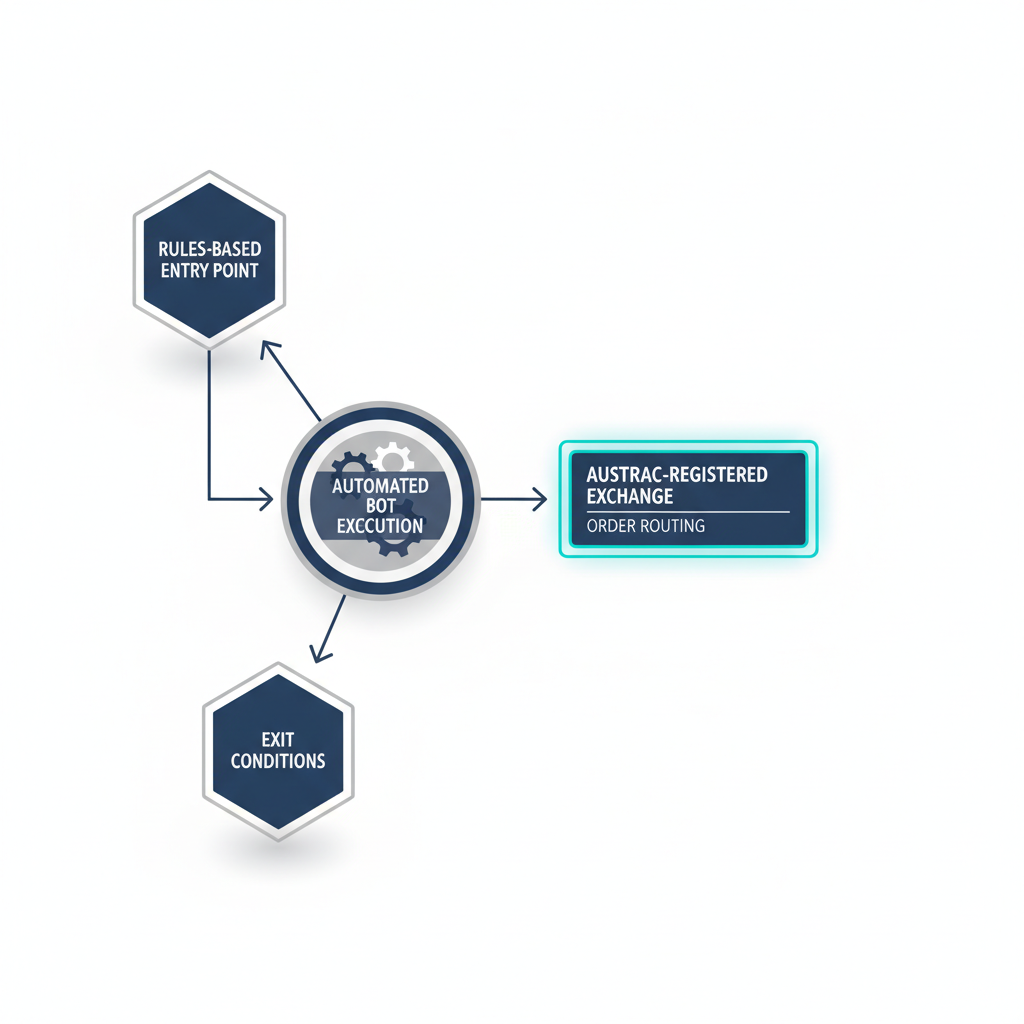
At their core, crypto algo trading strategies are sets of programmed rules that automatically trigger buy or sell orders when specific conditions are met. Those conditions might be based on price crossing a moving average, trading volume spiking above a threshold, or a momentum indicator reaching a particular reading. The algorithm watches the market continuously and acts the instant its conditions are satisfied, no human required.
Crypto markets are unusually well-suited to this kind of approach for a few reasons. They trade 24 hours a day, seven days a week, including Christmas Day and the middle of a Tuesday night in Sydney. Volatility is high, which creates frequent opportunities but also punishes slow reactions. And the major exchanges, including Kraken, Swyftx, and Coinbase Australia, expose their order books and price feeds through APIs, making it straightforward to connect an algorithm directly to execution infrastructure.
The practical advantages are real. Speed matters when BTC moves 3% in ninety seconds. Emotion-free execution matters when the market is in freefall and every instinct says to sell. The ability to monitor six trading pairs simultaneously matters when opportunities do not wait. And backtesting, which means running your strategy against years of historical price data before risking a dollar, is something no discretionary trader can replicate.
For Australians specifically, there are two things you cannot ignore. First, every exchange you use must be registered with AUSTRAC as a digital currency exchange provider. Second, the ATO considers every crypto trade a taxable event, including bot-generated ones. Both of these points get their own section later in this guide.
The rest of this article covers how algo trading actually works mechanically, the six main strategy types, the best platforms available to Australians in 2026, and the regulatory and tax obligations you are legally required to meet.
How Algorithmic Trading Works in the Crypto Market
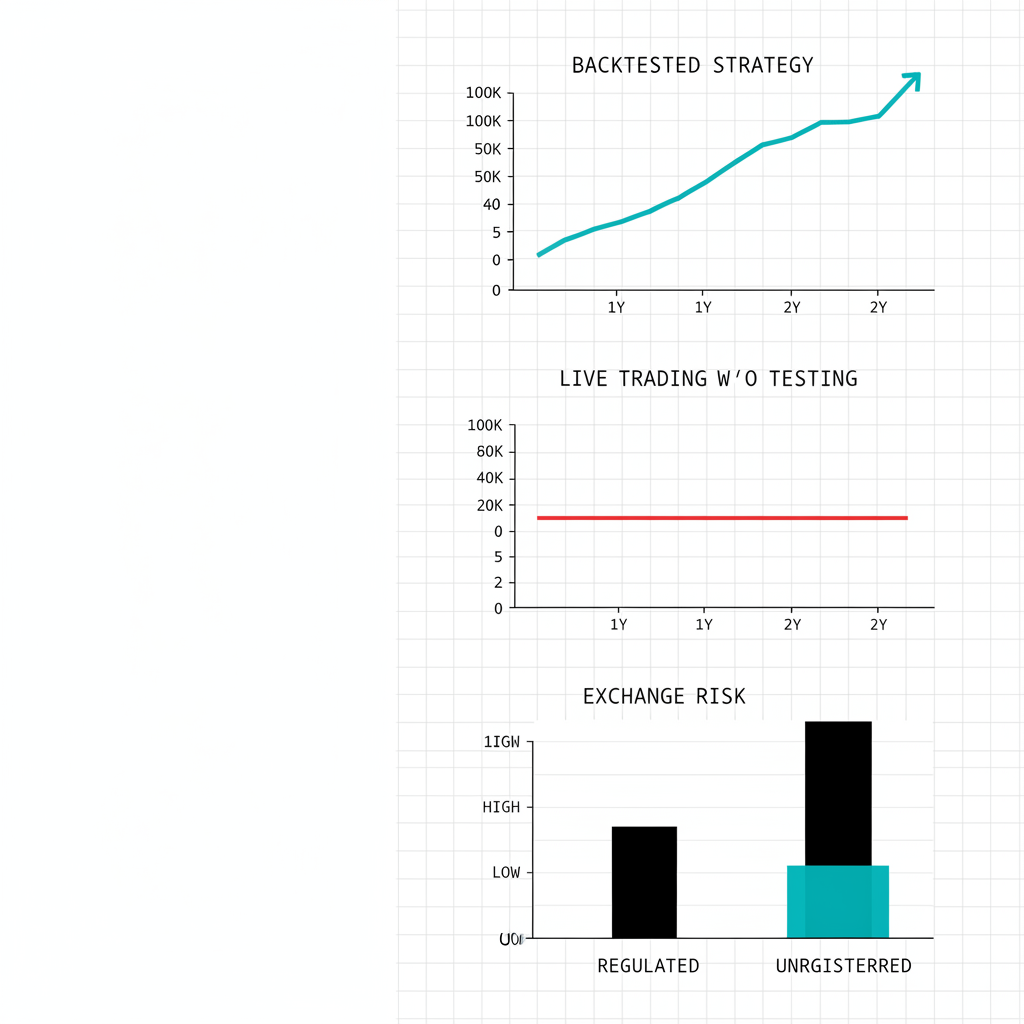
The basic flow looks like this: you define a strategy in logic (buy BTC when the 50-day moving average crosses above the 200-day moving average, sell when it crosses back below). That logic gets coded into a script or configured inside a bot platform. The bot connects to an exchange via its API, watches the live price feed, and fires off orders automatically when your conditions are met.
APIs are the plumbing. Every serious exchange publishes documentation covering endpoints for market data, order placement, account balances, and trade history. Kraken‘s API is widely regarded as one of the better-documented in the industry. Pepperstone‘s cTrader platform allows cBots built in C#, which is a more structured environment than writing raw API calls from scratch. The quality of an exchange’s API directly affects what you can build on top of it.
What the algorithm is actually monitoring depends on your strategy. Price feeds are the most common input. Order book depth matters for strategies that try to predict short-term moves based on pending buy and sell walls. Technical indicators like RSI, Bollinger Bands, and MACD are calculated by the algorithm in real time and used as entry and exit signals.
Not everything has to be fully automated. Semi-automated or signal-based setups are common, particularly among traders using TradingView. In that setup, TradingView generates an alert when a condition is met, which triggers a webhook that sends an order to your exchange. You are not clicking a button, but a human wrote the alert logic and the system is making discrete decisions rather than managing a live position autonomously.
Backtesting is where most traders should spend the majority of their preparation time. Running a strategy against BTC/AUD data from 2021 through 2024 will expose problems that are invisible on paper. A strategy that looks profitable in a bull market often collapses the moment conditions change. Pepperstone‘s cTrader has built-in backtesting tools. Cryptohopper and Bitsgap also offer backtesting in their platforms.
One more thing worth understanding: latency. In volatile conditions, the difference between an order being placed at the price you expected and the price it actually fills at (called slippage) can be significant. Retail traders using cloud-based bots will always have more latency than institutional players with co-located servers sitting inside exchange data centres. This matters more for high-frequency approaches and less for trend-following strategies where you are trading on hourly or daily timeframes.
The 6 Main Crypto Algo Trading Strategies Explained
No single strategy works in every market condition. Understanding what each approach is designed to do, and when it breaks down, will save you from deploying the wrong tool at the wrong time.
Trend-Following
This is the most widely used approach in retail algo trading. The algorithm identifies a directional price move, typically using moving averages or momentum indicators, and enters a position in the direction of that trend. A simple example: buy ETH/AUD when the 20-day EMA crosses above the 50-day EMA, exit when the crossover reverses. Trend-following works well in strongly directional markets, which crypto produces regularly. It struggles in flat, choppy conditions, where the algorithm gets repeatedly whipsawed entering and exiting positions that go nowhere.
Arbitrage
Arbitrage exploits price differences for the same asset across different exchanges. If BTC is trading at $145,200 AUD on Kraken and $145,650 AUD on Binance simultaneously, a well-configured bot can buy on Kraken and sell on Binance, pocketing the difference minus fees and transfer costs. In practice, pure arbitrage opportunities close in milliseconds, so execution speed and fee structure are critical. Bitsgap is purpose-built for this, offering cross-exchange tracking and structured arbitrage bot setups. The margins are thin and the competition is fierce, but the strategy is market-neutral, which is appealing when conditions are uncertain.
Mean Reversion
Mean reversion bets that an asset which has moved sharply away from its historical average price will return to that average. If ETH drops 12% in four hours on no fundamental news, a mean reversion algorithm might interpret that as an overextension and enter a long position. This approach works in range-bound markets and can be profitable during periods of high volatility without strong directional trend. It fails badly in trending conditions, where the “extreme” move keeps extending and the algorithm accumulates losses averaging into a falling asset.
Momentum Trading
Momentum strategies enter positions when an asset shows strong, accelerating directional movement backed by volume. Unlike trend-following, which waits for a confirmation signal like a moving average crossover, momentum trading responds to the velocity of a move. The logic is that strong moves tend to continue in the short term. Momentum works during breakouts and news-driven moves. It gets punished severely by false breakouts and rapid reversals, which crypto markets produce regularly.
Market Making
A market-making algorithm places simultaneous buy and sell limit orders slightly above and below the current price, capturing the spread as the market moves back and forth between them. This requires meaningful capital, a platform with very low maker fees (ideally zero), and a deep, liquid market. For most retail algo traders in Australia, market making is impractical. On liquid BTC/AUD pairs with tight spreads, you need scale to generate returns that justify the complexity and the inventory risk of holding positions that move against you.
High-Frequency Trading
HFT executes thousands of micro-trades per second, exploiting tiny price inefficiencies that exist for fractions of a second. This is not a retail strategy. It requires co-located servers physically inside exchange data centres, custom low-latency networking, and capital in the millions. Any Australian retail trader who encounters a service claiming to offer “HFT for everyday investors” should be immediately sceptical. The economics do not work at retail scale.
Strategy Comparison
| Strategy | Complexity | Capital Required | Best Market Condition | Example Platform |
|---|---|---|---|---|
| Trend-Following | Low–Medium | Low | Trending (bull or bear) | Pepperstone cTrader, Swyftx |
| Arbitrage | Medium–High | Medium–High | Any (price discrepancies) | Bitsgap |
| Mean Reversion | Medium | Low–Medium | Range-bound, high volatility | Cryptohopper, Pionex |
| Momentum | Medium | Low | Breakout, news-driven | Kraken API, Cryptohopper |
| Market Making | High | High | Low-volatility, high liquidity | Kraken Pro API |
| HFT | Very High | Very High (institutional) | Any | Not viable for retail |
Best Platforms for Crypto Algo Trading in Australia 2026
Before listing anything, the criteria matter. Every platform below is AUSTRAC-registered or operates under an equivalent regulated structure, offers API access or native bot functionality, supports AUD deposits, and has a fee structure that does not silently destroy returns before your strategy has a chance to work.
A word of warning upfront: avoid anything that resembles cryptoalgorithm.net. That site has no record of ASIC authorisation or AUSTRAC registration and has been flagged by review communities as a high-risk unregulated operation. There is no legitimate reason to put Australian funds through it.
Pepperstone
Pepperstone is the strongest option for Australians who want low-cost automated trading with a proper backtesting environment. It charges a flat 0.1% commission on crypto trades, which is among the lowest available on a regulated platform. The cTrader interface supports cBots written in C#, and the built-in backtesting engine lets you run strategies against historical data properly before going live. AUSTRAC registered. ASIC licensed. AUD deposits available. For algo traders running trend-following or momentum strategies who want a professional environment without paying institutional fees, this is where I would start looking.
Kraken
Kraken is AUSTRAC-registered, offers AUD deposits via PayID, and has some of the best API documentation in the industry. The WebSocket and REST APIs are well-maintained and support real-time order book data, which matters if you are building anything beyond basic price-triggered strategies. Fees on the Pro interface start at 0.16% maker / 0.26% taker for lower volume accounts, with reductions at higher tiers. Best suited to intermediate algo traders who are comfortable writing their own scripts or working with Python-based bot frameworks.
Interactive Brokers Australia
Interactive Brokers is the choice for advanced programmers who want to build strategies across multiple asset classes. It supports algorithmic trading via Python, Java, C++, and several other languages through its TWS API. The crypto offering is narrower than a dedicated crypto exchange, but if you want a single platform that handles equities, ETFs, and crypto within a single regulated account structure, it is worth considering. AFSL licensed in Australia.
Cryptohopper
Cryptohopper is a cloud-based bot platform with a strategy marketplace where you can either build your own conditions or deploy pre-built strategies created by other traders. It connects to multiple exchanges including Kraken and Coinbase and supports paper trading (their term for demo mode) before going live. The subscription model starts at around USD $19/month. Best for traders who want to run automated strategies without writing code. The backtesting tool is accessible if not the most sophisticated available.
Pionex
Pionex has built-in trading bots directly on the platform, no third-party connection required. The grid bot is the most popular, automatically buying low and selling high within a configured price range. DCA (dollar-cost averaging) bots are also available. Fees are very low at 0.05% maker and taker. Best for traders who want simple, low-maintenance automation without the complexity of API configuration or coding. Pionex holds a Money Services Business licence and its Australian compliance status should be verified before depositing significant capital.
Bitsgap
Bitsgap specialises in arbitrage and grid bots and lets you manage positions across multiple connected exchanges from one dashboard. The arbitrage scanner tracks price discrepancies across supported exchanges in real time. Subscription pricing starts around USD $23/month. Best for traders specifically focused on arbitrage strategies or multi-exchange grid trading. Check current AUSTRAC registration status for any exchanges you connect through it.
CoinSpot
CoinSpot is AUSTRAC-registered, has been operating in Australia since 2013, and offers 0.1% fees on market orders. It is not a sophisticated algo platform. The API is functional but limited compared to Kraken or Pepperstone. Where CoinSpot fits is for Australian beginners who want to connect a simple bot to a familiar, locally regulated exchange and start learning the mechanics without the complexity of a professional trading environment.
Swyftx
I have been using Swyftx since 2022 and the demo mode is genuinely useful for testing strategy logic before going live. AUSTRAC registered, wide asset range, and the interface is more approachable than Kraken for traders who are newer to the space. The API is available but not as extensively documented as Kraken’s. Best positioned for traders who are learning and want to test crypto algo trading strategies in a demo environment before committing capital.
Platform Comparison
| Platform | AUSTRAC Status | API Access | Key Algo Feature | Min. Deposit | Fees (crypto) |
|---|---|---|---|---|---|
| Pepperstone | Registered | Yes (cTrader) | cBots + backtesting | $0 | 0.1% flat |
| Kraken | Registered | Yes (advanced) | WebSocket + REST API | ~$10 | 0.16%/0.26% maker/taker |
| Interactive Brokers | AFSL licensed | Yes (multi-language) | TWS API, multi-asset | $0 | Varies |
| Cryptohopper | Via connected exchanges | Via integrations | Strategy marketplace | ~USD $19/mo subscription | Exchange fees apply |
| Pionex | Verify independently | Built-in | Grid + DCA bots | ~$0 | 0.05% maker/taker |
| Bitsgap | Via connected exchanges | Via integrations | Arbitrage + grid bots | ~USD $23/mo subscription | Exchange fees apply |
| CoinSpot | Registered | Basic | Simple bot integration | $20 | 0.1% market orders |
| Swyftx | Registered | Available | Demo mode for testing | $0 | ~0.6% spread on BTC/AUD |
Australian Regulations You Must Know Before Algo Trading Crypto
This is not optional reading. Getting the regulatory side wrong has financial and legal consequences.
AUSTRAC Registration
Every exchange operating in Australia must be registered with AUSTRAC as a digital currency exchange provider. As of April 2, 2026, AUSTRAC transitioned to an international Virtual Asset Service Provider (VASP) framework and updated its public register accordingly. You can search the register directly on the AUSTRAC website to verify whether a platform is currently authorised. If a platform is not on that register, it is operating illegally in Australia and you have no recourse if something goes wrong with your funds.
AUSTRAC has been explicit that it views the virtual asset sector as a high money laundering risk, and its enforcement activity has increased. Crypto ATM operators have already faced fines and compliance orders. Exchanges are next in line for scrutiny if they are not meeting their anti-money laundering and counter-terrorism financing obligations.
ASIC’s Role
ASIC’s authority in the crypto space is more focused than AUSTRAC’s. Platforms that issue crypto ETFs or offer derivatives and CFDs over crypto assets must hold an Australian Financial Services Licence (AFSL). If you are