Algorithmic Crypto Trading in Australia: Complete 2026 Guide
Algorithmic crypto trading in Australia has moved well past the hobbyist phase. In 2026, you have institutional-grade APIs, a brand new regulatory framework that passed on 1 April, and the ATO watching every on-chain move you make. If you are thinking about automating your crypto strategy, or you are already running bots and want to know where the legal lines are drawn, this guide covers the mechanics, the strategies, the platforms, and the compliance picture as it actually stands right now.
> TL;DR: Algorithmic crypto trading in Australia uses automated, rules-based systems to execute trades 24/7 without emotional bias. It is legal, but traders must meet ATO tax obligations (CGT applies to every trade), comply with incoming AFSL licensing requirements under the digital asset law that passed April 2026, and use only AUSTRAC-registered platforms. Top strategies include trend-following, arbitrage, and mean reversion. Platforms such as Pepperstone, Kraken, and Swyftx all support algorithmic approaches for Australian traders.
What Is Algorithmic Crypto Trading in Australia?

Algorithmic crypto trading in Australia refers to the use of programmed strategies and mathematical models to execute buy and sell orders automatically, based on predefined conditions. No manual clicks, no second-guessing at 2am, no panic-selling because you checked your phone during a family dinner. The system fires the order when the rules say so.
In practice, this means writing code (or configuring an existing tool) that monitors price, volume, order book depth, or other signals, then sends instructions directly to an exchange via an application programming interface (API). The exchange fills the order. Your bot moves on to the next condition.
What makes the Australian market context distinct is the regulatory stack sitting on top of that technical layer. You are dealing with three agencies. AUSTRAC requires that any exchange you deposit funds into holds a current registration. ASIC now has expanded jurisdiction over crypto platforms that qualify as financial product issuers, under the digital asset law that passed on 1 April 2026. The ATO treats every automated trade as a potential capital gains tax event, same as if you had clicked the button yourself.
Australia’s digital asset legislation is a genuine milestone. For years, crypto operated in a grey zone here. That zone has closed. The framework signals a maturing market, which is genuinely good news for anyone running a legitimate algo trading operation, because licensed platforms have obligations around custody, disclosures, and client money that unregulated ones do not.
Whether you are running a mean reversion script on Kraken or using cBots through Pepperstone, the underlying mechanics and the compliance obligations apply equally.
[INTERNAL LINK PLACEHOLDER: what is algorithmic trading → intro pillar page on algo trading fundamentals]
How Crypto Algo Trading Works: Core Mechanics
The foundation is the API connection between your trading bot and an exchange. The exchange publishes an API that lets external software query prices, read your account balance, and submit orders programmatically. Your bot authenticates with an API key, polls the market, runs its logic, and places orders without you being in the loop.
The logic itself is a set of predefined rules. A simple trend-following rule might be: if the 20-period moving average crosses above the 50-period moving average and 24-hour volume is above a threshold, place a market buy for 0.01 BTC. A more complex mean reversion rule might incorporate Bollinger Bands, Z-scores, and a stop-loss expressed as a percentage of entry price. The bot does not care about sentiment, headlines, or what Reddit is doing. It executes the rule.
Backtesting and Paper Trading
Before you risk real capital, you test the strategy against historical data. This is called backtesting. You feed your algorithm months or years of OHLCV (open, high, low, close, volume) data and see how it would have performed. Backtesting is useful but not infallible. Overfitting is a genuine trap: a strategy tuned too precisely to historical data often falls apart on live markets.
Paper trading (or demo mode) is the next step. You run the bot in a simulated environment using live market data but no real money. Swyftx offers a demo mode that I have found useful for this purpose. Pepperstone‘s cTrader platform also has a demo account that supports cBots in full.
Tools and Languages
Python is the dominant language for custom crypto bots, largely because of libraries like `ccxt` (which wraps dozens of exchange APIs into a single interface), `pandas` for data handling, and `backtrader` or `vectorbt` for backtesting. TradingView’s Pine Script is accessible for non-programmers and integrates well with services like TradersPost for automated order routing. Pepperstone’s cTrader platform supports cBots written in C#, which suits traders coming from a .NET background.
The honest caveat here: automation amplifies outcomes in both directions. A profitable strategy scales well. A flawed strategy can blow through a stop-loss, loop on an error, or execute trades you did not intend during a flash crash. Risk management, hard position size limits, and kill switches are not optional extras.
Top Algorithmic Trading Strategies Used by Australian Crypto Traders
Trend-Following
This is the most common starting point. The logic is straightforward: buy when price momentum is upward, exit or short when it turns downward. In crypto, which has a history of extended bull and bear runs, trend-following has generated solid returns across multi-month timeframes. Common indicators are moving average crossovers, the Average Directional Index (ADX), and Donchian channels. The weakness is whipsawing in sideways markets, where the strategy generates a string of small losses before the next real trend establishes.
Arbitrage
Arbitrage exploits price discrepancies for the same asset across different exchanges. If BTC/AUD is trading at $135,200 on Swyftx and $135,450 on Kraken, a bot can theoretically buy on the cheaper venue and sell on the more expensive one simultaneously. In practice, execution speed, transfer delays, and withdrawal fees often compress or eliminate the margin. Pure exchange arbitrage is increasingly competitive, but statistical arbitrage between correlated pairs (ETH/BTC spread, for instance) remains viable.
Mean Reversion
Mean reversion strategies assume that price will return to a historical average after an extreme move. If ETH has moved three standard deviations above its 20-day mean, the bet is that it reverts. Bollinger Band strategies, pairs trading, and Z-score models all fall under this umbrella. These work well in range-bound conditions but get punished hard during genuine breakouts, so position sizing and stop-losses matter more here than in almost any other strategy.
Momentum Trading
Distinct from trend-following in that momentum strategies focus on the rate of price change rather than direction alone. RSI divergence, MACD histogram shifts, and volume-weighted price moves are common signals. Momentum bots can hold positions for minutes or days depending on the timeframe. The risk is that crypto momentum can reverse violently, particularly around macro events or exchange-specific news.
Market Making and HFT
Market making involves simultaneously posting limit orders on both sides of the order book and collecting the spread. It requires deep liquidity, tight execution, and a platform with low or zero maker fees. This is not a retail strategy in 2026. High-frequency trading (HFT) goes further still, requiring co-location of servers near exchange matching engines and microsecond execution. Both approaches are effectively the domain of institutional or well-capitalised professional traders. If someone is pitching you an HFT bot for $99 a month, scrutinise that claim carefully.
Across every one of these strategies, the biggest cause of failure is not the signal logic. It is poor risk management: no stop-losses, oversized positions, or failing to account for liquidity when scaling up.
Best Platforms for Algorithmic Crypto Trading in Australia (2026)
Here is how the main platforms stack up for Australian algo traders. I have focused on API quality, fee structure, regulatory status, and AUD deposit access, because those are the variables that actually matter.
Pepperstone
Pepperstone is the standout for traders who want a proper algo environment. It holds an Australian Financial Services Licence (AFSL) and is regulated by ASIC, which matters more in 2026 than it ever has. The cTrader platform supports cBots in C#, has a strategy tester built in, and gives you access to over 1,200 instruments including crypto CFDs. Spreads on BTC/USD are among the tightest I have seen on an AFSL-licensed platform. The limitation is that you are trading CFDs, not holding actual crypto, which affects your tax treatment (CFDs are generally treated as revenue, not CGT assets, but confirm with your accountant).
Kraken
Kraken remains the strongest option for actual spot crypto algo trading with AUD access. The REST and WebSocket APIs are well-documented, rate limits are reasonable for active bots, and the fee structure rewards volume with maker fees dropping to 0.00% at higher tiers. AUD deposits work via SWIFT and PayID. Kraken holds AUSTRAC registration and is applying for AFSL under the new framework. The interface is less polished than some Australian-facing platforms but the infrastructure underneath it is professional-grade.
Swyftx
I have been using Swyftx since 2022 and it remains my go-to recommendation for Australian traders who want a local, AUSTRAC-registered exchange with solid API access. It offers over 420 assets, a demo mode for testing strategies, and AUD deposits via PayID with no deposit fee. The API is functional but not as feature-rich as Kraken’s, so it suits mid-frequency strategies better than high-frequency ones. The spread on BTC/AUD is typically around 0.6%, which is competitive for an Australian platform.
Interactive Brokers
Interactive Brokers supports Python, Java, C++, and its own TWS API for algorithmic trading. It has added crypto to its product range and the fee structure is genuinely low for professional-style execution. If you are running a multi-asset algo that includes crypto alongside equities or futures, IBKR is worth serious consideration. Less relevant if you want pure crypto exposure only.
TradersPost
TradersPost connects TradingView and TrendSpider alerts directly to exchange orders, which means you can automate a Pine Script strategy without writing any bot code yourself. It supports crypto on several exchanges and is a practical middle ground for traders who want automation without deep technical implementation. The subscription model includes additional rulesets at higher tiers.
Capital.com
Capital.com integrates with TradingView and MetaTrader 4/5, supports crypto CFDs, and has an AI-powered assistant that provides trade analysis. CFD spreads are low. For Australian traders, check its current AFSL status before opening an account, particularly given the post-April 2026 licensing requirements.
CoinSpot
CoinSpot is the platform for cost-conscious traders. Maker fees start at 0.1% and the OTC desk is useful for high-volume orders that would move the market on the standard order book. The API is more limited than Kraken’s, but it does the job for straightforward automated strategies. AUSTRAC-registered and Australian-owned.
eToro
eToro holds both an AFSL and AUSTRAC registration in Australia, which makes its compliance tick boxes easy. Copy trading functions as a semi-automated strategy: you allocate capital to a portfolio manager and their trades are replicated in your account proportionally. It is not algo trading in the traditional sense but it achieves a similar outcome for traders who want automation without coding.
Platform Comparison
| Platform | API Access | Min Fees | AFSL / AUSTRAC | AUD Deposits | Best For |
|---|---|---|---|---|---|
| Pepperstone | cTrader API, REST | From 0.0% spread | AFSL ✓ | Yes (via bank transfer) | cBots, CFD algo trading |
| Kraken | REST + WebSocket | 0.00% maker (high vol) | AUSTRAC ✓, AFSL pending | Yes (PayID, SWIFT) | Spot crypto algo, pro API |
| Swyftx | REST API | ~0.6% spread BTC/AUD | AUSTRAC ✓ | Yes (PayID, free) | Australian spot trading, demo mode |
| Interactive Brokers | TWS API (multi-language) | Variable, low | AFSL ✓ | Yes | Multi-asset algo strategies |
| TradersPost | TradingView/TrendSpider | Subscription-based | Check current status | Via linked exchange | No-code automation |
| Capital.com | MT4/MT5, TradingView | Low CFD spreads | Check current status | Yes | CFD algo via existing platforms |
| CoinSpot | REST API | 0.1% maker | AUSTRAC ✓ | Yes (PayID) | Low-fee spot, OTC desk |
| eToro | Limited algo API | Variable spread | AFSL ✓, AUSTRAC ✓ | Yes | Copy trading, semi-automated |
ASIC Regulations and Licensing for Algo Crypto Traders in Australia (2026)
On 1 April 2026, Australia passed its first complete digital asset law. It is not a drill and it is not a consultation paper. Any exchange or custody provider operating in or from Australia must obtain an Australian Financial Services Licence within six months. The legislation introduces a new financial product category called a “digital asset facility,” which covers the platforms most Australian algo traders are using.
ASIC has granted a sector-wide no-action position until 30 June 2026, meaning it will not take enforcement action against platforms actively applying for their AFSL during that window. After 30 June, operating without one becomes a serious legal exposure. ASIC’s Key Issues Outlook 2026, published in January, named unlicensed crypto activity as a “regulatory perimeter” priority. That language is specific and deliberate.
The practical implication for you as an algo trader is straightforward: before you deposit funds on any platform, check that it either already holds an AFSL or has publicly confirmed it is applying for one. ASIC maintains a public register. Two minutes of verification is worth considerably more than the legal headache of having your funds frozen on an unlicensed platform during an enforcement action.
Why does this matter beyond bureaucratic compliance? The NGS Crypto case answers that directly. In December 2025, the Federal Court ordered the liquidation of NGS Crypto and its associated companies after finding they had operated without a licence while targeting Australian retirement funds. Hundreds of Australians lost millions. The scheme promised automated crypto returns. The regulatory protection that would have applied under a properly licensed arrangement was entirely absent.
From 2 April 2026, digital currency exchange (DCE) providers are formally renamed Virtual Asset Service Providers (VASPs), aligning Australian terminology with the Financial Action Task Force (FATF) global standard. The name change reflects the expanded scope, covering staking services, custody, and token issuance, not just exchange.
Before depositing on any platform, confirm:
- AFSL number listed on ASIC’s register, or public confirmation of pending application
- AUSTRAC registration (searchable on the AUSTRAC website)
- Physical or registered presence in Australia if offering AUD pairs
[INTERNAL LINK PLACEHOLDER: ASIC AFSL crypto licensing → regulatory compliance guide]
AUSTRAC Compliance and Banking Restrictions for Australian Algo Traders
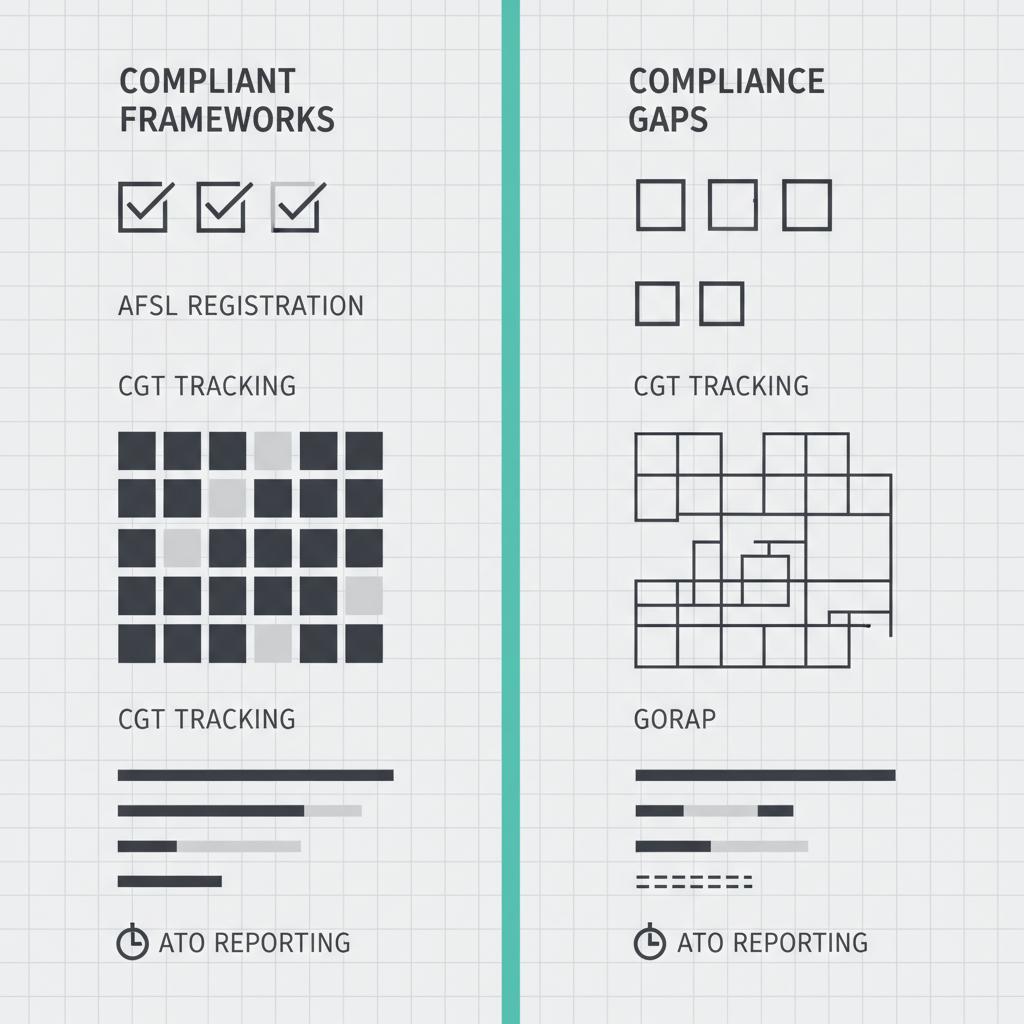
AUSTRAC registration is not optional. Every exchange you use for automated crypto trading in Australia must be registered as a VASP (formerly DCE) under the Anti-Money Laundering and Counter-Terrorism Financing Act. The obligations on those platforms include maintaining a tailored AML/CTF programme, appointing a compliance officer, running KYC checks on all customers, monitoring transactions, and submitting Suspicious Matter Reports (SMRs), Threshold Transaction Reports (TTRs), and International Funds Transfer Instructions (IFTIs) where required.
From 2 April 2026, those obligations strengthened further as part of the AML/CTF law expansion that accompanied the VASP renaming. Platforms now face more detailed transaction monitoring requirements and enhanced due diligence obligations for high-