Crypto Algo Trading Australia 2026: Platforms, Regulations & How It Works
Crypto algo trading in Australia has moved well past the hobbyist stage. What started as a niche for developers running Python scripts against exchange APIs is now a genuine part of how retail Australians participate in the market, and regulators have noticed.
> TL;DR: Crypto algo trading in Australia is legal but tightly regulated. From April 2027, all digital asset platforms must hold an AFSL, and AUSTRAC registration is mandatory right now. Top platforms include IC Markets, Pepperstone, Interactive Brokers, and local options like Swyftx and SaintQuant. Always verify AUSTRAC registration and ASIC licensing before depositing a cent.
What Is Crypto Algo Trading in Australia?
Algorithmic trading, at its core, is just a set of rules your computer follows so you do not have to. You define the conditions, whether that is a moving average crossover, a price hitting a certain level, or a signal from an external data source, and the software executes the trade the moment those conditions are met.
The difference between algo trading and manual trading is not just speed, though speed matters a lot. It is also consistency. An algorithm does not second-guess itself at 2 am when Bitcoin drops 8% in twenty minutes. It does not panic-sell because someone posted a doom thread on Reddit. It just follows the rules you gave it.
For Australian traders, crypto algo trading has a specific appeal that equities algo trading does not: the market never closes. ASX-listed shares trade between 10 am and 4 pm Sydney time, five days a week. Bitcoin trades every second of every day. If you want to capture overnight moves, react to US macro data, or run a strategy that requires constant market presence, you either need to be awake at 3 am or you need an algorithm doing it for you.
Crypto algo trading in Australia sits in a legal grey-to-green zone. It is not prohibited. But the platforms you use, and increasingly the strategies you run on derivatives products, fall under ASIC and AUSTRAC oversight. More on that shortly.
[INTERNAL LINK PLACEHOLDER: “how crypto is taxed in Australia” → CGT & crypto tax pillar]
Common Crypto Algo Trading Strategies Used in Australia
Most retail traders running bots in Australia are not doing anything exotic. Here is what actually gets used.
Trend-following is the most common starting point. You pick a momentum indicator, a moving average crossover being the classic, and the bot buys when the trend turns up and sells when it turns down. Low complexity, reasonably well-understood risk, and accessible to anyone who can read a TradingView chart. Beginners usually start here.
Arbitrage exploits price differences between exchanges. If BTC is trading at $104,200 AUD on one platform and $104,450 AUD on another, you buy on the first and sell on the second. The problem is that by the time retail traders can execute both legs, the gap has usually closed. Effective arbitrage requires very low latency and often co-located servers. It is largely the domain of professional shops in Australia, not retail accounts.
Mean reversion works on the assumption that prices eventually return to their historical average. In a range-bound market, this can be profitable. In a trending market, it will destroy your account. Context matters enormously here.
Momentum trading is a close cousin of trend-following but typically uses shorter timeframes and exits more aggressively on reversal signals. It suits volatile assets, which crypto certainly qualifies as.
Market making involves placing simultaneous buy and sell orders on both sides of the spread to collect the difference. It requires sophisticated infrastructure, significant capital, and exchange-level API access. A few Australian firms operate in this space professionally.
High-frequency trading, the kind that executes thousands of orders per second, is effectively inaccessible to retail. It requires institutional infrastructure and the kind of exchange relationships that individual traders do not have. Most Australians running bots are doing trend-following or signal-based strategies through platforms like TradingView, MT4, or exchange APIs.
[INTERNAL LINK PLACEHOLDER: “how to backtest a crypto trading strategy” → backtesting guide pillar]
Is CryptoAlgo a Legitimate Platform in Australia?
This question comes up constantly, and it deserves a straight answer rather than a vague disclaimer.
CryptoAlgo.com.au, which publishes this guide, is an independent Australian research and review site. It is not a trading platform, does not hold client funds, and does not execute trades on anyone’s behalf. Think of it as the pub mate who has spent too long researching this stuff, not the broker.
CrypAlgo (note the missing ‘o’), at cryptalgo.com, is a different product entirely. It is an AI-powered signals provider that integrates with TradingView, delivering buy and sell signals for crypto markets around the clock. Its algorithm combines machine learning, technical analysis, and market sentiment data. It is not an Australian-regulated broker. It sells monthly, quarterly, and lifetime access plans, and its signals are just that: signals. You still need a separate brokerage account to act on them.
Crypto Algorithm at cryptoalgorithm.net is something else again. This site has been flagged as an unregulated forex broker, and there are numerous negative customer reviews online consistent with scam behaviour. There is no AUSTRAC registration, no ASIC licensing, and no verifiable Australian business presence. Avoid it.
The naming confusion here is not accidental. Bad actors in this space deliberately use terms like “crypto algo” and “algorithm” to sound credible. Before you deposit anything with any platform using similar branding, run through this checklist.
Look for an AUSTRAC registration number, which you can verify on the AUSTRAC public register. Look for an AFSL number if the platform offers financial products or derivatives, verified via ASIC’s public register. Check for a verifiable Australian business address, not just a PO box or offshore address listed for compliance reasons. And look for a transparent fee schedule with real numbers, not vague percentages buried in terms and conditions.
ASIC’s MoneySmart website maintains a list of businesses you should avoid. Check it before you send money anywhere.
Australian Regulations for Crypto Algo Trading in 2026
The regulatory environment for crypto algo trading in Australia has changed more in the past twelve months than in the previous five years combined.
AUSTRAC Registration: Non-Negotiable
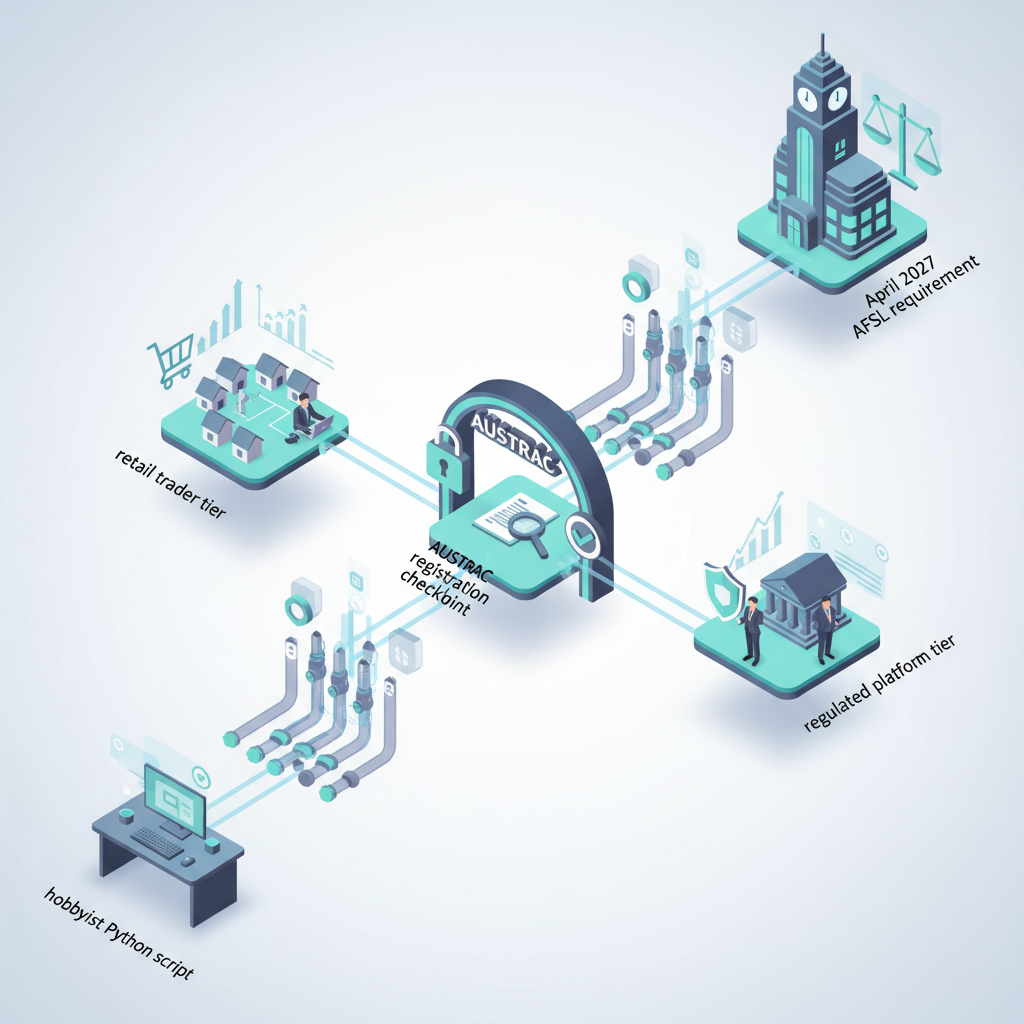
Any business providing digital currency exchange services in Australia must be registered with AUSTRAC. This has been the case for several years, but enforcement has sharpened. Operating without registration is a criminal offence, not a civil penalty. In late 2025, AUSTRAC ran what it called a “Use It or Lose It” blitz and removed 62 inactive or non-compliant businesses from the digital currency exchange register. The message was clear: registration is not a box-ticking exercise.
From 31 March 2026, the terminology shifted. Digital currency exchange providers are now classified as Virtual Asset Service Providers (VASPs), mirroring international Financial Action Task Force (FATF) language. The scope also expanded: additional virtual asset-related services that were previously unregulated now fall under AUSTRAC’s remit. AUSTRAC can refuse, suspend, or cancel VASP registrations if a business poses an unacceptable risk of money laundering or terrorism financing.
The AFSL Requirement Coming in April 2027
The Corporations Amendment (Digital Assets Framework) Bill 2025 cleared both houses of parliament by April 2026. The headline change: digital asset platforms must obtain an Australian Financial Services Licence (AFSL) by April 2027. There is an 18-month implementation period, but platforms that have not started the process are already behind.
ASIC will issue new guidance on custody requirements and financial obligations during this implementation window. For retail traders, the practical implication is straightforward: choose platforms that are already pursuing AFSL compliance. Platforms that are not actively working toward licensing are either planning to exit the Australian market or hoping regulators look the other way. Neither is a good sign for your funds.
Sanctions and Derivatives
Australia introduced new financial sanctions in March 2026 targeting individuals and entities linked to Russia, including crypto businesses that facilitate cross-border payments to circumvent existing sanctions. If you are using international platforms, verify they are not on the sanctions list.
For derivatives and CFDs on crypto, Australian retail clients can only legally access these products through AFSL-licensed providers. This is not new, but it is enforced more actively as ASIC increases its digital asset surveillance.
[INTERNAL LINK PLACEHOLDER: “AUSTRAC VASP registration guide” → AUSTRAC compliance pillar]
Best Platforms for Crypto Algo Trading in Australia 2026
No single platform is right for every trader. What works for a developer building a custom strategy via API is different from what works for someone who wants a pre-built bot with no coding required.
Platforms Worth Looking At
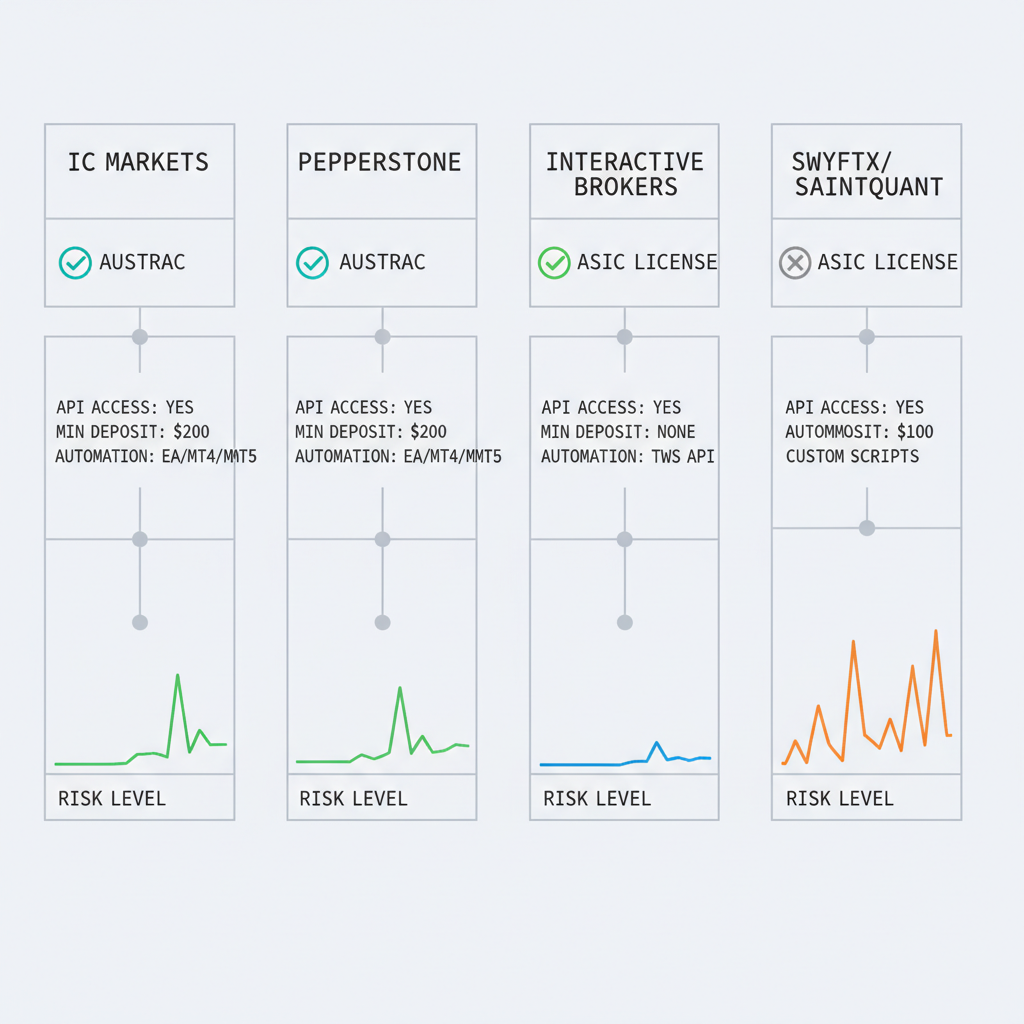
IC Markets is where experienced algo traders in Australia tend to land. It supports Expert Advisors via MT4 and MT5, offers some of the tightest spreads available to retail clients (BTC/USD spreads under 10 points in normal conditions), and execution speeds are genuinely fast. It is ASIC-regulated and holds an AFSL. Not beginner-friendly, but serious infrastructure for serious strategies.
Pepperstone is the platform I point people toward when they want algo trading without the steep learning curve of IC Markets. cTrader’s cBots feature lets you build and deploy automated strategies with backtesting built in. ASIC-regulated, good customer support, and the platform is stable. Spreads on BTC/USD are competitive, typically 0.5 to 1.5 pips during liquid hours.
Interactive Brokers Australia is the choice if you want to run algo strategies across multiple asset classes, not just crypto. It supports a range of programming languages via its API (Python, Java, C++), has access to crypto, equities, forex, and futures, and the fee structure is genuinely low for high-volume traders. The onboarding process is more involved than most, and the platform interface is not designed for casual use.
Alpaca Trading deserves a mention for developers. The API is well-documented, the onboarding is straightforward, and fees are low. It is particularly suited to Australian traders building custom Python strategies who want a clean API without the overhead of a full CFD broker’s platform.
Swyftx is the most accessible Australian-native option. Over 420 assets, AUD pricing throughout, PayID deposits with no fees, and a demo mode that is genuinely useful for testing strategies before you go live. I have been using Swyftx since 2022 and the platform has improved steadily. Native algo features are limited, but the API is available for those who want to connect external bots. It is AUSTRAC-registered and actively pursuing AFSL compliance.
SaintQuant is interesting because it is actually built in Australia, based in Cairns. It offers AI-powered crypto and stock trading bots without requiring any coding. The subscription tiers vary significantly in price and capability, from a Starter bot at $99 for 10 days through to an Institutional tier at $15,000 for 30 days. Worth evaluating if you want an automated strategy without building it yourself, but do your due diligence on performance claims.
CrypAlgo (the signals provider, not this site) integrates directly with TradingView and delivers buy and sell signals around the clock. Monthly, quarterly, and lifetime plans are available. It is not a broker, does not hold funds, and cannot execute trades. You pair it with your own exchange account. Useful as one data input; risky if you treat its signals as gospel.
Platform Comparison
| Platform | AUSTRAC/ASIC Status | Algo Method | Min Deposit | Fees | Best For |
|---|---|---|---|---|---|
| IC Markets | AFSL licensed | MT4/MT5 Expert Advisors | $200 AUD | From 0.0 pips + commission | Experienced algo traders |
| Pepperstone | AFSL licensed | cTrader cBots, backtesting | $200 AUD | From 0.0 pips + commission | Retail algo traders |
| Interactive Brokers | AFSL licensed | Multi-language API | $0 (no minimum) | Tiered, from 0.1% | Multi-asset developers |
| Alpaca | Check AU access | REST API, Python-friendly | $0 | Low/commission-free | Developers, custom bots |
| Swyftx | AUSTRAC registered | API, third-party bots | $0 | 0.6% trading fee | Australian retail, beginners |
| SaintQuant | Australian business | Pre-built AI bots | $99 (Starter) | Subscription-based | No-code algo users |
| CrypAlgo | Signals only, not a broker | TradingView signals | Subscription cost | Monthly/quarterly/lifetime | Signal-following traders |
Derivatives and CFDs on crypto require an AFSL-licensed provider for Australian retail clients. If a platform is offering crypto derivatives without an AFSL, that is a red flag, not a feature.
Fees and Costs of Crypto Algo Trading in Australia
The fee conversation gets uncomfortable when you are running a bot, because frequency amplifies everything.
Trading Fees and Spreads
On Australian exchanges, trading fees typically sit between 0.1% and 1% per trade. Maker fees (where you add liquidity by placing a limit order) are generally lower, often 0.1% to 0.25%. Taker fees, where you remove liquidity with a market order, run higher. Many algo strategies default to market orders for speed, which means you are consistently paying taker rates.
Bitcoin spreads on major Australian platforms range from roughly 0.1% to 0.8% in normal conditions. During volatile periods, those spreads can widen substantially. A bot executing a market order into a 0.8% spread on both entry and exit has already given up 1.6% before any market movement is considered.
AUD Deposits and Withdrawals
Most Australian exchanges offer free AUD deposits via PayID or direct bank transfer. Swyftx, CoinSpot, and Independent Reserve all fall into this category. Credit and debit card deposits are a different story, typically attracting fees of 1.22% to 1.99%. For regular deposits to fund bot trading, stick to bank transfers.
AUD withdrawals to Australian bank accounts are usually free or close to it. Instant withdrawals or transfers to overseas accounts can attract fees. Some platforms charge up to $25 per withdrawal, which adds up if you are regularly moving funds.
Bot and Signal Subscriptions
If you are using a third-party service rather than a self-built strategy, factor in subscription costs. CrypAlgo charges monthly, quarterly, or lifetime rates (exact pricing varies and should be checked directly on their site). SaintQuant’s range is wide: the Starter bot runs $99 for 10 days, the Basic tier is $150 for 5 days, the Advanced tier is $500 for 10 days, and the Institutional tier reaches $15,000 for 30 days. Do the maths on what your expected returns need to be just to break even on the subscription before you sign up.
Add a TradingView subscription if you are using Pine Script alerts or integrating signals. Add VPS hosting costs if you need your bot running 24/7 on a server rather than your home machine, typically $10 to $50 per month depending on the provider.
Slippage is the cost nobody budgets for. When your algo executes a market order during a volatile period, it may fill at a price meaningfully worse than the price when the order was placed. In a strategy that fires dozens of trades per day, slippage can quietly erode returns that look fine on a backtest.
[INTERNAL LINK PLACEHOLDER: “crypto tax calculator Australia” → ATO crypto reporting pillar]
FAQ
Is crypto algo trading legal in Australia?
Yes. Algorithmic crypto trading is legal for Australian retail traders. The legality of the platform you use is the question to focus on. Any platform offering digital currency exchange services must be AUSTRAC-registered, and from April 2027, platforms offering digital asset financial products must hold an AFSL.
Do I need an AFSL to run my own trading bot in Australia?
If you are trading your own funds with your own bot, you do not need an AFSL. AFSL requirements apply to businesses providing financial services to clients, not to individuals trading their own capital. If you were charging others to run a bot on their behalf, that changes the picture significantly and would likely require licensing.
How are profits from crypto algo trading taxed in Australia?
The ATO treats crypto as property, not currency. Gains from selling, swapping, or disposing of crypto are subject to Capital Gains Tax. If you hold an asset for more than 12