Algorithmic Crypto Trading in Australia: Complete Guide for 2026
Algorithmic crypto trading in Australia has moved well past the hobbyist phase. Walk into any trading Discord or crypto meetup in Sydney or Melbourne right now and you will find people running bots across Swyftx, OKX, and Binance while they sleep, not because it is glamorous, but because it actually works and the Australian market conditions make it particularly sensible.
> TL;DR: Algorithmic crypto trading in Australia is legal, growing fast, and now subject to tighter ASIC licensing rules from April 2027. This guide covers how algo trading works, which strategies suit Australian markets, tax obligations under the ATO, the new AFSL licensing framework, and how to compare the leading platforms available to Australian traders in 2026.
What Is Algorithmic Crypto Trading in Australia?
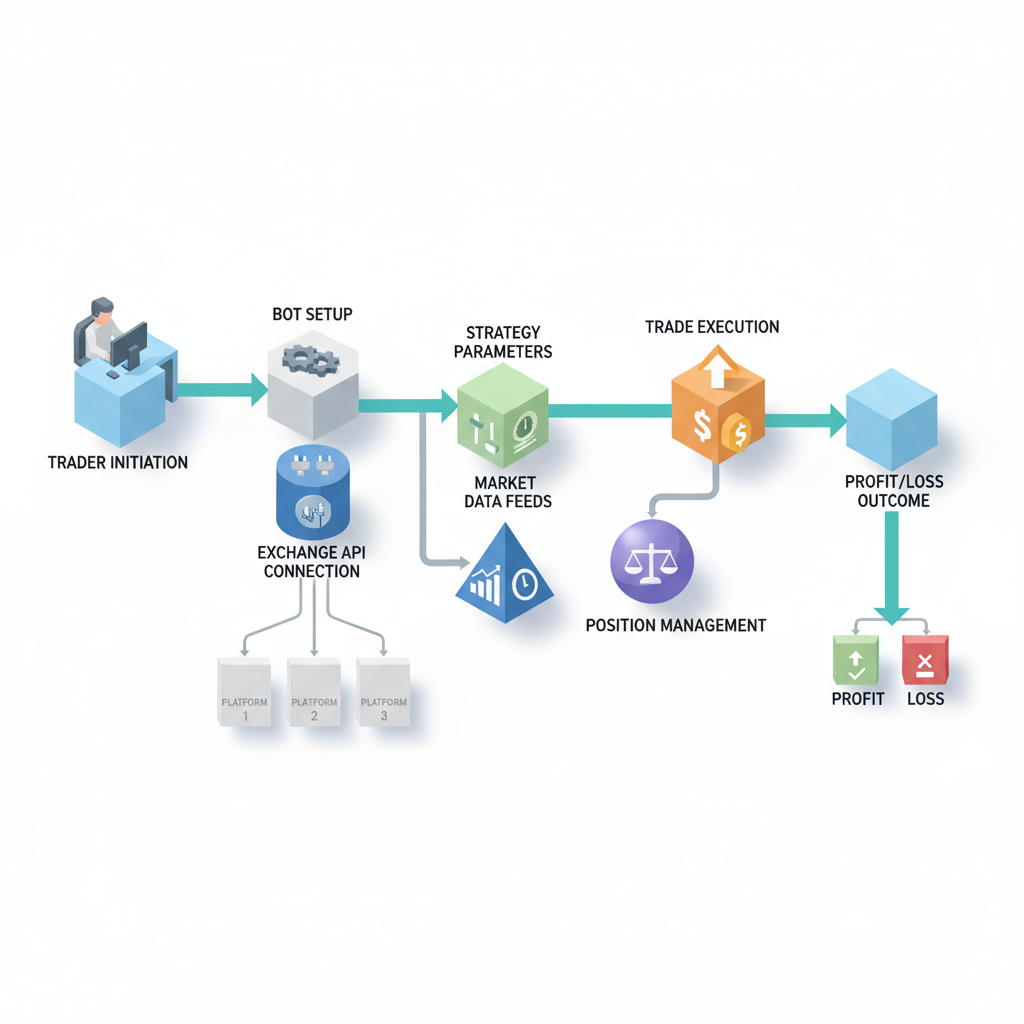
Algorithmic crypto trading is the practice of using programmed strategies and mathematical models to execute buy and sell orders automatically, based on predefined conditions. Instead of you watching a chart at 2am, the software does it. When Bitcoin drops 3% in 90 seconds, the bot has already responded before you have even unlocked your phone.
The contrast with manual trading is not just about speed. It is about consistency. A human trader will second-guess a stop-loss at the worst moment. A bot will not. It follows its instructions whether the market is behaving or spiralling, and it can monitor dozens of pairs simultaneously without fatigue.
The Australian context makes this particularly relevant. A 2024 study found nearly 4 million Australians now own cryptocurrency, a figure that keeps climbing as younger cohorts move beyond ETFs and into direct crypto exposure. That is a lot of people trying to manage assets across markets that never close, across time zones that are not always friendly for an early-morning trader in Brisbane or Perth.
Crypto markets run 24 hours a day, seven days a week, 365 days a year. Tokyo opens while Sydney sleeps. US markets move during the Australian dinner hour. Automated strategies let you maintain market presence through all of it without needing to be a zombie.
[INTERNAL LINK PLACEHOLDER: what is crypto trading → beginner guide to crypto trading in Australia]
Crypto trading bots are legal in Australia when used on legitimate, AUSTRAC-registered exchanges. The rest of this guide covers strategies, platforms, the new regulatory framework that arrives from April 2027, and what all of it means for your ATO obligations.
Key Benefits of Algo Trading for Australian Crypto Investors
The speed argument alone is worth taking seriously. A well-configured bot can react to a price movement in milliseconds. Manual trading introduces slippage not just from exchange latency, but from the simple human delay of recognising what is happening, deciding what to do, and executing. In volatile markets, that gap is costly.
Emotion is the other major factor. I have watched traders I respect hold through a 40% drawdown because they were convinced the trend would reverse, not because their strategy said so, but because of sunk-cost psychology. Bots do not have that problem. They execute the logic you built when you were calm, not the logic you would improvise when you are panicking.
For Australian traders specifically, the time zone issue is real. New York wakes up at 11pm AEST, London at 5pm or 6pm depending on daylight saving, and meaningful price action often hits during hours when most Australians are unavailable. Automated crypto trading in Australia addresses this gap directly: your strategy keeps running while you are at work, at dinner, or asleep.
Backtesting is an underappreciated advantage. Before risking real capital, you can run a proposed strategy against months or years of historical price data to see how it would have performed. This does not guarantee future results, but it does separate strategies that look good in theory from ones that have some evidence behind them.
Finally, AUD-denominated pairs on Australian exchanges like Swyftx, CoinSpot, and Independent Reserve mean you can run strategies without constantly converting back through USD, which simplifies your CGT record-keeping considerably.
Common Algorithmic Trading Strategies in Crypto Markets
There are more strategy types than most articles acknowledge, so I will be specific about what each one actually does and where it fits in the Australian market.
Trend-Following
The most common starting point. The bot identifies a prevailing price trend using indicators like moving averages (typically a 50-period and 200-period MA crossover) and enters positions in that direction. When the trend weakens or reverses, the position closes. It sounds simple because it is. The complexity is in the parameter tuning and in knowing which market conditions make trend-following useful versus when you are just generating noise.
Arbitrage
This one requires attention to Australian-specific conditions. Arbitrage bots exploit price discrepancies across exchanges, which can include differences between AUD-priced BTC on Swyftx versus USD-priced BTC on a global platform. The challenge is execution speed and withdrawal friction. Major banks like CBA and ANZ have put monthly caps and holds on crypto-related transfers, which can kill an arbitrage opportunity before you can fund the position. Profitable in theory, operationally harder for retail Australian traders than the pitch suggests.
Mean Reversion
This strategy assumes that when a price strays significantly from its historical average, it will return. Useful in range-bound markets, less useful in strong trends. The bot calculates statistical bands (often using Bollinger Bands or Z-score methods) and enters counter-trend positions near the extremes. The obvious risk: sometimes prices are ranging until they are not, and mean reversion bots get destroyed in breakouts.
Momentum and Market Making
Momentum trading involves entering positions based on the strength and velocity of recent price moves, essentially riding a wave that is already moving. Market making is the other side: placing simultaneous buy and sell orders at tight intervals to collect the spread. Market making requires high liquidity pairs and low fees to be viable. On Australian exchanges where spreads on BTC/AUD can sit around 0.6% during normal conditions, the economics for retail market making are tight.
Grid Trading and DCA Bots
Grid trading places buy and sell orders at preset price intervals above and below a defined level, profiting from oscillation within a range. Platforms like OKX have built-in Spot Grid Bot tools that make this accessible without custom code.
Dollar-cost averaging (DCA) bots automate regular purchases at fixed intervals to smooth entry price over time. Less sophisticated, but genuinely useful for long-term accumulation strategies, and very simple to configure on most Australian-friendly platforms.
High-Frequency Trading
HFT involves executing large numbers of orders at extremely high speed, exploiting tiny price inefficiencies. This is not a retail game. It requires co-located servers, low-latency infrastructure, and often direct exchange API connections with minimal overhead. IC Markets is one of the few Australian-regulated brokers that offers the execution infrastructure that approaches HFT requirements, though pure crypto HFT at institutional scale is mostly happening offshore.
Is Algorithmic Crypto Trading Legal in Australia?
Yes, unambiguously. Crypto trading bots are legal in Australia when deployed on legitimate exchanges and operated within the relevant legal framework. The question worth asking is not whether bots are legal, but whether the platforms you are using are operating within Australian law.
AUSTRAC: The Baseline
Digital currency exchanges operating in Australia have been required to register with AUSTRAC since 2018. This registration requires compliance with Australia’s Anti-Money Laundering and Counter-Terrorism Financing (AML/CTF) framework, which includes customer verification (KYC), transaction monitoring, and suspicious matter reporting. If an exchange does not have AUSTRAC registration, that is a hard stop. Do not use it.
In October 2025, new legislation gave the AUSTRAC CEO expanded powers to restrict or prohibit high-risk products and delivery channels. Tighter AML obligations for digital asset platforms took effect from March 31, 2026. This means exchanges are now under more scrutiny than they were 12 months ago, and that is a reasonable development given the scale of scam activity targeting Australians.
The DAF Act and What Changes in 2027
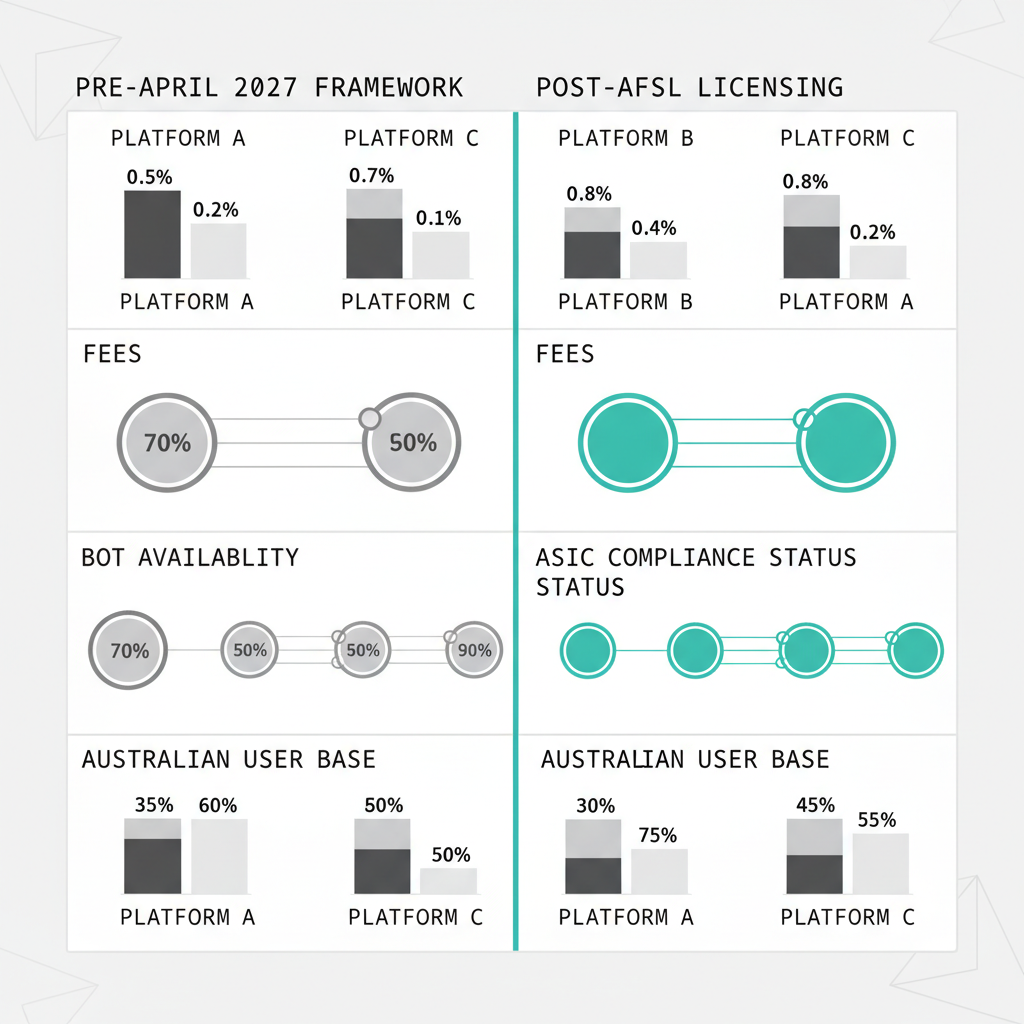
The Corporations Amendment (Digital Assets Framework) Act 2026 passed on April 1, 2026, and commences April 9, 2027. This is significant legislation. Every crypto exchange and custody platform operating in Australia will need to hold an Australian Financial Services Licence (AFSL) to operate legally after that commencement date.
ASIC issued a sector-wide no-action position until June 30, 2026, giving platforms time to assess the new guidance and begin licence applications. A dedicated ASIC regulatory guide is expected between July and December 2026, with operational standards to follow.
For traders choosing platforms now, the practical implication is clear. Prioritise exchanges that are AUSTRAC-registered today and are publicly working toward AFSL compliance. Platforms that are dragging their feet on this are either poorly resourced or not serious about operating in Australia long-term.
One nuance worth noting: ASIC’s general position is that most digital assets, including stablecoins, wrapped tokens, and tokenised securities, are financial products under existing law. Bitcoin, typically, is not. This distinction matters for how your platform’s obligations are structured and, indirectly, for how your own trading activity is categorised.
[INTERNAL LINK PLACEHOLDER: crypto regulation australia → ASIC crypto licensing guide 2026]
ASIC Licensing and the New Digital Assets Framework (2026–2027)
The DAF Act creates two main categories of regulated entity: Digital Asset Platforms (DAPs) and Tokenised Custody Platforms (TCPs). If you are using an exchange to run algo trading bots in Australia, you are almost certainly using a DAP, or a platform that interfaces with one.
What AFSL Compliance Means in Practice
From April 9, 2027, platforms without an AFSL cannot legally operate for Australian users. This is not a soft guideline. AFSL obligations include adequate financial resources, dispute resolution schemes, breach reporting obligations, and compliance with ASIC’s conduct standards. These are materially higher bars than AUSTRAC registration alone.
ASIC’s roadmap for this transition is roughly as follows. The regulatory guide arrives between July and December 2026. Operational standards follow. Platforms that have not begun the application process by mid-2026 are taking a significant risk, and so are the traders relying on them.
The broader economic argument is not trivial. Australia has the potential to access around AU$24 billion annually from tokenised markets once clear regulatory frameworks are in place. That number comes from industry analysis around what institutional capital flows become possible when custody, trading, and settlement infrastructure are properly licensed and auditable. The regulatory framework being built now is what makes that figure realistic.
Banking Friction and Automated Trading Cash Flows
One practical issue specific to automated crypto trading in Australia is how banking restrictions interact with bot-driven cash flows. CBA, ANZ, Westpac, and NAB have all implemented controls on crypto-linked transfers, including 24-hour holds, monthly caps around $10,000, and in some cases outright rejection of transfers to exchange addresses.
If your algo strategy involves frequent AUD deposits or withdrawals, especially smaller amounts at irregular intervals, you may trigger automated fraud flags at your bank. This is not a legal problem with the trading itself, but it is an operational problem. Using PayID and BPAY where available, keeping transactions above the threshold that attracts holds, and using exchanges with direct bank integrations all help reduce this friction.
[INTERNAL LINK PLACEHOLDER: crypto tax australia → ATO crypto tax guide for Australian investors]
The ATO’s growing sophistication here is also relevant. Real-time API connections between the ATO and licensed exchanges mean transaction data flows to the tax office automatically. Algo trading can generate hundreds of CGT events per year. If you are running any kind of active strategy, using crypto tax software like Koinly or CoinTracker from day one is not optional, it is essential.
Frequently Asked Questions
Is algorithmic crypto trading legal in Australia?
Yes. Crypto trading bots are legal in Australia when used on exchanges that hold valid AUSTRAC registration and, from April 2027, an AFSL. There are no laws prohibiting automated trading strategies for personal or professional use.
Do I need an AFSL to run my own trading bot?
No, individual traders running bots on their own accounts do not need an AFSL. The AFSL requirement applies to platforms and businesses providing financial services to others. If you are operating a bot as a business service for third parties, that is a different matter and you should get legal advice.
How does the ATO treat profits from algo trading?
The ATO treats each trade as a CGT event. If you are classified as an investor, gains are taxed at your marginal rate with a 50% CGT discount available for assets held over 12 months. If you are classified as a trader (frequent, systematic activity), gains may be treated as ordinary income with no CGT discount. Algo trading tends to generate frequent transactions, which pushes many users toward the trader classification. Get specific advice from a tax professional familiar with crypto.
Which Australian exchanges support algo trading bots?
Swyftx, Independent Reserve, and Binance Australia all support API access for bot integration. OKX has built-in bot tools including grid and DCA strategies. Third-party platforms like Cryptohopper and Bitsgap connect to multiple exchanges via API.
What is the difference between a trading bot and an algorithm?
A trading algorithm is the logic: the rules that define when to buy, sell, or hold. A trading bot is the software that implements that algorithm and executes orders automatically. The terms are often used interchangeably in retail contexts, but if you are building your own system, the distinction matters.
Will the new DAF Act affect traders or just platforms?
Primarily platforms. The licensing obligations fall on exchanges and custody providers, not individual traders. The effect on traders is indirect: you should ensure any platform you use is working toward compliance, because platforms that cannot obtain an AFSL will not be able to legally serve Australian users after April 2027.
Do major Australian banks allow transfers to crypto exchanges?
Most do, but with friction. CBA, ANZ, Westpac, and NAB have all implemented restrictions including holds, monthly caps, and occasional rejections. Using PayID where available, choosing exchanges with strong banking relationships, and keeping an eye on transaction patterns that might trigger fraud flags all help.
CryptoAlgo may earn a commission if you sign up through links on this page. This does not affect our editorial independence — we only recommend platforms we have actually used and would recommend to a mate. This article is general information, not financial advice. Crypto is volatile and you can lose money. Always do your own research and consider speaking to a licensed Australian financial adviser before investing.