Crypto Algo Trading Australia 2026: Complete Guide
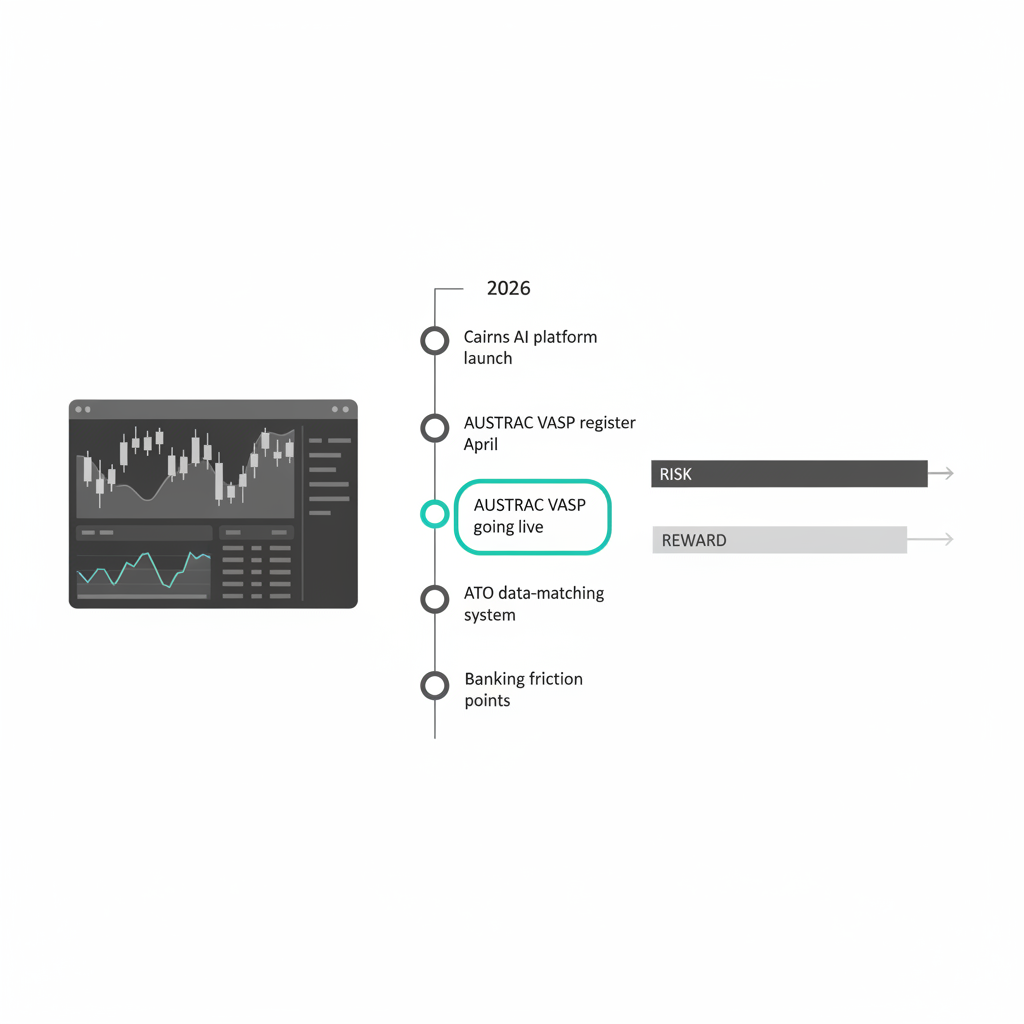
Crypto algo trading in Australia has moved well past the hobbyist phase. In 2026, you have Cairns-based AI platforms launching in April, AUSTRAC running a public VASP register, and the ATO matching your trade data directly from exchanges. The stakes are real, and so are the opportunities, if you know what you are doing.
> TL;DR: Crypto algo trading Australia covers automated, rule-based systems that execute trades 24/7 without emotion or hesitation. This guide explains how the main strategies work, which platforms Australian traders can actually use in 2026, what AUSTRAC and the ATO require from you, how the banks will slow you down, and what realistic risk looks like.
What Is Crypto Algo Trading in Australia?
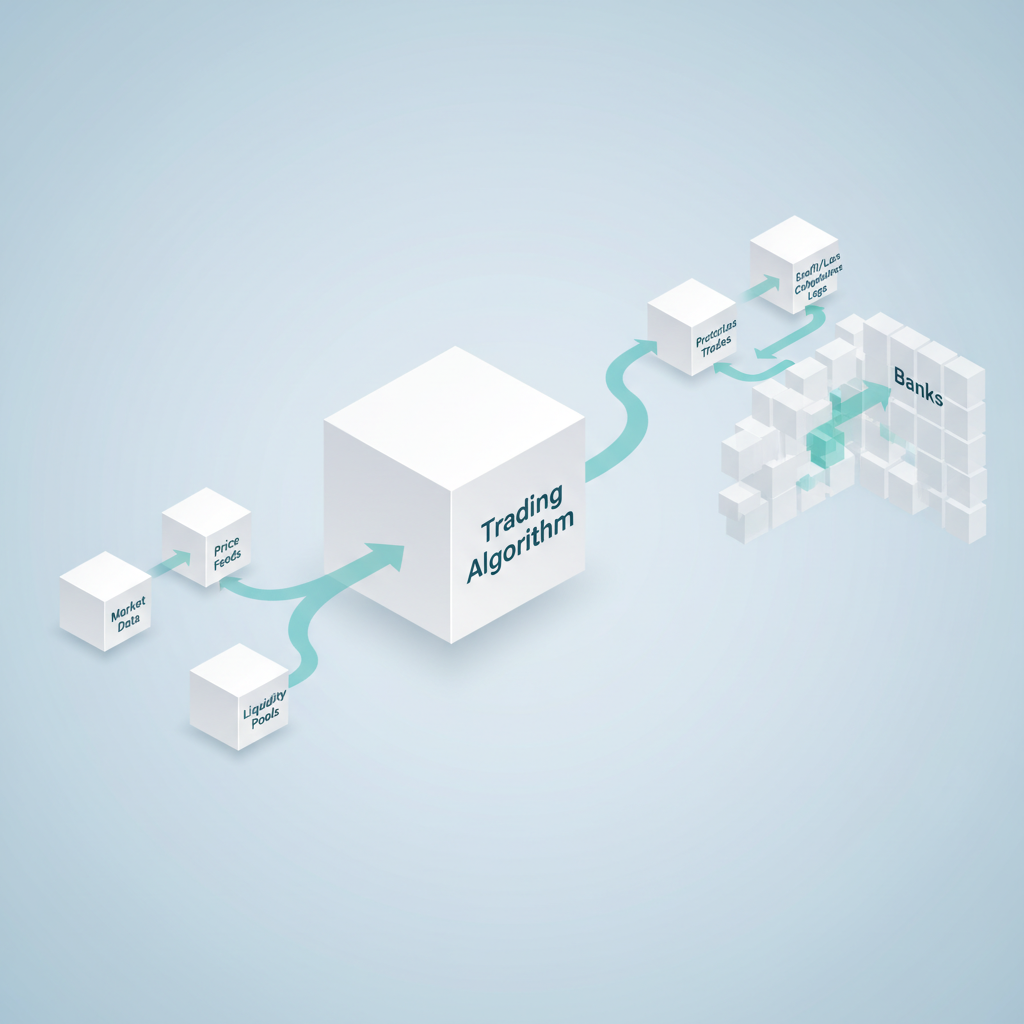
Crypto algo trading in Australia refers to using programmed strategies and mathematical models to execute buy and sell orders automatically, based on predefined conditions. You set the rules, the bot runs the trades. No watching charts at 2am, no panic selling when Bitcoin drops 8% in an hour.
The core appeal is straightforward: algorithms remove emotional decision-making, and crypto markets run 24 hours a day, seven days a week. A human cannot monitor every price movement across a dozen pairs. A well-configured bot can.
Australia is actually a decent environment for this. AUD-denominated trading pairs are available on most major local exchanges, liquidity on BTC/AUD is solid during both Sydney and overlap hours with Asian and US markets, and the round-the-clock nature of crypto suits automated strategies far better than ASX equities.
The participants range widely. Retail traders are running DCA bots on Swyftx or connecting Cryptohopper to Binance. Prop traders are building custom strategies on cTrader or MT5. Institutions are doing things that require co-location servers and Bloomberg terminals. Most readers here sit in the first two categories, and that is where this guide focuses.
The regulatory environment matters more in 2026 than it did even two years ago. AUSTRAC expanded its oversight of virtual asset service providers in April 2026, and ASIC is moving toward requiring exchanges to hold an Australian Financial Services Licence. If you are deploying capital through an algo platform, knowing whether that platform is legally operating in Australia is not optional.
[INTERNAL LINK PLACEHOLDER: algorithmic trading explained → trading-fundamentals-pillar]
How Crypto Algo Trading Works: Strategies Explained
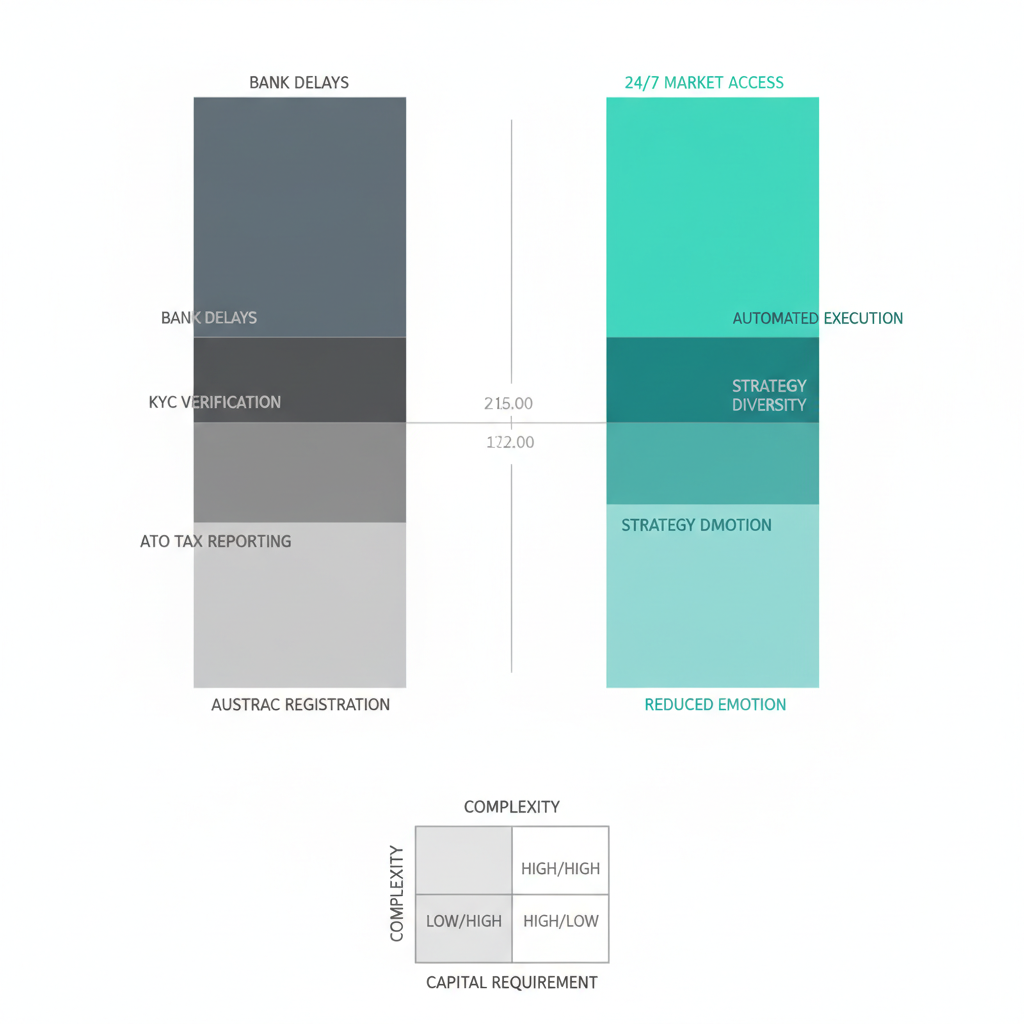
The strategy you choose defines everything: how often you trade, what infrastructure you need, and whether the approach is even realistic at a retail level.
Trend-following is the most accessible starting point. Bots detect sustained price movements using indicators like moving averages or the MACD, then enter positions in the direction of the trend. It sounds simple because the concept is simple. Execution is where most people fall down, particularly around false signals and slippage during volatile periods.
Arbitrage exploits price differences for the same asset across different exchanges simultaneously. If BTC is trading at $145,200 AUD on one exchange and $145,800 AUD on another, you buy on one and sell on the other. The window closes in milliseconds. For retail traders, pure arbitrage is largely out of reach without low-latency infrastructure, but statistical arbitrage between correlated pairs is more accessible.
Mean reversion operates on the assumption that prices will return to a historical average after deviating significantly. You are essentially fading extreme moves. It works until it does not, and knowing when the market has shifted regime rather than just deviated temporarily is genuinely difficult.
Momentum trading takes the opposite view: when an asset shows strong directional movement with volume backing it, the bot enters in that direction. The risk is entering late and catching the reversal.
Market making involves simultaneously posting buy and sell limit orders on both sides of the book, profiting from the spread between them. This is largely an institutional game. Retail attempts at market making on centralised exchanges will get eaten alive by faster participants.
High-frequency trading (HFT) executes thousands of trades per second and requires co-location, proprietary infrastructure, and direct market access. If you are reading this guide, HFT is not your game, and that is fine.
DCA bots are probably the most underrated tool for retail traders. You configure the bot to buy a fixed AUD amount of BTC or ETH at regular intervals regardless of price. It is not glamorous, but it removes timing risk and is easy to tax-account for. Cryptohopper, Swyftx’s recurring buy feature, and several other platforms support this natively.
The honest answer is that trend-following, DCA, and momentum strategies are what Australian retail traders can realistically run without institutional infrastructure. Anything promising consistent 10%+ monthly returns through a black-box algo should be treated with serious scepticism.
Best Platforms for Crypto Algo Trading in Australia (2026)
The platform choice splits depending on whether you want spot exchange bots or CFD algo trading. They are fundamentally different products with different regulatory treatment and different risk profiles.
Spot Exchange Bots
Cryptohopper is the most widely used third-party bot platform among Australian retail traders. It connects via API to exchanges including Binance and supports trend-following, DCA, and trailing stop strategies. The interface is accessible without needing to write code, and the marketplace lets you buy pre-built strategy templates. Subscription costs start around USD $19/month for basic plans. The downside is that the quality of marketplace strategies varies enormously and most of them have not been stress-tested in genuinely adverse conditions.
Swyftx is AUSTRAC-registered and supports recurring buys (automated DCA). It does not offer a full algo bot interface natively, but you can connect third-party bots via API. I have been using Swyftx since 2022 and found the AUD deposit and withdrawal experience to be the smoothest of the local exchanges. Spreads on BTC/AUD sit around 0.4 to 0.6% depending on conditions, which is competitive for a retail-facing exchange.
BTC Markets is one of the larger Australian-native exchanges and offers API access with maker fees from 0.10% and taker fees from 0.20% for higher volume tiers. It is better suited to traders who want to build custom integrations rather than use pre-built bot tools.
Altrady offers multi-exchange bot integration, including grid bots, signal bots, and DCA bots, with connections to Binance, Kraken, and others. Australian traders use it as an overlay on top of existing exchange accounts.
SaintQuant launched in Cairns on April 29, 2026, positioning itself as an AI-powered platform for automated market execution using real-time data analysis and quantitative models. It is very new, which means limited track record. Worth watching, but verify AUSTRAC registration before connecting any live funds.
CFD Algo Platforms
IC Markets supports Expert Advisors via MT4 and MT5. Spreads on crypto CFDs start from around 0.1% on BTC with raw spread accounts, and execution speed is fast enough for most retail automated strategies. It is not an exchange; you are trading a derivative of the underlying asset, which has different tax and risk implications.
Pepperstone offers cTrader with native cBot support. If you can write code in C#, you can build custom algorithms directly in the platform. Pepperstone is ASIC-regulated and has a solid reputation in the Australian retail trading space.
Interactive Brokers Australia supports API-driven algo trading across multiple asset classes including crypto. It suits more sophisticated traders who want to run strategies across equities and crypto from a single account.
Capital.com covers over 100 crypto CFDs with no commissions on spot positions and includes an AI trading assistant. Worth considering if you want AI-assisted strategy suggestions without building from scratch.
OANDA has strong API capabilities for strategy building and is worth considering if you are already familiar with their infrastructure from forex algo work.
Quick Platform Comparison
| Platform | Algo/Bot Support | AUD Support | AUSTRAC Registered | Best For |
|---|---|---|---|---|
| Cryptohopper | Full bot platform | Via connected exchange | Check register | Retail bot traders |
| Swyftx | API + recurring buys | Yes (native) | Yes | AUD spot, DCA |
| BTC Markets | API access | Yes (native) | Yes | Custom integrations |
| IC Markets | MT4/MT5 EAs | AUD accounts | Verify | CFD algo, HF strategies |
| Pepperstone | cTrader cBots | AUD accounts | Verify | Custom coded strategies |
| Interactive Brokers AU | Full API suite | AUD accounts | Verify | Multi-asset algo |
| Capital.com | AI assistant | AUD deposits | Verify | Guided AI strategies |
| SaintQuant | AI-native platform | AUD | Verify (new) | AI automated execution |
| Altrady | Multi-exchange bots | Via exchange | N/A (overlay) | Multi-exchange management |
Always check the AUSTRAC public VASP register directly before depositing. The register launched April 2, 2026, and is the authoritative source.
One more thing: eToro copy trading functions as a semi-automated alternative where you mirror another trader’s positions automatically. It is not algorithmic in the technical sense, but for someone who wants automated exposure without building a strategy, it does the job. Retail CFD accounts on eToro carry a risk warning: a significant proportion of retail accounts lose money.
[INTERNAL LINK PLACEHOLDER: Swyftx full review → swyftx-review]
[INTERNAL LINK PLACEHOLDER: IC Markets review → ic-markets-review]
[INTERNAL LINK PLACEHOLDER: Pepperstone review → pepperstone-review]
AUSTRAC and ASIC: Regulatory Rules You Must Know
Australia’s crypto regulatory framework tightened significantly in early 2026, and if you are running an algo strategy with real money, understanding who can legally take it is not optional.
AUSTRAC requires all businesses providing virtual asset services in Australia, referred to as VASPs, to be registered and comply with Anti-Money Laundering and Counter-Terrorism Financing obligations. This applies to exchanges, wallet providers, and any platform facilitating crypto transactions. On April 2, 2026, AUSTRAC launched a searchable public register of registered VASPs. Check it before you connect an API key to anything. The URL is on the AUSTRAC website and the register is free to search.
AUSTRAC has not been passive. In 2024, it established a taskforce targeting crypto ATM operators, identifying them as high-risk channels for money laundering and scams. Enforcement actions have followed. The message is clear: the regulator is watching and acting.
ASIC currently does not universally require crypto exchanges to hold an Australian Financial Services Licence, but that is expected to change. Regulatory reform is in progress, and platforms that operate now without an AFSL may be required to obtain one. For algo traders, the practical implication is that your chosen platform’s regulatory status may shift over the next 12 to 24 months.
A specific note on educational platforms: CT ALGO Inc. (ctalgo.com) explicitly prohibits the connection of real trading accounts. It is a learning environment, not a signal service or broker. This distinction matters because some platforms market themselves ambiguously. Read the terms before you assume a platform can execute live trades on your behalf.
For Australian algo traders, here is a working checklist:
1. Verify AUSTRAC registration via the public register before using any platform.
2. Read the Product Disclosure Statement and terms of service in full.
3. Never share API keys with unverified bot providers. Use read-only API access where possible, and set withdrawal permissions off.
4. Understand whether you are trading spot crypto or a CFD derivative, as the regulatory framework and tax treatment differ.
The Coinbase complaint to parliament in February 2026 adds useful context. Coinbase alleged that major Australian banks are systematically denying services to legitimate crypto companies. This is not just an inconvenience; it reflects ongoing tension between traditional financial regulation and crypto infrastructure. The regulatory environment is unsettled, and that creates both risk and opportunity for algo traders who stay informed.
[INTERNAL LINK PLACEHOLDER: AUSTRAC crypto registration guide → austrac-vasp-guide]
Australian Banking Restrictions and Funding Your Algo Account
Before your bot can execute a single trade, you need to get AUD into your account. This is where Australian banking makes things genuinely frustrating.
The major banks have implemented transfer restrictions on payments to crypto exchanges, framed as scam prevention. In practice, they affect legitimate traders as much as anyone else.
Commonwealth Bank runs the tightest restrictions: a hard $10,000 monthly cap on payments to crypto exchanges across all CBA accounts, plus a 24-hour hold on first transfers to a new exchange. If you are funding an algo account and want to deploy $15,000 to start, CBA will split that across two calendar months. Plan accordingly.
ANZ is considerably more workable. Established customers can transfer up to $25,000 per day to crypto exchanges. For active algo traders running meaningful capital, ANZ is the better banking option among the majors.
NAB and Westpac operate real-time transaction monitoring rather than hard caps, but NAB may flag transfers above $40,000. Westpac has been known to delay or decline transfers to exchanges without prior notice. If you bank with either and are planning a large algo deployment, calling the bank first is not a bad idea.
The most practical deposit methods for Australian algo traders are PayID, Osko, and BPAY. Most Australian exchanges offer these free of charge, and transfers typically settle in under a minute via Osko. Card deposits attract fees around 1.22% on most platforms, and cash deposits can hit 2.5%. Neither makes sense at scale.
The Coinbase debanking complaint to parliament in February 2026 captured what many Australian crypto users have experienced for years. Banks holding legitimate transfers, blocking accounts, and refusing to explain decisions. There is no simple fix yet, but choosing a bank with higher crypto transfer limits and keeping clear records of all transfers is the best mitigation available right now.
Practical approach: fund your algo account in advance of when you plan to start trading. Last-minute transfers can be held or declined, and if you are trying to deploy capital into a time-sensitive strategy, a 24-hour hold will cost you.
Crypto Algo Trading Tax in Australia: ATO Rules for 2026
The ATO’s position on crypto has not fundamentally changed, but the enforcement has. The data-matching program is active and exchanges are providing transaction data directly to the ATO. Do not assume the absence of a tax statement from your exchange means the ATO does not know what you traded.
The basic position: the ATO treats cryptocurrency as property, not currency. Every disposal is a taxable event. That includes selling crypto for AUD, trading one crypto for another, and using crypto to pay for goods or services. For algo traders running hundreds of trades per month, this creates significant record-keeping overhead.
CGT rates run from 0% to 45% depending on your total taxable income for the year. The 50% CGT discount applies if you hold an asset for more than 12 months before disposing of it. Most algorithmic strategies trade frequently by design, meaning the vast majority of positions will be held for less than 12 months. The discount will not apply to most algo trading gains.
The trader versus investor distinction matters significantly. If the ATO classifies your algo activity as running a business, rather than investing as a private individual, your gains are treated as ordinary income rather than capital gains. That removes the CGT discount option entirely, but it does allow you to deduct trading-related business expenses. The classification depends on factors like trading frequency, the commercial nature of your activity, and whether you are operating in a businesslike way. This is genuinely complex territory and worth getting professional advice on.
Losses from algo trading can offset capital gains in the same income year or be carried forward to future years. If your strategy has a rough quarter, keep those records. They have real value at tax time.
For practical record-keeping, the trade volumes generated by even a modestly active algo strategy will overwhelm any manual spreadsheet approach quickly. Koinly and CoinTracking both integrate with Australian exchanges and can handle the volume. Koinly in particular has solid ATO report generation built in.
The ATO’s data-matching program means that omitting or understating crypto income carries real risk. The ATO has been explicit about this in guidance released over the past two years.
This is general information only. For advice specific to your situation, speak to a registered tax agent with experience in cryptocurrency.
[INTERNAL LINK PLACEHOLDER: crypto tax Australia guide → crypto-tax-australia]
FAQ
Is crypto algo trading legal in Australia?
Yes. Using