CryptoAlgo Review Australia 2026: AI Signals, Costs & Risks Explained
If you have spent any time in Australian crypto circles lately, you have probably heard someone mention AI trading signals as though they are a shortcut to consistent profits. CryptoAlgo is one of the platforms getting attention, and this cryptoalgo review australia covers what the platform actually does, what it costs, how the performance claims stack up under scrutiny, and what the current regulatory environment means for you as an Australian user.
> TL;DR: This cryptoalgo review australia finds that CryptoAlgo is an AI-powered crypto signal platform claiming 95%+ effectiveness and 24/7 market coverage, designed to work with TradingView. Australian users must weigh unverified subscription costs, ATO tax obligations on any profits, major bank transfer limits, and ASIC’s tightening regulatory scrutiny of AI financial services before committing real capital.
CryptoAlgo Review Australia: What Is It and How Does It Work?
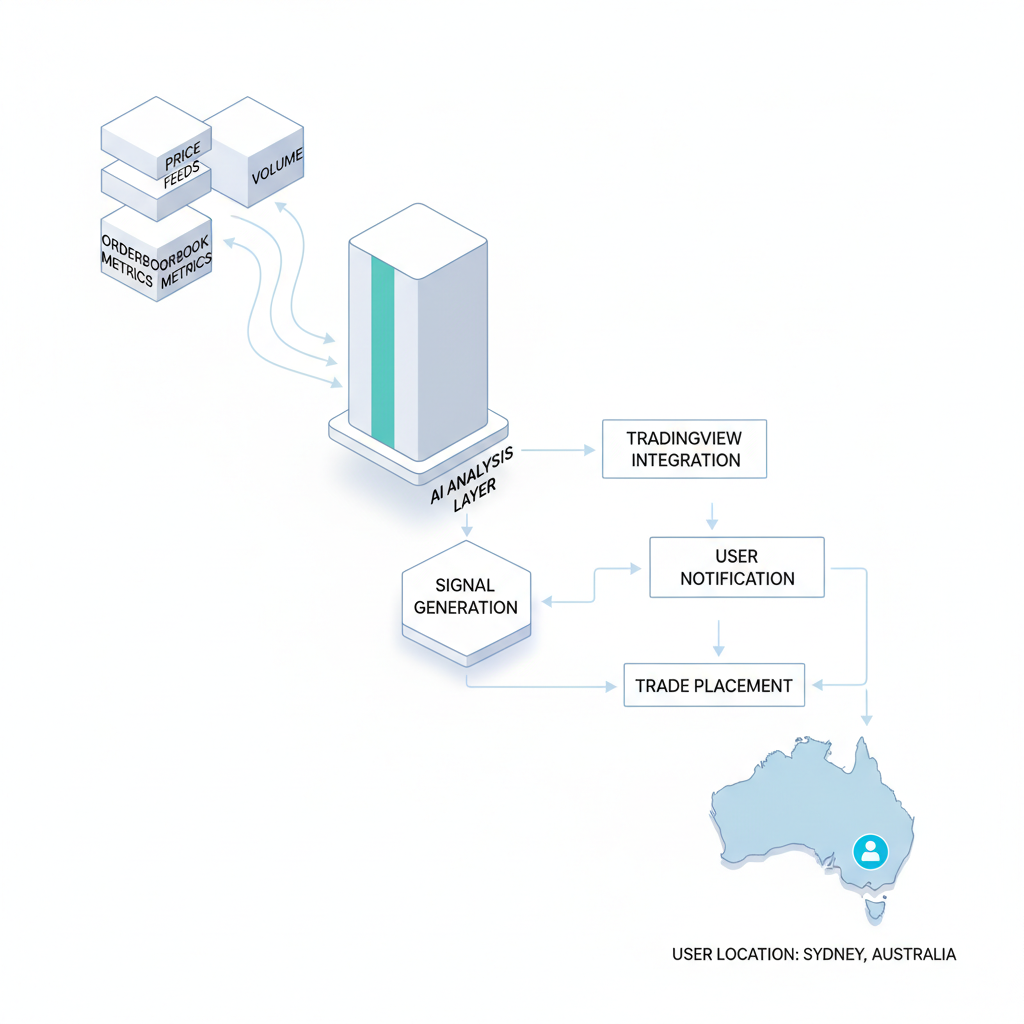
CryptoAlgo is not a crypto exchange and it is not an automated trading bot. It is a signal delivery platform. You receive a buy or sell signal, and then you go and execute the trade yourself on whatever exchange you use. That distinction matters, because a lot of people come in expecting the platform to do the trading for them and walk away confused.
The core product is an AI-powered algorithm that blends machine learning, technical analysis, and market sentiment data to identify potential trade setups across multiple crypto pairs. Signals run around the clock, which makes sense given crypto markets do not close on a Friday afternoon like the ASX does.
Each signal comes with three components: an entry point, a stop-loss level, and a take-profit target. That structure is actually useful. Vague signals that say “buy BTC now” are nearly worthless. Knowing where you are getting out if you are wrong, and where you are banking profit if you are right, lets you do basic position sizing before you touch your exchange.
The platform is designed to integrate with TradingView, which is the charting tool most serious retail traders in Australia already use. If you are already paying for a TradingView subscription, that integration means you are not bouncing between multiple interfaces to track signals and charts separately.
One thing worth flagging immediately: CryptoAlgo explicitly excludes US investors from accessing the platform. Australian users can access it, subject to the local regulatory conditions covered later in this article. The platform’s website is CryptoAlgo.com.au, which at least signals some awareness of the Australian market rather than treating us as an afterthought.
[INTERNAL LINK PLACEHOLDER: “AI crypto trading signals” → pillar: best-crypto-trading-signals-australia]
CryptoAlgo Signal Performance: Can You Trust the 95%+ Claim?
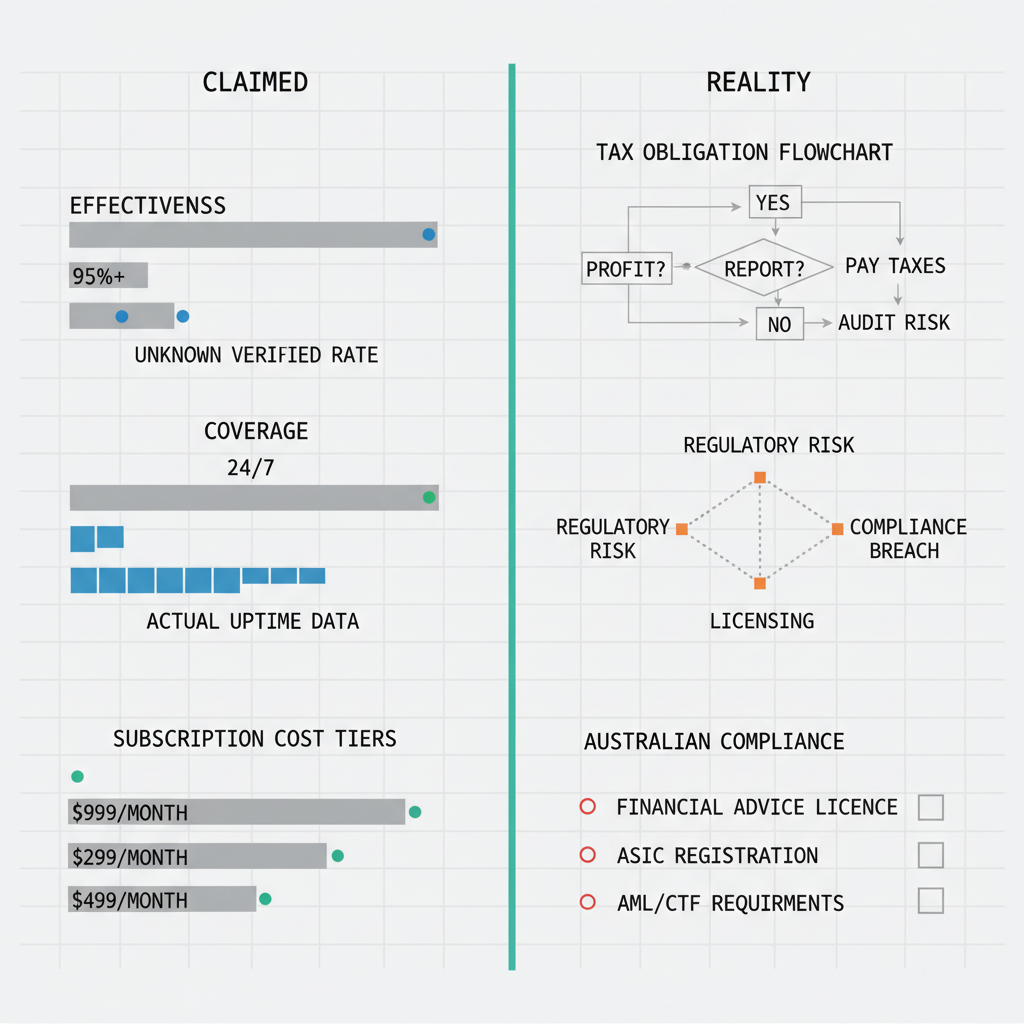
The 95%+ effectiveness rate is the headline number, and it deserves serious scrutiny before you build a trading strategy around it.
First, the obvious caveat: this figure is self-reported by the platform. There is no independently audited track record publicly available, no third-party verification, and no live trade log accessible to prospective subscribers. That does not make it false, but it does mean you should treat it the same way you would treat any unverified marketing claim.
Second, and more importantly, a high win rate does not automatically translate to a profitable strategy. This is one of the most persistently misunderstood concepts in retail trading. If a signal provider wins 95% of trades but the average losing trade is ten times the size of the average winning trade, the strategy is deeply unprofitable. The metrics that actually matter are risk-adjusted return and profit factor, not raw win rate. A win rate of 60% with disciplined position sizing and a favourable risk/reward ratio will outperform a 95% win rate strategy where the losses are uncontrolled.
There is also the backtesting problem. Signal providers commonly report performance based on historical backtests, which are optimised on past data and routinely overstate live performance. Markets change, correlations shift, and the edge that looked clean in a backtest frequently degrades in real conditions.
ASIC flagged in March 2026 that 64% of Gen Z Australians trust AI platforms for financial information without applying meaningful critical evaluation. That is a concerning statistic, and it is worth sitting with for a moment before subscribing to any AI signal service.
My recommendation: if CryptoAlgo offers any paper trading or demo mode, use it for at least 30 to 60 days before putting real capital on the line. Log every signal, track the outcomes against the stated entry, stop-loss, and take-profit levels, and calculate your own win rate and average risk/reward from that sample. If no demo option exists, the comparable platform UltraAlgo uses genetic algorithm optimisation and at least provides detailed indicator performance data you can evaluate before committing.
[INTERNAL LINK PLACEHOLDER: “backtesting vs live performance” → pillar: algo-trading-crypto-australia-2026]
CryptoAlgo Pricing and Subscription Costs for Australian Users
Here is where I have to be straight with you: CryptoAlgo’s exact subscription pricing in AUD is unverified at the time of writing. The platform does not prominently publish its pricing in a way that allows for direct, confirmed comparison. You should check CryptoAlgo.com.au directly for current pricing before making any decisions based on this article.
For context, the comparable signal platform VectorAlgo charges US$49 per month or US$399 per year for crypto signals, with premium multi-asset plans running from US$99 per month. Those are the kinds of numbers you are probably looking at when benchmarking signal-only platforms.
Australian subscribers will almost certainly be paying in USD, which means the AUD/USD exchange rate affects your effective cost every billing cycle. At current rates, US$49 per month is roughly AU$75 to AU$80, and that is before you have traded a single dollar.
The platform itself does not charge trading fees. That sounds attractive until you remember you still pay the underlying exchange. Typical Australian exchange fees run from 0.1% to around 1% per trade depending on the platform and trade type. If you are using Swyftx or CoinSpot to execute the signals, those fees compound across every trade the signals generate.
Your total cost of using CryptoAlgo looks something like this: CryptoAlgo subscription (unverified) plus your TradingView subscription (Pro plans start around US$14.95/month) plus exchange fees on every executed trade. For an active trader following multiple signals daily, exchange fees alone can easily exceed the subscription cost.
No verified free trial or paper trading option has been confirmed for Australian users.
How CryptoAlgo Compares to Other AI Crypto Signal Platforms in Australia
CryptoAlgo’s signal-only, manual-execution model puts it in a specific niche. Most competing platforms have moved toward some degree of automated execution, which either appeals to you or it does not depending on how much control you want over your own trades.
Here is how the main options available to Australian users stack up:
| Platform | Type | Execution | Approx. Price | ASIC/Regulatory Notes | AU Exchange Compatibility |
|---|---|---|---|---|---|
| CryptoAlgo | Signals only | Manual | Unverified (USD) | AUSTRAC status unverified; signals framed as informational | TradingView integration; manual execution on any exchange |
| SaintQuant | Automated AI execution | Automated | Varies by tier | Launched April 2026; AFSL status not confirmed | Supports major exchanges |
| Cryptohopper | Signals + bots | Both | From ~US$19/month | Not AFSL-licensed; general ToS disclaimers | Binance, Kraken, Coinbase |
| 3Commas | DCA + Grid bots | Automated | From ~US$29/month | Not AFSL-licensed | Binance, Kraken, OKX |
| Pionex | Built-in exchange bots | Automated | Zero subscription; 0.05% trading fee | Exchange registered separately | Native exchange only |
| UltraAlgo | Indicators + strategy tools | Manual (indicator-based) | Varies | Not AFSL-licensed | TradingView integration |
| Coinrule | Rule-based automation | Automated | From ~US$29/month | Not AFSL-licensed | Binance, Kraken, Coinbase |
| Bitsgap | Grid + DCA bots | Automated | From ~US$23/month | Not AFSL-licensed | Binance, OKX, Kraken |
A few things stand out from that comparison. Pionex is the obvious cost outlier because the bots are built into the exchange with no monthly subscription fee. The trade-off is that you are locked into their native exchange, which may or may not suit your existing setup. Cryptohopper is the closest functional alternative to CryptoAlgo in that it offers a signals marketplace alongside bot automation, giving you the option to follow external signals or automate execution entirely.
For Australians specifically, none of these platforms currently hold an AFSL for digital asset services, though that will change under the new Digital Assets Framework Act from April 2027. Compatibility with Swyftx and CoinSpot is a practical consideration: most bot platforms connect via API to international exchanges rather than Australian ones, which means you may be executing on Binance rather than an AUSTRAC-registered AU exchange.
[INTERNAL LINK PLACEHOLDER: “best crypto trading bots Australia” → pillar: best-crypto-trading-signals-australia]
Is CryptoAlgo Regulated in Australia? ASIC, AUSTRAC and Licensing
This is the section that matters most, and it is the one most signal platform reviews gloss over with a sentence or two.
AUSTRAC Registration
AUSTRAC requires Virtual Asset Service Providers operating in Australia to register under the expanded Anti-Money Laundering and Counter-Terrorism Financing laws that came into effect on 31 March 2026. CryptoAlgo’s specific AUSTRAC registration status as a signal provider is unverified at the time of writing. AUSTRAC maintains a publicly searchable register at austrac.gov.au, and I would strongly recommend checking it before subscribing. Searching takes about 30 seconds and tells you whether a platform is legitimately registered or not.
The Travel Rule, which requires registered VASPs to collect and share transaction information on transfers above a certain threshold, took effect on 1 July 2025. Whether CryptoAlgo’s signal-only model brings it within VASP definition depends on how AUSTRAC interprets its activities, which is another reason to verify registration independently.
The AFSL Question
The bigger regulatory question for any signal provider is whether delivering trading signals constitutes providing financial product advice under the Corporations Act. If it does, the platform needs an Australian Financial Services Licence.
CryptoAlgo, like most signal providers, almost certainly frames its output as “informational” rather than “advice” in its terms of service. That distinction is legally significant but increasingly fragile. ASIC has been explicit in 2026 about scrutinising AI-powered platforms that influence investment decisions. The regulator’s concern is not abstract: if an AI system tells you to buy a specific asset at a specific price with a specific stop-loss, that looks a lot like advice regardless of what the disclaimer says.
The Corporations Amendment (Digital Assets Framework) Act 2026 passed on 1 April 2026 and requires digital asset platforms and tokenised custody providers to obtain an AFSL from 9 April 2027. Signal providers may or may not fall under the new framework depending on how ASIC interprets their services during the transition period. ASIC’s INFO 225 class no-action position, which gave some informal shelter to crypto-adjacent services, expires in June 2026, tightening the transitional window considerably.
What This Means Practically
For Australian users, the regulatory situation creates some real uncertainty. The platform is not operating in a completely unregulated vacuum, but it is also not operating under a clear, verified licence that gives you the same protections as, say, a regulated financial adviser or an AFSL-holding exchange.
The practical steps I would take before subscribing are: check the AUSTRAC register, read CryptoAlgo’s terms of service carefully for how they characterise signals versus advice, and consider whether you are comfortable operating in that regulatory grey area given that ASIC is actively watching this space.
One piece of genuine reassurance: illicit crypto activity in Australia accounted for less than 1% of total on-chain activity between March 2025 and February 2026. The regulatory environment here is maturing and tightening, but it is not hostile to legitimate participants. That is actually a reasonable environment to be operating in, as long as platforms you use are doing the right thing.
[INTERNAL LINK PLACEHOLDER: “AUSTRAC crypto registration” → pillar: is-crypto-legal-in-australia]
Tax Implications of Using AI Crypto Signals in Australia
Every trade you execute based on a CryptoAlgo signal is a taxable event in Australia. The ATO treats cryptocurrency as property, not currency, which means profits are subject to Capital Gains Tax.
If you hold a position for more than 12 months before selling, you may be eligible for the 50% CGT discount. But if you are following AI signals actively, you are almost certainly turning positions over in days or weeks, which means the discount does not apply and you are paying your full marginal tax rate on every realised gain.
There is also the question of whether the ATO classifies you as an investor or a trader. Active, systematic use of signals across multiple positions starts to look more like a trading business in the ATO’s view. If you are classified as carrying on a business, profits are taxed as ordinary income rather than capital gains, which removes the CGT discount entirely and changes how losses are treated.
Keep records of every trade: date, asset, entry price, exit price, AUD equivalent at time of transaction, and any fees paid. Koinly, CoinTracker, and CryptoTaxCalculator all integrate with major Australian exchanges and can pull trade history automatically. Using AI signals across multiple pairs without solid record-keeping is a recipe for a painful tax season.
[INTERNAL LINK PLACEHOLDER: “crypto tax Australia” → pillar: crypto-tax-australia-guide]
Australian Banking Restrictions and Funding Your Trading Account
This is the practical bottleneck that catches a lot of Australian traders off-guard. Major Australian banks have implemented transfer limits and restrictions on transactions to crypto exchanges, framed as fraud prevention measures.
Commonwealth Bank caps monthly transfers to crypto exchanges at $10,000. ANZ allows up to $25,000 per day for established customers, though limits vary. NAB and Westpac have their own restrictions and in some cases have blocked transfers to specific exchanges outright. Coinbase has publicly alleged that Australian banks are engaging in debanking of crypto companies.
If you are planning to put meaningful capital behind CryptoAlgo signals, your first test is whether your bank will let you get funds to your exchange in the first place. Using an AUSTRAC-registered Australian exchange like Swyftx or CoinSpot tends to cause fewer banking friction points than sending money offshore to international exchanges.
Frequently Asked Questions
Is CryptoAlgo regulated in Australia?
CryptoAlgo’s AUSTRAC registration status as a signal provider is unverified at time of writing. You should check AUSTRAC’s public register directly. Whether the platform requires an AFSL under the new Digital Assets Framework Act 2026 depends on how ASIC classifies signal delivery services, a question that remains unresolved during the current regulatory transition period.
How does CryptoAlgo integrate with Australian crypto exchanges?
CryptoAlgo signals are designed to work with TradingView for charting. Execution is manual, meaning you view the signal and then place the trade yourself on whichever exchange you use. This means it is technically compatible with any exchange, including Australian ones like Swyftx and CoinSpot, since you are placing orders manually rather than via API.
Has anyone independently verified CryptoAlgo’s 95%+ success rate?
No independently audited verification of the 95%+ effectiveness claim has been confirmed. The figure is self-reported. Before committing capital, request transparent trade logs or run a paper trading trial for 30 to 60 days to evaluate signal quality yourself.
What tax do I pay on profits from AI crypto signals in Australia?
All realised profits from trades executed using crypto signals are subject to CGT in Australia. The 50% CGT discount applies only if you hold the asset for more than 12 months. Active signal-following typically results in positions held for days or weeks, meaning you pay your full marginal rate on