Algorithmic Crypto Trading in Australia 2026: Full Platform Guide
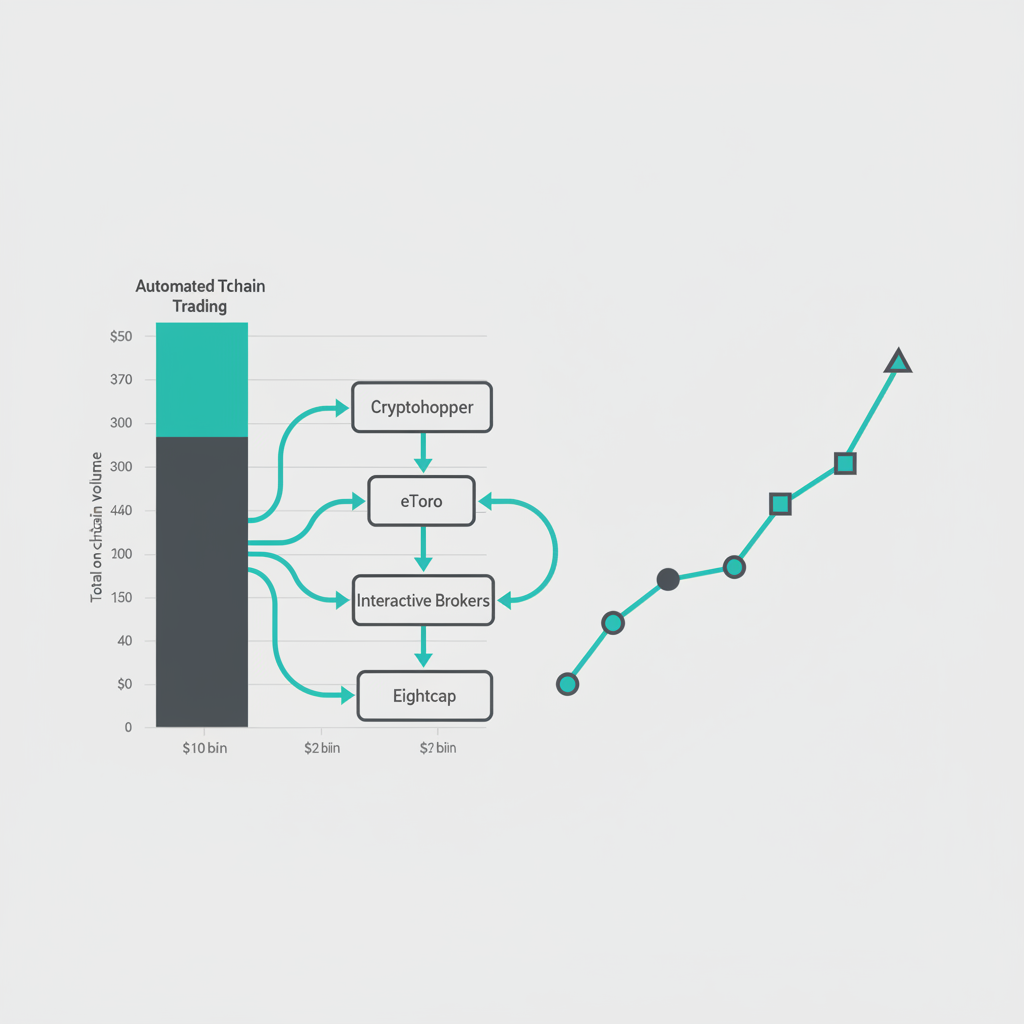
Algorithmic crypto trading in Australia processed over $50 billion on-chain in the 12 months to February 2026, and the share of that volume running through automated systems is growing fast. If you have been sitting on the sideline wondering whether bots and algo tools are worth the setup effort, this guide covers everything from how the platforms actually work through to what the ATO expects from you at tax time.
> TL;DR: Algorithmic crypto trading in Australia is maturing quickly in 2026, with platforms like Cryptohopper, eToro, Interactive Brokers, and Eightcap offering serious automated trading tools at varying price points. Australian traders need to pick AUSTRAC-registered exchanges, keep clean records for CGT purposes (50% discount applies if you hold 12+ months), and watch their bank, because CBA and Macquarie still restrict crypto transfers. Draft AFSL laws from Treasury could change platform obligations before the year is out.
What Is Algorithmic Crypto Trading in Australia?
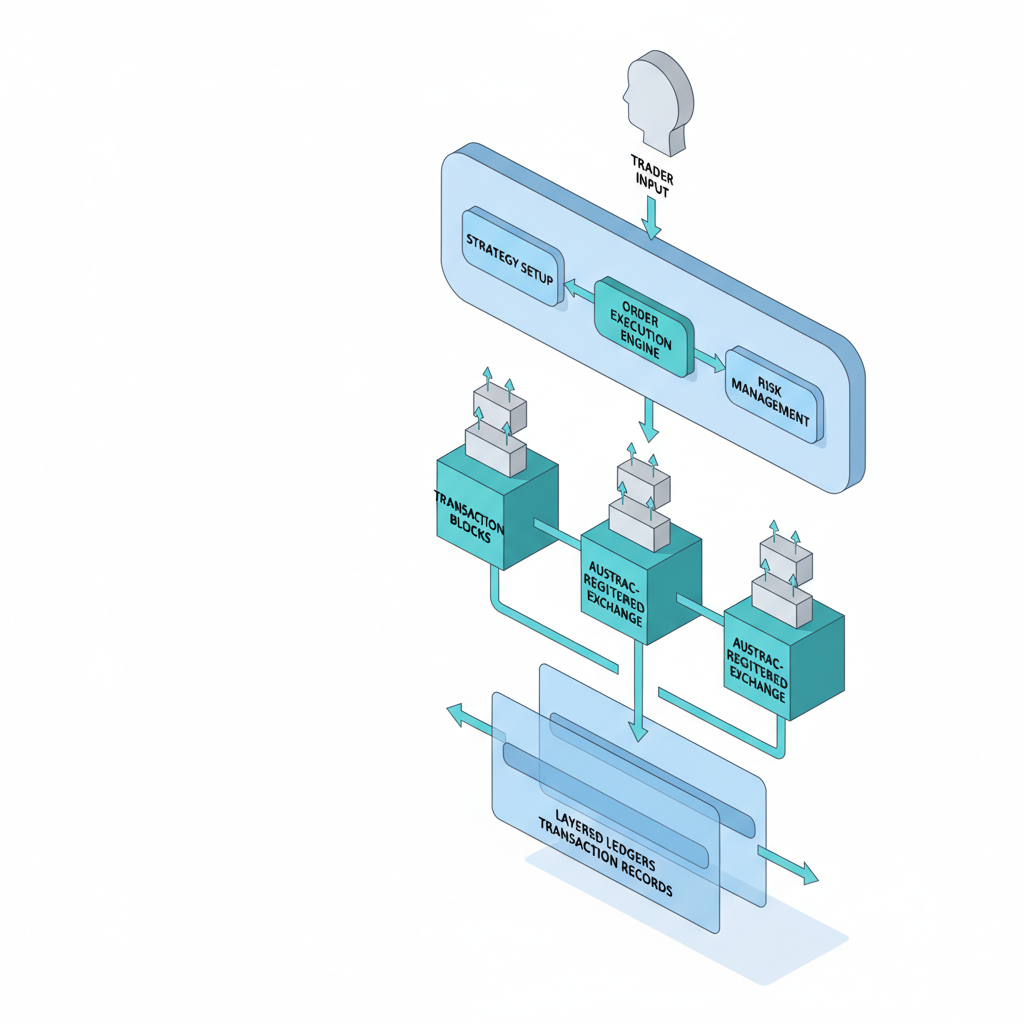
Algo trading, in plain terms, is getting a computer to execute trades on your behalf based on rules you define in advance. Instead of watching charts at 2am and clicking buy when BTC dips, you write a condition, or use a platform that lets you set one without coding, and the system fires the order for you. The “algorithm” can be as simple as “buy $100 of ETH every Monday” or as complex as a multi-factor momentum model scanning 40 pairs simultaneously.
The core appeal is straightforward. Crypto trades 24 hours a day, seven days a week, across dozens of exchanges. No human can monitor that consistently. Automated systems can. They also remove the emotional decision-making that kills most retail trading accounts: no panic selling at 3am, no revenge trading after a bad week.
Broadly, there are three tiers of automation available to Australians. Fully automated bots execute without you touching anything once they are live. Semi-automated tools, more common than people realise, handle the analysis or alerting side but require you to confirm the order. Copy trading platforms like eToro sit somewhere in between: you are technically copying another trader’s decisions automatically, but the strategy is human-authored.
Australian adoption is accelerating alongside broader digital asset awareness, and CryptoAlgo.com.au exists specifically as a resource hub for Australian algo traders trying to sort the legitimate tools from the noise. The local market has enough quirks, AUSTRAC registration requirements, AUD deposit constraints, specific CGT rules, that generic offshore guides miss most of what actually matters here.
How Algorithmic Crypto Trading Platforms Work in Australia
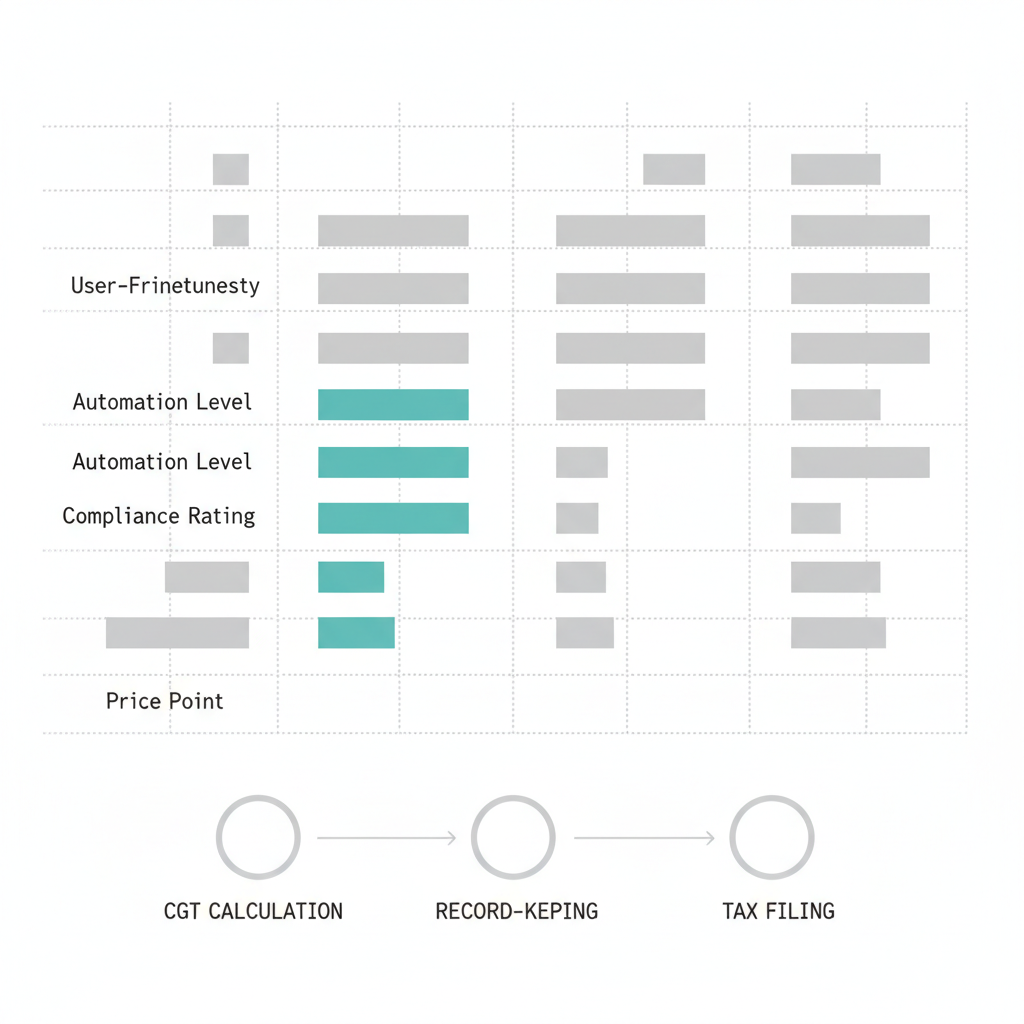
Almost every algo trading platform available to Australians connects to exchanges via API keys. You generate a key inside your exchange account (Binance, Kraken, Swyftx, whatever you use), paste it into the bot platform, and the bot can then read your balances and place orders on your behalf. The exchange itself holds your funds; the bot just has permission to trade them. If you are ever asked to deposit funds directly into a bot platform rather than an exchange, that is a red flag worth taking seriously.
Strategy types worth knowing
Trend following is the most common entry point: buy when price moves above a moving average, sell when it crosses back. Grid trading places a ladder of buy and sell orders across a price range and profits from oscillation. Dollar-cost averaging (DCA) bots automate regular buys regardless of price, which suits long-term accumulators. Arbitrage bots try to exploit price differences between exchanges, though the spreads on AUD pairs have tightened enough that pure arbitrage is harder than it was in 2020. Market-making bots post both buy and sell orders to collect the spread, but this is really only viable if you have volume or access to maker rebates.
Pre-built versus custom strategies
Platforms like Cryptohopper and Altrady offer drag-and-drop strategy builders that do not require you to write a line of code. That accessibility comes with a tradeoff: you are limited to what the platform supports. If you want full control, platforms that run MetaTrader 5 or accept Python scripts via a REST API give you room to build almost anything, but you are responsible for the logic being sound.
Backtesting is the feature that separates serious platforms from toy ones. Before running any strategy with real money, you want to see how it would have performed against historical data. Good backtesting accounts for fees, slippage, and the fact that past performance tells you almost nothing about the next six months, but it at least tells you whether the strategy is conceptually broken.
Risk management features, namely stop-loss settings, take-profit targets, and maximum position sizing, are non-negotiable. Cloud-based platforms have an uptime advantage for 24/7 crypto markets; a desktop bot on your home PC goes offline the moment your internet drops.
Top Algorithmic Crypto Trading Platforms Available to Australians
The platforms below are the ones that actually work for Australian residents, meaning they accept AUD deposits, connect to exchanges accessible from Australia, or are regulated locally.
Cryptohopper
Cryptohopper is the most purpose-built crypto bot platform on this list. It supports connections to major exchanges including Binance, Kraken, and Coinbase, and comes with DCA, market-making, and arbitrage tools baked in. Strategies can be built visually or sourced from its marketplace, where other traders sell their configurations. The subscription model runs from a free tier (limited features) up to paid plans unlocking more positions and exchange connections. It is not a perfect platform: the backtesting tool is adequate rather than rigorous, and the marketplace strategy quality varies wildly. But for an Australian wanting to automate crypto without writing Python, it is a practical starting point.
eToro
eToro holds an AFSL in Australia, which makes it one of the more clearly regulated options on this list. Its algo angle is copy trading: you browse a leaderboard of traders, allocate funds to one or several, and the platform mirrors their trades proportionally in your account. It is not traditional algorithmic trading, but it is automated execution based on someone else’s system. The platform is genuinely beginner-friendly, accepts AUD deposits, and offers access to crypto alongside stocks and ETFs. The spreads on crypto are wider than dedicated exchanges, which matters at scale.
Interactive Brokers Australia
Interactive Brokers is the institutional-grade option. It supports multiple programming languages for strategy development (Python, Java, C++), offers paper trading for testing, and connects to a broader asset universe than any crypto-only platform. The interface is not welcoming to newcomers, and the account setup process is thorough. For a quantitative trader who wants to run crypto alongside equities or options in a single environment, it is genuinely excellent. IBKR Australia holds an AFSL.
Eightcap
Eightcap is an ASIC-regulated broker offering over 95 crypto CFDs. It supports MT4 and MT5, meaning Expert Advisors (automated trading scripts) run natively. TradingView integration is solid, and the platform has become a go-to for CFD-based crypto algo traders in Australia. The catch with CFDs is that you do not own the underlying asset, and overnight funding/swap rates add up on leveraged positions held for more than a day.
Pepperstone via cTrader
Pepperstone offers cTrader as its primary algo environment. cBots are written in C# and the platform has a well-regarded backtesting suite. Pepperstone holds an AFSL and is one of the more tightly regulated CFD brokers operating here. Crypto selection is narrower than Eightcap, but the execution quality is strong.
IC Markets and AvaTrade via MT4/MT5
IC Markets and AvaTrade both support MetaTrader 4 and 5 with full Expert Advisor functionality. The MT ecosystem has the deepest library of pre-built EAs anywhere, though quality control is patchy and many published EAs are not worth running. Both platforms are ASIC-regulated. IC Markets has notably tight spreads on major pairs.
Capital.com
Capital.com offers over 100 crypto CFDs with no commissions (costs are spread-based), an AI-powered assistant for market analysis, and TradingView integration for automated alerts and order execution. It is accessible to beginners but has enough depth for systematic traders. Worth noting: the “no commission” framing requires checking spreads carefully before assuming it is cheaper than commission-based alternatives.
Altrady
Altrady is a multi-exchange management platform with quantitative modelling tools aimed at both beginners and more experienced traders. It connects to most major exchanges, supports grid bots and signal-based automation, and has portfolio tracking built in. The interface is cleaner than most in this category.
Comparison Table: Algorithmic Crypto Trading Platforms in Australia 2026
| Platform | Strategy Types | AFSL / AUSTRAC | Min Deposit (AUD) | Trading Fees | Subscription Cost | Best Suited For |
|---|---|---|---|---|---|---|
| Cryptohopper | DCA, grid, arbitrage, market-making, signal | AUSTRAC (via connected exchanges) | ~$50 (exchange-side) | Exchange fees apply | Free–~$107/mo | Crypto bot beginners to intermediate |
| eToro | Copy trading, manual | AFSL | ~$270 | Spread-based (~1%) | None | Beginners, copy trading |
| Interactive Brokers | Custom code, API, algorithmic | AFSL | ~$0 (no formal min) | From $0 + spread | None | Advanced, quant traders |
| Eightcap | MT4/MT5 EAs, TradingView, manual | ASIC/AFSL | ~$100 | Spread + commission | None | CFD algo traders |
| Pepperstone (cTrader) | cBots, MT4/MT5 EAs, manual | AFSL | ~$270 | Spread-based | None | Intermediate CFD traders |
| IC Markets (MT5) | MT4/MT5 EAs, custom | AFSL | ~$270 | From 0.0 pips + $3.50/lot | None | Advanced CFD, tight spreads |
| Capital.com | TradingView automation, manual | AFSL | ~$27 | Spread-based (no commission) | None | Beginners to intermediate |
| Altrady | Grid, DCA, signal, portfolio | AUSTRAC (via connected exchanges) | ~$50 (exchange-side) | Exchange fees apply | ~$30–$70/mo | Multi-exchange management |
| Swyftx | Manual + basic auto (DCA via third-party) | AUSTRAC | ~$0 | 0.6% spread | None | Aussie beginners, simple DCA |
| Kraken | Manual, API, advanced orders | AUSTRAC | ~$0 | 0.16%/0.26% maker/taker | None | Intermediate to advanced |
Editorial note: For pure crypto bot automation, Cryptohopper is the most accessible starting point. For CFD-based algo trading with strong regulatory standing, Eightcap and Pepperstone are the picks. If you want institutional-grade tooling and do not mind a learning curve, Interactive Brokers runs everything else off the table on features. Swyftx and Kraken are better as the exchange layer your bot connects to than as algo platforms in their own right.
[INTERNAL LINK PLACEHOLDER: “how to connect Cryptohopper to Swyftx” → crypto-bot-setup-guide]
Fees and Costs: What Australian Algo Traders Actually Pay
The fee conversation in Australian crypto is more complicated than most platforms want you to think, because the number on the fee page is rarely the whole story.
Trading fees on Australian exchanges range from 0.1% (CoinSpot, Binance) to 0.6% on Swyftx. Maker/taker models reward volume: on Kraken, you pay 0.16% as a taker and 0.0% as a maker at higher tiers. If your bot is placing a lot of market orders (taker orders), that 0.1% difference per trade compounds quickly across hundreds of executions a week.
Deposit fees are one area where Australian traders catch a break. PayID and direct bank transfers are free on most exchanges. Card deposits are not: CoinSpot charges 1.22%, Swyftx charges 1.99%, and those costs hit before you place a single trade. PayPal deposits on CoinSpot carry a 0.5% fee. If you are funding an algo account regularly, bank transfer is always the right choice.
Withdrawal fees for AUD back to your bank account are generally free. Crypto withdrawals are a different matter because network and gas fees apply, and those vary based on blockchain congestion at the time of withdrawal.
Subscription costs for bot platforms sit on top of all of this. Cryptohopper’s paid tiers run from around $30 to over $100 AUD per month depending on features and how many open positions you want to run. Altrady is broadly similar. These fees are real costs that need to factor into your break-even calculation.
Spread-based platforms like Capital.com and eToro advertise zero or low commissions, but the spread on a crypto CFD can be 1% or wider on smaller assets. Zero commission means nothing if the spread is eating your edge. Always check the actual bid-ask on the instrument you plan to trade, not the headline number.
For CFD platforms running leveraged positions overnight, swap rates apply. These are usually small daily percentages, but on a position held for weeks they become material.
The real total cost of running an algo is: trading fee, plus spread, plus deposit fee, plus subscription, plus the cost of getting your tax records in order. That last one gets overlooked constantly. Automated trading can generate hundreds of taxable events per year. Crypto tax software like Koinly or CoinLedger, which costs around $50–$200 annually depending on transaction volume, is not optional if you are running a bot with regular activity.
[INTERNAL LINK PLACEHOLDER: “crypto tax Australia 2026” → crypto-tax-guide-australia]
ASIC, AUSTRAC, and the Regulatory Picture for Algo Traders in 2026
Australian traders have two distinct regulatory frameworks to understand, and they operate in parallel rather than replacing each other.
AUSTRAC registration applies to Digital Currency Exchange providers. Any exchange where you deposit AUD and buy crypto needs to be AUSTRAC-registered. Over 400 entities currently hold that registration, including most major international exchanges operating here. AUSTRAC compliance means the exchange has AML/CTF obligations: customer identity checks, suspicious matter reporting, large transaction reporting. From your perspective as a trader, this mostly means you will complete identity verification before trading and your transaction history is visible to regulators when required.
ASIC oversight is a separate layer. An AFSL from ASIC means the platform is authorised to provide financial product advice or deal in financial products. CFD brokers like Eightcap, Pepperstone, and IC Markets hold AFSLs because CFDs are regulated financial products. Spot crypto exchanges are not currently required to hold an AFSL, though Treasury’s draft laws would change that. If those laws pass in 2026 as drafted, digital asset platforms would need AFSLs, which would reshape which operators can legally serve Australian clients.
ASIC’s Key Issues Outlook published in January 2026 specifically called out new digital asset participants as a “regulatory perimeter” risk, citing unlicensed activity and misleading conduct. The civil proceedings against NGS Crypto for operating without a licence are a live example of where that rhetoric goes when ASIC decides to act.
For algo traders specifically, the regulatory implication is to stick to AUSTRAC-registered exchanges as your execution layer and prefer AFSL-licensed platforms where CFDs or financial advice are involved. Running a bot through an unregistered offshore exchange is not just a compliance risk; it is a practical risk if the exchange freezes withdrawals or exits the market.
Crypto Tax in Australia for Algo Traders: What You Actually Need to Know
This section is not a substitute for advice from a registered tax agent, but the broad rules are clear and algo traders need to understand them before they start.
The ATO classifies cryptocurrency as property, which means CGT applies on disposal. A disposal happens when you sell crypto for AUD, trade one crypto for another, use crypto to buy something, or gift it. Each of those events triggers a CGT calculation based on the market value at the time.
The 50% CGT discount applies if you held the asset for more than 12 months before disposal. For algo traders running frequent short-term strategies, the discount almost never applies. Every filled sell order is a taxable event, and your