Crypto Regulation in Australia 2026: What You Need to Know
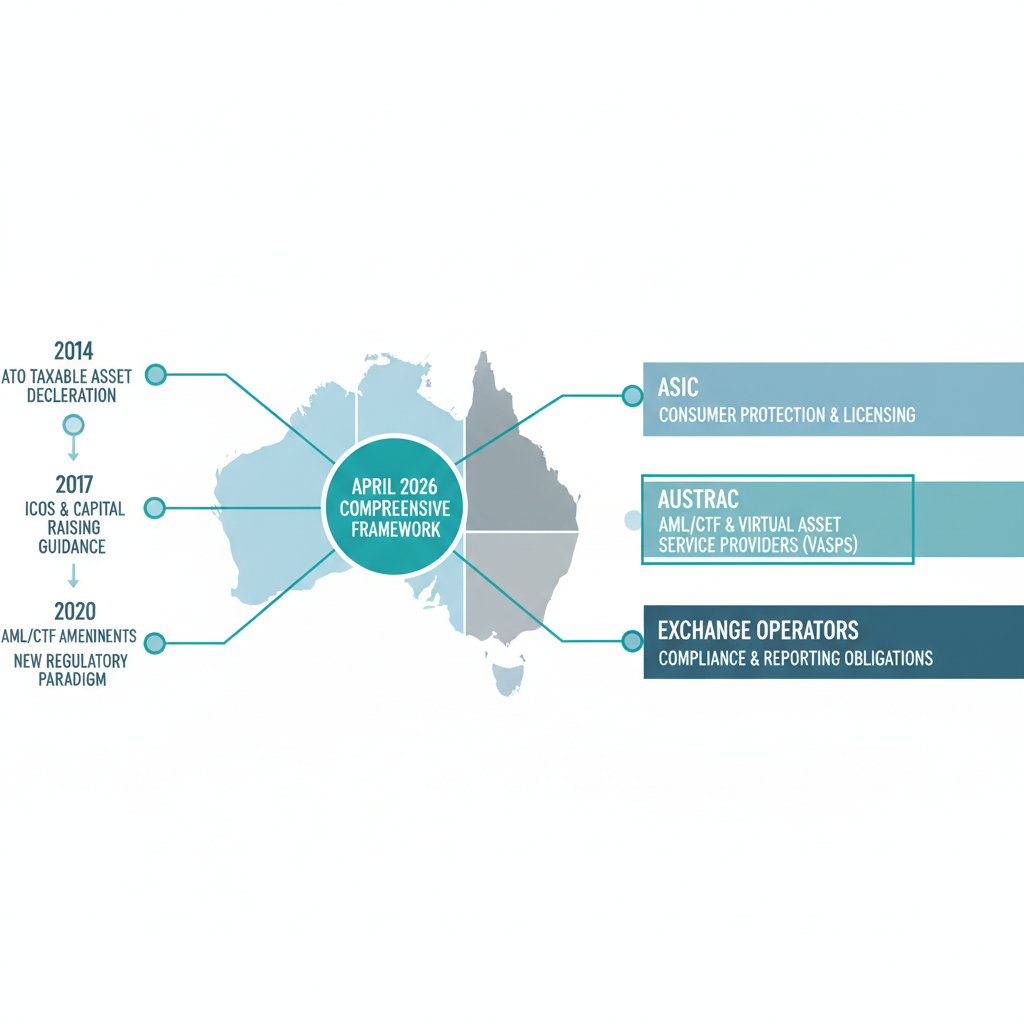
If you have been trying to make sense of crypto regulation Australia-wide over the past few months, you are not alone. April 2026 was the most significant month for Australian crypto law since the ATO first declared crypto a taxable asset back in 2014, and the changes affect everyone from casual holders to exchange operators.
> TL;DR
> Australia passed its first comprehensive crypto regulation framework in April 2026, requiring exchanges and custody providers to obtain an Australian Financial Services Licence. ASIC will begin licensing digital asset platforms from April 2027, giving the industry a transition window, while AUSTRAC has renamed crypto businesses as Virtual Asset Service Providers. Crypto regulation Australia-wide does not change your tax obligations — CGT and income tax still apply as before, and major banks continue to restrict payments to exchanges.
Crypto Regulation Australia: The 2026 Landscape at a Glance

On 1 April 2026, Australia passed its first full crypto regulatory framework. Royal Assent followed on 8 April, and the Corporations Amendment (Digital Assets Framework) Act 2026 is set to commence on 9 April 2027. That gap is not an oversight. It is a deliberate 18-month implementation window for ASIC to build out its licensing infrastructure and for industry to get compliant.
Three regulators carve up the space between them. ASIC handles financial services licensing and consumer protection. AUSTRAC focuses on anti-money laundering and counter-terrorism financing. The ATO collects tax on your gains and income. Each has distinct powers and none of them overlap neatly, which is part of what has made Australian crypto law so patchy until now.
For everyday investors, the immediate practical changes are limited. You cannot yet demand ASIC-licensed status from your exchange because the licensing regime does not commence until April 2027. What has changed is the direction of travel. Platforms without a credible path to an Australian Financial Services Licence (AFSL) are now on borrowed time, and AUSTRAC’s enforcement posture has visibly tightened.
For crypto businesses, the calculus is more urgent. AFSL applications, AML/CTF program upgrades, and VASP registration are no longer optional planning items. They are legal requirements with hard deadlines.
[INTERNAL LINK PLACEHOLDER: crypto tax Australia → tax pillar page]
The DAF Act 2026: What the New Law Actually Says
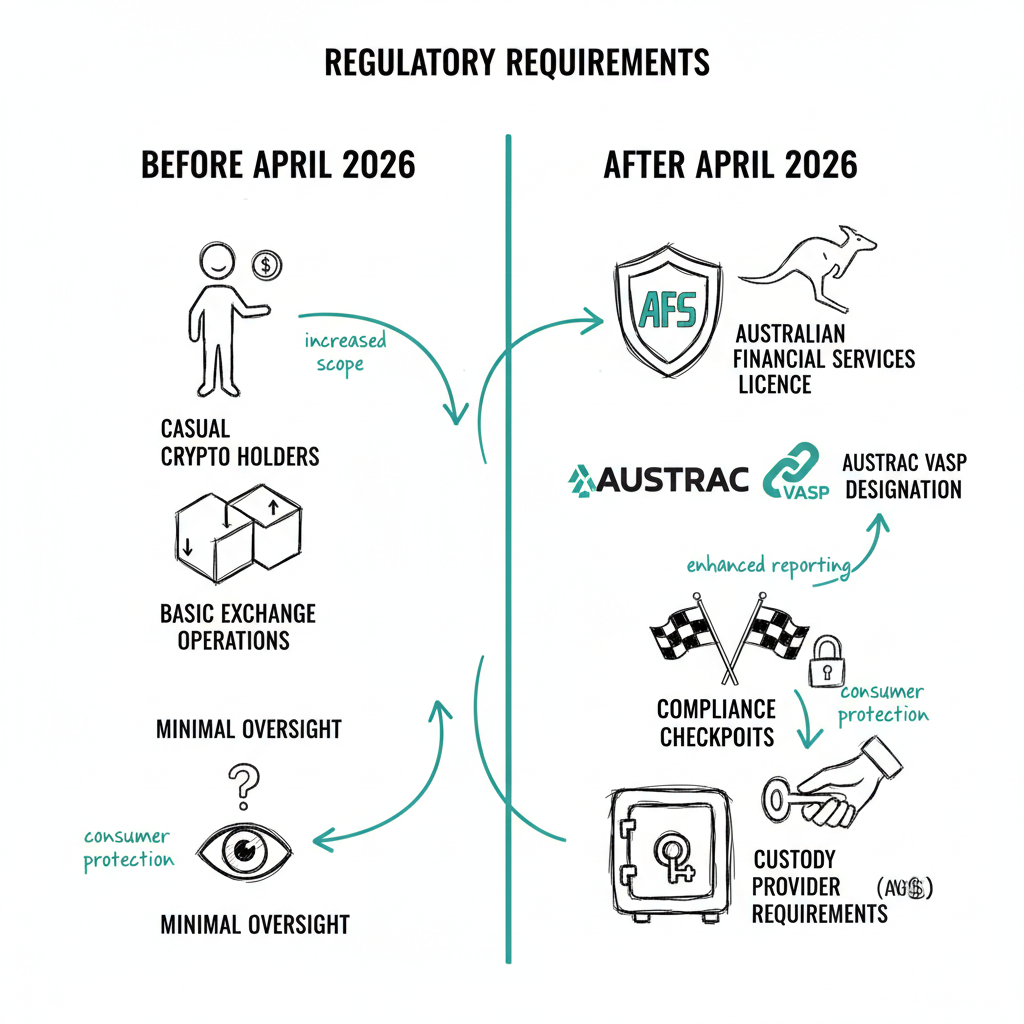
The Corporations Amendment (Digital Assets Framework) Act 2026, commonly called the DAF Act, is the centrepiece of Australia’s new approach to crypto licensing. It received Royal Assent on 8 April 2026 and commences on 9 April 2027, giving the industry roughly twelve months to prepare.
The core mechanism is a licensing regime for two categories of platform. Digital Asset Platforms (DAPs) cover spot exchanges and trading services. Tokenised Custody Platforms (TCPs) cover custody and asset-holding services. Both must obtain an AFSL within six months of the commencement date, meaning the practical deadline for most platforms is around October 2027.
What falls within scope is broad. Spot exchanges, custody providers, and potentially some decentralised finance protocols are captured, though DeFi remains a genuinely contested area. The Act does not resolve every question about DeFi applicability, and ASIC is expected to address this in forthcoming guidance. Tokenised securities and platforms already licensed under existing financial services law have separate treatment.
The 18-month implementation period is there for a reason. ASIC needs time to process applications, issue operational standards, and publish the guidance documents that will define what “compliant” actually looks like in practice. Firms that already hold an AFSL for other financial products will still need to apply for the specific DAP or TCP authorisation.
What the Act does not do is nationalise crypto or ban it. It brings crypto exchange and custody into the same licensing framework that managed funds and financial advisers have operated under for years. That framing matters. The obligations are familiar ones, just applied to a new asset class.
ASIC’s Role: Licensing, Guidance, and the April 2027 Deadline
ASIC’s involvement in crypto regulation Australia-wide predates the DAF Act. Its INFO 225 guidance, already in effect, explains how existing Corporations Act provisions apply to digital assets. That guidance matters now because the new licensing regime does not start until April 2027.
To bridge the gap, ASIC granted a sector-wide no-action position until 30 June 2026. This means ASIC would not pursue enforcement against platforms still transitioning, provided those firms were genuinely working toward compliance. That window has closed for most purposes, and firms now need a credible AFSL application timeline to avoid regulatory exposure.
From April 2027, ASIC will issue new regulatory guidance and operational standards specifically for DAPs and TCPs. These documents will cover how capital adequacy, custody arrangements, disclosure obligations, and dispute resolution requirements apply to crypto platforms. The detail matters enormously here. A platform running a hot wallet for client funds will face very different requirements to one using institutional cold storage.
Operating without a licence after the six-month grace period expires is a serious offence under the Corporations Act. Financial penalties and orders to cease operations are both available to ASIC. The regulator has shown in recent years, through actions against unlicensed margin lenders and CFD providers, that it is willing to act.
By comparison, the EU’s MiCA framework and Singapore’s MAS licensing regime provided longer transition windows. Australia’s approach is more compressed, which is creating some urgency among mid-sized platforms that have not historically engaged with ASIC’s licensing process.
AUSTRAC and VASPs: Anti-Money Laundering Rules for Crypto Businesses
AUSTRAC has been regulating crypto businesses since 2018, when digital currency exchanges were first required to register. The April 2026 changes updated the terminology and tightened the obligations.
The headline change is the renaming of digital currency exchange (DCE) providers to Virtual Asset Service Providers (VASPs). This is not purely cosmetic. The shift aligns Australian terminology with FATF international standards and reflects the expanded range of services now in scope, including custody, transfer, and exchange of a broader set of digital assets than the old DCE definition covered. Tighter AML/CTF obligations commenced on 31 March 2026.
Any business providing digital currency exchange or virtual asset services must register with AUSTRAC. Registration requires a documented AML/CTF program and a risk assessment. AUSTRAC maintains a public searchable VASP register, which you can use to check whether a platform is legitimately registered before using it.
AUSTRAC has been active in enforcing registration requirements. In February 2026, it cancelled the registrations of Reserve Currency of Australia Pty Ltd, Coast to Coast Vending Pty Ltd, and Product.ST Pty Ltd. In March 2026, Self Custody Pty Ltd, Jam Xchange Pty Ltd, and Coinsec Australia Pty Ltd were deregistered for posing what AUSTRAC described as an unacceptable risk of money laundering or terrorism financing. These are not obscure offshore entities. They were Australian-registered businesses that failed to meet ongoing compliance obligations.
The virtual asset sector remains a priority high money-laundering risk area for AUSTRAC. The March 2026 enforcement actions signal that AUSTRAC is not waiting for the ASIC licensing regime to begin before it acts. If your platform is not on the public register, you should treat that as a significant warning sign.
Crypto Tax in Australia: CGT, Income Tax, and Key Rules
Australian crypto tax law has not changed under the new framework. The ATO’s position has been consistent since 2014, and the DAF Act does not alter it.
Capital Gains Tax applies whenever you dispose of crypto. Disposal includes selling crypto for AUD, swapping one crypto for another, gifting crypto, and using crypto to purchase goods or services. Each of these events triggers a CGT calculation based on the difference between your cost base and the value at the time of disposal.
If you have held a crypto asset for more than 12 months before disposing of it, you may be eligible for the 50% CGT discount, provided you are an individual investor rather than a business trader. This is one of the most valuable aspects of the Australian crypto tax rules and one of the most commonly overlooked. I have spoken to traders who did not realise they could have halved their CGT bill simply by waiting a few extra weeks past the 12-month mark.
Simply buying and holding crypto has no immediate tax impact. You do not owe anything at the point of purchase. The liability crystallises when you dispose of the asset.
Ordinary income tax applies to earned crypto. Staking rewards, mining income, airdrops, and income from running a crypto trading business are all assessed as ordinary income in the year received, at your marginal rate. The distinction between investment and business trading matters here. A person who regularly trades high volumes with a profit motive may be assessed as carrying on a business, which changes both the income treatment and the ability to claim deductions.
Non-taxable events include transferring crypto between wallets you own yourself, buying crypto with AUD, and receiving crypto as a genuine gift in some circumstances. GST has not applied to buying, selling, or using crypto as payment since 1 July 2017.
Record-keeping is not optional. The ATO runs a data matching program that pulls transaction data from Australian exchanges. If your records do not reconcile with what AUSTRAC-registered platforms have reported, you will hear about it. Keep records of the date, value in AUD at time of acquisition and disposal, and the nature of each transaction.
[INTERNAL LINK PLACEHOLDER: crypto tax records → tax record-keeping guide]
Australian Bank Restrictions on Crypto Payments: What to Expect
Coinbase called it “systemic debanking” in February 2026, and they were not wrong to name it directly. Australian banks have been progressively tightening controls on payments to crypto exchanges, and the current environment is restrictive by any honest assessment.
Commonwealth Bank applies a $10,000 monthly cap on payments to crypto exchanges and may delay transfers by 24 hours. Bank of Queensland caps transfers at $5,000 per month. Bankwest, Macquarie Bank, and HSBC have implemented restrictions or outright blocks on certain crypto-related transactions. The banks cite $330 million in annual crypto scams and the risk of significant AML/CTF penalties as justification. Those concerns are not fabricated, but the blunt instrument of blanket caps affects legitimate users far more than it affects bad actors.
On the more accommodating side, ANZ, NAB, Westpac, ING Australia, St. George, UBank, Bank Australia, and Great Southern Bank are generally more permissive about crypto exchange payments, though policies can change and individual branch decisions sometimes diverge from stated policy.
A few other things worth knowing. Some platforms impose a 7-day hold on crypto purchased immediately after an initial AUD deposit. This is a platform-level security measure, not a bank restriction, but it catches people off guard when they are expecting to trade immediately.
Binance Australia reinstated AUD deposits and withdrawals via PayID and bank transfer in January 2026, following a prolonged suspension. Whether your specific bank will process those transfers is a separate question from whether Binance accepts them.
The practical advice is to test your bank’s tolerance with a small transfer before committing to a platform, and to check whether PayID is available as an alternative to standard bank transfer, since some restrictions apply specifically to direct debit rather than PayID payments.
Which Crypto Platforms Are Compliant in Australia Right Now?
With the new framework in place and the licensing deadline approaching, knowing which platforms are actually operating within the rules matters more than it did twelve months ago.
The baseline check is AUSTRAC registration. Any platform you use for buying, selling, or exchanging crypto in Australia should appear on the public VASP register. If it does not, stop there. AUSTRAC registration does not guarantee quality, but the absence of it is a genuine red flag, not a minor administrative gap.
Beyond registration, look for whether a platform holds an existing AFSL or has published a credible path to obtaining one before October 2027. The no-action period provided breathing room, but it has largely elapsed.
Established compliant platforms operating in Australia currently include:
Swyftx is AUSTRAC-registered and Australia-based, with over 420 assets and a BTC/AUD spread I have consistently seen around 0.6%. I have been using Swyftx since 2022 and their compliance communications around the April 2026 changes were among the clearer ones I received from any platform.
CoinSpot has been operating since 2013 and has over 2.5 million users. It supports POLi, BPAY, and PayID deposits and is AUSTRAC-registered.
Binance Australia operates under Australian regulatory requirements with AUSTRAC registration in place. Derivatives are no longer permitted following their 2023 decision to exit that market in Australia.
CoinJar has been around since 2013 and supports bank transfer and card payments. Straightforward for smaller portfolios.
eToro is worth noting specifically because it holds both an AFSL and AUSTRAC VASP registration, making it one of the few platforms already operating under the full regulatory model that the DAF Act will eventually require of everyone else.
For algorithmic trading and CFD exposure to crypto, Interactive Brokers Australia, Pepperstone, and IC Markets hold AFSLs and operate under ASIC oversight, though they are not crypto exchanges in the traditional sense.
Red flags to watch for: offshore-only registration with no Australian entity, no AML/CTF disclosure on the website, and platforms that cannot point you to their AUSTRAC registration number. Unregistered platforms are not just a regulatory risk. They are a counterparty risk.
What the Regulatory Changes Mean for Australian Crypto Investors
The practical upshot of crypto regulation Australia’s new framework is a period of transition that carries both opportunity and risk for investors.
The upside is real. Once AFSL licensing is in full effect from 2027, Australian crypto investors will have consumer protections that simply do not exist today. Dispute resolution requirements, custody standards, and capital adequacy rules mean that a licensed exchange failure will be treated differently to the unregulated collapses investors have experienced in the past.
The cost side is also real. Compliance is expensive. Smaller platforms that cannot absorb the cost of an AFSL application, upgraded AML/CTF programs, and ongoing reporting obligations will exit the market before April 2027. Some of those platforms offer genuinely useful services. Consolidation is likely.
For you as an investor, the action items right now are straightforward. Verify that any platform you use appears on AUSTRAC’s public VASP register. Check whether your bank imposes crypto payment restrictions before attempting a large transfer. Keep meticulous tax records, because the ATO’s data matching capability is better than most people assume. Review your holding periods if you are approaching 12 months on any position, because the CGT discount is worth capturing.
Your tax obligations have not changed. CGT and income tax apply exactly as they did before April 2026, and the ATO has not signalled any intent to alter the fundamental treatment of crypto assets. Whatever protections the new licensing regime eventually delivers, the tax office will still want its share.
Banking restrictions are not going to ease in the short term. The $330 million annual scam figure the banks cite is not fictional, and the regulatory pressure on them from AUSTRAC means they have little incentive to loosen controls until the broader ecosystem demonstrates lower fraud rates.
Frequently Asked Questions
Is crypto regulated in Australia in 2026?
Yes. Australia passed its first comprehensive crypto regulatory framework in April 2026. The Corporations Amendment (Digital Assets Framework) Act 2026 received Royal Assent on 8 April 2026 and commences on 9 April 2027. AUSTRAC’s expanded AML/CTF obligations for virtual asset service providers commenced on 31 March 2026.
Do I need to pay tax on crypto in Australia?
Yes. Crypto is subject to Capital Gains Tax when you sell, swap, or gift it, and to ordinary income tax when you earn it through staking, mining, airdrops, or trading as a business. Simply buying and holding crypto with no disposal does not trigger an immediate tax liability.
What is a VASP in Australia?
VASP stands for Virtual Asset Service Provider. AUSTRAC renamed digital currency exchange providers to VASPs in April 2026 to align with FATF international standards. Any business providing crypto exchange or virtual asset services in Australia must register with AUSTRAC as a VASP.
When do crypto exchanges need an AFSL in Australia?
The DAF Act commences on 9 April 2027. Exchanges and custody providers classified as Digital Asset Platforms or Tokenised Custody Platforms must obtain an Australian Financial Services Licence within six months of commencement, making the practical deadline approximately October 2027.
Can Australian banks block crypto payments?
Yes. Several Australian banks have implemented restrictions on payments to crypto exchanges. Commonwealth Bank applies a