Algorithmic Crypto Trading Australia: Strategies, Tools & Tax Guide 2026
Algorithmic crypto trading in Australia has moved well past the “tech enthusiast hobby” phase. With roughly 3.7 million Australians now holding crypto and a completely new licensing framework live as of April 2026, the combination of automated strategies and a maturing regulatory environment makes this worth understanding properly, whether you are running a basic moving-average bot on Swyftx or building multi-leg arbitrage across several exchanges.
> TL;DR
> Algorithmic crypto trading in Australia uses automated, rules-based strategies to execute trades without emotional bias, 24/7 across markets that never close. Core strategies include trend-following, arbitrage, mean reversion, and high-frequency trading, each with distinct infrastructure requirements and risk profiles. Australian traders must comply with ATO tax rules (CGT or ordinary income), AUSTRAC AML/CTF obligations, and the April 2026 AFSL requirement, so choosing a properly licensed platform is no longer optional.
What Is Algorithmic Crypto Trading in Australia?
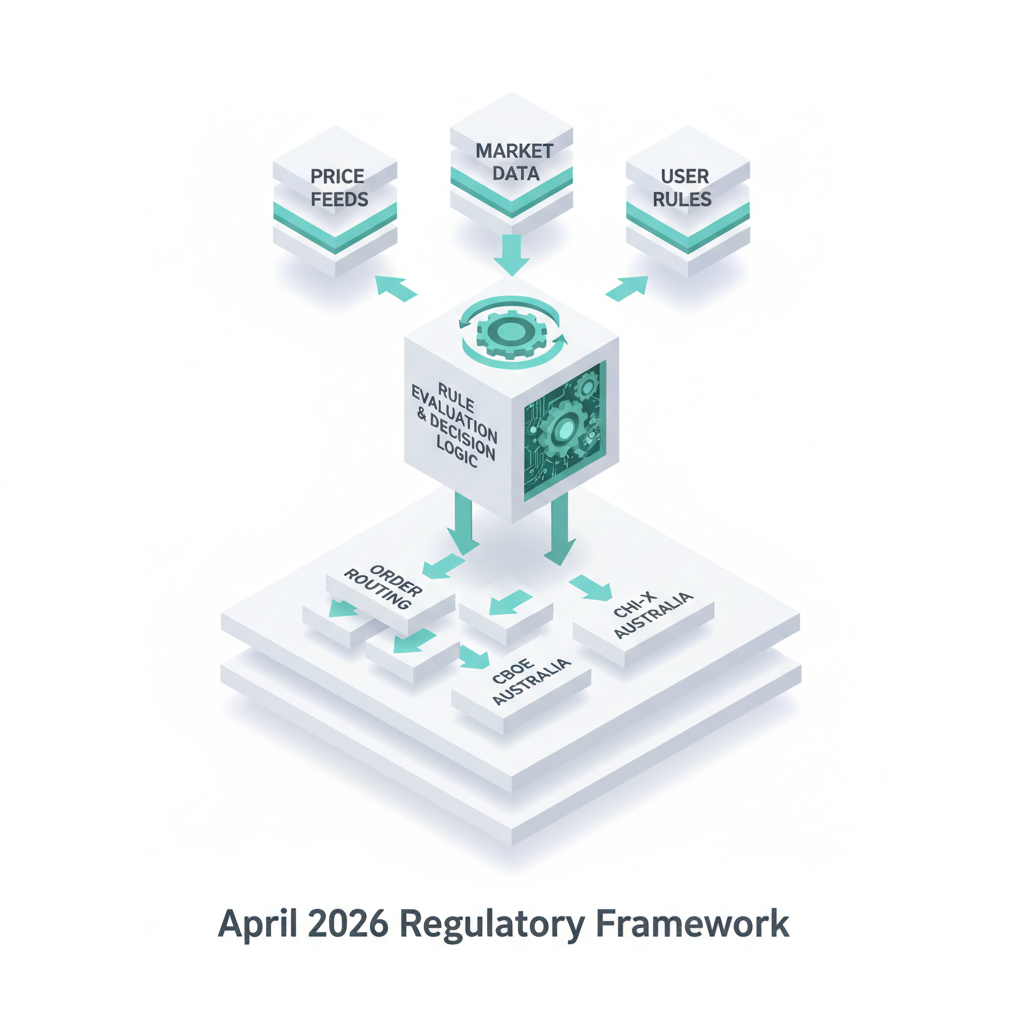
Algorithmic crypto trading in Australia refers to the use of programmed rules and mathematical models to automatically execute buy and sell orders without a human sitting at the keyboard for every trade. The algorithm monitors market conditions continuously and fires orders the moment predefined criteria are met, whether that is a price crossing a moving average, a spread appearing between two exchanges, or a volatility threshold being breached.
The most practically useful feature for crypto is the 24/7 angle. Unlike ASX equities, which close at 4pm Sydney time, Bitcoin does not take a lunch break. A human trader sleeping through a 3am BTC flash crash is a problem an algorithm does not have.
There is also the emotional dimension. I have watched experienced traders hold a losing position for three days longer than their own rules said to because it “felt like it was turning around.” Algorithms do not feel anything. The strategy either fires or it does not, based on the logic you wrote, not on how you are feeling about the market on a Tuesday.
With approximately 3.7 million Australians owning crypto, the local retail market is large enough that platform operators have invested in proper API infrastructure. The regulatory environment, particularly the April 2026 AFSL requirement, also means the platforms still standing are more likely to be legitimate operations worth connecting a bot to.
[INTERNAL LINK PLACEHOLDER: “what is crypto trading” → beginner crypto trading guide]
How Algo Trading Works: Core Mechanics Explained
At its simplest, an algorithm is a set of if-then instructions connected to an exchange’s API. If BTC/AUD crosses above the 50-day moving average and volume is above the 20-day average, then place a market buy for X units. When the price drops 3% from the entry high, close the position. That logic runs continuously, executing at millisecond speed rather than the several seconds it takes a human to open a browser tab and type in an order.
The API Connection
The practical link between your strategy and the market is the exchange API. Platforms like Kraken, Binance, and BTC Markets publish REST and WebSocket APIs that let your code retrieve live price data, check your account balance, and submit orders programmatically. The WebSocket connection is the one that matters for speed, as it pushes data to your system in real time rather than you having to keep asking for it.
Backtesting
Before you risk a single dollar of real capital, backtesting runs your strategy logic against historical price data to see how it would have performed. A decent backtesting setup tells you the win rate, maximum drawdown (the worst peak-to-trough loss), Sharpe ratio, and profit factor. The Sharpe ratio in particular is worth watching: a strategy that returns 40% per year with massive drawdowns is a lot less useful than one returning 20% with a smooth equity curve, especially if you have other financial commitments, like, say, a mortgage.
The inputs feeding a crypto algorithm typically include price (open, high, low, close), volume, technical indicators derived from those, and increasingly, on-chain data such as exchange inflows and wallet activity.
Paper Trading
Paper trading is live-market simulation with virtual funds. Your algorithm runs against real current prices but no actual orders are placed and no real money moves. It is the step between “this looked good in backtesting” and “I am putting $10,000 AUD on this.” Most serious platforms offer it. Use it.
6 Common Algo Trading Strategies Used in Crypto
Trend-Following
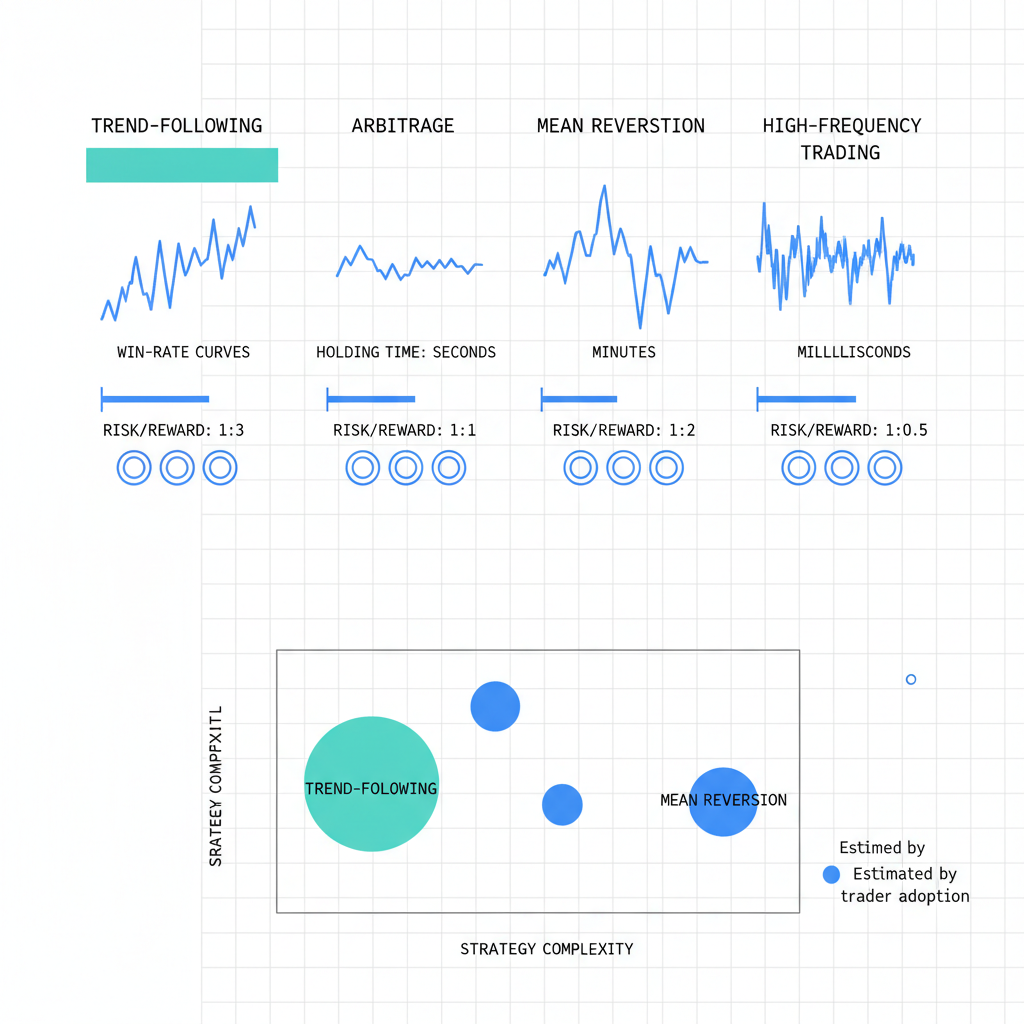
The most widely used approach in automated crypto trading. The algorithm identifies an established directional move, typically using moving averages, the MACD, or momentum indicators, and enters in the direction of that trend. A simple version might buy when the 20-day EMA crosses above the 50-day EMA on BTC/AUD and exit when it crosses back below. The strategy works well in strong directional markets and struggles badly in choppy sideways conditions, which crypto provides plenty of.
Arbitrage
Arbitrage exploits price discrepancies for the same asset across different exchanges. If BTC/AUD is trading at $142,000 on CoinSpot and $142,600 on Kraken at the same moment, in theory you buy on one and sell on the other for a risk-free $600. In practice, fees, withdrawal times, and execution speed compress that margin fast. Pure spot arbitrage in crypto is effectively the domain of well-capitalised, low-latency operations now. Statistical arbitrage between correlated pairs, ETH/BTC for example, is more accessible for retail traders.
Mean Reversion
Mean reversion strategies assume that when an asset deviates significantly from its historical average price or from a correlated pair, it will eventually revert. The algorithm enters a position against the extreme move, betting on normalisation. It performs well in ranging markets and gets destroyed in trending markets, which is roughly the opposite profile to trend-following. Some traders run both simultaneously for that reason.
Momentum Trading
Distinct from trend-following in that it focuses on the strength and acceleration of price moves rather than just direction. High volume combined with sharp price movement triggers an entry to ride the continuation. This works well around major news events or exchange listings and requires fairly tight stop management because momentum can reverse just as fast.
Market Making
A market-making algorithm places simultaneous buy and sell limit orders on both sides of the order book, profiting from the bid-ask spread. This is standard territory for institutional desks and sophisticated retail operations. On exchanges with thin order books for smaller altcoins, the spread can be meaningful enough to make this viable, but you need serious capital, low fees, and fast execution infrastructure to do it properly.
High-Frequency Trading
HFT executes thousands of trades per second, exploiting tiny, short-lived inefficiencies. It requires co-located servers physically close to the exchange’s matching engine, sub-millisecond latency, and institutional-grade infrastructure. For Australian retail traders, true HFT is essentially out of reach without significant capital and technical resources. That said, IC Markets is the platform most commonly used by Australian traders who want to get as close to HFT conditions as practical retail access allows, given their ultra-low spreads and MT4/MT5 expert advisor support.
Top Platforms and Tools for Algo Trading in Australia
Choosing a platform for automated crypto trading strategies in Australia involves more than comparing fees. Post-April 2026, AUSTRAC registration and an AFSL are the baseline. After that, you are looking at API quality, fee structure, and whether the platform actually supports the kind of automation you want to run.
| Platform | AUSTRAC Registered | AFSL | API Access | Fees (approx.) | Best For |
|---|---|---|---|---|---|
| BTC Markets | Yes | Yes | REST + WebSocket | From 0.85% | Serious AU algo traders |
| Kraken | Yes | Check | REST + WebSocket | 0.25% maker / 0.4% taker | AUD deposits, 400+ assets |
| Swyftx | Yes | Yes | REST API | From 0.6% | AU-based, SMSF accounts |
| Eightcap | Yes | Yes | MT4/MT5 + TradingView | CFD spreads vary | CFD automation, AUS regulated |
| IC Markets | Yes | Yes | MT4/MT5 Expert Advisors | Ultra-low spreads | Near-HFT, expert advisors |
| Binance | Yes | Check status | Comprehensive REST/WS | From 0.1% | API depth, lower fees |
| eToro | Yes | Yes | Copy trading | Spread-based | No-code automation |
| Capital.com | Yes | Yes | AI assistant + API | CFD spreads | 100+ crypto CFDs |
BTC Markets
BTC Markets is the most credible Australian-built option for algo trading in the local context. Melbourne-based since 2013, AFSL-compliant, and with a REST plus WebSocket API that has been stable enough to rely on. Fees start at 0.85% which is not the cheapest globally, but you get a properly licensed Australian exchange that has survived multiple market cycles. They also support SMSF accounts, which matters if you are running a self-managed super fund strategy.
Kraken
Kraken accepts AUD deposits, lists over 400 cryptocurrencies, and has one of the better APIs in the industry for algorithmic use. Maker fees from 0.25% and taker from 0.4% make it competitive for higher-frequency strategies. I have found the API documentation solid and the WebSocket feed reliable enough for serious work.
Swyftx
I have been using Swyftx since 2022 and it remains a strong choice for Australian traders who want AUD-native access to 440+ assets. The REST API covers the basics for automated trading strategies, though it is not as deep as Kraken’s or Binance’s for complex execution. The 0.6% spread on BTC/AUD is the headline number. SMSF accounts are a genuine differentiator if that is relevant to your situation.
Eightcap and IC Markets
Both are ASIC-regulated Australian brokers rather than spot crypto exchanges. Eightcap offers 95+ crypto CFDs with MT4/MT5 and TradingView automation support. IC Markets is the go-to for traders running expert advisors who want execution speed close to the limit of what retail infrastructure allows. If you are trading crypto CFDs rather than spot, these two are the most credible local options.
Binance
Binance remains the most popular platform globally for building automated crypto trading systems, largely due to its comprehensive API, deep liquidity, and fees from 0.1%. The legal position for Australian users has been in flux, so check the current AFSL status before connecting a live system. The API depth is genuinely superior for complex multi-leg strategies.
eToro
eToro is the right call if you want automation without writing a line of code. The copy trading feature lets you mirror the positions of top-performing traders automatically. It is not algo trading in the strict programmatic sense, but it serves a similar purpose for traders who do not want to build a bot.
[INTERNAL LINK PLACEHOLDER: “best crypto exchanges australia” → best crypto exchanges australia comparison]
Backtesting and Paper Trading: Validate Before You Risk Real Capital
The single most common mistake I see from traders getting into automated crypto trading in Australia is going from idea to live capital in one step. Backtesting and paper trading exist specifically to avoid that.
How Backtesting Works
You run your strategy’s logic against historical OHLCV (open, high, low, close, volume) data and record what would have happened. The key metrics to evaluate are win rate (percentage of trades that were profitable), maximum drawdown (worst equity dip from peak to trough), Sharpe ratio (return per unit of risk), and profit factor (gross profits divided by gross losses). A profit factor above 1.5 and a Sharpe ratio above 1.0 are reasonable starting benchmarks, though context matters enormously depending on the strategy type.
Three backtesting pitfalls catch out most retail traders. Overfitting means you have tuned your parameters so precisely to historical data that the strategy captures noise rather than genuine market behaviour, and it falls apart immediately on live data. Survivorship bias occurs when you test only against assets that still exist today, ignoring the dozens of altcoins that have gone to zero. Ignoring slippage and fees is the third one: a strategy that backtests at 35% annual return might produce 12% after real-world execution costs are applied.
One Australian-specific consideration: if you are backtesting on BTC/AUD rather than BTC/USDT, your results include AUD/USD exchange rate movement. A strategy that looks strong in USD terms can look meaningfully different in AUD terms depending on the period tested. Always confirm which denomination your backtesting tool is working in.
Paper Trading in Practice
Paper trading is live simulation with virtual funds. Your bot runs its real logic against actual current market prices, but no real orders hit the exchange. This catches problems that backtesting misses: API latency, order fill assumptions, and strategy behaviour during unusual market conditions that do not appear in your historical dataset. The recommended progression is: backtest thoroughly, paper trade for at least four to six weeks across different market conditions, then deploy with a small live allocation before scaling up.
[INTERNAL LINK PLACEHOLDER: “crypto risk management” → crypto portfolio risk management guide]
Australian Regulations: ASIC, AUSTRAC and the New AFSL Rules
This section matters more than most people realise. Running an algo on an unlicensed exchange is not just a compliance problem for the exchange, it creates real exposure for you as a trader if the platform is later shut down.
AUSTRAC and AML/CTF Obligations
Digital currency exchanges (DCEs) operating in Australia have been required to register with AUSTRAC since 2018. That registration comes with obligations: customer due diligence, ongoing transaction monitoring, and suspicious matter reporting. AUSTRAC expanded its AML/CTF laws on April 2, 2026, introducing stronger oversight for virtual asset businesses broadly. The expansion applies beyond traditional exchanges to cover a wider range of virtual asset service providers.
In October 2025, AUSTRAC issued an infringement notice of $56,340 to Cryptolink for AML/CTF breaches, including late reporting of large cash transactions and weaknesses in their risk assessment processes. It is a relatively small fine in isolation, but it signals AUSTRAC’s willingness to use its enforcement tools on smaller operators.
The crypto ATM crackdown is worth noting separately. AUSTRAC identified ATMs as a high money-laundering risk and in June 2025 placed specific conditions on operators: a $5,000 limit on cash deposits and withdrawals, enhanced customer due diligence requirements, and mandatory scam warnings displayed at the machine. If you are using ATMs as part of any trading workflow, those conditions now apply.
The April 2026 AFSL Requirement
The Corporations Amendment (Digital Asset Framework) Bill passed on April 1, 2026. From that date, every crypto exchange and custody platform operating in Australia is required to hold an Australian Financial Services Licence within six months. This is the single most significant change to the Australian crypto regulatory environment since the AUSTRAC registration requirement in 2018.
ASIC has already demonstrated it will act on this. Prior to the April 2026 changes, ASIC took enforcement action against crypto businesses operating without an AFSL and shut down hundreds of crypto scam websites. The message is consistent: operate without a licence and expect consequences.
For algo traders, the practical implication is straightforward. Only connect your automated systems to AUSTRAC-registered, AFSL-licensed platforms. If a platform cannot confirm its AFSL status, treat that as a serious red flag. The platforms listed in the comparison table above are those with established compliance postures, but always verify current licensing directly with ASIC’s register.
Banking Restrictions
Australian banks have been an ongoing headache for the crypto sector. In February 2026, Coinbase publicly accused Australia’s Big Four banks of systematically blocking or restricting services to legitimate crypto companies, including unilateral account closures. The banks point to AML obligations and fraud exposure: Australians lost over $330 million to crypto-related scams in 2023, and banks carry real liability for facilitating those transactions.
Some banks have implemented monthly limits of $10,000 AUD on crypto purchases. For algo traders running higher volumes, this is not an abstract concern. It affects deposit velocity, which can interfere with strategies that require rapid capital